Key takeaways
- 50% of prospective students use AI tools at least weekly to research programs and schools, yet only about 30% of institutions have a formal AI search strategy, per UPCEA's 2025 survey of member institutions.
- There's a real gap between being mentioned and being cited: a Gradial study of 51 institutions found a 35% mention rate in AI answers but only 10.5% actual citation of .edu domains, because Wikipedia, Niche, and U.S. News out-publish most university websites in structured, extractable formats.
- WGU leads the 2026 online university AI visibility rankings at 14% citation share, while University of Phoenix sits at just 1.5% despite heavy paid search spend, according to 5W PR's research.
- General-purpose GEO platforms like Promptwatch, Profound, and Semrush's AI Visibility Toolkit work fine for universities, but higher-ed-specific tools like EAB's GEO Intelligence Dashboard add enrollment-funnel context that generic trackers don't.
- AI answers are volatile. Identical prompts can return 38% different brand sets on repeat runs, so one-off ChatGPT checks tell you almost nothing. You need continuous tracking.
Why universities are suddenly worried about AI search
I'll be honest, this one surprised me. A majority of prospective students, 50% weekly according to UPCEA's research with Search Influence, are now using ChatGPT or Perplexity to shortlist colleges before they ever open a school's website. Seventy-nine percent read Google's AI Overviews before clicking a single result. That means a lot of the decision-making that used to happen on a university's own program pages now happens somewhere the university has zero control over, and often no visibility into at all.
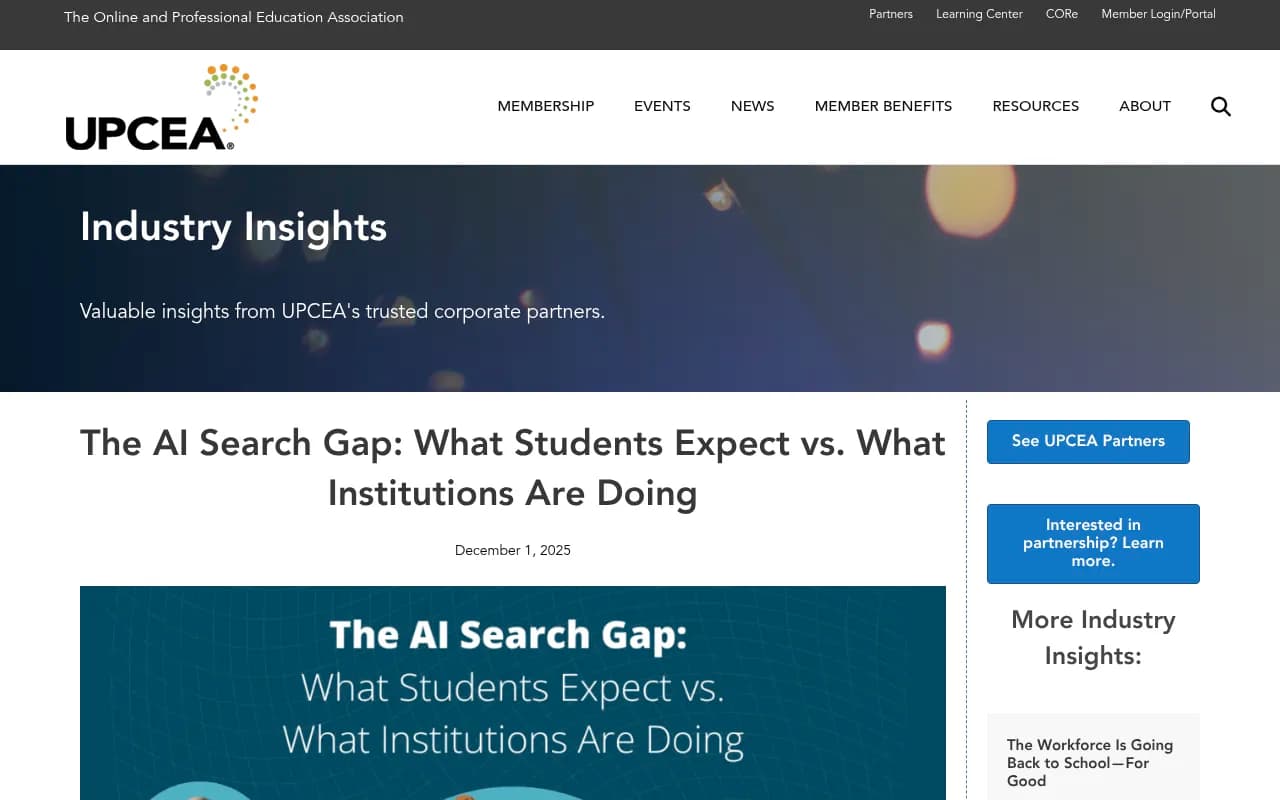
Meanwhile, institutions are lagging. A UPCEA snap poll of member schools found 60% are still in "early-stage exploration" of AI search, 30% have something resembling a full strategy, and 10% have done nothing at all. That's a strange place to be when more than half your applicant pool is already asking a chatbot which program to pick.
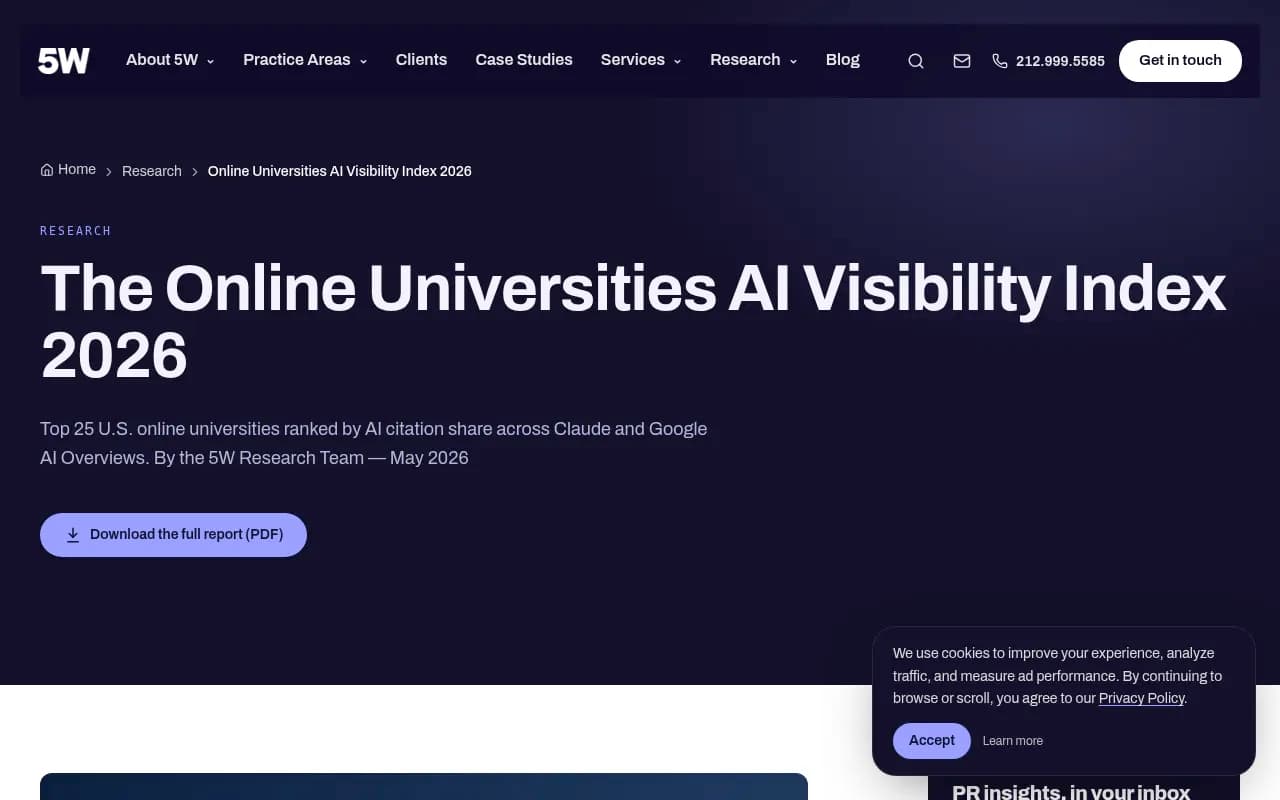
The stakes are concrete, not abstract. 5W PR's Online Universities AI Visibility Index 2026 ranked the top 25 US online universities by AI citation share and found a massive spread: Western Governors University leads at 14%, while University of Phoenix, despite spending heavily on paid search, sits at only 1.5%. Paid media clearly doesn't buy you a seat at the AI table.
The mention-to-citation gap no one talks about
Here's the part that should actually worry university marketing teams more than the headline numbers. A Gradial study that ran 20 queries across 7 AI providers for 51 institutions (7,000+ data points total) found an average brand mention rate of 35%, meaning AI tools talk about these schools fairly often. But the average citation rate for the institution's own domain was only 10.5%. That's a 24.5-point gap between being discussed and being the source.
Why the gap? Third-party aggregators like Wikipedia, Niche, CollegeVine, U.S. News, and Reddit dominate the actual citations, not .edu pages. These sites publish structured, easily extractable content: rankings tables, FAQ-style comparisons, clean lists of program details. University websites, by contrast, are often a maze of PDFs, catalog pages built for humans, and content buried three clicks deep in a CMS no one has touched since 2019.
It's a little depressing, honestly. A school can have genuinely better information about its own nursing program than Niche does, and still lose the citation to Niche because Niche's page is just easier for an AI crawler to parse and extract.
What actually gets cited: the content-type angle
Promptwatch's citation data for ChatGPT Search in August 2026 gives a useful, if slightly counterintuitive, read on where to focus. Product pages (the closest equivalent for a university would be a program or course page) still made up about 28.7% of citations for most of the month, though that share dropped from roughly 30% to 25% by late August. The bigger story is how-to content: it more than doubled, from 4.3% to 9.1%, and documentation-style content went from 3.3% to 8.2% over the same period. (Read the full breakdown in Promptwatch's ChatGPT citation types data for August 2026.)
For a university, that translates fairly directly: your program pages still matter, but "how to apply," "how to transfer credits," "how financial aid works," and similar how-to style content are the fastest-growing citation category right now. If your admissions FAQ reads like a legal disclaimer instead of an answer to an actual question, that's probably costing you citations.
You also don't need Ivy League domain authority to compete. Promptwatch's domain-rank breakdown for ChatGPT citations in August 2026 found DR 46-75 domains picked up nearly half of all citations combined, while the very top tier, DR 91-100, actually fell from about 7% to 3% share by month's end. (Full data here.) A mid-sized regional university with a DR of 55 is in a perfectly competitive position for program-specific queries.
Where Reddit fits in (and where it doesn't anymore)
Students have historically used Reddit heavily to research schools, so it's worth flagging a shift that's easy to miss. Promptwatch's data shows Reddit held a steady ~3.8% share of ChatGPT Search citations through early August 2026, then collapsed to under 1% on August 14, an 86% relative drop. (Reddit citations are dropping in ChatGPT.) Google AI Overviews and AI Mode show a much gentler decline over the same window.
So if your GEO plan leaned on getting mentioned in r/ApplyingToCollege threads, that channel just got a lot weaker specifically inside ChatGPT. YouTube is the better bet across most engines now. Promptwatch's social-citation data shows YouTube beating Reddit in AI Overviews (4.08% vs Reddit's smaller share) and Perplexity (2.67%), while LinkedIn barely registers anywhere, just 0.74% overall and 0.23% on ChatGPT specifically. (Social media citations by AI model.) Campus tour videos, admitted-student Q&As, faculty interviews, these have a real shot at getting cited. A polished LinkedIn thought-leadership post from the provost, less so.
The tools: general GEO platforms vs higher-ed-specific dashboards
There are two paths here. You can buy a general-purpose AI visibility tool and apply it to your institution, or you can go with a platform built specifically for higher ed.
General AI visibility platforms
Promptwatch is worth a look if your marketing team wants a single platform that does more than just tell you whether you got mentioned. It tracks citations across ChatGPT, Gemini, Claude, Perplexity, Google AI Overviews, AI Mode, and more, but the part that matters for a university content team with limited headcount is the execution layer: Content Agents that draft and publish GEO-optimized pages to your CMS, AI crawler logs that show exactly which admissions pages GPTBot and PerplexityBot are actually reading, and a content gap analysis feature that can flag where your program pages are thin compared to what AI answers are pulling from competitors or aggregators instead. It's used by 1,840+ brands, including education and consumer brands, and is rated 4.7/5 on G2.

Other general tools worth knowing about:
- Profound is an enterprise option tracking nine answer engines, but it dropped its self-serve plans in mid-2026 and now requires a custom quote.
- Otterly.AI is a cheaper entry point, starting around $29/month, with ChatGPT, Google AI Overviews, Perplexity, and Copilot included in every tier, though Claude and Gemini cost extra.
- Semrush's AI Visibility Toolkit bundles into existing SEO subscriptions many university marketing departments already have, at $99/month per domain for 25 tracked prompts.
- Peec AI and Rankscale sit in the budget-to-midrange tier and are reasonable if you just need prompt tracking without the content-execution layer.
Higher-ed-specific tools
EAB's GEO Intelligence Dashboard is the one purpose-built tool worth calling out separately, because it's designed around enrollment funnels rather than generic brand mentions. EAB claims it tracks visibility across 12+ AI models and has supported 1,152+ institutions, flagging over 128,000 page audit issues across the institutions it monitors. It comes in three tiers: a tracking-only dashboard, a managed-strategy tier with quarterly reviews and .edu content optimization, and a full transformation tier that adds technical SEO and schema work. Pricing isn't public; it's a sales-assisted, demo-first model, which is typical for enterprise higher-ed vendors but can be a slower sales cycle than a self-serve SaaS tool.
For agencies working specifically in the higher-ed space, Silverback Strategies has been named a top fit for institutions that want AI visibility tied to measurable recruitment outcomes, qualified RFIs, applications, enrollments, with past clients including Johns Hopkins, eCornell, and Strayer University.
Comparison table: AI visibility tools for universities
| Tool | Starting price | Engines tracked | Content execution | Best for |
|---|---|---|---|---|
| Promptwatch | $95/mo (Essential) | ChatGPT, Gemini, Claude, Perplexity, AI Overviews, AI Mode, Grok, and more | Content Agents, CMS publishing, crawler logs, content gap analysis | Universities that want tracking plus actual content production |
| EAB GEO Intelligence Dashboard | Custom (demo-only) | 12+ models | Managed strategy tiers add content optimization | Enterprise institutions wanting enrollment-funnel context |
| Profound | Custom (enterprise only) | 9 engines | Limited, credit-based agent add-on | Large institutions with budget for a custom contract |
| Otterly.AI | $29/mo | ChatGPT, AI Overviews, Perplexity, Copilot (others extra) | Recommendations only, no publishing | Smaller colleges on a tight budget |
| Semrush AI Visibility Toolkit | $99/mo per domain | ChatGPT, Google AI, Gemini, Perplexity | Basic site audit, no content generation | Schools already paying for Semrush SEO tools |
Practical steps for a university marketing team
A few things I'd prioritize if I were running digital marketing for a university right now, in rough order of effort-to-impact:
- Rewrite program pages around actual student questions. Not "Program Overview" headers, but the literal phrasing a prospective student types into ChatGPT: "how much does the MBA cost at [school]," "can I transfer credits from community college to [school]." FAQ schema matters here too, per Frase.io's research, pages with FAQPage schema are reportedly 3.2x more likely to appear in Google AI Overviews.
- Stop fighting Wikipedia and start using it. Since Wikipedia accounts for roughly 47.9% of all ChatGPT citations in one widely-cited arXiv study, make sure your institution's Wikipedia page is accurate, current, and not neglected. It's a cheap win most schools ignore.
- Invest in YouTube over LinkedIn for social citation share. The data is pretty clear that YouTube beats LinkedIn across almost every AI engine for citation purposes.
- Track continuously, not periodically. Given that identical prompts can return 38% different brand sets run to run, a single ChatGPT spot check tells you almost nothing. You need a tool running the same prompts on a schedule.
- Use schema on course and program pages. Schema.org Course markup, with dates, pricing, and instructor info, makes your pages more machine-readable, even if the exact causal link to LLM training-time citations is still debated among vendors.
If your institution's marketing team wants outside help building and executing a GEO strategy rather than just buying another dashboard, that's the kind of work an agency like 1001 SEO Media focuses on, combining technical SEO, content production, and generative engine optimization so a school shows up in both Google and the AI tools students are actually using to decide where to apply.
For institutions that want to browse the broader category before committing, the GEO software directory at bestgeosoftware.com is a decent place to compare more options side by side.