Key takeaways
- AthenaHQ is a capable monitoring tool, but its credit system burns fast, the best features are locked behind Enterprise pricing, and there's no free trial at $295/month.
- Most GEO platforms have the same problem: they show you where you're invisible but don't help you fix it.
- The alternatives below were chosen specifically because they go beyond monitoring -- offering content gap analysis, AI content generation, or both.
- Promptwatch is the only platform in this comparison rated as a "Leader" across all GEO categories, combining tracking, gap analysis, and a built-in AI writing agent in one loop.
- Pricing ranges from free tiers to enterprise contracts -- there's a realistic option at every budget.
Why people are looking for AthenaHQ alternatives
AthenaHQ does a lot of things well. It monitors brand mentions across 8+ LLMs, has solid Shopify and GA4 attribution, and the AI Blindspot Detection feature is genuinely useful. If you just want a dashboard that tells you where your brand appears in AI-generated answers, it works.
But three things keep coming up when people evaluate it seriously.
First, there's no free trial. You're committing $295/month before you've seen a single data point about your own brand. That's a real ask.
Second, the credit system is punishing. 3,600 monthly credits sounds like plenty until you do the math: 50 prompts across 5 engines daily burns through roughly 250 credits per day, which means you're out in two weeks. Add-ons run $100 per 1,250 credits. Real monitoring programs often cost double what the headline price suggests.
Third -- and this is the bigger issue -- the features that actually matter for optimization are Enterprise-only. Persona targeting, multi-region tracking, the Citation Engine, advanced content optimization: all behind a custom pricing conversation.
But there's a more fundamental problem that applies to AthenaHQ and most of its competitors: they're monitoring tools. They tell you your brand isn't appearing when someone asks ChatGPT for a recommendation in your category. They don't tell you what to do about it, and they certainly don't help you do it.
That's the gap this guide is designed to fill.
What to look for in an alternative
Before diving in, here's a quick framework for evaluating these platforms:
| Capability | Why it matters |
|---|---|
| Multi-LLM tracking | You need coverage across ChatGPT, Perplexity, Claude, Gemini, and others -- not just one or two |
| Content gap analysis | Shows you which prompts competitors rank for that you don't |
| AI content generation | Helps you create content that actually gets cited |
| Crawler/traffic attribution | Connects AI visibility to real website traffic and revenue |
| Prompt volume data | Tells you which prompts are worth targeting |
| Reddit/YouTube tracking | These sources heavily influence what AI models cite |
| Pricing transparency | No surprise credit burns or Enterprise-only walls |
The tools below are ranked roughly by how well they cover the full loop -- from finding gaps to fixing them.
1. Promptwatch
Promptwatch is the most complete option in this space. Where most platforms stop at monitoring, Promptwatch is built around a three-step loop: find the gaps, create content that ranks in AI, then track the results.

The Answer Gap Analysis is the standout feature. It shows you exactly which prompts competitors are visible for that you're not -- not as a vague category insight, but as specific questions and topics your site is missing. From there, a built-in AI writing agent generates articles, listicles, and comparisons grounded in real citation data (880M+ citations analyzed), prompt volumes, and competitor analysis. This isn't generic SEO filler -- it's content engineered to get cited by ChatGPT, Claude, Perplexity, and other AI models.
The platform monitors 10 AI engines: ChatGPT, Perplexity, Google AI Overviews, Google AI Mode, Claude, Gemini, Meta/Llama, DeepSeek, Grok, Mistral, and Copilot. A few capabilities that most competitors lack entirely: real-time AI crawler logs (which pages ChatGPT and Claude are reading on your site, errors they're hitting, how often they return), Reddit and YouTube citation tracking, ChatGPT Shopping monitoring, and query fan-outs that show how one prompt branches into sub-queries.
Traffic attribution closes the loop -- connect a code snippet, GSC integration, or server log analysis to tie visibility scores to actual revenue.
Pricing starts at $99/month (Essential: 1 site, 50 prompts, 5 articles), $249/month (Professional: 2 sites, 150 prompts, 15 articles, crawler logs), and $579/month (Business: 5 sites, 350 prompts, 30 articles). Free trial available. That's a meaningful contrast to AthenaHQ's no-trial, $295/month entry point.
In a 2026 comparison of 12 GEO platforms, Promptwatch was the only one rated "Leader" across all categories. The reason is simple: it's the only one that completes the optimization loop instead of stopping at data collection.
2. Profound
Profound is the other enterprise-grade option worth taking seriously. It covers 9+ AI search engines, has strong brand mention tracking, and the reporting is genuinely polished. It's a better fit for large marketing teams that need depth and are willing to pay for it.
Profound

The main limitation compared to Promptwatch: Profound is primarily a monitoring and analytics platform. The content optimization and generation capabilities are limited, and there's no equivalent to the Answer Gap Analysis or built-in writing agent. You'll get excellent data on where you stand -- you'll need to figure out what to do with it yourself.
Pricing is higher than most alternatives here, which makes it harder to justify for teams that aren't already at enterprise scale. No Reddit tracking, and no ChatGPT Shopping monitoring either.
Best for: Enterprise brands that need deep analytics and have a separate content team to act on the insights.
3. Otterly.AI
Otterly.AI is one of the more popular monitoring tools in this space, and it's easy to see why -- the interface is clean, setup is fast, and it covers the major AI engines including ChatGPT, Perplexity, and Google AI Overviews.
Otterly.AI

The honest assessment: Otterly is a monitoring dashboard. It shows you where your brand appears (or doesn't), tracks share of voice over time, and sends alerts when things change. That's useful, but it's the first step of a process, not the whole process.
There's no content gap analysis, no AI writing agent, no crawler logs, and no traffic attribution. If you're looking for a tool that helps you improve your AI visibility rather than just measure it, Otterly will leave you with good data and no clear path forward.
That said, it's more affordable than AthenaHQ and doesn't have the credit-burn problem. For teams that just need basic monitoring and have the internal resources to act on insights independently, it's a reasonable choice.
Best for: Small teams that need simple monitoring without a big budget commitment.
4. Peec AI
Peec AI tracks brand visibility across ChatGPT, Perplexity, and Claude, with a focus on share-of-voice metrics and competitor comparisons. The UI is straightforward and the data is reliable.

Like Otterly, Peec is monitoring-first. The platform doesn't offer content generation, gap analysis, or crawler insights. What it does well is give you a clear picture of how your brand compares to competitors across specific prompts -- useful for reporting and for identifying which categories you're losing ground in.
The pricing is more accessible than AthenaHQ, and there's a free tier to evaluate before committing. Worth considering if your primary need is competitive benchmarking rather than optimization.
Best for: Teams focused on competitive share-of-voice reporting.
5. Scrunch AI
Scrunch AI sits in interesting territory -- it has stronger analytics than most monitoring-only tools, with features like source analysis (which pages and domains AI models are citing) and some content optimization guidance.
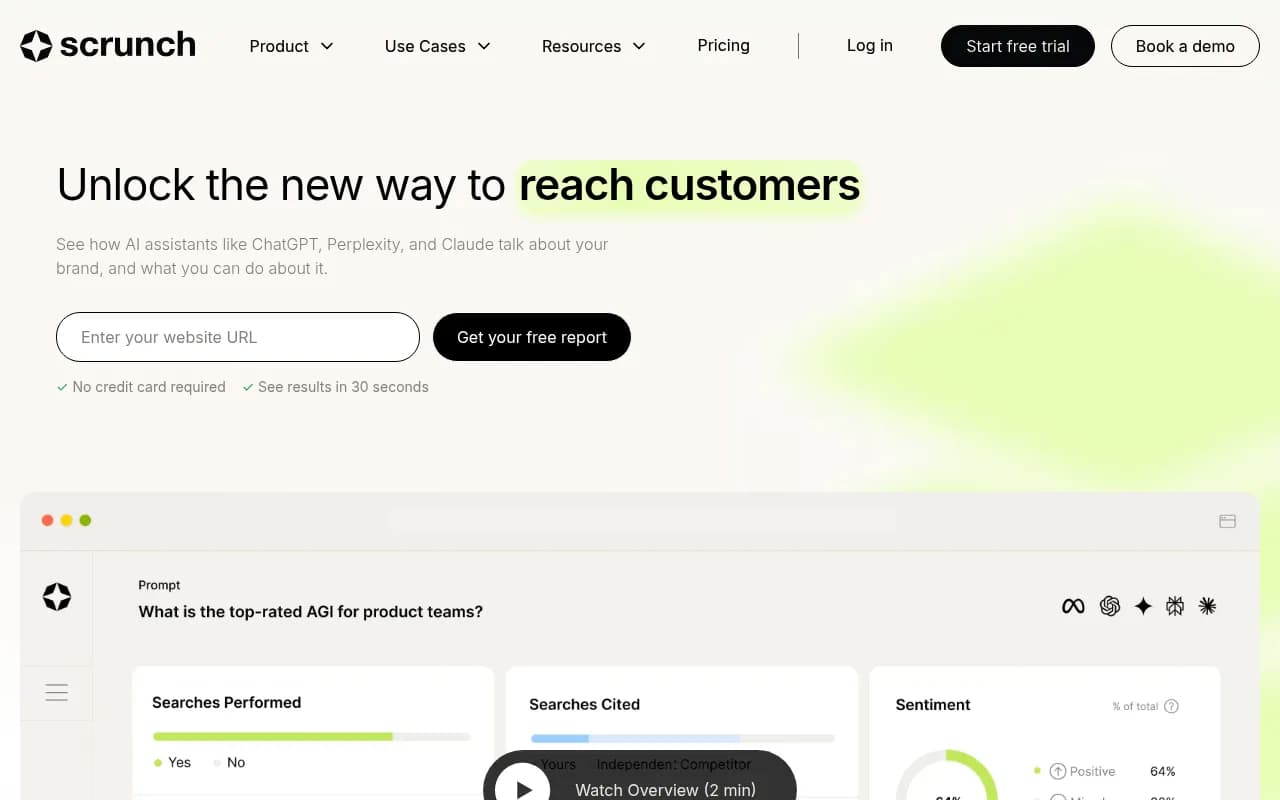
It's not as complete as Promptwatch's full optimization loop, but it goes further than pure monitoring tools. The citation source analysis is particularly useful: knowing that AI models are citing a specific Reddit thread or competitor blog post gives you a concrete target to work toward.
The platform covers major LLMs and has decent prompt tracking. Pricing is higher than entry-level alternatives, which puts it in direct competition with Promptwatch -- where the gap in content generation capabilities becomes harder to ignore.
Best for: Teams that want deeper citation analysis and some optimization guidance without a full enterprise commitment.
6. Evertune
Evertune positions itself as an enterprise GEO platform, with a focus on Fortune 500 brands. The feature set is substantial: brand mention tracking, sentiment analysis, competitor benchmarking, and GEO insights across major AI platforms.
The platform is genuinely strong for large organizations that need structured reporting and executive-level dashboards. The GEO insights go beyond simple mention counting -- you get context about how your brand is being described, not just whether it appears.
The trade-off is that Evertune is built for scale, which means the pricing and onboarding process reflect that. It's not the right fit for mid-market teams or agencies managing multiple smaller clients. Content generation isn't a core feature either.
Best for: Enterprise marketing teams at large brands that need sophisticated GEO reporting.
7. Rankshift
Rankshift focuses on tracking brand visibility across ChatGPT, Perplexity, and AI search, with a cleaner interface than many competitors and reasonable pricing for what you get.

It's a solid mid-tier option. The tracking is reliable, the competitor comparison features are useful, and the platform doesn't have the credit-burn issues that plague AthenaHQ. The gap is in optimization -- Rankshift tells you where you stand but doesn't help you move.
For teams that are primarily trying to get visibility data to inform their existing content strategy (rather than generate new content directly in the platform), Rankshift is worth evaluating.
Best for: Mid-market teams that want reliable tracking without enterprise pricing.
8. Searchable
Searchable is one of the few alternatives that combines AI search visibility tracking with built-in content generation -- which makes it one of the more direct competitors to Promptwatch's approach.
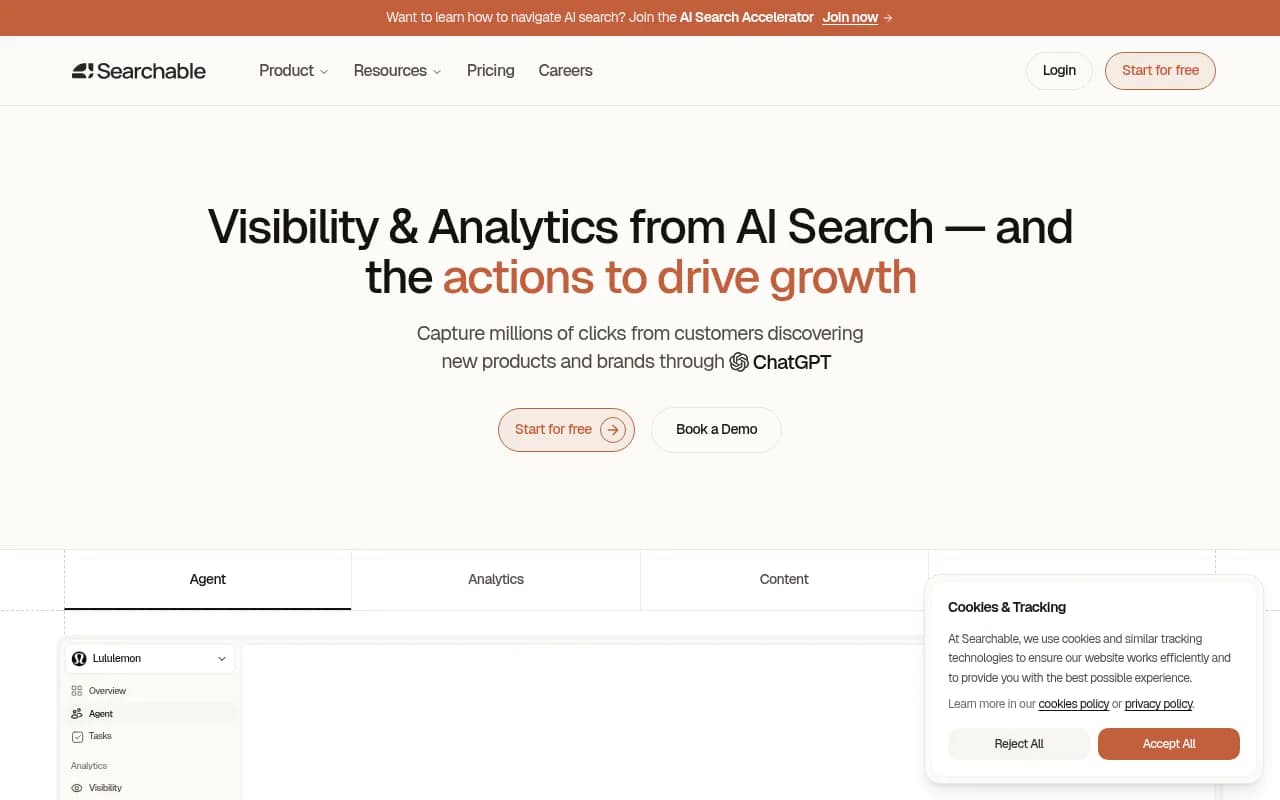
The content generation features are useful, though the citation data and prompt intelligence that powers Promptwatch's writing agent is more developed. Searchable is a reasonable option for teams that want to move beyond pure monitoring without jumping to a full enterprise platform.
The platform covers major AI engines and has a content gap identification feature, though it's less granular than Promptwatch's Answer Gap Analysis. Worth a trial if you're specifically looking for the monitoring-plus-creation combination at a lower price point.
Best for: Teams that want content generation alongside tracking but aren't ready for a full-featured platform.
Head-to-head comparison
| Platform | Multi-LLM tracking | Content gap analysis | AI content generation | Crawler logs | Reddit/YouTube tracking | Free trial | Starting price |
|---|---|---|---|---|---|---|---|
| Promptwatch | 10 engines | Yes (Answer Gap Analysis) | Yes (built-in agent) | Yes | Yes | Yes | $99/mo |
| AthenaHQ | 8+ engines | Limited | No | No | No | No | $295/mo |
| Profound | 9+ engines | Limited | No | No | No | No | High |
| Otterly.AI | Major engines | No | No | No | No | Yes | Low |
| Peec AI | 3 engines | No | No | No | No | Free tier | Low |
| Scrunch AI | Major engines | Partial | No | No | No | Yes | Mid |
| Evertune | Major engines | Partial | No | No | No | No | Enterprise |
| Rankshift | 3 engines | No | No | No | No | Yes | Mid |
| Searchable | Major engines | Partial | Yes | No | No | Yes | Mid |
The monitoring-only trap
There's a pattern worth naming directly. Most of the tools in this space -- including AthenaHQ -- are built around the same core premise: show you a dashboard of where your brand appears in AI responses, compare it to competitors, and send you alerts when things change.
That's genuinely useful information. But it's the beginning of the work, not the end of it.
The question that matters is: once you know you're invisible for a high-value prompt, what do you do? You need to know which specific content is missing from your site. You need to understand what topics and angles AI models want to see. You need to create that content in a way that's actually likely to get cited -- not just keyword-stuffed articles that worked for Google in 2019.
That's the gap most platforms leave open. Promptwatch's Answer Gap Analysis and built-in writing agent are specifically designed to close it. The writing agent doesn't generate generic content -- it uses citation data from 880M+ analyzed citations to understand what AI models actually reference, then creates content engineered to match those patterns.
For teams that are serious about improving AI visibility rather than just measuring it, that distinction matters a lot.
How to choose
A few honest recommendations based on different situations:
If you want the complete optimization loop -- tracking, gap analysis, content generation, and traffic attribution -- Promptwatch is the clear choice. It's the only platform that handles all four in a single workflow, and it's priced accessibly enough that you don't need an enterprise budget to get started.
If you're at a Fortune 500 brand and need sophisticated GEO reporting for executive stakeholders, Evertune or Profound are worth evaluating -- just plan to have a separate content team act on the insights.
If you just need basic monitoring and have a tight budget, Otterly.AI or Peec AI will give you the essentials without the credit-burn headaches of AthenaHQ.
If you want monitoring plus content generation without a full enterprise commitment, Searchable is the most direct mid-tier option.
What you probably shouldn't do is pay $295/month with no free trial for a tool that locks its best features behind Enterprise pricing. That's the AthenaHQ situation in a sentence -- and it's exactly why this guide exists.