Key Takeaways
- Sanity leads for AI-native workflows with its Content Operating System approach, treating content as programmable data that AI agents can safely automate
- Contentful excels at enterprise scale with modular content architecture, extensive personalization, and compliance certifications for large organizations
- Strapi offers maximum control as the leading open-source option, appealing to teams that want self-hosted infrastructure and complete customization
- AI search visibility matters: structured content from headless CMS platforms is easier for ChatGPT, Perplexity, and other AI engines to cite and recommend
- Developer experience varies significantly: Sanity uses schema-as-code, Contentful provides SDKs for 10+ languages, Strapi gives you direct database access
The Headless CMS Landscape in 2026
The headless CMS market has matured from experimental technology to critical infrastructure. The sector is projected to grow from $3.94 billion in 2026 to $22.28 billion by 2034, expanding at a CAGR of 21%. This surge reflects a fundamental shift: legacy monolithic systems can't keep pace with content demands across web, mobile, and emerging AI channels.
But going "headless" alone isn't the endgame anymore. The leaders of 2026 are platforms that handle content operations -- not just publishing. AI-powered features are now table stakes, real-time collaboration matches Google Docs expectations, and edge deployment with global CDN performance has become a differentiator.
For teams building content strategies around AI search visibility, the choice of headless CMS directly impacts how well your content gets discovered and cited by ChatGPT, Claude, Perplexity, and Google AI Overviews. Structured, semantic content stored in a headless CMS is far easier for AI models to parse, understand, and recommend than unstructured HTML buried in a traditional CMS.
Sanity: The Content Operating System
G2 Score: 4.7/5
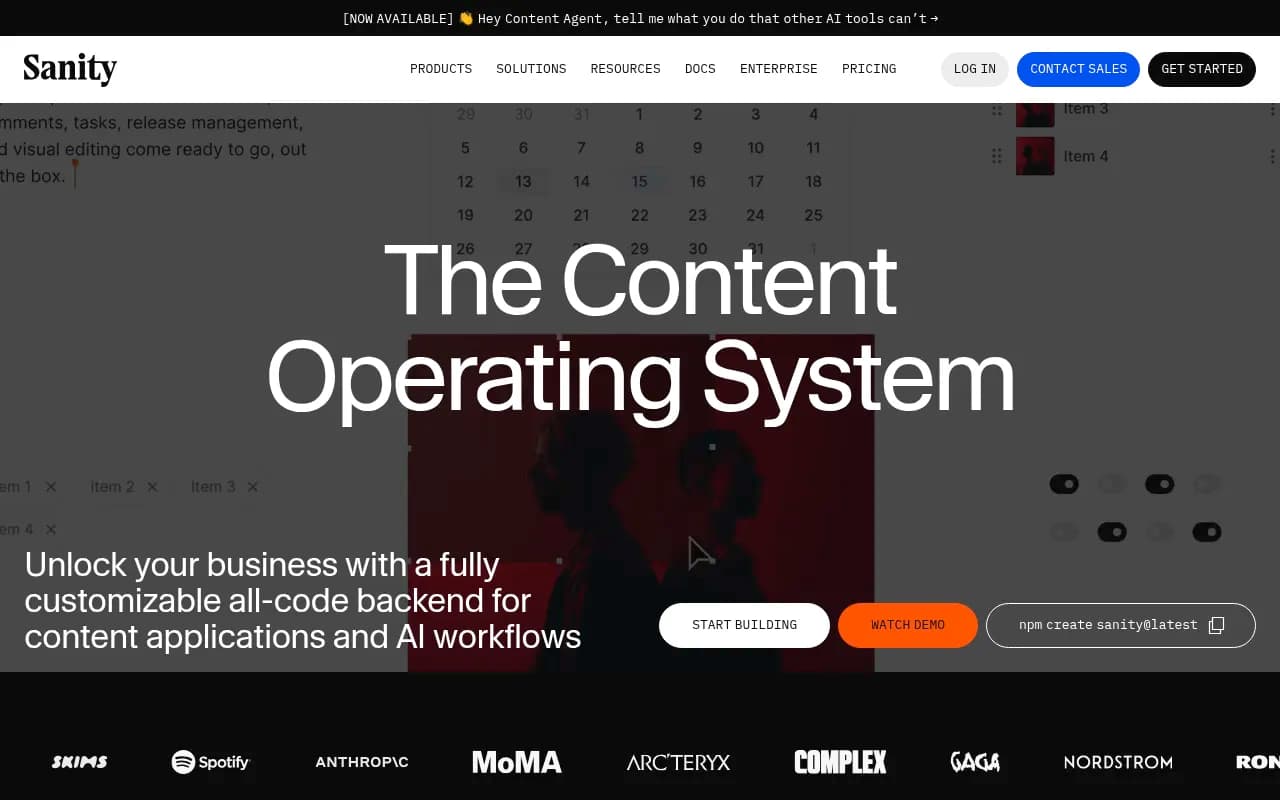
Sanity has evolved beyond the traditional definition of a headless CMS. It positions itself as a Content Operating System designed for organizations that treat content as strategic data rather than static text. This distinction matters for the "second revolution" of AI.
Why Sanity Wins for AI-Native Teams
Because Sanity treats content as programmable data stored in a schema-less Content Lake, it provides the rich context AI agents need to automate workflows safely. While traditional enterprise CMSs like Adobe Experience Manager focus on page rendering, Sanity focuses on structured content that AI models can actually understand.
This architecture makes Sanity content inherently more discoverable by AI search engines. When ChatGPT or Perplexity crawls your website, they're looking for semantic structure -- entities, relationships, metadata -- not just text blobs. Sanity's content model gives them exactly that.
Developer Experience: Schema as Code
Sanity is built on the philosophy of Schema as Code. Developers define content models in JavaScript or TypeScript, allowing for version control and safe deployments. This enables teams to build a fully customizable editing environment -- Sanity Studio -- that mirrors their actual business workflows, rather than forcing them into generic templates.
Key technical advantages:
- Real-time collaboration: Multiple users and AI agents work in the document simultaneously, eliminating lockouts
- GROQ query language: A powerful, intuitive query language designed specifically for content (think GraphQL but better for editorial use cases)
- Portable Text: A rich text specification that stores content as structured JSON, not HTML -- making it trivial to render the same content across web, mobile, and AI contexts
- Content Lake architecture: All content lives in a single source of truth, accessible via APIs from any frontend
Content Operations at Scale
Sanity has been rated #1 on G2 for four years straight largely due to its real-time collaboration capabilities. Content teams can work like they do in Google Docs -- no more "this page is locked" errors. For AI-optimized content workflows, this means your content creation, review, and publishing cycles move faster.
Sanity also offers:
- AI-assisted content creation: Built-in integrations with GPT-4 and Claude for drafting, summarizing, and translating content
- Webhooks and automation: Trigger workflows when content changes, enabling automated publishing, cache invalidation, or AI processing
- Granular permissions: Control who can edit what, down to individual fields within a document
Pricing
Sanity offers a generous free tier for small projects, with paid plans starting around $99/month for growing teams. Enterprise pricing is custom and includes SLAs, dedicated support, and advanced security features.
Best For
Sanity is ideal for:
- Development teams that want full control over their content model and frontend
- Organizations building AI-native content workflows
- Multi-channel publishing (web, mobile, IoT, AI assistants)
- Teams that value real-time collaboration and developer experience
Contentful: The Enterprise Standard
G2 Score: 4.3/5
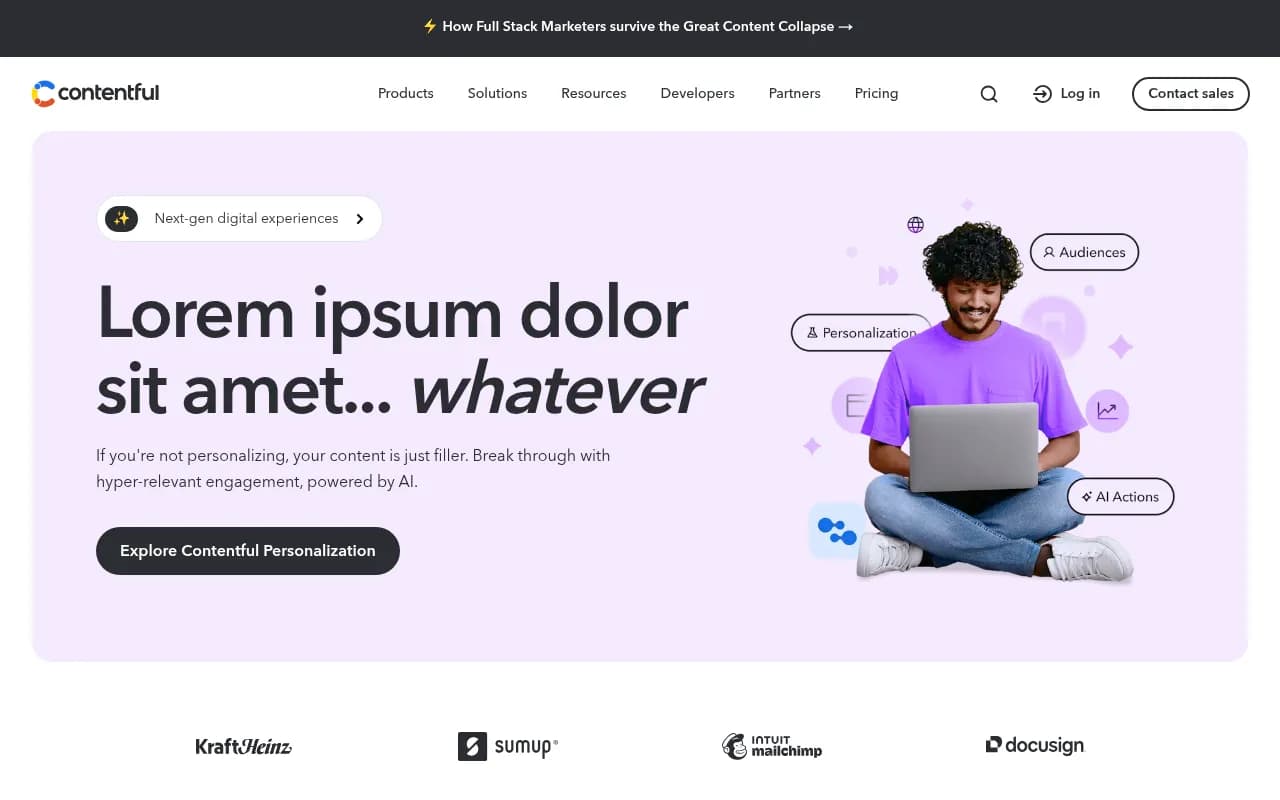
Contentful positions itself as a Digital Experience Platform (DXP) with headless CMS capabilities. It's the "safe" choice for enterprises -- a mature, cloud-based platform with robust APIs, a polished UI, and a massive ecosystem of integrations.
Why Enterprises Choose Contentful
Contentful's core strength is modular content architecture. Content is broken into reusable components that can be assembled into any experience -- web pages, mobile apps, digital signage, voice assistants, or AI-generated responses. This composability makes it easier to maintain consistency across channels.
For AI search visibility, Contentful's structured content model means your content is already organized in a way that AI models prefer. Instead of scraping unstructured HTML, AI engines can consume your content via Contentful's APIs and understand the relationships between entities.
Developer Experience: API-First
Contentful offers:
- REST and GraphQL APIs: Choose the API style that fits your stack
- SDKs for 10+ languages: JavaScript, Python, Ruby, PHP, .NET, Java, Swift, and more
- Content Preview API: See draft content before it's published, enabling editorial review workflows
- Webhooks: Trigger external systems when content changes
Contentful's developer experience is polished but less flexible than Sanity's. You're working within Contentful's content modeling paradigm rather than defining your own schema in code. For many teams, this is a feature -- it provides guardrails and best practices out of the box.
AI-Powered Personalization
Contentful has invested heavily in AI-driven personalization across channels. Their platform can:
- Automatically tag and categorize content using AI
- Recommend related content to editors based on semantic similarity
- Optimize content delivery based on user behavior and context
- A/B test content variations and surface winning combinations
These features are particularly valuable for large content libraries where manual organization becomes impractical.
Enterprise Features
Contentful shines in enterprise contexts with:
- Compliance certifications: SOC 2, ISO 27001, GDPR, HIPAA
- Role-based access control: Granular permissions for large teams
- Localization: Built-in support for multi-language content with translation workflows
- SLAs and dedicated support: 99.99% uptime guarantee with enterprise plans
Pricing
Contentful's pricing starts at $300/month for the Team plan, with Enterprise pricing custom-quoted based on usage. The platform can get expensive at scale, but enterprises value the stability and support.
Best For
Contentful is ideal for:
- Large enterprises with complex content operations
- Teams that need compliance certifications and SLAs
- Multi-brand organizations managing dozens of websites
- Projects where stability and ecosystem maturity matter more than cutting-edge features
Strapi: The Open-Source Powerhouse
G2 Score: 4.6/5
Strapi is the leading open-source headless CMS, offering self-hosted and cloud deployment options. It appeals to developers who want maximum control over their infrastructure and the ability to customize every aspect of the platform.
Why Developers Love Strapi
Strapi is 100% open-source with over 60,000 GitHub stars. This means:
- No vendor lock-in: Your content lives in your own database (PostgreSQL, MySQL, SQLite, or MongoDB)
- Full customization: Extend or modify any part of the platform with plugins or custom code
- Self-hosted option: Deploy on your own infrastructure for complete control
- Active community: Thousands of developers contributing plugins, tutorials, and support
For AI-optimized content, Strapi's flexibility is a double-edged sword. You have complete control over your content model and can structure it exactly how AI models prefer -- but you're also responsible for implementing those optimizations yourself.
Developer Experience: Code-First
Strapi provides:
- Admin panel auto-generation: Define your content types, and Strapi generates a full admin UI automatically
- REST and GraphQL APIs: Both generated automatically from your content model
- Plugin system: Extend functionality with official or community plugins (SEO, sitemap generation, AI integrations, etc.)
- Webhooks and lifecycle hooks: Trigger custom logic at any point in the content lifecycle
Strapi's learning curve is steeper than Contentful's but shallower than Sanity's. You're working with familiar Node.js patterns and can inspect/modify the source code when needed.
AI Features and Integrations
Strapi recently launched Strapi AI features including:
- AI-powered content modeling: Automatically generate content types from natural language descriptions
- AI translations: Translate content into multiple languages with a single click
- Content suggestions: AI-assisted writing and editing within the admin panel
These features are newer than Sanity's or Contentful's AI capabilities, but they're evolving rapidly. The open-source nature means you can also integrate your own AI models or third-party services.
Deployment Options
Strapi offers three deployment paths:
- Self-hosted: Deploy on your own servers, AWS, DigitalOcean, etc. Full control, full responsibility.
- Strapi Cloud: Managed hosting with automatic scaling, backups, and updates. Starting at $99/month.
- Enterprise Edition: Self-hosted with enterprise features like SSO, audit logs, and dedicated support. Custom pricing.
Pricing
Strapi's open-source version is free forever. Strapi Cloud starts at $99/month for the Essential plan, $249/month for Professional, and $579/month for Business. Enterprise pricing is custom.
This makes Strapi the most cost-effective option for teams with technical resources to manage their own infrastructure.
Best For
Strapi is ideal for:
- Development teams that want full control over their stack
- Startups and agencies building multiple projects on a budget
- Teams with specific compliance or data residency requirements
- Developers who prefer open-source tools and active communities
Head-to-Head Comparison
Content Modeling
- Sanity: Schema-as-code with TypeScript. Maximum flexibility, steeper learning curve. Content stored as JSON in a proprietary Content Lake.
- Contentful: GUI-based content modeling with reusable components. Easier for non-technical users. Content stored in Contentful's cloud.
- Strapi: GUI-based content modeling with auto-generated APIs. Content stored in your own database (PostgreSQL, MySQL, etc.).
AI Search Optimization
All three platforms store content as structured data, making it easier for AI models to parse and cite. However:
- Sanity's Portable Text format is specifically designed for multi-channel rendering, including AI contexts
- Contentful's modular content makes it easy to expose semantic relationships between entities
- Strapi's flexibility lets you structure content exactly how you want, but requires more manual optimization
For teams serious about AI search visibility, tools like Promptwatch can help you track how well your content is being discovered and cited by ChatGPT, Perplexity, and other AI engines -- regardless of which CMS you choose.

Developer Experience
- Sanity: Best for teams that want to define everything in code. GROQ query language is powerful but unique.
- Contentful: Best for teams that want a polished, API-first experience with extensive SDKs.
- Strapi: Best for teams that want to customize everything and prefer open-source tools.
Real-Time Collaboration
- Sanity: Industry-leading real-time collaboration. Multiple users can edit the same document simultaneously.
- Contentful: Basic collaboration with locking mechanisms. Users can see who's editing what, but can't edit simultaneously.
- Strapi: No built-in real-time collaboration. Users can overwrite each other's changes.
Pricing
- Sanity: Free tier available. Paid plans start around $99/month. Enterprise pricing custom.
- Contentful: Starts at $300/month. Enterprise pricing custom and can get expensive at scale.
- Strapi: Open-source version free. Strapi Cloud starts at $99/month. Most cost-effective for self-hosted deployments.
Ecosystem and Integrations
- Sanity: Growing ecosystem with integrations for Vercel, Netlify, Gatsby, Next.js, and major frontend frameworks.
- Contentful: Massive ecosystem with 100+ official integrations and thousands of community plugins.
- Strapi: Active open-source community with 200+ plugins. Easy to build custom integrations.
Choosing the Right Platform
Choose Sanity If:
- You're building AI-native content workflows and want content as programmable data
- Real-time collaboration is critical for your team
- You want maximum flexibility in content modeling and frontend rendering
- Your developers are comfortable with schema-as-code and modern JavaScript/TypeScript
Choose Contentful If:
- You're an enterprise that needs compliance certifications and SLAs
- You want a mature, stable platform with extensive integrations
- You're managing multiple brands or websites from a single content hub
- You prefer a polished GUI over code-based configuration
Choose Strapi If:
- You want full control over your infrastructure and data
- You're building on a budget and have technical resources to manage your own hosting
- You need specific customizations that aren't available in closed platforms
- You prefer open-source tools and active developer communities
AI Search Visibility Considerations
Regardless of which headless CMS you choose, optimizing your content for AI search engines requires:
- Structured content models: Define clear entities, relationships, and metadata that AI models can understand
- Semantic markup: Use schema.org vocabulary and JSON-LD to provide context to AI crawlers
- API accessibility: Ensure your content is accessible via clean, well-documented APIs that AI models can consume
- Content quality: AI models prioritize authoritative, well-written content with clear answers to user questions
All three platforms -- Sanity, Contentful, and Strapi -- support these requirements. The difference is in how much work you need to do to implement them.
For teams that want to track and optimize their AI search visibility, monitoring tools can show you exactly how ChatGPT, Perplexity, and other AI engines are discovering and citing your content. This feedback loop helps you understand which content gaps to fill and which topics to prioritize.
The Bottom Line
Sanity, Contentful, and Strapi represent three distinct approaches to headless CMS:
- Sanity is the most forward-thinking, treating content as data and enabling AI-native workflows
- Contentful is the enterprise standard, offering stability, compliance, and a massive ecosystem
- Strapi is the open-source champion, providing maximum control and cost-effectiveness
For teams building content strategies around AI search visibility in 2026, all three platforms can work -- but Sanity's Content Operating System approach and real-time collaboration give it an edge for AI-native workflows. Contentful remains the safest choice for large enterprises with complex requirements. Strapi offers the best value for technically sophisticated teams that want full control.
The right choice depends on your team's priorities: flexibility vs. stability, cost vs. features, control vs. convenience. Evaluate each platform against your specific use cases, and consider running a proof-of-concept with your actual content before committing.