Key takeaways
- I trialed six AI visibility platforms (Profound, Otterly.ai, AthenaHQ, Semrush AI Visibility Toolkit, ZipTie, and Promptwatch) against the same 40 prompts across ChatGPT, Perplexity, Gemini, and Google AI Overviews for three weeks.
- Most tools are monitors, not fixers. They'll tell you that your citation share dropped. Only a couple tell you why, and fewer still help you do anything about it.
- Pricing varies wildly for similar coverage: Otterly starts at $29/month but Claude and Gemini cost extra, while AthenaHQ's credit model can burn through 100 credits in a single 20-prompt, 5-model run.
- Data consistency between tools was the biggest surprise. Running identical prompts through two platforms on the same day sometimes produced different citation counts, because AI answers aren't deterministic and tools differ in whether they use API access or real browser sessions.
- If you want a platform that goes past the dashboard and actually produces and publishes content to close visibility gaps, Promptwatch and Profound were the only two in my trial that attempt it seriously.
Why I ran this trial the hard way
I didn't want another listicle built from marketing pages. So I signed up for free trials or lowest paid tiers on six platforms, loaded the exact same 40 prompts into each (a mix of branded, comparison, and "best X for Y" queries), and let them run daily for three weeks against ChatGPT, Perplexity, Gemini, and Google AI Overviews. Then I spot-checked the results manually against live AI responses, because a CMO quoted in an industry trial writeup put it bluntly: she ran the same queries by hand and got different numbers than her tool reported. That's the risk with any of these platforms, and it's worth testing before you commit a budget to one.
A bit of context before the results: ChatGPT cites roughly 5 sources per web-search response on average, the smallest citation inventory of any major engine Promptwatch tracks, while Google AI Overviews cites close to double that and Perplexity sits consistently near 10 sources per answer (Promptwatch's average sources per response data). That scarcity is the whole reason this category of tool exists. If ChatGPT is only handing out five seats per answer, knowing whether you hold one of them (and why you don't) matters more than almost any other marketing metric right now.
What I actually tested
I wasn't grading UI polish. I was checking four things on each platform:
- Does the citation data match what I see when I run the same prompt manually?
- Which engines are actually covered out of the box, versus gated behind add-ons?
- When visibility drops, does the tool explain why, or just show a chart?
- Can the platform help close the gap, or does it stop at the alert?
That last point split the field cleanly. As one Reddit thread on AI visibility tooling put it, a lot of these products give you "a dashboard, not a strategy."
The six platforms, head to head
Profound: enterprise depth, enterprise price
Profound's self-serve Starter plan is $99/month but only tracks ChatGPT with up to 50 prompts. To get three engines and 100 prompts you're at Growth, $399/month. Its standout feature is Agent Analytics, which connects AI crawler visits to Google Analytics conversion data, something ZipTie's own comparison calls the only tool attempting full-funnel AI search ROI measurement. Profound also carries SOC 2 and HIPAA certifications, which matters if you're at a bank or healthcare brand. During my trial, data generally held up against manual spot checks, though a few reviewers flag pricing opacity as it scales past Growth.
Profound

Otterly.ai: cheap to start, expensive to finish
At $29/month, Otterly's Lite plan looks like the obvious budget pick: 15 prompts, four base engines, daily tracking, unlimited team seats. The catch showed up fast in my trial. Claude, Gemini, and Google AI Mode are not included by default. They're paid add-ons ranging from $9 to $439/month depending on tier and engine. If you actually want six-engine coverage, you're closer to $200+/month once you stack add-ons on Standard. One practitioner on Reddit called it "a thermometer, not a GPS" and that tracked with my experience: good for a yes/no mention alert, no optimization guidance, and no automated prompt discovery.
Otterly.AI

AthenaHQ: the credit model that bites back
AthenaHQ's free Essential tier is a genuinely useful way to test the waters, 300 credits and competitor insights at no cost. But the credit math gets ugly fast. Running 20 prompts across 5 AI models in a single pass can burn roughly 100 credits, meaning a modest monitoring cadence eats through a free allocation in days. Starter jumps to $295/month billed annually for 3,600 credits and 11-model visibility, which is broad coverage, but budget carefully before scaling prompt counts.

Semrush AI Visibility Toolkit: convenient if you're already inside Semrush
At $99/month per domain as a standalone add-on, with additional domains costing another $99 and extra prompt blocks $60 each, Semrush's toolkit is really built for people already paying for the core platform. One agency CMO quoted in a review summed up the sentiment I ran into repeatedly: "I can't say this tool is worth $99/month, not for a startup and not for a big brand either." If you need traditional SEO and AI visibility in one subscription, Semrush One bundles are reasonable. If AI visibility is your main job, it felt thin next to dedicated platforms.
ZipTie: narrow but honest about it
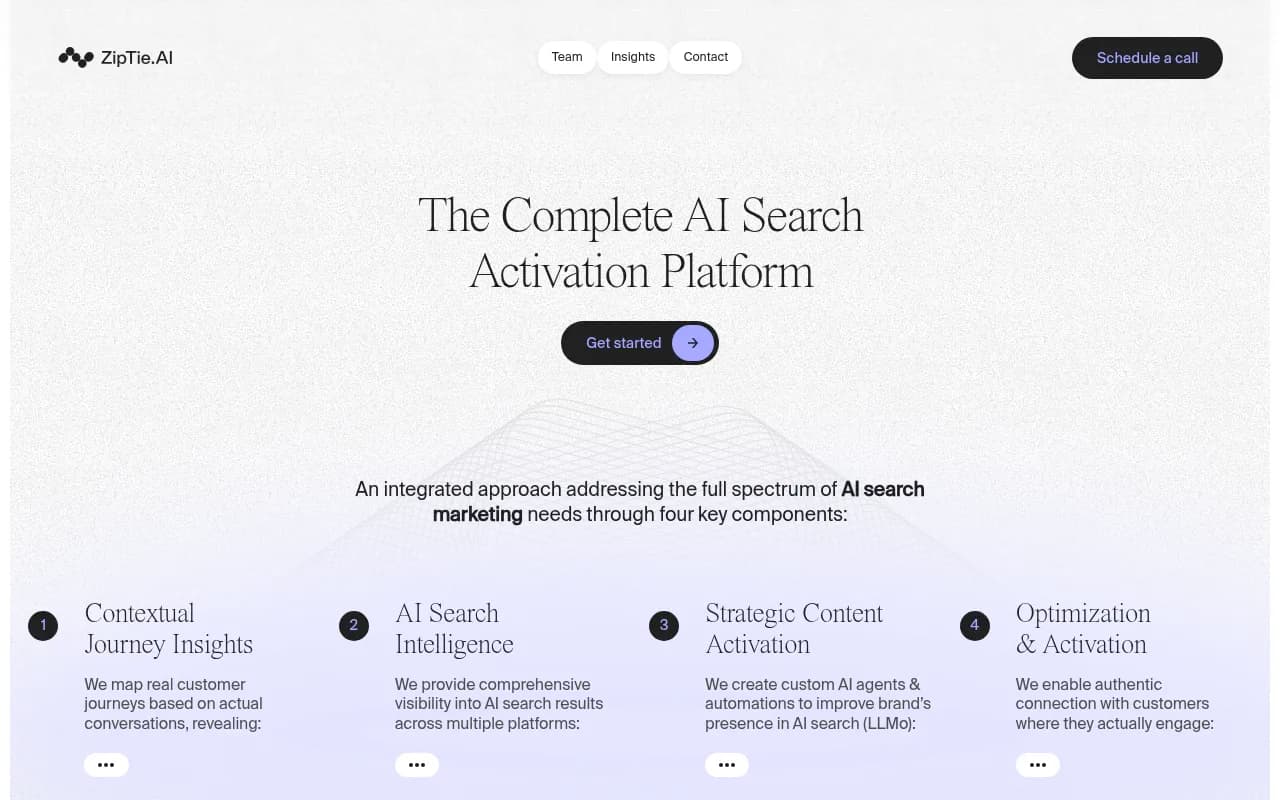
ZipTie covers only three platforms versus the 6-10+ most competitors claim, but it uses real browser-level monitoring rather than API-only calls. That matters specifically for Google AI Overviews, which needs an authenticated session to render accurately, something API-only tools can struggle to replicate. For a sub-$200 tool, it was the most transparent about its limitations of anything I tested.
Promptwatch: the only one that tried to fix what it found
Promptwatch was the platform in my trial that didn't stop at the chart. It tracks ChatGPT, Gemini, Claude, Perplexity, Grok, DeepSeek, Mistral, Microsoft Copilot, Google AI Overviews, Google AI Mode, and even AI coding assistants like Claude Code, all monitored through the actual user-facing interfaces rather than API calls alone, which matters because user-facing answers can genuinely differ from API outputs.
What separated the trial experience wasn't the dashboard, it was what happened after I saw a drop. Promptwatch's AI crawler logs showed me exactly when ChatGPTBot, ClaudeBot, and PerplexityBot had actually visited specific pages on my test domain, and whether they hit errors. Citation analytics then showed which pages got cited and, separately, caught brand mentions inside third-party pages AI cited even when there was no link back. From there, Unified Actions turned that into a prioritized to-do list, and the Content Agents could draft and publish a fix straight to a connected CMS. Competing platforms in this trial gave me the "what," Promptwatch was the only one that consistently got me to "now fix it."

Pricing sits in a sensible middle: Essential at $95/month (1 site, 50 prompts, all LLM tracking), Professional at $245/month (150 prompts, automated content generation, shopping insights), and Business at $579/month for larger teams, with a 7-day free trial on the entry tiers. It's used by over 1,840 brands and agencies including Duolingo, Yelp, and Shutterstock, and rated 4.7/5 on G2.
Side-by-side comparison
| Platform | Entry price | Engines included at entry | Fixes gaps or just reports? | Notable limitation |
|---|---|---|---|---|
| Promptwatch | $95/mo | All major LLMs + AI Overviews/Mode | Yes, Content Agents + Unified Actions | Higher tiers needed for full crawler log volume |
| Profound | $99/mo | ChatGPT only at Starter | Partial, via Agent Analytics | 3 engines require $399/mo Growth plan |
| Otterly.ai | $29/mo | 4 engines (Claude/Gemini extra) | No | Add-ons push real cost well past $29 |
| AthenaHQ | Free (300 credits) | Up to 11 models on paid tiers | Partial, content recommendations | Credit burn is fast and easy to underestimate |
| Semrush AI Visibility Toolkit | $99/mo/domain | Bundled with core Semrush | No | Treated as add-on, not core focus |
| ZipTie | Sub-$200 | 3 platforms only | No | Narrowest engine coverage of the group |
What the trial taught me about data reliability
AI answers aren't deterministic. Ask ChatGPT the same question twice and you can get two different citation lists. This is the single biggest reason manual spot-checking matters during any trial, and it's also why a static score like "your visibility is 23%" is close to meaningless on its own. What's actually useful is a trend: you showed up in 8 of 50 prompts this month, up from 3 last month, here's which competitors are showing up instead of you. Every platform I tested could eventually show that trend line. The difference was how much manual reconciliation it took to trust the number.
It's also worth knowing the ground is shifting under all of these tools. Reddit's share of ChatGPT Search citations held steady near 3.8% through late July 2026, then collapsed to under 1% in a single day on August 14, an 86% relative drop, while the equivalent decline on Google AI Overviews was far gentler, around 11% (Promptwatch's data on Reddit citations dropping in ChatGPT). A tracking platform that was accurate in July could look stale in September just because the underlying engine changed its source selection. Any platform you pick needs to update its methodology at that same speed, which is part of why I weighted crawler-log access and real-interface monitoring heavily in this review.
Due-diligence questions worth asking before you buy
Based on what tripped me up during the trial, ask any vendor these before signing:
- Which platforms are covered, and is the methodology API-based or real-browser monitoring? This matters most for Google AI Overviews.
- How does the tool handle non-deterministic answers, same prompt, different response across sessions?
- Can it tie AI visibility to actual traffic or revenue, and through which integration?
- What does it cost at 500 prompts and 1,000 prompts, not just the advertised entry tier?
- Does the roadmap account for sudden shifts in how engines select sources, the kind we just saw with Reddit?
Final take
If your budget is under $50/month and you just need a smoke alarm, Otterly's Lite tier or AthenaHQ's free credits will tell you whether you're mentioned at all. If you're an enterprise with compliance requirements, Profound's SOC 2 certification and Agent Analytics are hard to ignore even at $399/month. But for the actual job most marketing teams hire these tools to do, understand why visibility changed and then do something about it before the quarter ends, Promptwatch was the one platform in this trial that consistently closed the loop from alert to published fix, and it did it across more engines than any competitor I tested. If you want to browse other options before committing, the GEO software directory at bestgeosoftware.com is a reasonable next stop.