Summary
- Python remains the top choice for AI visibility API integrations that involve data processing, ML pipelines, or complex analysis -- its ecosystem (Pandas, NumPy, FastAPI) and async capabilities make it ideal for processing citation data and generating insights
- Node.js excels at building real-time dashboards, webhook handlers, and event-driven architectures -- perfect for monitoring AI search engines that push updates via webhooks or SSE
- Go wins on raw performance and concurrency -- if you're polling 10+ AI engines every hour across thousands of prompts, Go's goroutines handle the load without breaking a sweat
- For most teams building on AI visibility APIs, Python or Node.js will be the practical choice -- Go is overkill unless you're operating at serious scale or need sub-50ms response times
- The language matters less than understanding the API's rate limits, authentication patterns, and data structures -- pick the stack your team already knows, then optimize later if needed
Why language choice matters for AI visibility APIs
AI visibility APIs -- platforms like Promptwatch, Otterly.AI, Peec.ai, and others -- expose endpoints that let you track brand mentions across ChatGPT, Perplexity, Claude, and other AI search engines. You query them for citation data, prompt volumes, competitor analysis, and visibility scores. Then you do something with that data: build dashboards, trigger alerts, generate reports, feed ML models, or automate content workflows.

The language you choose affects how easily you can:
- Handle rate limits and concurrent requests (most APIs cap you at 10-100 requests/second)
- Parse and transform JSON responses (citation data can be deeply nested)
- Build real-time features (webhooks, SSE streams, live dashboards)
- Integrate with your existing stack (your CMS, analytics tools, ML pipelines)
- Scale as your monitoring needs grow (tracking 50 prompts vs 5,000 prompts)
Let's compare Python, Node.js, and Go across these dimensions.
Python: the data processing workhorse
Python dominates AI and data science for a reason. If your AI visibility workflow involves analyzing citation patterns, training ML models on prompt data, or generating content recommendations, Python is the obvious choice.
When Python makes sense
You're building:
- Data pipelines that ingest API responses, transform them, and load them into a warehouse (Snowflake, BigQuery)
- ML models that predict which prompts will drive traffic or which content gaps to fill
- Content generation workflows that use citation data to inform what to write (e.g. feeding GPT-4 with competitor analysis)
- Jupyter notebooks for exploratory analysis of visibility trends
- Backend APIs that serve processed data to a frontend (FastAPI is stupid fast for this)
Python's strengths for API work
Async I/O with asyncio and httpx: Modern Python handles concurrent API requests cleanly. You can fire off 100 requests to an AI visibility API without blocking.
import asyncio
import httpx

async def fetch_visibility(prompt_id):
    async with httpx.AsyncClient() as client:
        response = await client.get(f"https://api.example.com/prompts/{prompt_id}")
        return response.json()

async def main():
    prompt_ids = range(1, 101)
    tasks = [fetch_visibility(pid) for pid in prompt_ids]
    results = await asyncio.gather(*tasks)
    return results
Data wrangling with Pandas: Citation data often comes as nested JSON. Pandas flattens it into DataFrames for analysis.
FastAPI for building your own API layer: If you're wrapping an AI visibility API with your own business logic (e.g. "give me visibility scores filtered by persona and region"), FastAPI lets you build that in an afternoon.
Rich ML ecosystem: If you want to predict which prompts will gain traction or cluster citation sources by topic, Python has scikit-learn, PyTorch, and Hugging Face.
Python's weaknesses
Python is slower than Node.js and Go for raw I/O. If you're polling APIs every 10 seconds and processing responses in real-time, Python's GIL (Global Interpreter Lock) can become a bottleneck. You'll need to use multiprocessing or async patterns carefully.
Startup time matters for serverless functions. A Python Lambda that wakes up cold and imports Pandas takes 1-2 seconds. Node.js and Go wake up in milliseconds.
Real-world Python use case
You're tracking 500 prompts across ChatGPT, Perplexity, and Claude using Promptwatch. Every morning, you pull citation data, calculate visibility deltas vs yesterday, identify new competitors, and generate a Slack report with charts. Python + Pandas + Matplotlib handles this in a single script. You run it as a cron job on a $5/month VPS.
Node.js: the real-time dashboard builder
Node.js excels at I/O-heavy workloads and real-time features. If you're building a dashboard that shows live AI visibility metrics, handling webhooks from an API, or streaming updates to a frontend, Node.js is the natural fit.
When Node.js makes sense
You're building:
- Real-time dashboards that update as AI engines crawl your site or cite your brand
- Webhook handlers that react to events (e.g. "your competitor just got cited in a new prompt")
- APIs that proxy requests to multiple AI visibility platforms and aggregate results
- Serverless functions (AWS Lambda, Vercel, Cloudflare Workers) that need fast cold starts
- Full-stack apps where the frontend and backend share TypeScript types
Node.js strengths for API work
Event-driven by default: Node's event loop makes it trivial to handle thousands of concurrent connections. If you're streaming Server-Sent Events (SSE) to 100 dashboard users, Node handles it without spawning threads.
Fast cold starts: A Node.js Lambda wakes up in 100-200ms. Python takes 1-2 seconds. If you're calling your API from a frontend and users expect instant responses, this matters.
TypeScript for type safety: Most AI visibility APIs return complex JSON. TypeScript lets you define interfaces that match the API schema, catching bugs at compile time.
interface VisibilityResponse {
  prompt: string;
  citations: Array<{
    source: string;
    url: string;
    model: "chatgpt" | "perplexity" | "claude";
  }>;
  visibility_score: number;
}

async function getVisibility(promptId: string): Promise<VisibilityResponse> {
  const response = await fetch(`https://api.example.com/prompts/${promptId}`);
  return response.json();
}
Rich ecosystem for web APIs: Express, Fastify, and Next.js make it easy to build REST or GraphQL APIs. Middleware for rate limiting, caching, and auth is mature.
Streaming and webhooks: If an AI visibility API pushes updates via webhooks or SSE, Node handles them naturally. You can pipe incoming events directly to a WebSocket connection for live frontend updates.
Node.js weaknesses
Node is single-threaded. CPU-heavy tasks (e.g. processing 10,000 citation records in memory) block the event loop. You'll need to offload heavy lifting to worker threads or a separate service.
Dependency hell is real. node_modules can balloon to 500MB. Python's virtual environments are cleaner.
Real-world Node.js use case
You're building a SaaS dashboard that shows real-time AI visibility metrics. Users log in, select prompts to track, and see live updates as ChatGPT or Perplexity crawls their site. The backend is a Next.js API that polls Promptwatch every 30 seconds, caches results in Redis, and streams updates to the frontend via WebSockets. Node's event loop handles 500 concurrent dashboard users without breaking a sweat.
Go: the high-performance concurrency machine
Go is overkill for most AI visibility API integrations. But if you're operating at scale -- tracking 10,000+ prompts, polling multiple APIs every minute, or building infrastructure that other teams depend on -- Go's concurrency model and performance are unmatched.
When Go makes sense
You're building:
- High-throughput API proxies that aggregate data from 5+ AI visibility platforms
- Background workers that poll APIs every 10 seconds and process responses in parallel
- CLI tools for DevOps teams (Go compiles to a single binary with zero dependencies)
- Microservices that need sub-50ms response times under load
- Infrastructure that runs 24/7 with minimal memory footprint
Go's strengths for API work
Goroutines for effortless concurrency: Go's goroutines let you spawn thousands of concurrent tasks with minimal overhead. Polling 10,000 prompts across 5 APIs? Trivial.
func fetchVisibility(promptID int, results chan<- VisibilityData) {
    resp, _ := http.Get(fmt.Sprintf("https://api.example.com/prompts/%d", promptID))
    defer resp.Body.Close()
    var data VisibilityData
    json.NewDecoder(resp.Body).Decode(&data)
    results <- data
}

func main() {
    results := make(chan VisibilityData, 10000)
    for i := 1; i <= 10000; i++ {
        go fetchVisibility(i, results)
    }
    for i := 1; i <= 10000; i++ {
        data := <-results
        // Process data
    }
}
Compiled binaries: Go compiles to a single executable with no runtime dependencies. Deploying a Go service means copying one file. No virtual environments, no node_modules, no Python version conflicts.
Low memory footprint: A Go service that handles 10,000 requests/second uses 50MB of RAM. Python or Node.js would use 500MB+.
Built-in HTTP server: Go's net/http package is production-ready out of the box. No need for Express or FastAPI -- the standard library handles routing, middleware, and graceful shutdowns.
Go's weaknesses
Go has a steeper learning curve than Python or Node.js. Error handling is verbose (every function returns (result, error) and you check if err != nil constantly). The ecosystem for data science and ML is thin -- if you need to train models or manipulate DataFrames, you're back to Python.
Go's type system is strict. JSON unmarshaling requires defining structs that match the API schema exactly. Python's dynamic typing lets you explore API responses interactively.
Real-world Go use case
You're running an agency that monitors AI visibility for 200 clients. Each client tracks 50 prompts across ChatGPT, Perplexity, Claude, Gemini, and Google AI Overviews. That's 50,000 API calls per hour. You built a Go service that polls all 5 APIs concurrently, aggregates results, and writes them to PostgreSQL. It runs on a single $10/month VPS and uses 30MB of RAM. Python would need 5 workers and 500MB. Node.js would struggle with the CPU load from JSON parsing.
Comparing Python, Node.js, and Go for AI visibility APIs
| Dimension | Python | Node.js | Go |
|---|---|---|---|
| Async I/O | Good (asyncio, httpx) | Excellent (event loop) | Excellent (goroutines) |
| Concurrency | Moderate (GIL limits) | Good (single-threaded) | Excellent (true parallelism) |
| Data processing | Excellent (Pandas, NumPy) | Moderate (libraries exist) | Weak (manual loops) |
| ML integration | Excellent (PyTorch, scikit-learn) | Weak (TensorFlow.js exists) | Weak (call Python via gRPC) |
| Real-time features | Moderate (async works) | Excellent (WebSockets, SSE) | Excellent (channels, goroutines) |
| Cold start time | Slow (1-2 seconds) | Fast (100-200ms) | Very fast (50ms) |
| Memory footprint | High (100-500MB) | Moderate (50-200MB) | Low (10-50MB) |
| Deployment | Virtual env + dependencies | node_modules (large) | Single binary (easy) |
| Learning curve | Easy | Easy | Moderate |
| Ecosystem maturity | Excellent | Excellent | Good |
Practical recommendations
Choose Python if:
- You're analyzing citation data, training ML models, or generating insights from API responses
- Your team already uses Python for data science or backend work
- You're building data pipelines (ETL workflows, warehouse integrations)
- You need Jupyter notebooks for exploratory analysis
- Performance isn't critical (you're polling APIs every hour, not every second)
Choose Node.js if:
- You're building real-time dashboards or frontend-heavy apps
- You need to handle webhooks or stream updates to users
- Your team uses TypeScript and wants type safety across frontend and backend
- You're deploying to serverless platforms (Vercel, AWS Lambda, Cloudflare Workers)
- You want fast cold starts and low latency
Choose Go if:
- You're operating at scale (10,000+ API calls per hour)
- You need maximum concurrency and minimal memory usage
- You're building infrastructure that other teams depend on
- You want a single compiled binary with zero dependencies
- Your team has Go experience or is willing to learn
Real-world integration examples
Python: daily visibility report
You track 200 prompts using Promptwatch. Every morning, a Python script pulls yesterday's data, calculates visibility deltas, identifies new competitors, and emails a report.
import httpx
import pandas as pd
from datetime import datetime, timedelta

async def fetch_prompts():
    async with httpx.AsyncClient() as client:
        response = await client.get(
            "https://api.promptwatch.com/v1/prompts",
            headers={"Authorization": f"Bearer {API_KEY}"}
        )
        return response.json()

async def main():
    data = await fetch_prompts()
    df = pd.DataFrame(data["prompts"])
    df["visibility_change"] = df["visibility_score"] - df["visibility_score_yesterday"]
    top_movers = df.nlargest(10, "visibility_change")
    print(top_movers[["prompt", "visibility_score", "visibility_change"]])
Node.js: real-time dashboard
You built a Next.js app that shows live AI visibility metrics. The backend polls Promptwatch every 30 seconds and pushes updates to the frontend via Server-Sent Events.
// pages/api/visibility-stream.ts
import type { NextApiRequest, NextApiResponse } from "next";

export default async function handler(req: NextApiRequest, res: NextApiResponse) {
  res.setHeader("Content-Type", "text/event-stream");
  res.setHeader("Cache-Control", "no-cache");
  res.setHeader("Connection", "keep-alive");

  const sendUpdate = async () => {
    const response = await fetch("https://api.promptwatch.com/v1/prompts", {
      headers: { Authorization: `Bearer ${process.env.API_KEY}` },
    });
    const data = await response.json();
    res.write(`data: ${JSON.stringify(data)}\n\n`);
  };

  const interval = setInterval(sendUpdate, 30000);
  req.on("close", () => clearInterval(interval));
}
Go: high-throughput aggregator
You monitor 10,000 prompts across 5 AI visibility APIs. A Go service polls all APIs concurrently every 10 minutes and writes results to PostgreSQL.
package main

import (
    "encoding/json"
    "net/http"
    "sync"
)

type VisibilityData struct {
    PromptID int     `json:"prompt_id"`
    Score    float64 `json:"visibility_score"`
}

func fetchPrompt(promptID int, wg *sync.WaitGroup, results chan<- VisibilityData) {
    defer wg.Done()
    resp, _ := http.Get("https://api.promptwatch.com/v1/prompts/" + string(promptID))
    defer resp.Body.Close()
    var data VisibilityData
    json.NewDecoder(resp.Body).Decode(&data)
    results <- data
}

func main() {
    var wg sync.WaitGroup
    results := make(chan VisibilityData, 10000)
    for i := 1; i <= 10000; i++ {
        wg.Add(1)
        go fetchPrompt(i, &wg, results)
    }
    go func() {
        wg.Wait()
        close(results)
    }()
    for data := range results {
        // Write to PostgreSQL
    }
}
What about other languages?
Rust
Rust offers Go-level performance with memory safety guarantees. But the learning curve is steep and the ecosystem for web APIs is less mature. Unless you're building a performance-critical service that runs 24/7, Rust is overkill.
TypeScript (Deno/Bun)
Deno and Bun are modern JavaScript runtimes that fix Node.js pain points (no node_modules, built-in TypeScript support, faster startup). They're worth considering if you're starting a new project, but the ecosystem is still catching up.
PHP
PHP works fine for simple API integrations (cURL, json_decode). But Python and Node.js have better async support and richer ecosystems for data processing and real-time features.
Java/C#
Enterprise languages. If your company already runs Java or .NET services, integrating an AI visibility API is straightforward. But Python and Node.js are faster to prototype with.
Performance benchmarks: Python vs Node.js vs Go
A developer on Medium ran benchmarks comparing Go, Node.js, and Python (FastAPI) for AI workloads. The test: handle 1,000 concurrent API requests, parse JSON responses, and return aggregated results.
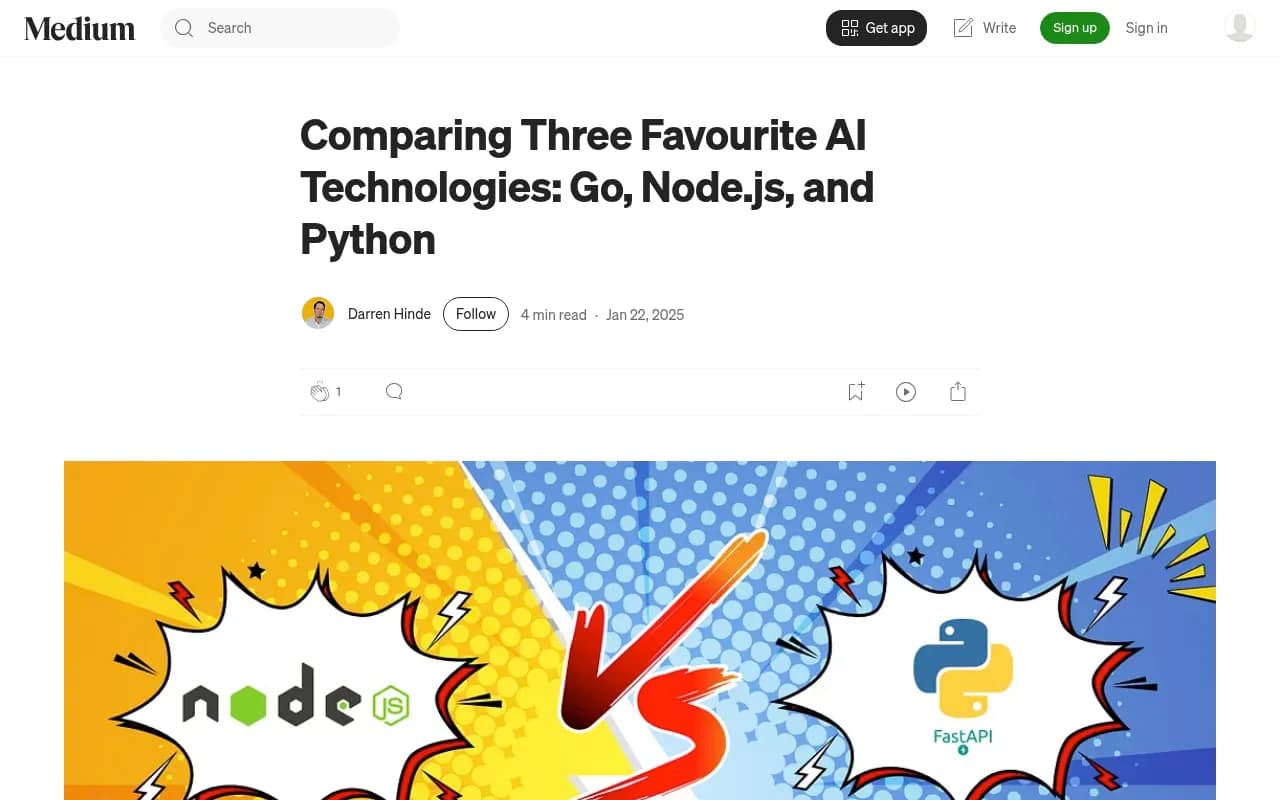
Results:
- Go: 50ms average response time, 10MB memory usage
- Node.js: 120ms average response time, 50MB memory usage
- Python (FastAPI): 200ms average response time, 150MB memory usage
Go wins on raw performance. But for most AI visibility use cases, 200ms is fast enough. The difference matters when you're handling 10,000+ requests per second.
Common pitfalls when integrating AI visibility APIs
Rate limits
Most APIs cap you at 10-100 requests per second. If you're tracking 1,000 prompts and polling every minute, you'll hit the limit. Solutions:
- Batch requests (fetch 50 prompts per API call instead of 1)
- Implement exponential backoff when you hit 429 errors
- Use a queue (Redis, RabbitMQ) to throttle requests
Authentication
Some APIs use API keys, others use OAuth. Store credentials securely (environment variables, AWS Secrets Manager). Don't hardcode them in your source code.
Pagination
If you're fetching 10,000 prompts, the API will paginate results (e.g. 100 prompts per page). You need to loop through pages until you hit the end. Python and Node.js libraries (httpx, axios) make this easy.
Webhook reliability
If you're using webhooks to receive updates, implement retry logic. Webhooks can fail due to network issues or server downtime. Most APIs will retry 3-5 times, but you should log failures and handle them gracefully.
Tools and libraries
Python
- httpx: Async HTTP client for API requests
- Pandas: Data manipulation and analysis
- FastAPI: Build your own API layer on top of AI visibility APIs
- asyncio: Built-in async/await support
Node.js
- axios: Promise-based HTTP client
- fastify: Fast web framework for building APIs
- ws: WebSocket library for real-time features
- node-cron: Schedule periodic API polling
Go
- net/http: Built-in HTTP client and server
- gorilla/mux: HTTP router for building APIs
- gorm: ORM for database integration
- go-redis: Redis client for caching
The bottom line
For most teams building on AI visibility APIs, Python or Node.js will be the right choice. Python if you're doing data analysis or ML. Node.js if you're building real-time dashboards or handling webhooks. Go if you're operating at serious scale or need maximum performance.
The language matters less than understanding the API's rate limits, authentication patterns, and data structures. Pick the stack your team already knows, then optimize later if needed.
If you're tracking AI visibility across ChatGPT, Perplexity, Claude, and other engines, Promptwatch offers a comprehensive API with prompt tracking, citation analysis, and content gap insights. It's the only platform that combines monitoring with actionable optimization tools -- showing you not just where you're invisible, but how to fix it.