Key takeaways
- Relixir positions itself as an end-to-end GEO engine, but several alternatives offer more mature feature sets, better pricing transparency, and stronger enterprise support.
- Promptwatch is the only platform in this comparison rated as a "Leader" across all GEO categories -- and uniquely, it closes the loop from gap analysis to content creation to traffic attribution.
- Profound and Evertune are the strongest enterprise-grade options if your priority is deep prompt intelligence and Fortune 500-level security compliance.
- AthenaHQ and Peec AI work well for teams that need solid monitoring at a lower price point, but neither offers content generation or crawler log analysis.
- If you're running an agency or managing multiple brands, Promptwatch's multi-site plans and white-label reporting make it the most practical choice.
The GEO tool market has exploded. Two years ago, you could count the serious players on one hand. Now there are dozens of platforms claiming to help your brand show up in ChatGPT, Perplexity, Claude, and Google AI Overviews -- and the differences between them matter a lot.
Relixir is one of the newer entrants, marketing itself as an "autonomous GEO engine" for enterprise brands. It has some interesting ideas, particularly around automated content publishing. But it's also relatively unproven compared to platforms with larger customer bases, more transparent pricing, and deeper feature sets.
This guide breaks down the best Relixir alternatives in 2026 -- what each one does well, where it falls short, and who it's actually built for.
What to look for in a GEO platform
Before getting into specific tools, it's worth being clear about what separates a real GEO platform from a monitoring dashboard with a GEO badge slapped on it.
A monitoring-only tool tells you where you're visible. That's useful, but it's table stakes. The platforms worth paying for in 2026 do three things: they find the gaps (which prompts are your competitors winning that you're not?), they help you create content to close those gaps, and they track whether that content actually moved the needle.
Most tools in this space only do step one. Keep that in mind as you read through the options below.
The best Relixir alternatives in 2026
Promptwatch
Promptwatch is the most complete GEO platform available right now. It monitors 10 AI models -- ChatGPT, Perplexity, Claude, Gemini, Google AI Overviews, Google AI Mode, Grok, DeepSeek, Meta AI, Copilot, and Mistral -- and goes well beyond tracking to actually help you fix what's broken.

The core differentiator is the action loop. Answer Gap Analysis shows you exactly which prompts your competitors are being cited for that you're not. The built-in AI writing agent then generates articles, listicles, and comparisons grounded in real citation data (880M+ citations analyzed). Once you publish, page-level tracking shows which pages AI models are citing, how often, and by which model. Traffic attribution via GSC integration, a code snippet, or server log analysis connects visibility to actual revenue.
A few capabilities that most competitors lack entirely: real-time AI crawler logs (see when ChatGPT, Claude, or Perplexity crawls your site and which pages they hit), ChatGPT Shopping tracking, Reddit and YouTube citation insights, and query fan-outs that show how a single prompt branches into sub-queries.
Pricing starts at $99/month for the Essential plan (1 site, 50 prompts, 5 articles). Professional is $249/month (2 sites, 150 prompts, 15 articles, crawler logs). Business is $579/month (5 sites, 350 prompts, 30 articles). Agency and enterprise pricing is custom. A free trial is available.
For most marketing and SEO teams evaluating Relixir alternatives, Promptwatch is the strongest all-around choice.
Profound
Profound is the enterprise heavyweight of AI visibility platforms. It's built for large organizations that need deep prompt intelligence, security compliance, and the kind of data infrastructure that can support a team of analysts.
Profound

Where Profound excels: prompt volume estimates, difficulty scoring, and the ability to monitor AI responses across 9+ platforms with granular filtering. It's particularly strong for teams running competitive intelligence programs or tracking brand sentiment across AI models at scale.
The trade-off is price. Profound sits at a significantly higher price point than most alternatives, and its content optimization capabilities are more limited compared to platforms like Promptwatch. It's a monitoring and intelligence tool first. If you need to act on the data -- create content, optimize pages, track the results -- you'll likely need additional tools alongside it.
Best for: Enterprise organizations with dedicated SEO or brand intelligence teams and budgets to match.
Evertune
Evertune targets Fortune 500 brands and positions itself squarely in the enterprise GEO space. It focuses on brand perception tracking across AI models -- not just whether you appear, but how AI models describe you, what attributes they associate with your brand, and how that compares to competitors.

This makes Evertune particularly valuable for brand teams and CMOs who care about narrative control, not just citation frequency. If your concern is "ChatGPT is describing our product incorrectly" rather than "we're not appearing for this prompt," Evertune has more nuanced tools for that problem.
The downside: like Profound, Evertune is primarily a monitoring and intelligence platform. Content generation and optimization workflows aren't its strength. It's also priced for enterprise budgets.
Best for: Large brands running brand perception programs alongside their GEO strategy.
AthenaHQ
AthenaHQ has built a solid reputation as a mid-market GEO monitoring platform. It covers the major AI models, offers decent prompt tracking, and has a clean interface that non-technical marketers can actually use.

The platform is monitoring-focused. You can see where you appear, track changes over time, and compare visibility against competitors. What it doesn't do well: there's no content generation, no crawler log analysis, and no traffic attribution. It's a good dashboard for understanding your current state, but it won't tell you what to do next.
For teams that are just getting started with GEO and want a clear picture of their AI visibility without a steep learning curve, AthenaHQ is a reasonable starting point. For teams that want to actually improve their visibility, it's likely a stepping stone rather than a destination.
Best for: Mid-market teams that need monitoring without the complexity of a full optimization platform.
Peec AI
Peec AI is a browser-based AI monitoring tool that's popular with smaller teams and individual practitioners. It covers ChatGPT, Perplexity, and Claude, and has a straightforward interface for tracking brand mentions and prompt responses.

It's genuinely useful for what it does. The browser-based approach means there's minimal setup, and the pricing is accessible. But Peec AI is firmly in the monitoring-only camp. No content generation, no crawler logs, no visitor analytics, no traffic attribution.
For a startup or small team that wants to dip their toes into AI visibility tracking without committing to a full platform, Peec AI makes sense. For an enterprise team replacing Relixir, it's probably not enough.
Best for: Small teams and individual practitioners doing basic AI visibility monitoring.
Otterly.AI
Otterly.AI is another monitoring-focused platform that covers ChatGPT, Perplexity, and Google AI Overviews. It's known for daily brand monitoring and a clean reporting interface.
Otterly.AI

The platform does what it says on the tin: it monitors your brand mentions across AI search engines and alerts you to changes. The daily monitoring cadence is useful for catching sudden shifts in how AI models describe your brand.
Like Peec AI and AthenaHQ, Otterly.AI stops at monitoring. There's no content optimization loop, no crawler data, and no way to connect AI visibility to actual traffic or revenue. It's a solid monitoring tool, not a GEO optimization platform.
Best for: Teams that want daily brand monitoring with minimal setup.
Scrunch AI
Scrunch AI positions itself as an enterprise GEO and content audit platform. It's stronger than most monitoring-only tools because it includes content analysis features -- it can look at your existing content and identify what's likely to get cited by AI models versus what isn't.
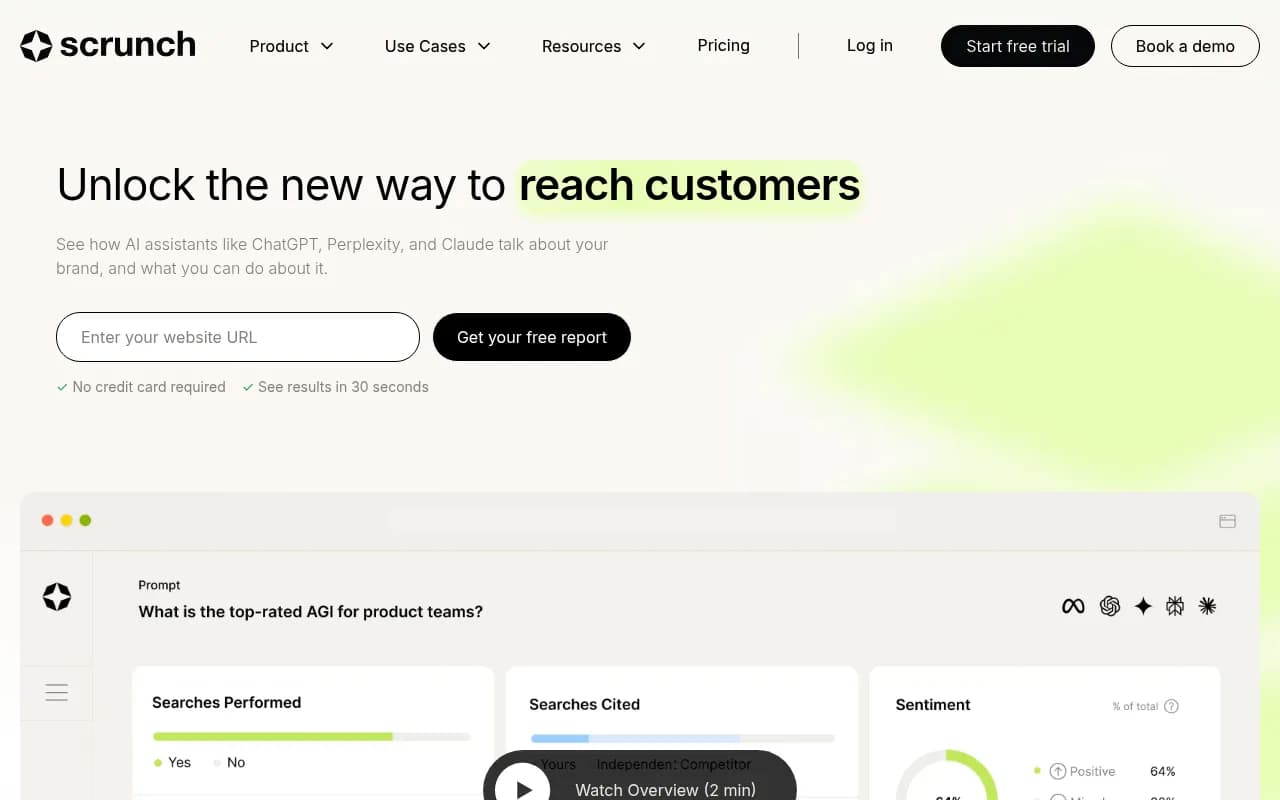
The content audit angle makes Scrunch AI more actionable than pure monitoring tools. It's particularly useful for teams with large content libraries who want to understand which pages are AI-ready and which need work.
Where it falls short compared to Promptwatch: the content generation capabilities are less developed, and the citation data underpinning its recommendations is smaller. It's a good tool for content audits, less strong as a full-cycle GEO platform.
Best for: Enterprise teams running content audits alongside their GEO strategy.
Search Party
Search Party takes a different approach -- it's more of an AI automation consultancy that builds custom GEO workflows than a self-serve platform. For agencies and enterprise teams that want bespoke solutions rather than off-the-shelf software, that can be appealing.
Search Party
The trade-off is that you're dependent on their team to build and maintain your workflows, which limits flexibility. Prompt metrics and content gap analysis are less developed than what you'd get from a dedicated platform.
Best for: Agencies that want custom workflow automation and are comfortable with a service-led model.
Feature comparison
Here's how the main Relixir alternatives stack up across the capabilities that matter most for enterprise GEO:
| Platform | AI models monitored | Content generation | Crawler logs | Traffic attribution | Reddit/YouTube tracking | ChatGPT Shopping | Starting price |
|---|---|---|---|---|---|---|---|
| Promptwatch | 10+ | Yes (AI writing agent) | Yes | Yes (GSC, snippet, logs) | Yes | Yes | $99/mo |
| Profound | 9+ | No | No | Limited | No | No | Enterprise |
| Evertune | Multiple | No | No | No | No | No | Enterprise |
| AthenaHQ | Multiple | No | No | No | No | No | Mid-market |
| Peec AI | 3 (ChatGPT, Perplexity, Claude) | No | No | No | No | No | Low |
| Otterly.AI | 3+ | No | No | No | No | No | Low-mid |
| Scrunch AI | Multiple | Limited | No | No | No | No | Enterprise |
| Search Party | Multiple | Custom | Custom | Custom | No | No | Custom |
How to choose
The right platform depends on what stage you're at and what you actually need to accomplish.
If you're an enterprise team that needs to move from monitoring to optimization -- finding gaps, creating content, tracking results -- Promptwatch is the most complete option. The combination of Answer Gap Analysis, the AI writing agent grounded in citation data, and traffic attribution is something no other platform in this list offers end-to-end.
If your primary need is brand perception tracking at Fortune 500 scale with security compliance, Profound or Evertune are worth evaluating. They're expensive, but they're built for that use case.
If you're a smaller team or just starting out, Peec AI or Otterly.AI give you a low-friction way to understand your current AI visibility. Just know that you'll likely outgrow them quickly.
If content audits are your immediate priority, Scrunch AI has more to offer than pure monitoring tools.
One thing worth noting: several tools in this space (including some that market themselves as "enterprise") are essentially monitoring dashboards with enterprise pricing. Before committing to any platform, ask specifically how it helps you improve your visibility -- not just measure it. The answer will tell you a lot.
A note on Relixir itself
Relixir has some genuinely interesting ideas, particularly around autonomous content publishing for GEO. But it's a newer platform with less proven track record, a smaller customer base, and less transparency around pricing and data methodology than the alternatives listed here.
For enterprise teams making a serious investment in GEO, the platforms above -- particularly Promptwatch, Profound, and Evertune -- offer more mature infrastructure, clearer ROI measurement, and better support.
If you're currently evaluating Relixir, it's worth running a parallel evaluation against Promptwatch specifically. The feature gap is significant, and the pricing is more accessible than most enterprise alternatives.