Key takeaways
- The cheapest verified AI visibility trackers in 2026 are Rankscale ($20/month) and Otterly.AI ($29/month), but both gate full engine coverage behind add-ons or higher tiers.
- LLMrefs charges a flat $79/month for all engines with no per-model add-on fees, which makes the real cost easier to predict than cheaper-looking competitors.
- Watch for "credits vs prompts" confusion: Rankscale and Peec AI's agency tiers bill in credits, not flat prompt counts, so a $20 headline price can mean fewer actual tracked queries than it looks.
- Peec AI repriced in August 2026, moving to euro-denominated annual billing, so older roundups quoting $95/month are stale.
- If your goal is fixing visibility gaps rather than just watching a number go up or down, tools like Promptwatch go beyond monitoring into content generation and crawler-level diagnostics, though that's a step up from the budget tier covered here.
Why price shopping for an AI visibility tracker is harder than it looks
I spent a while going through vendor pricing pages for this guide and the thing that struck me is how little the sticker price tells you. A tool advertised at $29 a month can quietly become $70 once you add the AI engine your buyers actually use. A tool that looks expensive at $99 can turn out to be the better deal because it includes everything in one number. This is not a knock on any single vendor, it's just how the category has evolved: engine coverage, prompt volume, and "credits" all get priced separately, and almost nobody puts a true all-in number on the homepage.
So before you pick a tool based on the lowest number you see, it helps to know what you're actually buying. An AI visibility tracker runs a set of prompts against engines like ChatGPT, Google AI Overviews, Perplexity, Gemini, and Copilot, then reports whether your brand showed up, what got cited instead of you, and how your share of voice compares to competitors. For a solo founder, the real question isn't "which tool has the most features", it's "which tool covers the engines my buyers are actually using, at a price I won't resent paying every month."
The 2026 pricing table
All prices below are monthly, USD unless noted, and reflect what each vendor's pricing page showed in the second half of 2026. I've flagged where the headline price excludes something important.
| Tool | Entry price | What you get | Add-ons / catches |
|---|---|---|---|
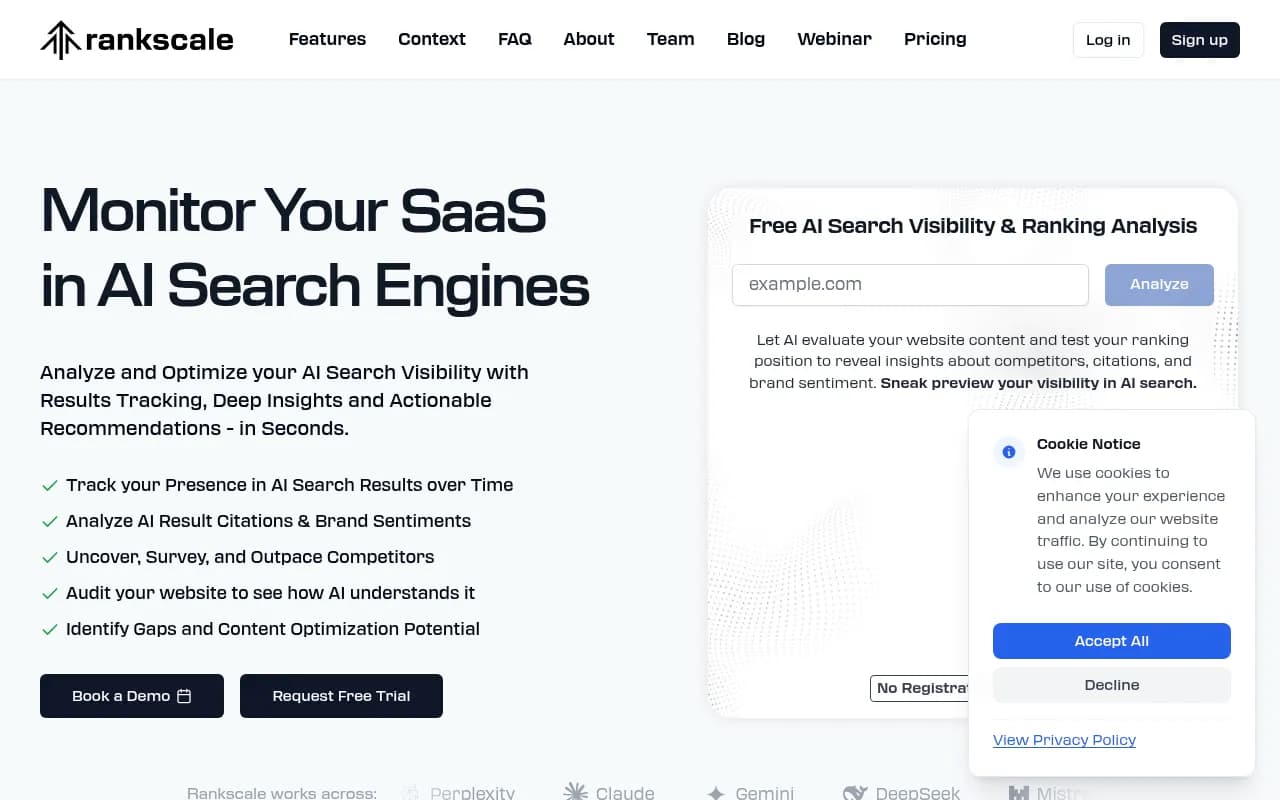
| Rankscale | $20/mo (Essentials) | Credit-based tracking; Pro at $99/mo gives 1,200 credits (up to 4,800 AI responses), unlimited search terms | Credits, not flat prompts; 0.25 credits per engine query |
| Otterly.AI | $29/mo (Lite, 15 prompts) | ChatGPT, Google AI Overviews, Perplexity, Copilot; unlimited team members; daily tracking | Claude, Gemini, Google AI Mode cost extra, $9 to $439/mo depending on plan |
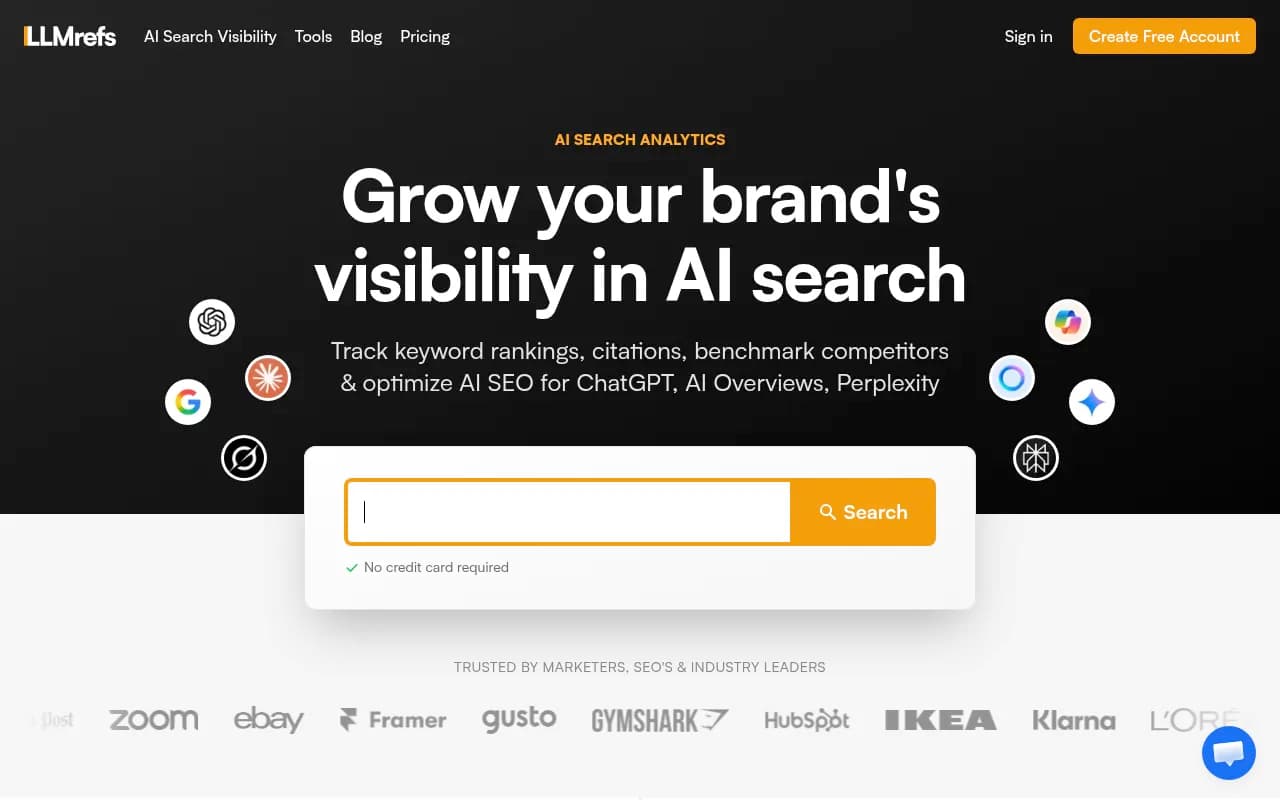
| LLMrefs | $79/mo (single plan) | 500 prompts, all supported engines included, no per-engine fees, unlimited seats and projects | Weekly refresh only, not daily |
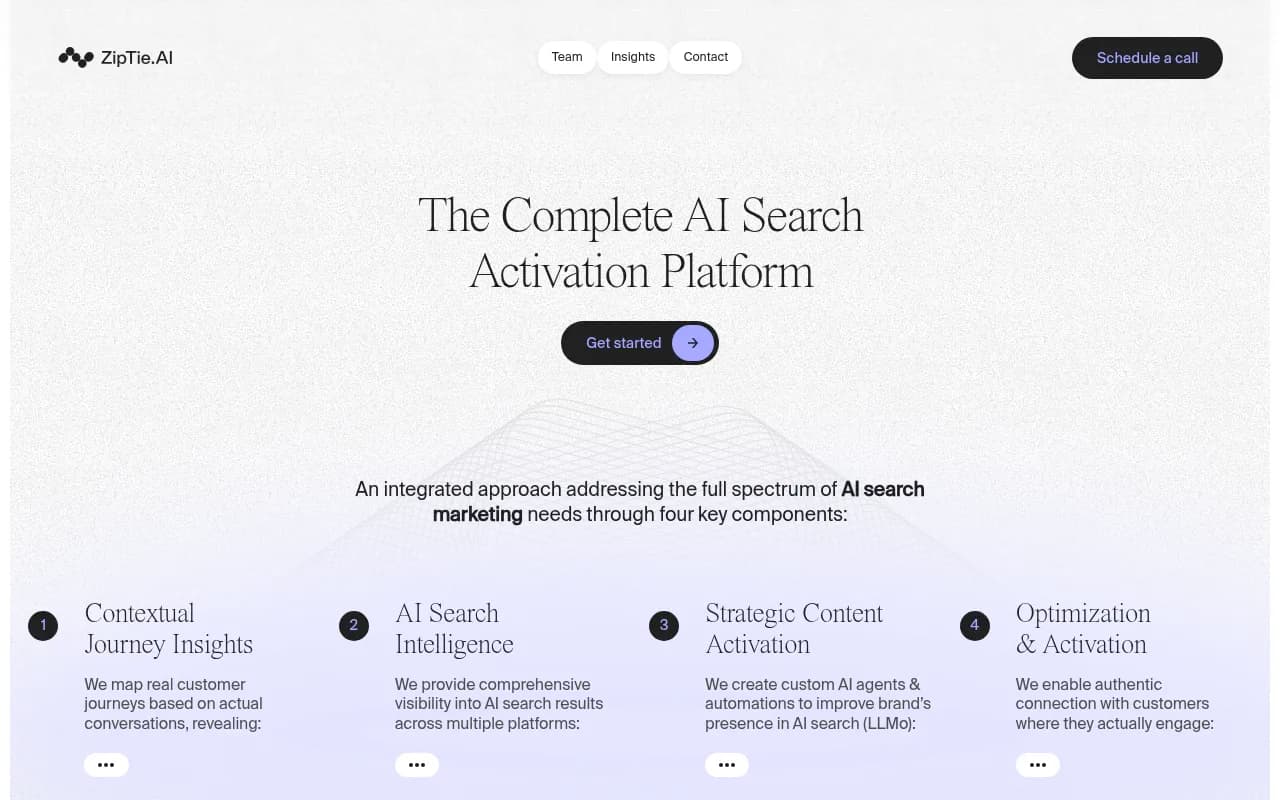
| ZipTie | from ~$43/mo (usage-based) | Calculator-based pricing by engine count and prompt cadence | No fixed plan; add-ons like UGC Impact Analysis add 80% to the bill |
| Peec AI | ~€70/mo billed annually (Starter) | 50 prompts, up to 3 models, 1 project | Repriced in Aug 2026 to EUR; monthly billing costs more; extra models $35 to $165/mo |
| Rank Prompt | $49/mo (Starter, 150 prompts) | All six engines plus API included | 20% off on annual billing |
| AthenaHQ | $295/mo (Starter) | Up to 8-11 engines, unlimited topics and seats | Not a budget option; included for contrast |
A quick gut check: if you're a true solo operator testing whether AI search is worth your time at all, Rankscale's $20 floor or Otterly.AI's $29 Lite plan are the lowest real entry points. If you want to avoid the add-on trap entirely, LLMrefs' flat $79 is probably the least annoying bill you'll get, because there's no second invoice line for "Claude tracking."
Otterly.AI

LLMrefs
The add-on trap, explained
This is the part that catches people off guard. Otterly.AI's $29 Lite plan tracks ChatGPT, Google AI Overviews, Perplexity, and Copilot, four engines, which sounds complete until you realize Claude, Gemini, and Google AI Mode are each billed separately as add-ons. If your buyers are asking Gemini for recommendations and you didn't budget for the add-on, you're flying blind on exactly the engine that matters to you.
Peec AI's agency tiers and Rankscale both bill in "credits" rather than a flat prompt count, which sounds like a minor technicality but actually matters: Rankscale burns roughly 0.25 credits per engine query, so a $20/month plan with a small credit allotment can get eaten up fast if you're tracking five engines instead of two. Do the math on what a "credit" actually buys before comparing it against a flat-prompt competitor.
ZipTie is the extreme case here. It doesn't really have a "starting price" in the normal sense, it has a pricing calculator where you pick engines, cadence, and add-ons, and the bill scales accordingly. The official minimum example lands around $43/month for a light 15-daily-prompts-on-3-engines config, but third-party roundups quote wildly different numbers ($35, $69, $179) because they're each describing a different configuration. If you see a flat ZipTie price in a comparison article, treat it as one example build, not a floor.

Do you even need broad engine coverage?
Here's something worth knowing before you pay for nine-engine coverage: not all engines give you the same number of chances to get cited. Promptwatch's data on citations per response shows ChatGPT typically cites around 5 sources per web-search answer, while Google AI Overviews and Perplexity cite closer to 10, and Perplexity is unusually consistent about it day to day. Microsoft Copilot, by contrast, swings wildly, sometimes under 2 sources, sometimes nearly 17 (Promptwatch's average sources per response data). If you're a solo founder picking which engines to prioritize, Perplexity and AI Overviews offer more consistent citation slots to compete for than ChatGPT or Copilot.
There's also a myth worth busting here: you don't need a massive domain to get cited. Promptwatch's citation-share-by-domain-rank data for August 2026 found that mid-authority domains (DR 46-75) captured nearly half of all ChatGPT citations, while the very biggest sites (DR 91-100) fell to around 3% by mid-August, down from 7% at the start of the month (Promptwatch's domain rank citation data). A small brand's content genuinely competes here, which is one more reason not to overspend on a tool before you've even tested whether the channel works for you.
Monitoring vs fixing: the real decision
Every tool in the pricing table above does one job, it tells you where you stand. None of them fix anything. That's fine if your plan is to read the dashboard and manually go publish better content. But if you're a solo founder without the bandwidth to turn a list of "missed prompts" into actual published pages, the monitoring-only tools become expensive homework assignments.
This is where the category splits. Budget trackers like Otterly.AI, Rankscale, and LLMrefs answer "was I mentioned?" Platforms like Promptwatch try to answer "how do I get mentioned more," with content gap analysis, automated content agents that draft and publish to your CMS, and crawler logs that show whether AI bots are even reading your pages correctly. It's a different price bracket (Promptwatch's Essential plan starts at $95/month), but for a solo founder who'd rather spend evenings writing than babysitting a dashboard, the gap between monitoring and action is worth the extra spend once you've validated the channel.

Which tool should you actually pick?
Here's the simplest way to think about it, based on what each tool is actually good at rather than what it claims to be good at:
- If you want to spend as little as possible and are comfortable doing credit math, start with Rankscale at $20/month.
- If you want a published, no-surprise price ladder and don't mind that Claude and Gemini cost extra, Otterly.AI's $29 Lite plan is the most-recommended budget option in the category for a reason.
- If you hate add-on fees and want one flat number that covers everything, LLMrefs at $79/month is the cleanest bill.
- If you've validated the channel and want a tool that also writes and publishes content to close the gaps it finds, that's where Promptwatch or a similar action-oriented platform earns its higher price.
- If you're a one-person shop who just wants a sanity check before spending anything, run a free checker like Ahrefs Brand Radar or Omnia's AI Visibility Checker first.
A word on testing before you commit
Most of these tools offer free trials, Otterly.AI (7-day), Rankscale (7-day on Pro), Rank Prompt (free first report, no card), LLMrefs (7-day, no card). Use them. Run the same 10 to 15 prompts through two or three tools during their trial windows and compare what each one actually surfaces. You'll often find the cheapest tool on paper isn't the cheapest tool for your actual prompt list once you account for engine coverage and refresh frequency.
If you want to browse a wider set of options beyond what's covered here, the GEO software directory at bestgeosoftware.com lists additional platforms across price points, and agenticseotools.com is worth a look once you're ready to move from monitoring into automated execution.
Bottom line
For a solo founder or a two-person team, start cheap, start narrow, and expand only when a specific prompt set or engine starts mattering to your pipeline. The $20 to $79 tier gives you enough signal to know whether AI search is sending you buyers at all. Once it is, the calculation changes, and spending more on a platform that actually helps you close the gaps it finds, rather than just reporting them, starts paying for itself.