Key takeaways
- Copy.ai is an AI copywriting tool built for generating marketing content fast -- it has no AI search visibility or GEO features.
- Promptwatch is a dedicated AI search optimization platform that tracks brand citations across 10+ LLMs, identifies content gaps, and generates content engineered to get cited.
- These tools don't really compete -- but many teams use both, and understanding what each does (and doesn't do) saves you from buying the wrong thing.
- If your goal is to appear in ChatGPT, Perplexity, or Google AI Overviews, Copy.ai won't help you get there. Promptwatch is built specifically for that.
- For pure content generation at scale, Copy.ai is fast and capable. For AI search visibility, Promptwatch is the more complete solution.
Why this comparison exists
Searching for "AI tools for content and search optimization" in 2026 returns a confusing mix of results. Copy.ai and Promptwatch both show up in various "best AI tools" lists, and on the surface they sound similar -- both use AI, both help with content, both are used by marketing teams.
But they're solving fundamentally different problems. Comparing them directly is a bit like comparing a word processor to an analytics platform. They can coexist in your stack, but they don't substitute for each other.
Still, if you're evaluating your marketing tech budget and trying to figure out which one to prioritize, this breakdown should give you a clear answer.
What Copy.ai actually does
Copy.ai is an AI writing platform. Its core job is generating marketing copy quickly -- product descriptions, email sequences, social posts, ad headlines, blog outlines, sales scripts. It's fast, it covers a lot of content formats, and it's designed for teams that need to produce a high volume of written assets without hiring more writers.

The platform has evolved since its early days as a simple text generator. By 2026, it includes workflow automation features, GTM (go-to-market) templates, and integrations that let teams build repeatable content pipelines. It's genuinely useful for marketing teams that need to move fast.
What it doesn't do: track where your brand appears in AI-generated answers, identify which prompts your competitors are winning, analyze citations from ChatGPT or Perplexity, or tell you why an AI model isn't recommending your product. None of that is in Copy.ai's scope, and it's not trying to be.
What Promptwatch actually does
Promptwatch is an AI search visibility platform. Its job is to help brands understand and improve how they appear in AI-generated search results -- across ChatGPT, Claude, Perplexity, Gemini, Google AI Overviews, Grok, DeepSeek, Copilot, Meta AI, and Mistral.

The core loop works like this: you track a set of prompts relevant to your category, see where your brand appears (and where it doesn't), identify the specific content gaps that are causing you to lose visibility, generate content designed to close those gaps, and then watch your citation rates improve over time.
That's a meaningfully different workflow from "generate marketing copy." Promptwatch is used by 6,700+ brands and agencies -- including Booking.com and Center Parcs -- and has processed over 1.1 billion citations, clicks, and prompts. The data depth matters because it's what makes the content recommendations actually grounded in what AI models want to cite, rather than generic SEO advice.
Feature-by-feature comparison
| Feature | Copy.ai | Promptwatch |
|---|---|---|
| AI content generation | Yes (marketing copy, workflows) | Yes (engineered for AI citations) |
| AI search visibility tracking | No | Yes (10+ LLMs) |
| Brand citation monitoring | No | Yes |
| Competitor visibility analysis | No | Yes (heatmaps) |
| Content gap / answer gap analysis | No | Yes |
| Prompt volume & difficulty scoring | No | Yes |
| AI crawler logs | No | Yes |
| Reddit & YouTube citation tracking | No | Yes |
| ChatGPT Shopping tracking | No | Yes |
| Traffic attribution from AI search | No | Yes (GSC, snippet, server logs) |
| Multi-language / multi-region | Limited | Yes |
| Google AI Overviews tracking | No | Yes |
| Pricing (entry level) | ~$49/mo | $99/mo |
| Best for | Marketing copy at scale | AI search visibility & optimization |
The core difference: monitoring vs. optimization vs. writing
Most tools in the AI visibility space fall into one of two camps: monitoring dashboards that show you data, or writing tools that generate content. Promptwatch is one of the few that connects both -- it shows you what's missing and then helps you fix it.
Copy.ai sits firmly in the writing camp. It's good at what it does. But it has no awareness of how AI search engines discover or cite content. A blog post written in Copy.ai might get cited by Perplexity -- or it might not. Copy.ai has no mechanism to tell you which, or why.
Promptwatch's Answer Gap Analysis does something specific: it shows you the exact prompts where competitors are getting cited but you're not. Then its built-in writing agent generates content grounded in 880M+ citation data points -- articles and comparisons designed around what AI models actually want to reference. That's a different kind of content generation than Copy.ai offers.
When to use Copy.ai
Copy.ai makes sense when:
- You need to produce a high volume of marketing assets quickly (emails, ads, social posts, product descriptions)
- You're running GTM campaigns and need templated content at scale
- Your team doesn't have dedicated writers and needs to move fast
- AI search visibility isn't a current priority
It's a solid tool for content production. It's not a GEO or AEO tool.
When to use Promptwatch
Promptwatch makes sense when:
- You want to appear in ChatGPT, Perplexity, or Google AI Overviews when people search for your category
- You need to understand why competitors are getting cited and you're not
- You want to track which of your pages AI models are reading and citing
- You need to connect AI search visibility to actual traffic and revenue
- You're an agency managing AI search performance for multiple clients
The platform's pricing reflects its depth: Essential at $99/mo covers one site with 50 prompts and 5 articles per month. Professional at $249/mo adds crawler logs, state/city tracking, and 15 articles. Business at $579/mo scales to 5 sites and 350 prompts. A free trial is available.
Can you use both?
Yes, and some teams do. The workflow looks like this: Promptwatch identifies a content gap (say, your brand isn't appearing when people ask "best [your category] for enterprise teams"), and you use Copy.ai to draft a first version of that content quickly. Then you refine it using Promptwatch's citation data to make sure it's actually structured to get picked up by AI models.
That said, Promptwatch has its own AI writing agent built in, specifically designed to produce content that gets cited. For teams whose primary goal is AI visibility, that's often enough -- and it means one fewer tool to manage.
How they compare to the broader market
The AI search optimization space has gotten crowded fast. Tools like Otterly.AI, Peec AI, and AthenaHQ offer monitoring features, but most stop at showing you data. Promptwatch goes further by closing the loop between insight and action.
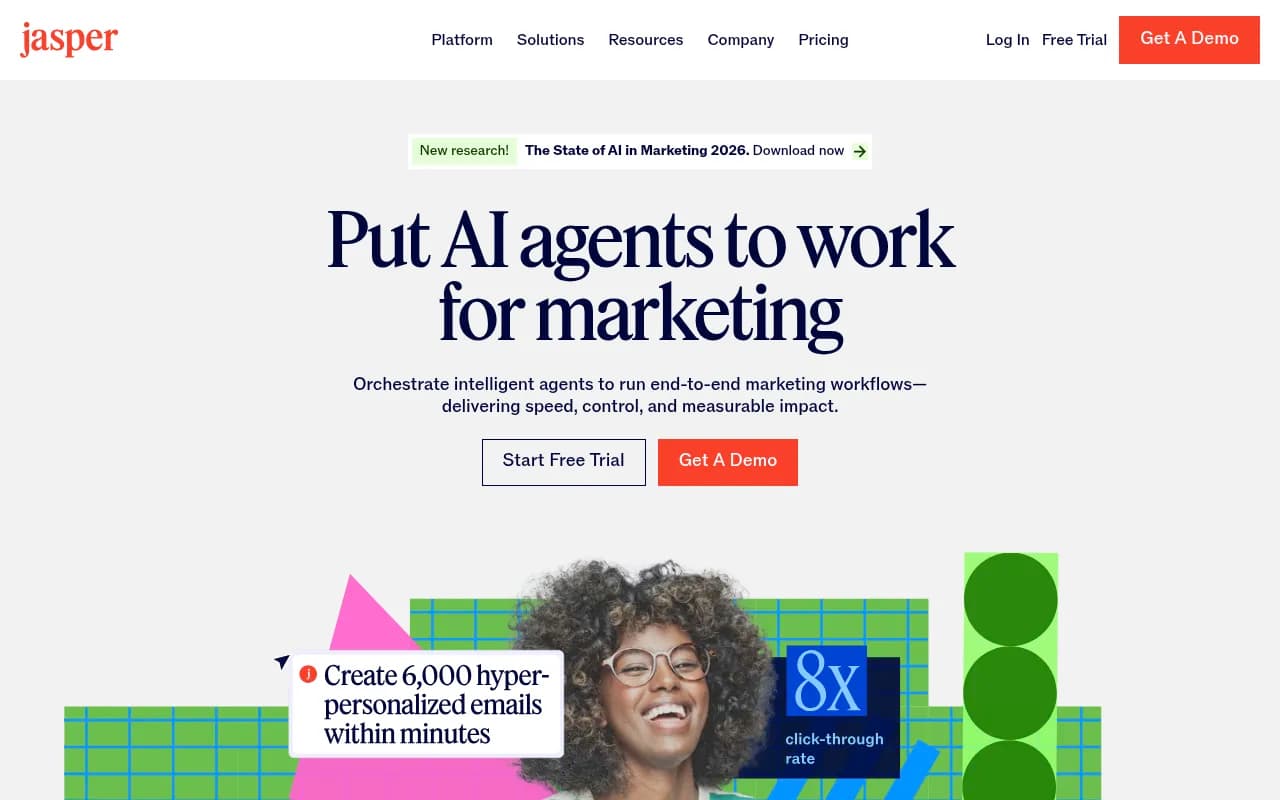
Copy.ai competes more directly with tools like Jasper, Writesonic, and Rytr -- AI writing platforms focused on content volume and speed.

These are genuinely different categories, and the confusion mostly comes from both being marketed as "AI tools for marketing teams."
A note on AI SEO agents
One framing that's become common in 2026 is the "AI SEO agent" -- tools that automate multiple stages of the content pipeline, from research to writing to monitoring. Frase, for example, positions itself this way and covers several pipeline stages.
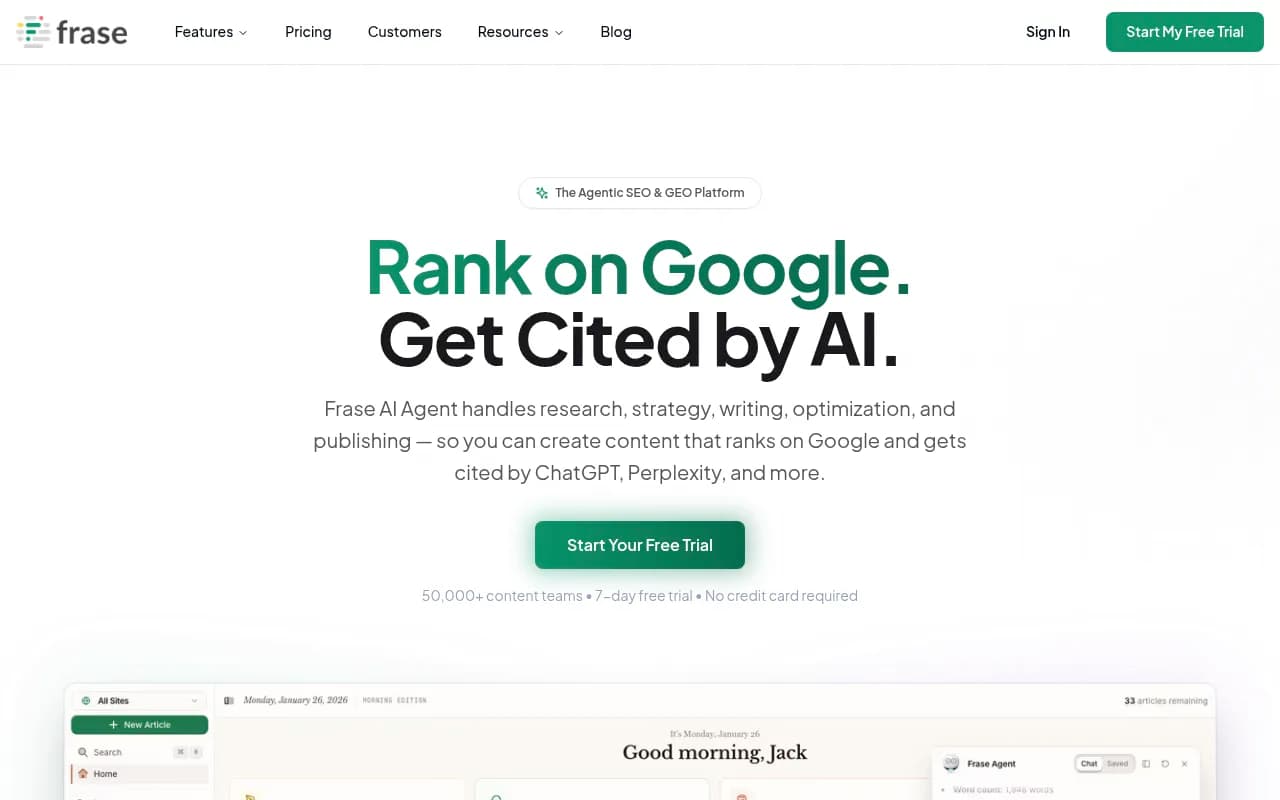
Copy.ai has moved in this direction with its workflow features, but it still doesn't touch AI search visibility. Promptwatch, meanwhile, covers the full GEO cycle: find gaps, create content, track results. Whether you call that an "agent" or not, the outcome is the same -- you're not just generating content, you're generating content that's engineered to improve your position in AI-generated answers.
Bottom line
If you're trying to decide between Copy.ai and Promptwatch, the decision is actually straightforward once you know what each tool does.
Copy.ai is for writing marketing content faster. Promptwatch is for getting your brand cited by AI search engines. They're not substitutes.
If AI search visibility is on your radar -- and in 2026, it should be -- Promptwatch gives you the monitoring, the gap analysis, the content generation, and the traffic attribution to actually move the needle. Copy.ai, for all its strengths as a writing tool, doesn't touch any of that.
The smarter question isn't "which one?" It's "do I need one, or both?"