Key takeaways
- ChatGPT uses two separate location layers: an always-on IP-based estimate and an opt-in, device-level precise location you have to grant permission for.
- Saved memories can localize answers even without web search or device location turned on. If you once told ChatGPT you live in Denver, it may still be using that months later.
- IP geolocation is wrong at the city level roughly a third of the time in the US, and worse elsewhere, so "near me" answers are a probabilistic guess, not a tracking certainty.
- Precise GPS data gets discarded after each prompt, but the conversation content built from it (restaurant names, neighborhoods, addresses you discussed) sticks around in chat history until you delete it.
- For anyone doing AI search optimization, location context matters a lot: ChatGPT cites a directory or review site in 84% of localized answers, and competition for its roughly five citation slots per response is intense.
Why this question keeps coming up
Go searching Reddit or the OpenAI developer community and you'll find a steady stream of people genuinely unsettled by the same experience: they ask ChatGPT something innocuous, and it responds with a restaurant, product, or service that happens to be five miles from their actual front door. They never typed their city. They never told it in a prior chat, at least as far as they remember. So how did it know?
One OpenAI community thread from February 2025 captures this almost perfectly. A user named CupCake pushed ChatGPT to explain itself after it suggested a product near their actual location, and the model's answers kept contradicting each other, first claiming it inferred location from "previous searches and chat contexts," then admitting it retains no such information and has no access to private data unless explicitly shared.
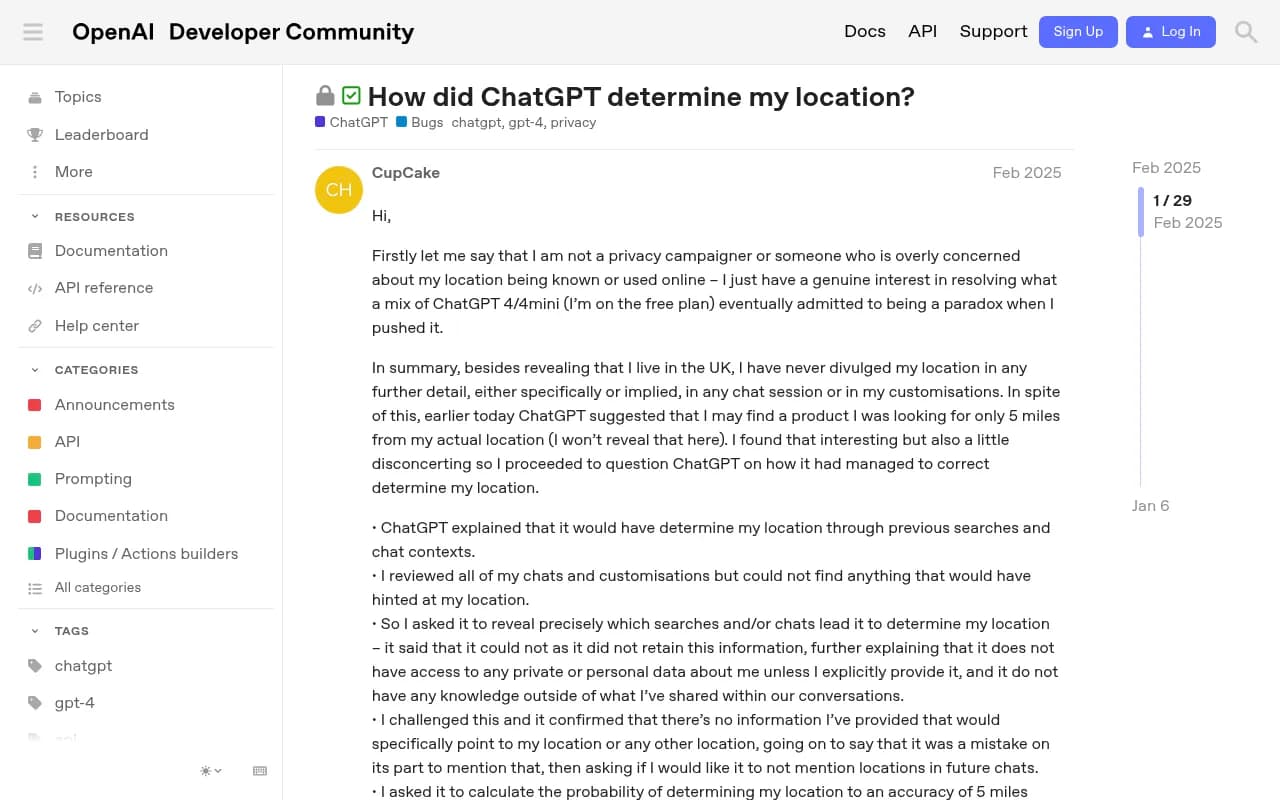
That back-and-forth is a good illustration of the actual problem: ChatGPT itself is a pretty unreliable narrator of its own mechanics. It will confidently explain a process that isn't quite what's happening under the hood, because the model is generating a plausible-sounding answer, not querying its own system logs. The real explanation sits in OpenAI's documentation, not in anything the chatbot tells you in the moment.
The two location layers, according to OpenAI
OpenAI's help center article on "Searching the web with ChatGPT" lays out two distinct mechanisms, and they work very differently.
IP-based approximate location
This one is always on and requires no permission. ChatGPT estimates your country, state, and city from your IP address, then uses that to rewrite vague queries into specific ones. OpenAI's own example: "good restaurants near me" becomes "top restaurants San Francisco" behind the scenes. Critically, OpenAI says ChatGPT doesn't hand your raw IP address to the search providers it works with (Bing and others); it passes along a generalized, rewritten location string instead.
Device precise location
This is opt-in and off by default. When you grant it, ChatGPT can use GPS-level accuracy for things like nearby business recommendations, local weather, or local news, and on iOS and Android the answer can come with an inline map. You manage this in Settings > Data Controls > Location, and on mobile the permission options mirror what you'd see for any app: Allow Once, Allow While Using App, Don't Allow.
There's a nuance worth sitting with here: OpenAI says the precise GPS ping itself gets discarded right after it answers your prompt. But the conversation content generated from that location, the ice cream shop on the corner, the pharmacy two blocks over, sticks around in your chat history indefinitely, because that's just... the chat. Turning off location doesn't retroactively scrub what the model already said about where you were. If that bothers you, you need to delete the specific chat, not just the location permission.
Memory, the quieter third layer
Here's the piece that explains a lot of the "how did it know" forum posts. If you've ever told ChatGPT, even in passing, that you live somewhere, and it decided that was worth remembering, it saves that as a memory. Memories persist across sessions until you go delete them in Settings > Personalization > Manage memories. OpenAI's documented example: a user in San Francisco who mentioned being vegan gets a search rewritten to "good vegan restaurants San Francisco" automatically, even on a chat where they never typed a location that day.
This matters because memory and location settings are independent systems. You can have precise location fully disabled and still get hyper-local answers, because the model is pulling from something you said three weeks ago and forgot about.
Why ChatGPT sometimes gets your city completely wrong
IP geolocation is a database lookup, not a GPS signal, and the databases are wrong more often than people assume. According to analysis from WhatIsMyLocation, MaxMind's city-level accuracy within a 50km radius sits around 66% in the US, and drops to anywhere from 20% to 75% elsewhere depending on the country and network type. That means roughly one in three IP-based location guesses names the wrong city, even in a country with relatively good data coverage.
A few concrete reasons this happens:
- ISPs route traffic through a regional hub rather than anything close to your literal street address.
- Mobile carriers using Carrier-Grade NAT can place your phone's public IP at a gateway hundreds of kilometers away, so switching from WiFi to LTE mid-session can shift your detected city by 200km.
- A VPN or proxy, including an invisible background corporate VPN, will make ChatGPT's IP guess match the VPN server's location, not where you actually are.
- Geolocation databases go stale between updates, and different providers source different databases, so two sites can disagree about your city on the same day.
If you've ever run a VPN and had ChatGPT confidently localize an answer to a country you've never set foot in, this is why, and honestly it's a useful trick if you want to see how an answer changes for a different market.
How location actually reshapes the answer
Location context doesn't just swap in a city name. It changes which sources get pulled into the response in the first place. Research from Sanbi.ai, running identical prompts across ChatGPT, Gemini, Perplexity, and Claude from different geographic contexts, found that the top-recommended product for an identical query changed in 41% of major US metros. For categories like home services, fitness, and food delivery the variance was even higher.
That's not a minor styling difference. It means "best running shoes under $150" can point to a genuinely different product depending on whether the model thinks you're in Austin or Boston, because the retrieval layer is pulling in regionally different inventory, pricing, and review data before the model ever starts writing.
Engines don't localize the same way
There's also a real structural gap between how ChatGPT and Google's AI surfaces handle local answers. For home-services queries, ChatGPT cited a directory, review platform, or "best of" list in 84.2% of answers with citations, versus just 38.3% for Google AI Mode, according to data compiled by Cheers' GEO Academy. Google leans harder on its own Maps and Local Pack data; ChatGPT leans on third-party directories like Expertise.com and Angi, which showed up in 32.1% and 29.4% of 9,434 sampled home-services answers respectively. Google reviews barely register in ChatGPT citations (0.1% in that dataset) despite ChatGPT's map cards still pulling business listings from somewhere OpenAI doesn't name publicly.
| Dimension | ChatGPT | Google AI Mode / AI Overviews |
|---|---|---|
| Location fallback | IP-based estimate, always on | Tied to real-time device proximity |
| Precise location | Opt-in, GPS-level, off by default | Built into Google account/device permissions |
| Directory citation rate (local queries) | 84.2% | 38.3% |
| Average citations per web-search response | ~5 | AI Overviews ~10 |
| Primary local data source | Third-party directories (Expertise.com, Angi, Yelp maps) | Google Maps / Local Pack layer |
The average-citations figure comes from Promptwatch's data on how many sources different AI engines cite per response, which found Copilot swings wildly (under 2 to around 17) while ChatGPT and Perplexity stay fairly stable around 5 and 10 respectively. With only about five citation slots on a typical ChatGPT answer, a local business or publisher competing for a location-based query has very little room for error.
What this means if you're trying to show up in local AI answers
If you run a business, publish local content, or manage visibility for a brand with multiple locations, location context is not a background detail, it's the whole game. A few things worth internalizing:
- You don't need top-tier domain authority to get cited for local intent. Promptwatch's domain-rank breakdown for August 2026 found mid-authority domains (DR 46-75) earned 46% of all ChatGPT citations that month, while the very biggest sites (DR 91-100) fell to just 3-4%. Even a single local dealer group site made it into the top cited domains in an automotive-vertical sample at 0.28% share, sitting alongside national brands.
- Marketplaces and listing sites dominate commercial local queries. In that same automotive data, marketplace/listing sites took 14.65% of citations combined and review/research sites took 12.62%, well ahead of manufacturer sites at 7.92%.
- Reddit is a smaller factor for local/commercial queries than people assume, ranking ninth at 1.34% share in the automotive sample, and Reddit's overall share of ChatGPT citations has collapsed broadly: Promptwatch's tracking shows reddit.com's share of ChatGPT Search citations dropping from roughly 4% to about 0.5% on a single day in August 2026.
- The practical move for local visibility is less about chasing a generic "best X" listicle and more about making sure your actual location pages (not just your homepage) are structured so a directory or review platform can cite specifics about your address, service area, and offerings.
If you want to track how your brand actually appears across ChatGPT, Perplexity, Gemini, and Google's AI surfaces, including by location, that's the kind of thing a platform like Promptwatch is built for. It goes beyond just flagging mentions, it shows crawler logs of when AI bots actually hit your pages, tracks citations down to the prompt level with country and city granularity, and can generate and publish location-targeted content through Content Agents rather than just telling you there's a gap.

Managing your own location settings in ChatGPT
If you're on the user side and just want more control, there's a sensible workflow here, drawn from OpenAI's documentation and corroborated by independent testing from PCWorld.
- Go to Settings > Data Controls > Location to see and manage both IP-based and precise location.
- For one-off local queries (finding a restaurant while traveling, say), tap "Use precise location" at the bottom of an answer rather than granting blanket "Allow While Using App" access. That one-time grant resets after use, so the next query falls back to the less accurate IP estimate unless you tap it again.
- Check Settings > Personalization > Manage memories periodically. This is where the quieter, longer-lived location data lives, and it's the layer most people forget to clean out.
- If you want to see how ChatGPT localizes an answer for a market you're not in, a VPN set to that region's server will shift the IP-based guess accordingly. Just know this only affects the fallback layer; it won't override a saved memory that says you live somewhere else.
- Remember that disabling location doesn't erase past conversations where location-specific details were discussed. If discretion matters to you, delete the specific chat.
A quick gut check
None of this is secret tracking in the sense people fear when they post "ChatGPT knows where I live and won't admit it" threads. It's a documented, layered system: an always-on IP fallback that's wrong about a third of the time, an opt-in GPS layer you control explicitly, and a memory system that quietly persists anything you've mentioned before. The "mystery" cases in forums are almost always one of those three things working exactly as designed, just not explained well by the chatbot itself in the moment you ask it.
What's genuinely interesting, and a little underappreciated, is how much this location machinery reshapes the actual substance of answers, not just the phrasing. A "best running shoes" query pulling a different top pick in 41% of US metros means location isn't a footnote on AI search, it's one of the main levers determining what gets surfaced at all. For anyone building visibility strategy around AI search, that's worth taking seriously, and it's worth checking how your own content performs across different simulated locations rather than assuming a single national answer covers everyone.
For broader tracking across AI search platforms, the directory at bestgeosoftware.com is a decent starting point if you want to compare GEO tools beyond just Promptwatch.