Key takeaways
- AI Overviews appear automatically inside standard Google search results for qualifying queries; AI Mode is a separate, opt-in conversational interface powered by Gemini 2.5.
- AI Mode has reached roughly 75 million daily active users and shows a 93% zero-click rate — even higher than the 83% seen with AI Overviews.
- The citation logic differs between the two surfaces: AI Overviews tend to pull from pages already ranking well organically, while AI Mode uses a broader, more conversational retrieval process.
- Optimizing for both requires the same foundation (authoritative, well-structured content) but different tactical emphasis.
- Tracking which surface is citing you — and which isn't — is now a core part of SEO measurement.
Google quietly changed the rules of search again. For most of 2023 and 2024, SEOs were focused on one question: "Is my site appearing in AI Overviews?" That was already a meaningful shift. But in 2025 and into 2026, a second surface arrived and started pulling serious traffic: Google AI Mode.
The two features have similar names and both involve AI-generated answers. But they work differently, they serve different user intents, and they have different implications for how you get cited. Treating them as the same thing is one of the more common mistakes I see SEO teams making right now.
This guide breaks down exactly what each surface is, how they differ, and what you should actually do about it.
What Google AI Overviews actually are
AI Overviews (formerly Search Generative Experience, or SGE) are the AI-generated summaries that appear at the top of standard Google search results pages. You don't opt into them — they just show up when Google decides a query warrants a synthesized answer.
The key word there is "automatic." Google decides when to trigger an AI Overview based on query type, topic, and a range of signals it hasn't fully disclosed. Early 2025 data from Semrush put AI Overview prevalence at around 13% of queries. By Q1 2026, Conductor's analysis of 21.9 million searches showed 25.11% triggering one. For specific categories like health, finance, and how-to queries, that number climbs higher — some studies report up to 48%.
When an AI Overview appears, it sits above the organic results. It cites sources, usually 3–8 of them, displayed as small cards. Users can expand the overview or click through to the cited pages. The catch: most don't. Zero-click rates for queries with AI Overviews sit around 83%, compared to roughly 60% for standard queries without them.
From an SEO perspective, AI Overviews pull heavily from pages that already rank well organically. If you're in the top 5 for a query, your chances of being cited in the AI Overview for that query are meaningfully higher. It's not a perfect correlation, but the overlap is strong enough that traditional SEO still matters here.
What Google AI Mode actually is
AI Mode is a different beast. It's a standalone, opt-in conversational search experience — you access it via a dedicated tab in Google Search. Instead of a results page with blue links, you get a chat interface powered by Gemini 2.5 that handles multi-turn conversations, follow-up questions, and complex research tasks.
Think of it as Google's answer to ChatGPT Search or Perplexity. You're not just running a query; you're having a conversation with a research assistant that happens to have access to the web.
The numbers are striking. AI Mode reached 75 million daily active users by early 2026 — a 4x increase since its May 2025 launch — and has expanded to 53 languages and 40+ markets. That's not an experiment anymore. That's a primary search channel.
The zero-click rate for AI Mode queries is even higher than for AI Overviews: around 93%. Users are getting what they need from the conversation itself, without clicking through to sources. Citations still appear, but they're less prominent and the bar for getting cited is different.

Side-by-side comparison
| Feature | AI Overviews | AI Mode |
|---|---|---|
| Where it appears | Inside standard Google SERP | Separate tab / dedicated interface |
| User opt-in required | No — automatic | Yes — user must navigate to AI Mode |
| Underlying model | Gemini | Gemini 2.5 |
| Query style | Single queries, informational | Multi-turn conversations, complex research |
| Zero-click rate | ~83% | ~93% |
| Citation style | Source cards alongside summary | Inline citations in conversational response |
| Organic rank correlation | High — top-ranking pages cited more | Lower — broader retrieval logic |
| Ad presence | Yes — 25.5% of AI Overviews include ads | Limited / evolving |
| User intent | Quick answers, research starting points | Deep research, comparison, decision-making |
| Availability | Broadly rolled out | Rolled out to 40+ markets, expanding |
How citation logic differs between the two
This is where it gets practically important for SEOs.
For AI Overviews, Google's citation behavior correlates closely with organic rankings. A study by seo.com found that pages either get cited or don't appear at all — there's no middle ground equivalent to ranking on page 2. But the pages that do get cited are predominantly those already performing well in traditional search. This means your existing SEO work carries over, at least partially.
AI Mode is different. Because it handles longer, more conversational queries — the kind that don't map neatly to a single keyword — it retrieves from a broader pool of sources. A page that ranks for "best CRM software" might not be what AI Mode surfaces when someone asks "I run a 10-person SaaS company, we've outgrown spreadsheets, what should I look at and why?" Those are technically related but the retrieval logic treats them differently.
AI Mode also appears to weight brand authority, third-party mentions, and topical depth more heavily than AI Overviews does. This is consistent with what we know about how large language models build their understanding of a topic — they're synthesizing from many sources, not just ranking a list. Distributed brand mentions across Reddit, YouTube, industry publications, and review sites matter more here than they do for a standard SERP.
What this means for your SEO strategy
For AI Overviews: double down on what already works
The good news is that AI Overviews reward the same things traditional SEO rewards: clear, authoritative, well-structured content that directly answers the query. A few things to focus on specifically:
- Answer the question early. AI Overviews pull concise, direct answers. If your page buries the answer in paragraph four, you're less likely to be cited.
- Use structured data where relevant. FAQ schema, HowTo schema, and clear heading hierarchies help Google understand what your page answers.
- Monitor which queries are triggering AI Overviews for your target keywords. Not every query gets one, and the ones that do tend to be informational. Transactional queries are less likely to trigger an Overview.
- Watch your click-through rates. If you're being cited in AI Overviews but your organic CTR is dropping, that's expected — it doesn't mean your SEO is failing. It means the surface is changing how users interact with results.
For AI Mode: think topical authority and brand presence
AI Mode requires a different mindset. You're not optimizing a page for a keyword; you're building the kind of brand and content presence that a conversational AI would naturally draw from when answering complex questions in your space.
Practically, that means:
- Create content that covers topics in depth, not just individual keywords. AI Mode handles multi-turn queries, so it needs sources that can speak to a topic from multiple angles.
- Build presence beyond your own website. Reddit discussions, YouTube videos, third-party reviews, and industry mentions all feed into how AI Mode perceives your brand's authority. A strong on-site SEO presence with zero off-site footprint is a gap.
- Target the kinds of questions your customers actually ask, not just the keywords they search. AI Mode users are having conversations, not typing queries. Content that mirrors natural language and addresses real decision-making scenarios performs better here.
- Don't ignore entity optimization. AI Mode's retrieval is more entity-aware than traditional search. Making sure your brand, products, and key people are clearly defined and consistently described across your web presence matters.
The tracking problem
Here's a challenge that doesn't get talked about enough: most standard SEO tools weren't built to track either of these surfaces well, let alone both.
Google Search Console doesn't distinguish between clicks from AI Overviews, AI Mode, and organic results. Rank trackers show you where you rank, but not whether you're being cited in AI-generated answers. You can be ranking #3 organically and completely absent from AI Overviews for the same query — or vice versa.
This is a real blind spot. If you're making decisions based on traditional rank tracking alone, you're missing a significant portion of what's actually happening in Google search right now.
Tools built specifically for AI search visibility help close this gap. Promptwatch tracks citations across AI Overviews, AI Mode, and other AI search engines, and shows you which pages are being cited, how often, and what content gaps are preventing you from appearing where competitors do.

For traditional SEO tracking alongside emerging AI surfaces, Semrush has also added AI visibility features to its platform.
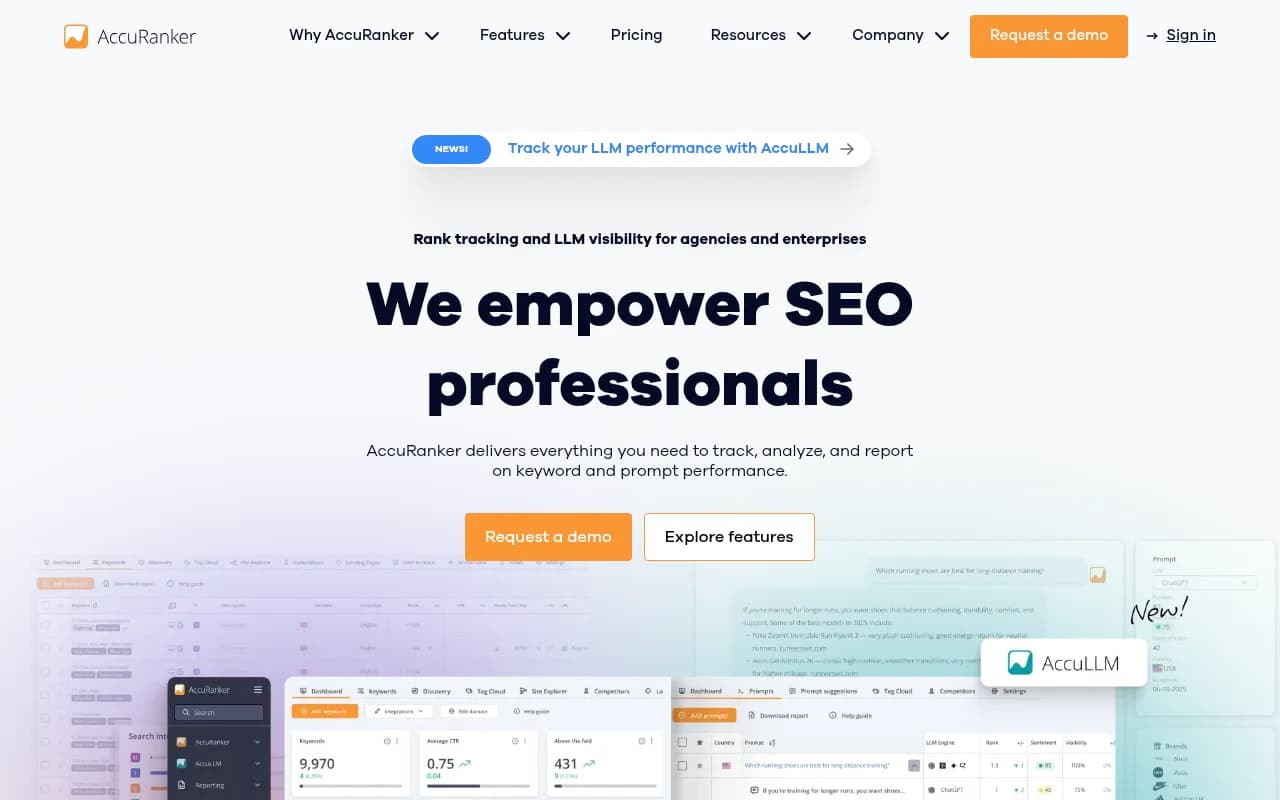
And if you want a dedicated rank tracker that's starting to incorporate AI search signals, AccuRanker is worth a look.
The zero-click reality and what to do about it
Let's be honest about something: both AI Overviews and AI Mode are reducing click-through rates. The data is clear on this. A 93% zero-click rate for AI Mode queries means that for most searches handled by that surface, your content is being consumed without a visit to your site.
This doesn't mean SEO is dead — a phrase that gets recycled every two years regardless of what's actually happening. It means the value of being cited has shifted. Being cited in an AI response builds brand awareness and trust even when users don't click. It influences purchasing decisions. It shapes how people perceive your brand's authority in a space.
The SEOs who are adapting well are thinking about AI citations the way PR teams think about media mentions: not every mention drives direct traffic, but the cumulative effect on brand perception and downstream conversions is real.
That said, there are still clicks to be had. Sidebar citations in AI Mode achieve 6–10% CTR according to Digital Applied's 2026 data — comparable to organic positions 4 through 10 in traditional search. Being cited well, in the right position, still drives traffic. It's just a different game than ranking #1 for a keyword.
A note on Google's three-surface reality
It's worth stepping back to name what's actually happening here. Google now effectively runs three parallel search surfaces for the same query:
- Classic organic search (10 blue links, still exists)
- AI Overviews (automatic summaries on the SERP)
- AI Mode (separate conversational interface)
Each surface has different citation logic, different user intent, and different traffic implications. A comprehensive SEO strategy in 2026 needs to account for all three — and measure performance across all three separately.
That's a meaningful increase in complexity. But it's also an opportunity. Most brands are still optimizing for classic search and treating AI surfaces as an afterthought. The gap between brands that understand how to appear in AI-generated answers and those that don't is growing.
Practical next steps
If you're trying to figure out where to focus, here's a reasonable starting point:
- Audit which of your target queries are triggering AI Overviews. Tools like Semrush's AI Overview tracker or a dedicated GEO platform can help with this.
- Check whether your pages are being cited in those Overviews. If you're ranking but not being cited, look at how directly your content answers the query.
- Identify your highest-value informational topics and make sure you have deep, authoritative content covering them. These are your best candidates for AI Mode citations.
- Map your off-site presence. Are you mentioned in relevant Reddit threads, YouTube videos, industry roundups? If not, that's a gap that matters more for AI Mode than it ever did for traditional SEO.
- Set up tracking that separates AI citation performance from traditional rank tracking. You need to know what's happening in each surface independently.
The fundamentals of good SEO haven't changed: create content that genuinely helps people, build real authority in your space, and make your site easy for crawlers to understand. What's changed is that "crawlers" now includes AI systems that synthesize answers rather than just index pages — and those systems have different preferences than the traditional Google bot.
Understanding those preferences, for both AI Overviews and AI Mode, is the job now.