Key takeaways
- Peec AI is a clean, capable monitoring tool, but its Pro plan caps you at 4 AI engines and 100 prompts per month, with no content creation, no site audits, and no crawler data
- Most alternatives fall into two camps: monitoring-only tools (which have the same ceiling) and action-oriented platforms that help you close the gaps they find
- If you need to actually improve AI visibility -- not just measure it -- look for tools with content gap analysis, AI content generation, and crawler log access
- For teams that want to go beyond dashboards, Promptwatch is the most complete option in 2026, covering all three phases: find gaps, create content, track results
- Budget-conscious teams can get solid monitoring from Otterly.AI or LLM Pulse; enterprise teams should evaluate Profound or Scrunch AI
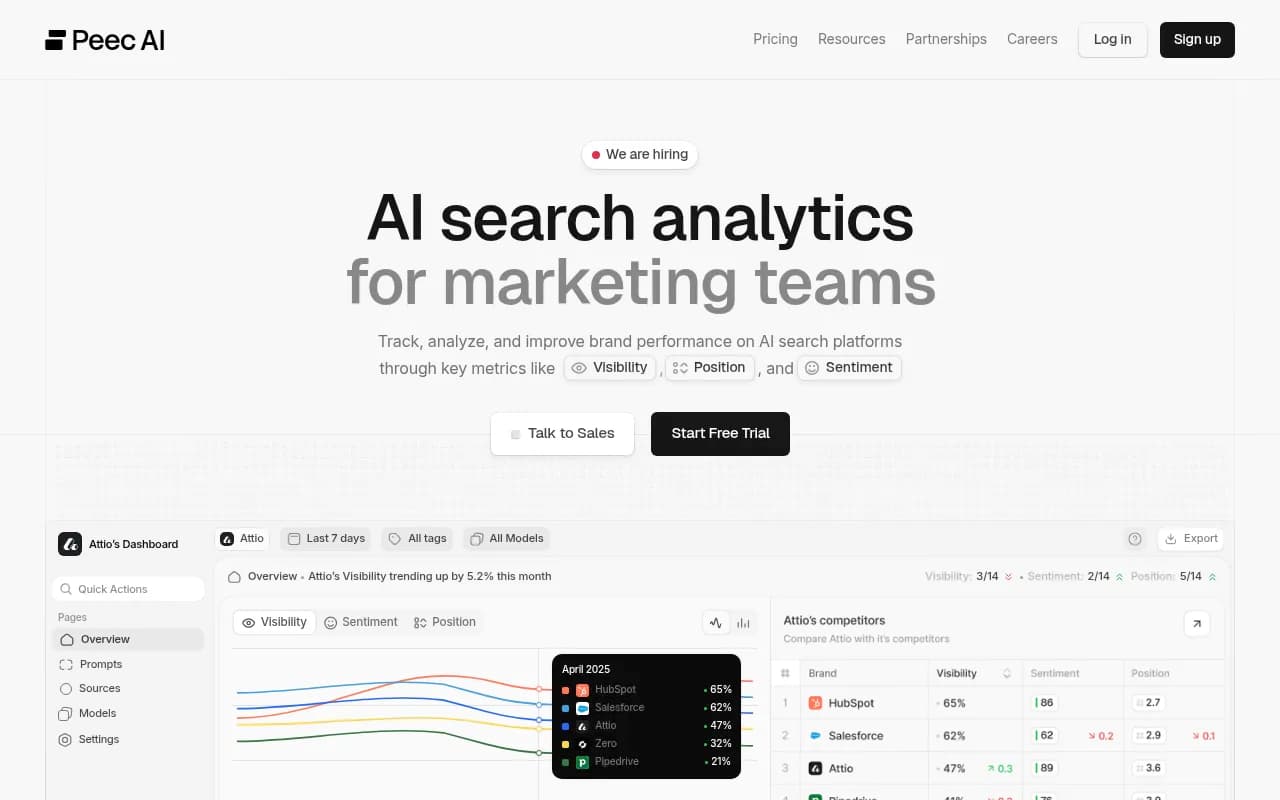
Peec AI has earned its reputation as a straightforward AI visibility tracker. It's clean, it works, and the unlimited countries/languages at no extra cost is genuinely useful. But "solid starting point" is exactly what it is -- a starting point.
The Pro plan (€199/mo) covers four base AI engines. Want Claude, Gemini, or Google AI Mode? Those are enterprise add-ons with custom pricing. You're capped at 100 prompts and 9,000 AI answers per month. There's no content creation tooling, no crawler logs, no shopping visibility, and no way to act on what you find.
For teams that have outgrown that ceiling -- or never wanted a pure monitoring dashboard in the first place -- here's what's actually worth considering in 2026.
What to look for in a Peec AI alternative
Before jumping to the list, it helps to know what separates the tools worth your time from the ones that just replicate Peec's limitations with a different logo.
The questions that matter:
- Does it track AI responses from the actual user interface, or just through APIs? UI-level tracking catches things API calls miss -- shopping carousels, citation formatting, follow-up suggestions.
- How many AI engines does it cover, and at what price tier? Some tools bury Gemini or Claude behind enterprise gates.
- Does it tell you why you're not being cited, or just that you're not?
- Can it help you create content to fix the gaps it finds?
- Does it show you crawler activity -- which AI bots are hitting your site, which pages they're reading, and whether those pages are getting cited?
With that in mind, here are nine alternatives worth a serious look.
The 9 best Peec AI alternatives in 2026
1. Promptwatch -- best for teams that want to fix visibility, not just track it
Most AI visibility tools show you a dashboard and leave you to figure out the rest. Promptwatch is built differently -- it's designed around a loop: find the gaps, create content to fill them, then track whether that content gets cited.
The Answer Gap Analysis shows you exactly which prompts competitors are visible for that you're not. You see the specific topics and questions AI models are already answering -- just not with your content. From there, Content Agents generate articles, listicles, and comparisons grounded in real prompt data, citation patterns, and competitor analysis. Then page-level tracking shows when those pages get crawled and cited, with a timeline from publish to first citation.
A few things that stand out vs Peec specifically: Promptwatch tracks 10 AI models (including Google AI Mode, DeepSeek, Grok, and Mistral) at standard pricing tiers, not enterprise add-ons. It also includes AI Crawler Logs -- real-time data on which AI crawlers are hitting your site, which pages they're reading, and what errors they're encountering. Peec has nothing equivalent.
Pricing: Essential $99/mo (1 site, 50 prompts), Professional $249/mo (2 sites, 150 prompts, crawler logs), Business $579/mo (5 sites, 350 prompts). Free trial available.
Promptwatch is used by 1,480+ brands including Booking.com and Center Parcs, and its data has been cited in the Wall Street Journal.

2. Profound -- best for enterprise teams with deep data needs
Profound is a strong enterprise-tier option with solid coverage across major AI engines and a focus on predictive insights. It's built for larger teams that need granular prompt-level data and competitive benchmarking.
Where it pulls ahead of Peec: broader model coverage at standard tiers, more sophisticated share-of-voice metrics, and better support for multi-brand or multi-market setups. Where it falls short: it's primarily a monitoring and analytics platform. There's no content generation, no crawler logs, and the price point is higher than most mid-market teams need.
Good fit for: enterprise marketing and SEO teams that need serious data depth and have a separate content workflow.
Profound

3. Scrunch AI -- best for enterprise-wide AI monitoring
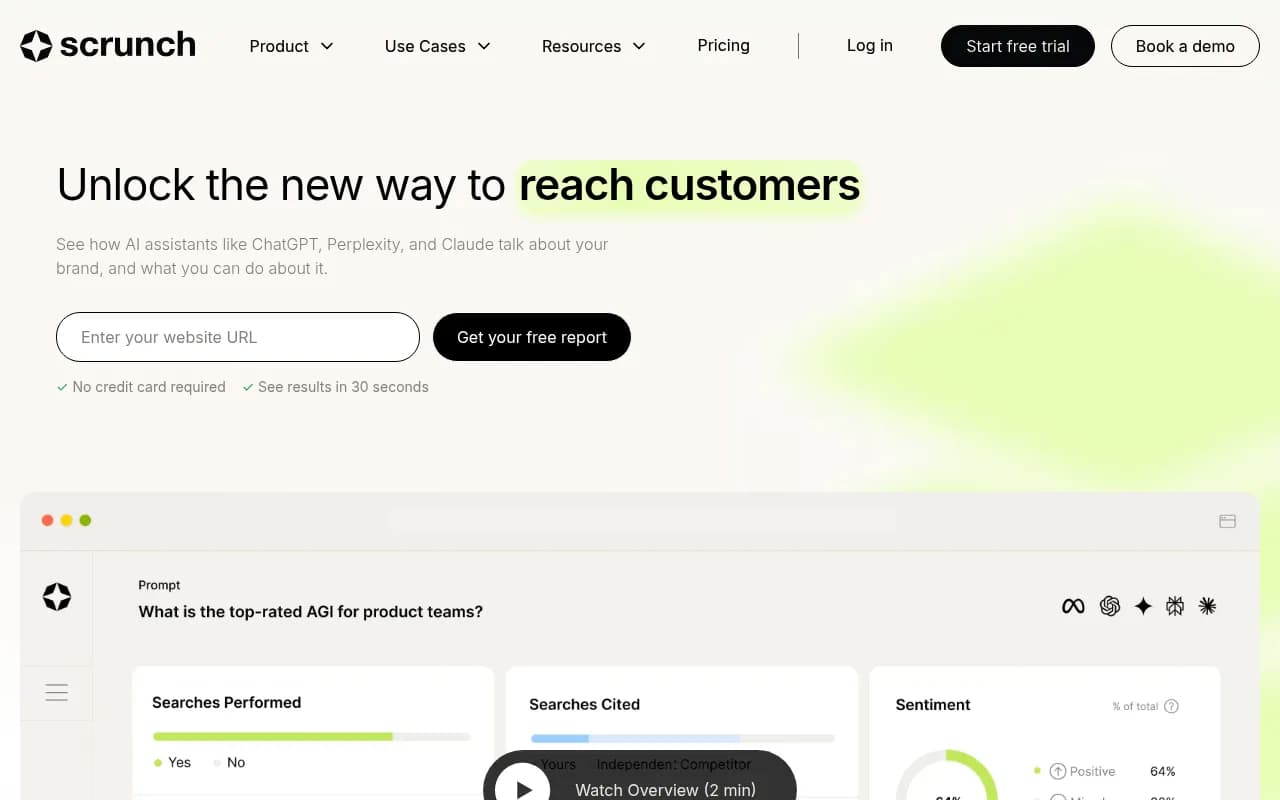
Scrunch AI positions itself at the enterprise end of the market, with an emphasis on monitoring AI search visibility at scale across large organizations. It covers multiple AI engines and offers competitive benchmarking with reasonable depth.
The limitation is similar to Profound: it's a monitoring platform. It tells you what's happening but doesn't help you change it. If your team has the resources to act on monitoring data independently, Scrunch is worth evaluating. If you need the platform to help you close gaps, look elsewhere.
4. Otterly.AI -- best for focused AI search tracking on a budget
Otterly.AI is one of the cleaner monitoring tools in this space. It tracks brand mentions across ChatGPT, Perplexity, and Google AI Overviews, with a straightforward interface that doesn't overwhelm you with features you won't use.
It's a reasonable Peec alternative if your main complaint is price or prompt limits -- Otterly's entry pricing is competitive. But it's firmly in the monitoring-only camp: no content generation, no crawler logs, no gap analysis. Think of it as a lighter version of Peec, not a more capable one.
Otterly.AI

5. AthenaHQ -- best for sentiment-led brand monitoring
AthenaHQ takes a slightly different angle, focusing on how AI models characterize your brand -- not just whether they mention you. Sentiment analysis and brand positioning insights are more developed here than in most pure-tracking tools.
That's genuinely useful if you're managing a brand reputation problem in AI search, where a model might cite you but frame you negatively. The gap is on the action side: AthenaHQ doesn't help you create content to shift that positioning. It surfaces the problem; fixing it is on you.

6. SE Visible -- best for teams already using SE Ranking
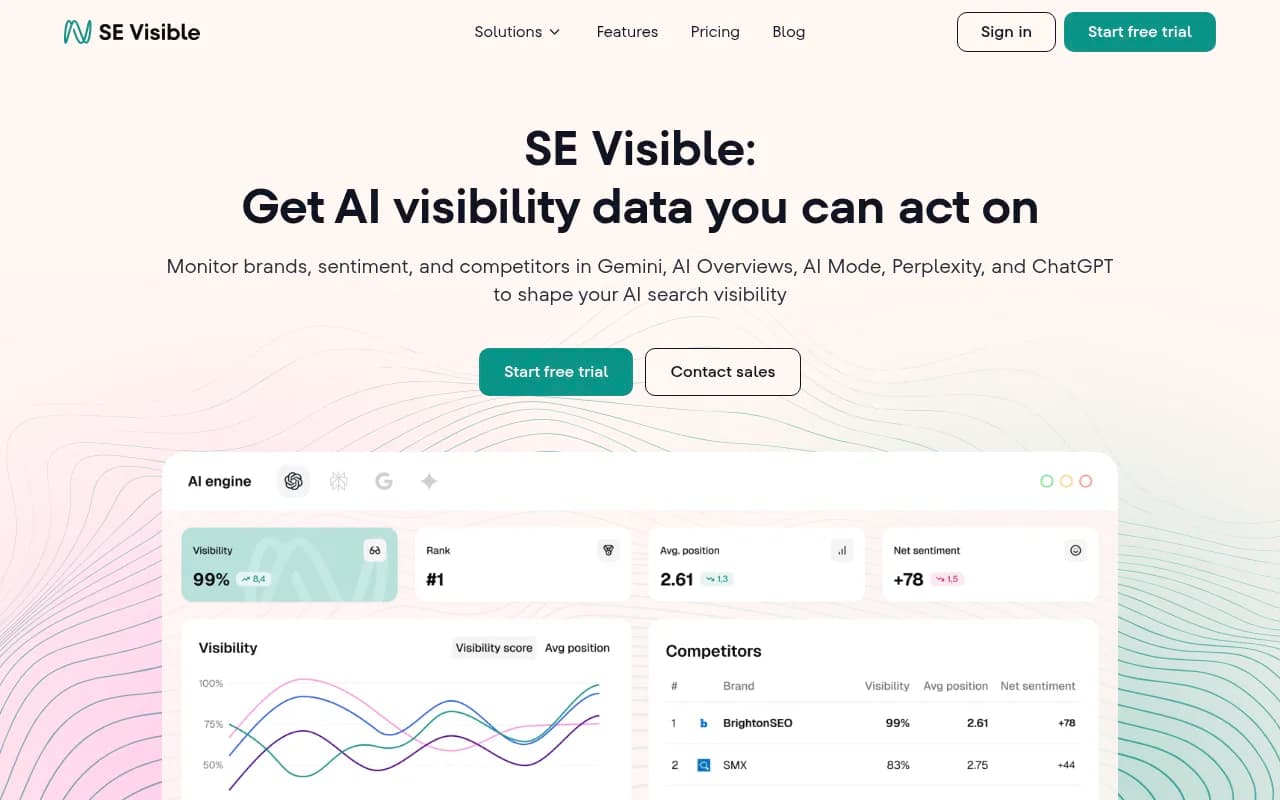
SE Visible is SE Ranking's AI visibility module, which means it fits naturally into teams already paying for SE Ranking's broader SEO suite. You get AI mention tracking across major engines alongside traditional rank tracking, site audits, and keyword research -- all in one platform.
The integration is the main argument here. If you're already in SE Ranking, adding AI visibility tracking without switching platforms makes sense. If you're not, the AI-specific features aren't strong enough to justify adopting the full suite just for this.
7. LLM Pulse -- best for lightweight citation tracking
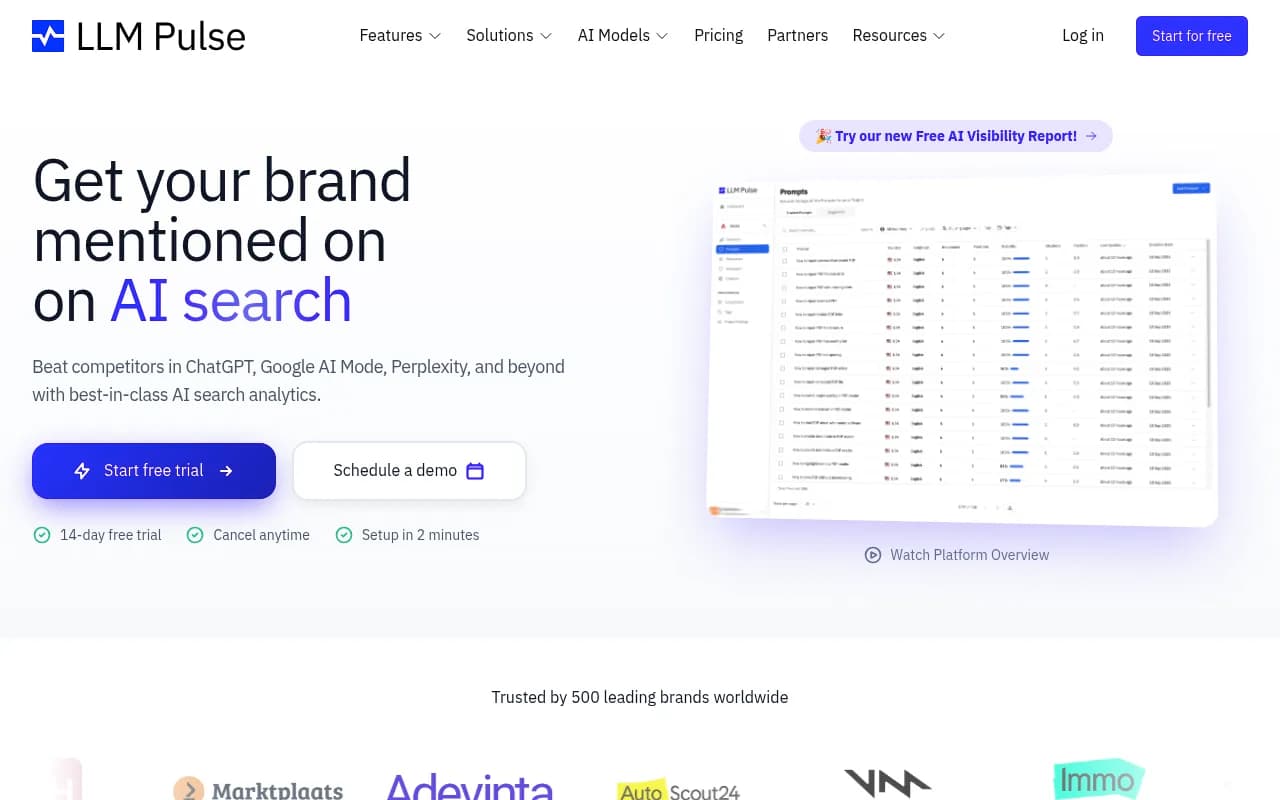
LLM Pulse focuses specifically on citation and source tracking -- which pages, domains, and content types AI models are pulling from when they answer questions in your space. It's a narrower tool than most on this list, but that focus makes it genuinely useful for content teams trying to understand what kind of content gets cited.
It won't replace a full visibility platform, but it works well as a complement to broader monitoring tools, especially if you're trying to understand the citation landscape before building a content strategy.
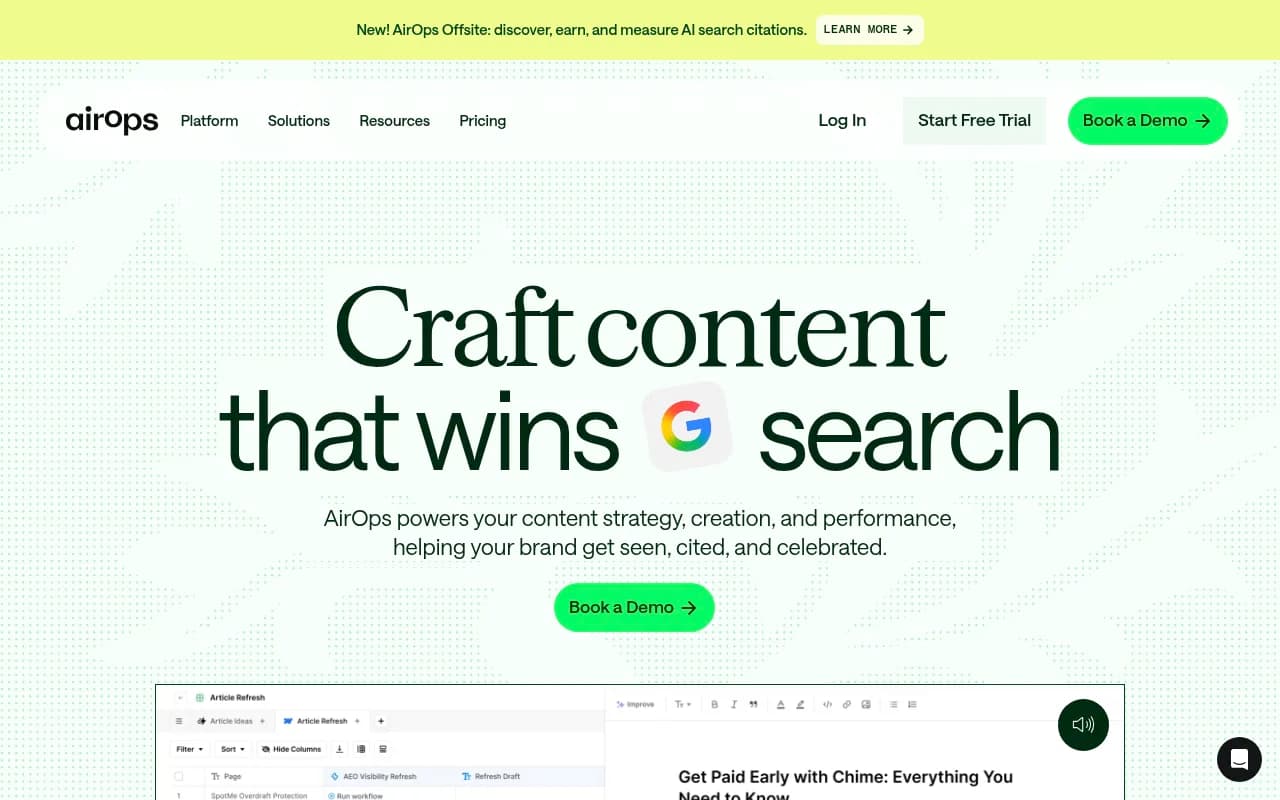
8. AirOps -- best for content engineering at scale
AirOps approaches AI search from the content side rather than the monitoring side. It's built for teams that want to systematically create content optimized for AI search -- articles, structured data, content briefs -- using workflows that incorporate search data and AI response patterns.
The monitoring capabilities are limited compared to dedicated tracking tools, but if your primary bottleneck is content production rather than visibility measurement, AirOps is worth a look. It pairs well with a monitoring tool rather than replacing one.
9. Semrush -- best for teams that want AI visibility inside a traditional SEO suite
Semrush has been adding AI visibility features to its platform, making it a reasonable option for teams that want to consolidate tools. The AI Visibility Toolkit tracks brand mentions across AI engines, and the broader platform covers keyword research, site audits, backlink analysis, and content optimization.
The honest limitation: Semrush's AI visibility features use fixed prompts rather than custom prompt tracking, and there's no AI traffic attribution. It's a useful addition to an existing Semrush workflow, not a reason to choose Semrush over a dedicated AI visibility platform.
How these tools compare
Here's a direct comparison across the features that matter most when evaluating Peec alternatives:
| Tool | AI engines covered | Content generation | Crawler logs | Prompt customization | Best for |
|---|---|---|---|---|---|
| Promptwatch | 10 (incl. DeepSeek, Grok, Mistral) | Yes (Content Agents) | Yes | Yes | Full optimization loop |
| Profound | 9+ | No | No | Yes | Enterprise data depth |
| Scrunch AI | Multiple | No | No | Yes | Enterprise monitoring |
| Otterly.AI | 3-4 | No | No | Yes | Budget monitoring |
| AthenaHQ | Multiple | No | No | Yes | Brand sentiment |
| SE Visible | 4-5 | No | No | Limited | SE Ranking users |
| LLM Pulse | Multiple | No | No | Limited | Citation research |
| AirOps | Limited | Yes | No | Limited | Content production |
| Semrush | 4-5 | Limited | No | Fixed prompts | SEO suite users |
| Peec AI (baseline) | 4 (Pro), more at Enterprise | No | No | Yes | Simple monitoring |
The monitoring-only problem
It's worth naming directly: most tools on this list -- and most tools in this category generally -- are monitoring dashboards. They show you visibility scores, mention counts, and competitor benchmarks. That data is useful. But it doesn't tell you what to write, and it doesn't help you write it.
The gap between "your brand appears in 12% of AI responses for this prompt category" and "here's what you need to publish to change that" is where most teams get stuck. They have the data. They don't have the path from data to action.

That's the real differentiator to look for in 2026. Monitoring is table stakes. The question is whether the platform helps you do something about what it finds.
How to choose the right alternative
A few practical decision points:
If you're a small team or solo marketer and just want to know whether your brand is showing up in AI answers, Otterly.AI or LLM Pulse will cover the basics without the overhead of a more complex platform.
If you're a mid-market marketing or SEO team that needs to actually improve AI visibility -- not just report on it -- Promptwatch is the most complete option. The combination of gap analysis, content generation, and crawler logs means you're not just watching the numbers; you're moving them.
If you're at an enterprise with a dedicated SEO team and existing content workflows, Profound or Scrunch AI give you the data depth you need. Just be prepared to handle the "now what" question internally.
If you're already paying for SE Ranking or Semrush, adding their AI visibility modules is the path of least resistance. The features aren't best-in-class, but the integration value is real.
If content production is your bottleneck, AirOps is worth pairing with a monitoring tool. It won't replace visibility tracking, but it fills the gap on the creation side.
The one thing worth avoiding: picking a tool based on its dashboard aesthetics or pricing alone, then discovering six months later that it can't tell you what to do with the data it's collecting. The monitoring problem is easy to solve in 2026. The action problem is where the real work is.