Key Takeaways
- Content gap analysis for AI search identifies topics where competitors appear in LLM responses but you don't -- revealing exactly what content you need to create or improve to get cited by ChatGPT, Claude, Perplexity, and other AI engines
- The workflow combines three core analyses: competitor keyword gaps (what they rank for that you don't), LLM prompt gaps (queries where AI models cite competitors but ignore you), and content depth gaps (where your existing content lacks the detail AI models need to cite it)
- AI visibility platforms like Promptwatch close the loop by showing you which prompts you're missing, generating content designed to get cited, and tracking whether your new content actually appears in AI responses
- Manual gap analysis doesn't scale -- you need systematic workflows that pull AI Overviews, compare them to your content, identify missing elements, and prioritize fixes based on prompt volume and difficulty
- The goal isn't just visibility, it's attribution -- track which content improvements drive actual traffic from AI search engines using visitor analytics, citation tracking, and conversion data
AI search engines now answer questions directly instead of sending users to websites. Google's AI Overviews appear on 21% of queries. ChatGPT, Perplexity, Claude, and Gemini synthesize answers from multiple sources without requiring clicks. For most brands, this shift has been brutal: visibility in traditional search no longer guarantees visibility in AI-generated answers.
The problem isn't that your content is bad. It's that AI models don't know it exists, or they find it but consider competitor content more relevant, more detailed, or better structured for citation.
Content gap analysis -- the practice of identifying what your audience wants but you haven't covered -- has been an SEO staple for years. But AI search changes the rules. You're no longer optimizing for keywords and rankings. You're optimizing for prompts, citations, and whether an AI model considers your content authoritative enough to reference.
This guide walks through how to build a systematic content gap analysis workflow designed specifically for AI search visibility. You'll learn how to identify gaps at three levels (competitor keywords, LLM prompts, and content depth), prioritize fixes based on real data, and track whether your optimizations actually improve AI citations.
Why Traditional Content Gap Analysis Fails for AI Search
Traditional content gap analysis focuses on keywords: what terms do competitors rank for in Google that you don't? Tools like Semrush, Ahrefs, and Moz make this easy. You plug in competitor domains, export a list of keywords they rank for, filter out branded terms, and start creating content.
This workflow still works for traditional SEO. But it misses the AI search layer entirely.
AI models don't care about keyword rankings. They care about:
- Prompt relevance: Does your content directly answer the question being asked?
- Content depth: Do you cover the topic comprehensively enough to be cited as a source?
- Semantic clarity: Can the AI model parse your content structure and extract key facts?
- Source authority: Do other authoritative sources link to or reference your content?
- Recency: Is your content up-to-date with current information?
A keyword gap analysis might tell you to write about "best project management tools." But it won't tell you:
- Which specific prompts ("What's the best project management tool for remote teams?") trigger AI responses
- What angles competitors are covering that get them cited (pricing comparisons, integration lists, use case breakdowns)
- What depth of coverage AI models expect before they'll cite you (500 words vs 2000 words, feature tables vs prose)
- Whether your existing content on the topic is being ignored because it lacks structured data, expert quotes, or recent updates
You need a different workflow -- one that starts with how AI models actually discover, evaluate, and cite content.
The Three-Layer Content Gap Analysis Framework
An effective AI search content gap analysis operates at three levels:
1. Competitor Keyword Gaps (Traditional SEO Foundation)
Start with the basics: what topics do competitors cover that you don't? This identifies missing content at the site level.
How to do it:
- Use Semrush's Keyword Gap tool, Ahrefs' Content Gap feature, or similar competitor analysis tools
- Enter your domain and 3-5 competitors
- Filter for non-branded keywords where competitors rank in the top 10 but you don't appear
- Export the list and prioritize by search volume and keyword difficulty
This gives you a baseline list of content opportunities. But it's just the starting point.
2. LLM Prompt Gaps (AI Search Visibility)
Next, identify which prompts trigger AI responses where competitors are cited but you're not. This is where most brands have massive blind spots.
How to do it:
- Use an AI visibility platform (Promptwatch, Profound, Otterly.AI, or similar) to track competitor citations across ChatGPT, Perplexity, Claude, Gemini, and other LLMs
- Run Answer Gap Analysis to see which prompts competitors appear for but you don't
- Look at prompt volume estimates and difficulty scores to prioritize high-value, winnable queries
- Analyze the actual AI responses to understand what content angles and formats get cited

Tools like Promptwatch show you the exact prompts where you're invisible, the competitors being cited instead, and the specific content elements (features, comparisons, use cases) that AI models are pulling from competitor sites. This is the data you need to create content that actually gets cited.
3. Content Depth Gaps (Page-Level Optimization)
Finally, audit your existing content to find pages that should be getting cited but aren't. Often the issue isn't missing content -- it's shallow content that doesn't meet AI models' citation thresholds.
How to do it:
- Pull a list of your top-performing pages from Google Search Console or your analytics platform
- For each page, manually search the topic in ChatGPT, Perplexity, and Claude
- Compare the AI-generated answer to your content: what's in the AI response that you don't cover?
- Look for missing elements: data points, expert quotes, examples, comparisons, structured lists, recent updates
- Prioritize pages with high traffic potential but low AI citation rates
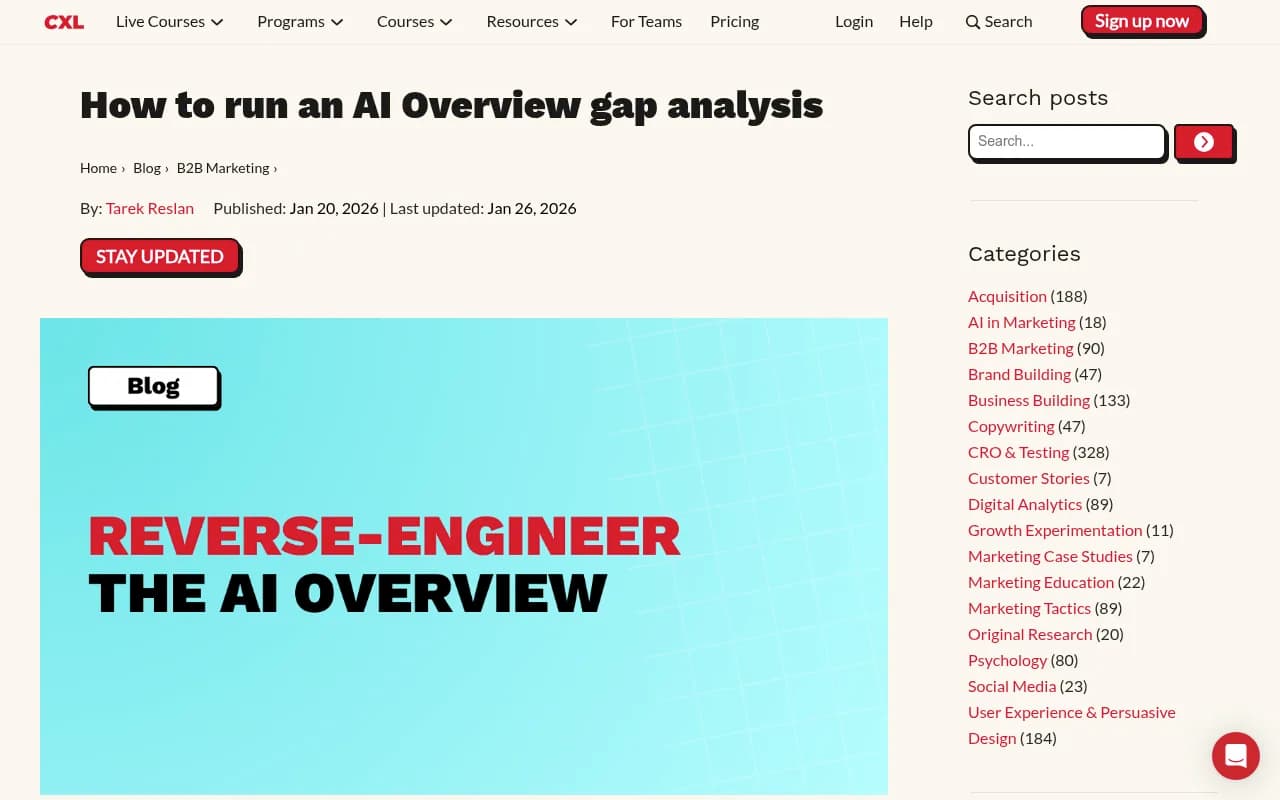
This is where Chris Long's manual workflow (prompting ChatGPT to pull the AI Overview, compare it to your page, and identify gaps) becomes useful -- but only if you systematize it.
Building a Scalable AI Overview Gap Analysis System
Manual gap analysis works for 5-10 pages. But most sites have hundreds or thousands of pages that could benefit from optimization. You need automation.
Here's how to build a scalable system:
Step 1: Identify High-Priority Pages
Start with pages that already have traffic but aren't being cited in AI responses. These are your quick wins.
Data sources:
- Google Search Console: pages with high impressions but declining clicks (likely being replaced by AI Overviews)
- Analytics: pages with high organic traffic that could be vulnerable to AI cannibalization
- AI visibility tools: pages that rank in traditional search but don't appear in LLM citations
Export a list of 50-100 high-priority pages and their primary target keywords or topics.
Step 2: Pull AI Overviews at Scale
You need to see what AI models are actually saying about each topic. Manual searches don't scale.
Options:
- API-based approach: Use ChatGPT's API, Perplexity API, or similar to programmatically query each topic and capture the response
- Browser automation: Use tools like Puppeteer or Playwright to automate searches in ChatGPT, Claude, and Perplexity, capturing screenshots and text
- Dedicated platforms: Tools like Promptwatch and Profound already do this -- they track AI responses for your target prompts and show you which sources get cited
The goal is to build a dataset: for each target topic, what does the AI Overview or LLM response include?
Step 3: Compare AI Responses to Your Content
Now you need to identify the gaps. What's in the AI response that your content doesn't cover?
Manual approach (small scale):
- Open your page and the AI response side-by-side
- List every fact, data point, example, or subtopic in the AI response
- Check whether your content covers each element
- Note missing elements and shallow coverage
Automated approach (large scale):
- Use an LLM (Claude, GPT-4) to compare the AI response to your page content
- Prompt: "Here is an AI Overview for [topic]. Here is our page content. Identify what the AI Overview includes that our page does not cover. Be specific."
- Parse the LLM output to extract missing elements
- Aggregate results across all pages to find common gaps
This is where Promptwatch's Answer Gap Analysis becomes valuable -- it automates this comparison across hundreds of prompts and shows you exactly what content you're missing.
Step 4: Prioritize Gaps by Impact
Not all gaps are worth fixing. Prioritize based on:
- Prompt volume: How many people are asking this question? (Use prompt intelligence tools or search volume as a proxy)
- Difficulty: How hard is it to rank for this prompt? (Based on competitor strength and content depth required)
- Current traffic: Is this a page that already drives significant traffic? (Higher priority if yes)
- Business value: Does this topic align with your conversion goals? (Lead gen, product sales, etc.)
Create a prioritized list of content gaps to address, starting with high-volume, low-difficulty prompts on pages that already have traffic.
Step 5: Create or Optimize Content
Now you know what to fix. The next step is execution.
For missing content (new pages):
- Use AI writing tools (Jasper, Copy.ai, or Promptwatch's built-in AI agent) to generate drafts grounded in citation data and competitor analysis
- Focus on comprehensive coverage: answer the prompt directly, include data and examples, structure content with clear headings and lists
- Add expert quotes, original research, or unique insights that competitors lack
- Optimize for semantic clarity: use schema markup, structured data, and clear formatting that AI models can parse
For shallow content (existing pages):
- Add missing sections identified in the gap analysis
- Expand thin sections with more detail, examples, and data
- Update outdated information (AI models prioritize recency)
- Improve structure: break up long paragraphs, add subheadings, use bullet lists
- Add visual elements: tables, charts, screenshots that make information easier to extract
The goal isn't to write more words. It's to cover the topic comprehensively enough that AI models consider your content authoritative and citation-worthy.
Step 6: Track Results and Iterate
Optimization without measurement is guesswork. You need to know whether your content improvements actually increase AI citations.
What to track:
- Citation rate: How often does your page appear in AI responses for target prompts? (Use AI visibility platforms to monitor this)
- Citation position: When you are cited, are you the primary source or a secondary reference?
- Traffic from AI search: Are you seeing referral traffic from ChatGPT, Perplexity, or other AI engines? (Requires visitor analytics or server log analysis)
- Traditional search impact: Did optimizing for AI search also improve your Google rankings and traffic?
Run this tracking monthly. Compare citation rates before and after optimization. Identify which content improvements had the biggest impact and apply those patterns to other pages.
Tools and Platforms That Support AI Search Gap Analysis
You can build parts of this workflow manually, but dedicated platforms make it significantly faster and more accurate.
AI Visibility Tracking:
- Promptwatch: End-to-end platform with Answer Gap Analysis, AI content generation, crawler logs, and traffic attribution. The only platform rated as a "Leader" across all GEO categories in 2026 comparisons.
- Profound: Enterprise-focused with strong multi-LLM tracking but higher price point and no Reddit/YouTube insights
- Otterly.AI: Basic monitoring across ChatGPT, Perplexity, and Google AI Overviews but lacks content generation and optimization features
Otterly.AI

Traditional SEO Gap Analysis:
- Semrush: Keyword Gap tool for competitor analysis, plus emerging AI search tracking (though limited to fixed prompts)
- Ahrefs: Content Gap feature and Brand Radar for AI mentions (but no AI traffic attribution)
- Moz: Keyword gap analysis and rank tracking, but minimal AI search capabilities
Content Optimization:
- Surfer SEO: Content optimization based on SERP analysis, useful for traditional SEO but doesn't optimize for AI citations
- Clearscope: Content intelligence platform that helps improve depth and relevance
- Frase: AI-powered content research and writing, with some GEO-focused features
AI Writing Agents:
- Jasper: Marketing-focused AI writing with brand voice and content pipelines
- Copy.ai: Fast AI copywriting for various content types
- Promptwatch AI Agent: Generates content specifically designed to get cited by AI models, grounded in 880M+ citation data points
The key difference: most tools stop at showing you the gaps. Platforms like Promptwatch close the loop by helping you fix the gaps (with AI content generation) and tracking whether the fixes work (with citation monitoring and traffic attribution).
Common Mistakes to Avoid
Building an AI search content gap analysis workflow is straightforward in theory but easy to mess up in practice. Watch out for these pitfalls:
1. Focusing only on keywords, not prompts
Keyword research tells you what people type into Google. Prompt research tells you what people ask AI models. These are different. AI prompts tend to be longer, more conversational, and more specific. If you only optimize for keywords, you'll miss the queries that actually drive AI citations.
2. Ignoring content depth
AI models have citation thresholds. A 500-word blog post might rank in Google but will rarely get cited by ChatGPT or Perplexity. If your gap analysis identifies missing topics, make sure you're creating comprehensive content (1500-3000 words minimum for most topics), not thin SEO filler.
3. Not tracking AI-specific metrics
Traditional SEO metrics (rankings, organic traffic) don't tell you whether AI models are citing your content. You need AI-specific tracking: citation rates, prompt visibility, referral traffic from AI engines. Without this data, you're flying blind.
4. Treating AI search as a separate channel
AI search optimization and traditional SEO aren't separate disciplines. The same content improvements that get you cited by ChatGPT (comprehensive coverage, clear structure, expert insights) also improve your Google rankings. Build one workflow that optimizes for both.
5. Trying to scale manually
Manual gap analysis works for 5-10 pages. Beyond that, you need automation. Trying to manually compare AI Overviews to hundreds of pages will burn out your team and produce inconsistent results. Invest in tools or build scripts to automate the comparison and gap identification.
6. Ignoring Reddit and YouTube
AI models don't just cite traditional websites. They pull heavily from Reddit discussions and YouTube videos. If your gap analysis only looks at competitor websites, you're missing a huge source of citation data. Tools like Promptwatch surface Reddit threads and YouTube videos that influence AI recommendations -- channels most competitors ignore entirely.
Measuring Success: What Good Looks Like
How do you know if your content gap analysis workflow is working? Look for these indicators:
Short-term (1-3 months):
- Increasing citation rates for target prompts (tracked via AI visibility platforms)
- More pages appearing in AI responses (even if not as the primary source)
- Improved content depth scores (word count, topic coverage, structured data implementation)
Medium-term (3-6 months):
- Higher citation positions (moving from secondary to primary source)
- Referral traffic from AI engines (tracked via analytics or server logs)
- Improved traditional search rankings (as a side effect of better content)
Long-term (6-12 months):
- Consistent visibility across multiple AI models (ChatGPT, Perplexity, Claude, Gemini)
- Attribution data showing AI search driving conversions and revenue
- Competitive advantage: appearing in AI responses where competitors don't
The ultimate metric: AI search becomes a measurable, growing traffic and revenue channel for your business. Not just a vanity metric, but a source of qualified visitors who convert.
Putting It All Together: A 30-Minute Quick-Start Workflow
If you want to test this approach before building a full system, here's a condensed 30-minute workflow:
Minutes 1-10: Identify one high-priority page
- Pick a page that already has decent traffic but could be vulnerable to AI cannibalization
- Note the primary topic or keyword
Minutes 11-15: Pull AI responses
- Search the topic in ChatGPT, Perplexity, and Claude
- Screenshot or copy the responses
- Note which sources get cited
Minutes 16-25: Compare and identify gaps
- Open your page and the AI responses side-by-side
- List everything in the AI responses that your page doesn't cover
- Identify 3-5 specific gaps (missing subtopics, data points, examples)
Minutes 26-30: Plan fixes
- Prioritize the gaps by impact
- Draft a quick outline of what to add or update
- Schedule the content work
This won't scale, but it will give you a feel for the process and help you identify whether your content has significant gaps worth addressing.
The Future of Content Gap Analysis
AI search is still evolving. As more users shift from Google to ChatGPT, Perplexity, and other AI-first search experiences, the importance of AI visibility will only grow.
Content gap analysis workflows will need to adapt:
- Multi-modal gaps: AI models are starting to cite images, videos, and audio sources. Future gap analysis will need to identify missing visual and multimedia content, not just text.
- Real-time optimization: As AI models update their training data more frequently, content will need to be refreshed continuously to maintain citation rates.
- Persona-specific gaps: AI models personalize responses based on user context. Gap analysis will need to account for different personas and use cases, not just generic prompts.
- Cross-platform gaps: As new AI search engines emerge (Grok, DeepSeek, Meta AI), gap analysis will need to cover more platforms and identify where you're visible vs invisible across the ecosystem.
The brands that build systematic, scalable content gap analysis workflows today will have a massive advantage as AI search continues to grow. The brands that wait will find themselves invisible in the channels that matter most.
Conclusion
Content gap analysis for AI search isn't a one-time project. It's an ongoing workflow:
- Find the gaps: Use competitor analysis, prompt research, and AI Overview comparison to identify what you're missing
- Create content that ranks in AI: Generate comprehensive, well-structured content designed to get cited by AI models
- Track the results: Monitor citation rates, traffic from AI engines, and business impact
- Iterate: Double down on what works, fix what doesn't, and expand to more topics
The tools exist. The data exists. The question is whether you'll build the workflow to act on it -- or watch competitors dominate AI search while you're stuck in traditional SEO mode.
If you're serious about AI visibility, start with a systematic gap analysis. Identify where you're invisible, fix it, and measure the results. That's how you win in AI search.