Key takeaways
- Alexa for Shopping (which replaced Rufus in May 2026) answers from listing details, reviews, and community Q&A. You can't optimize the answer, only the inputs it draws from.
- Fill every attribute field, write plain declarative sentences, and state who a product is not for. Assistants quote what is explicit and skip what is implied.
- Meta AI is a different case. I found no official Meta documentation on how it picks shopping recommendations, so the sound move is to keep your pages crawlable and your product data clean.
- Promptwatch's data shows Meta-WebIndexer reaching about 38% of tracked AI crawler requests by August 9, 2026. Check your robots.txt and server logs for it.
- Measure by asking the assistants your own buyer questions on a schedule and recording which products they name.
What actually changed in 2026
Shoppers used to type "wireless headphones" and scroll a results page. Now they ask "what's the best wireless headphones for long flights?" or "is this compatible with my MacBook Air?" and get a written answer with a few products attached.
As Tinuiti's team notes, Amazon retired the Rufus name on May 13, 2026 and folded the technology into Alexa for Shopping. Same job, new label: a generative assistant that sits in the search bar, on results pages, on product detail pages, and in the cart.
I want to be upfront about the limits here. Amazon has published which surfaces the assistant reads (listing details, reviews, community Q&A) and nothing about how answers are ranked. Any guide promising a ranking formula is guessing. What follows is the defensible version: improve the inputs, then test the outputs.
Meta AI is murkier still. In my research I found no official Meta documentation on how Meta AI chooses shopping recommendations, and nothing confirming a recommendation feature tied directly to product pages. So I treat it as a crawl-and-data-hygiene problem, covered below.
How the two assistants differ
| Alexa for Shopping | Meta AI | |
|---|---|---|
| Where it lives | Amazon search bar, results, PDP, cart | Meta's apps and assistant |
| Known inputs | Listing details, reviews, community Q&A, shopping signals | Not documented for shopping |
| What you control | Titles, bullets, attributes, A+ content, Q&A | Site content, crawl access, product data, ad settings |
| Documentation | Partial, no ranking details | None found on shopping picks |
| Main risk | Missing or vague listing data | Blocked or unreadable pages |
Treat the product page as a database first
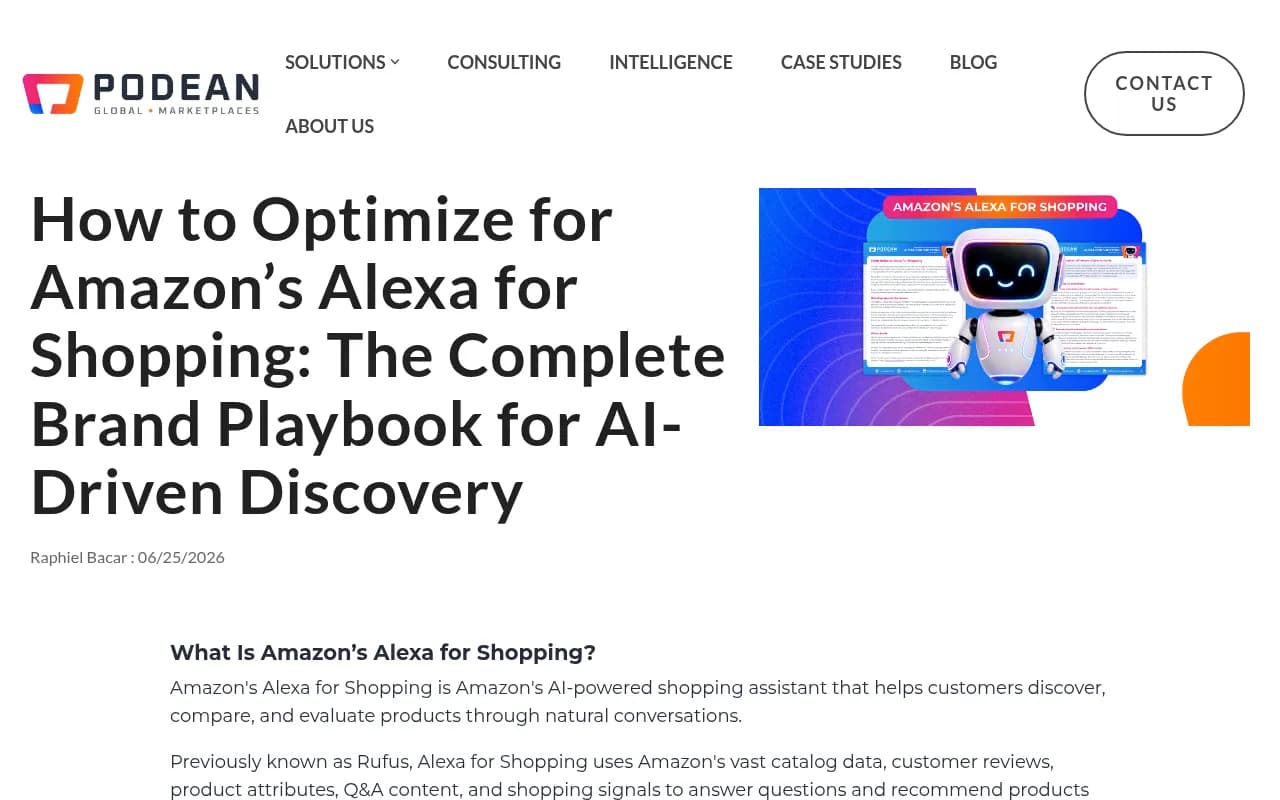
Podean's playbook frames listings as AI-ready databases, and I think that is the most useful mental shift. The assistant pulls titles, bullets, attributes, reviews, Q&A, and media as separate structured objects. A missing field is a missing fact.
Practical steps:
- Fill every attribute field on every ASIN, even the ones that feel optional. Attributes act as an eligibility gate: if the assistant can't confirm a product meets a constraint, it can't recommend it for that constraint.
- Use consistent units. "10 lbs" everywhere, not "10 lbs" in one bullet and "ten pounds" in another.
- Keep identifiers clean and specs normalized across variations.
- Make sure your title, bullets, and A+ content don't contradict each other. Contradictions make a retrieval system hedge or skip you.
One timely wrinkle: Digital Applied reports that Amazon caps titles at 75 characters from July 27, 2026, with a separate 125-character Item Highlights field, and rewrites non-compliant titles with AI. If you haven't audited your titles since then, do it now. A machine rewrite of your title is a machine deciding how your product is described.
Write for constraints, not just keywords
Shoppers frame needs as "Can I...?" and "Will this work if...?" Tinuiti's example is a laptop backpack. A plain spec list becomes far more matchable when it says "best for daily commuters, frequent flyers, and students" and also "not ideal for extended outdoor exposure or laptops larger than 15.6 inches."
That second sentence is the one most brands refuse to write. It feels like talking yourself out of a sale. But an assistant that knows when your product is a poor fit is an assistant that can confidently recommend it when it is a good one.
A few habits that work:
- Answer constraint questions directly: "Will this stroller fit in a small car trunk?" "Can this serum be layered with vitamin C?"
- Use short declarative sentences an AI can quote without rewriting.
- Add vertical-specific detail. Fit and sizing comparisons in fashion, ingredient layering in beauty, compatibility and assembly time in hard goods.
- Structure with clear headings, bullets, and Q&A-style snippets.
- Mine reviews and customer service logs for the real "how," "why," and "what if" questions, then answer them on the page.
Cover each query type
Podean notes the assistant classifies queries into types such as comparison and use-case questions. A decent self-audit is to take one product and write down the five questions a knowledgeable store associate would get about it: compatibility, comparison to the sibling model, who it suits, who it doesn't, and care or maintenance. If your listing can't answer all five in plain text, that is your to-do list.
Fix your Q&A, even though shoppers can't see it
This is the part I find most interesting. According to Canopy Management, Amazon pulled the browsable Q&A block off the product detail page and pushed it to secondary pages, while the assistant kept reading it. Canopy also notes Amazon launched "Join the chat" in April 2026, which lets shoppers interrupt an audio product summary and ask a question, with answers assembled from product information and customer feedback.
So Q&A went from something you show people to something you supply to machines. A machine reader never browses, never infers, and gives you no credit for what you merely implied. Rewrite accordingly:
- Audit existing answers. Delete or correct anything vague, outdated, or wrong.
- Answer your own community questions with verifiable specifics: dimensions, materials, certifications, compatibility lists.
- Reconcile your copy with what verified reviews say. If reviews keep mentioning a sizing quirk and your bullets say "true to size," the assistant sees the conflict.
- Skip reassurance language written for a browsing human. "Great quality you'll love" gives a retrieval system nothing to quote.
Align ads and Stores with the same language
Eva's seller guide suggests adding buyer-question coverage to titles, bullets, A+ Content, Q&A, and Store pages, then aligning Sponsored Products and Sponsored Brands around the same use-case language. It also suggests turning review themes into product-page improvements. This is sensible, and it costs little: you are reusing one vocabulary across every surface the assistant might read.
Amazon is also generating ad prompts from your content, so reviewing those prompts shows you how Amazon's own systems currently interpret your listing.
Meta AI: what to do without a rulebook
Here is the honest version. No verified source tells us how Meta AI picks shopping recommendations. What we do have is crawler data.
Promptwatch tracked Meta-WebIndexer at about 2.2% of AI crawler requests in mid-July 2026. By August 9 it hit a peak of 37.8%, roughly a 17x rise in under a month, making it the heaviest AI crawler in Promptwatch's logs. The Promptwatch Data report on Meta-WebIndexer ties this to unconfirmed reports that Meta is building its own web search index so Meta AI doesn't depend on Google or Bing. The evidence is a single tweet marked "allegedly," so treat the motive as unproven. The crawl increase itself is measured, though, and the share only counts AI crawlers Promptwatch tracks, not total site traffic.

What to do about it:
- Check robots.txt and server logs for these user agents:
meta-webindexer,meta-externalagent,meta-externalfetcher, andFacebookBot. - Decide deliberately whether to allow them. Promptwatch's advice is that blocking may decide whether your content is in Meta's index at launch. That is a business call, not an automatic yes.
- Make sure product pages render server-side or are prerendered. A crawler that can't see your price, specs, or stock status can't use them.
- Budget for sustained crawl load if you have a large catalog.
A simple robots.txt snippet if you want to explicitly allow the indexer:
User-agent: meta-webindexer
Allow: /

User-agent: meta-externalagent
Allow: /
One Meta-specific pitfall from Pennock's write-up (I only saw the summary): Meta's ad setting "Send people to the destination most likely to improve ad performance" can override the product page you picked as the destination. If you've spent effort tuning a page, check that Meta isn't sending traffic somewhere else.
Product pages are what AI cites most, so make them comparable
There is no first-party data on Alexa or Meta shopping citations. Promptwatch's closest data is for ChatGPT, and I'd use it as an analogue, not as Alexa or Meta numbers.
In Promptwatch's data on ChatGPT citation content types for Sep 28 to Oct 4, 2026, product pages were the most cited type at 22.4% of classified citations. For commercial prompts they reached 26.0%, with landing pages (20.6%), listicles (15.0%), and comparisons (7.9%) bringing those four types to almost 70% of commercial citations. For branded prompts, reviews were 5.6%, over three times their overall share.
The suggested actions from that report translate well to any assistant: make pages easy to compare with clear pricing, specs, and who it's for; get into best-of roundups; add FAQ sections; and collect reviews on trusted sites.
On shopping cards specifically, Promptwatch's ChatGPT shopping usage data shows shopping features appear on only a low single-digit percentage of web-search responses, concentrated on commercial and transactional prompts. Its readiness advice: complete Product schema, accurate prices and availability, and a clean merchant feed. That applies on and off Amazon.
Two unverified figures worth testing yourself rather than quoting: a Shopify snippet saying 50% of AI-referred sessions in Q2 2026 landed on product pages, and a secondary citation of Adobe's April 2026 benchmark scoring product pages last for machine readability at 66%. If the second is accurate, product pages are the most cited type and also among the hardest for machines to read, which is an opening for anyone who cleans theirs up.
Product page checklist
| Area | Do this | Why |
|---|---|---|
| Attributes | Fill every field, consistent units | Eligibility gate for constraint queries |
| Title | Comply with the 75-character cap, lead with the core product | Avoids AI rewrites |
| Bullets | Declarative sentences, include limits | Quotable and honest fit signals |
| Q&A | Rewrite answers with verifiable specifics | Read by the assistant at full depth |
| Reviews | Reconcile copy with review themes | Conflicts cause hedging |
| Schema | Complete Product markup, price, availability | Machine readability off Amazon |
| Crawl access | Allow Meta and other AI user agents deliberately | Index inclusion |
| Ads | Reuse the same use-case language | One vocabulary across surfaces |
Measure what the assistants say
Because you can't see the ranking, test the answers. A workable routine:
- Write 20 to 50 buyer questions per category: comparison, compatibility, use-case, "best for."
- Ask them in Alexa for Shopping and Meta AI on a schedule, ideally from the markets you sell in.
- Record which products are named, in what order, and with what claims.
- Fix the listing or page behind any wrong or missing claim, then re-test.
Manual testing works for a handful of SKUs. Past that, you want tooling. Podean and others point to dedicated Alexa-for-Shopping tools; Ecomtent names Azoma as its top pick, though I did not verify pricing or capabilities. For cross-assistant brand monitoring beyond Amazon, Promptwatch tracks the real interfaces of ChatGPT, Gemini, Perplexity, Meta AI, and Amazon Alexa including product results, and shows AI crawler logs so you can see whether Meta's bots are hitting your pages. Other monitors in the category include [tool:otterly-ai] and [tool:peec-ai], which are tracking-focused. If you are comparing options, the GEO software directory at bestgeosoftware.com lists many more.
For technical hygiene, a crawler such as [tool:screaming-frog] can find missing structured data and inconsistent specs across a catalog, and [tool:google-search-console] shows which product pages already earn impressions.
A realistic first month
Week one: pick your top 20 products by revenue and audit attributes, titles, and Q&A. Week two: rewrite bullets and answers with constraints and limits. Week three: check robots.txt and server logs for Meta user agents and validate Product schema. Week four: run your question set in both assistants and log the results as your baseline.
The forward bet, as Digital Applied puts it, is that this discipline compounds: every new assistant surface that learns to buy reads from the same structured content you are cleaning up now. You don't need to know how Alexa ranks anything to benefit from a page that states exactly what the product is, who it fits, and who it doesn't.