Key takeaways
- The biggest changes in the last year came from the AI platforms, not the tools. ChatGPT started showing ads, started using the site: operator at scale, and nearly stopped citing Reddit. Tools that tracked prompts once a week were left with stale data.
- What shipped broadly: multi-engine tracking, citation analysis, AI ad monitoring, content recommendations, and some form of publishing or agent workflow.
- What mostly didn't: trustworthy revenue attribution, verified pricing transparency, and execution that is more than a content generator bolted onto a dashboard.
- Most roundups sort tools by tracking depth. A better test is whether the product changes anything on your site or in your content.
- I did not verify per-tool release dates for this piece. Where a date appears, it comes from first-party platform data. Check each vendor's own changelog before you buy.
Why a GEO changelog is hard to write
Most software categories have tidy release notes. GEO does not. The category is new enough that vendors announce faster than they ship, and one reviewer in the research for this piece put it bluntly: the category generates vendor announcements faster than it generates verifiable usage data.
So this is not a month-by-month list of version numbers. I could not verify those, and I am not going to invent them. Instead, this guide tracks two things: what changed in the AI platforms that GEO tools measure (that part is well documented), and which capabilities the tools have, and have not, actually delivered in response.
There is a second wrinkle. Generative engine optimization has a dated origin: the November 16, 2023 arXiv paper "GEO: Generative Engine Optimization," from researchers at Princeton, Georgia Tech, the Allen Institute for AI, and IIT Delhi. Since then the term has merged with AEO in most vendor marketing. When a tool says it does either, ask what it changes, not what it calls itself.
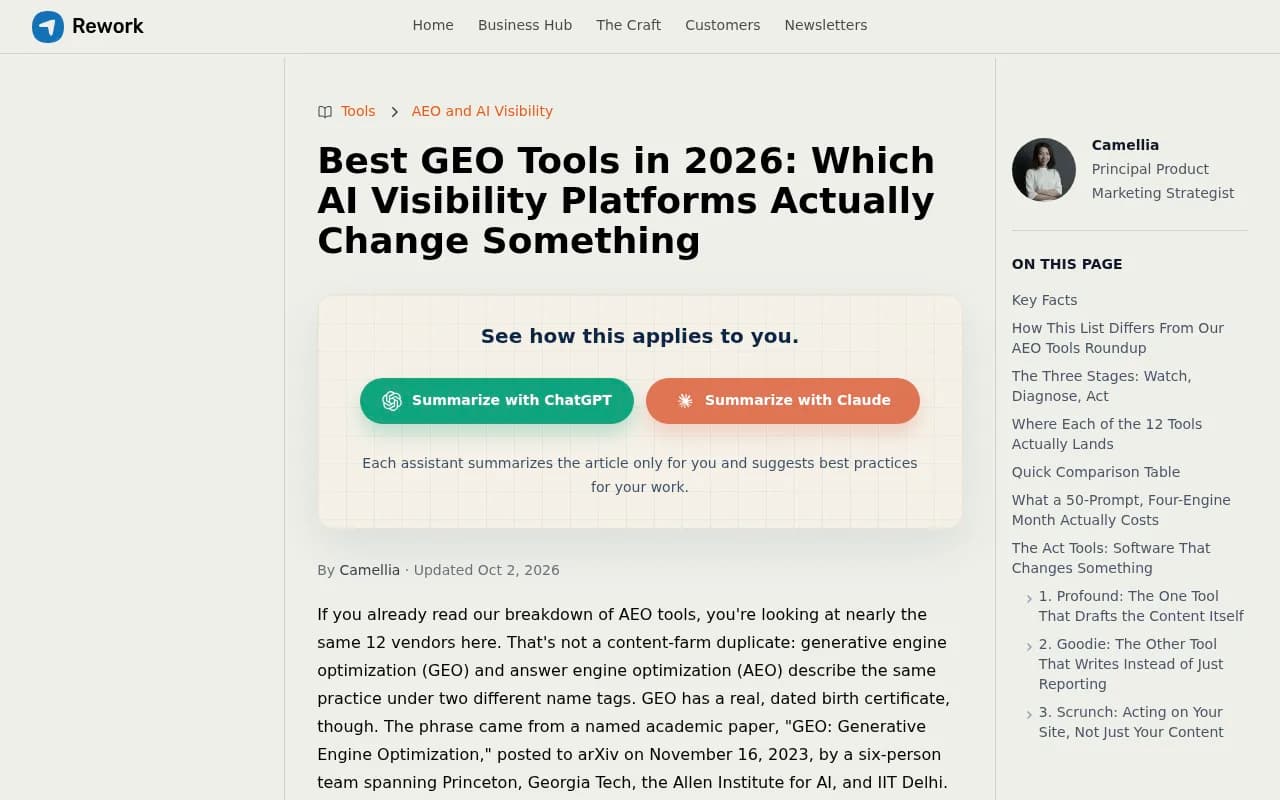
The Rework roundup above is useful because it sorts 12 vendors by stage (watch, recommend, act) and asks whether each one touches your site or content directly. That is the lens I use below.
What shifted underneath the tools
These are the platform changes that forced GEO tools to adapt, or exposed the ones that couldn't. All figures come from Promptwatch Data, and every one carries its period because these numbers move.
March 2026: citations per response dropped
Average citations per ChatGPT response fell across GPT-5.3, GPT-5.4, and GPT-5-Mini around the GPT-5.3 rollout on March 4, 2026. The ChatGPT citation drop report shows it hit ChatGPT's search behavior as a whole. Any tool that reported a flat "citation count" suddenly showed declines that had nothing to do with the brand's work. Tools that separated platform-wide movement from brand-level movement came out looking better.
May 2026: ads arrive in ChatGPT
ChatGPT served no ads until May 27, 2026, when they appeared in 1.69% of responses. Over the 90 days to August 17, ads showed up in an average of 20.1% of web-searching, citation-bearing responses, with a daily peak of 43.9%. The rate passed 30% on July 1 and stayed there. The ChatGPT ads report also shows that, by volume, ad-bearing responses skewed to organic prompts (73.3% over the latest seven days), with brand-specific at 18.0% and competitor comparisons at 8.6%.
That last split is a volume mix, not a probability, so don't read it as "organic prompts are most likely to trigger ads." But it does mean ad monitoring went from a curiosity to a feature worth asking about.
August 2026: the site: operator and the Reddit collapse
On August 8, 2026, ChatGPT started using the site: operator at scale. Per the site: operator report, those queries jumped from roughly 0.37% to 16.8% of fanout queries in a day, and average fanout queries per response rose from about 1.08 to 1.83. The added searches stacked on top of the generic ones.
Six days later, on August 14, reddit.com's share of ChatGPT citations fell from about 4% to 0.5%, according to the Reddit citations report. AI Overviews and AI Mode declined more gradually. If your GEO playbook was "seed Reddit threads," that playbook broke overnight in one engine.
Crawlers and social sources
Meta-WebIndexer grew from about 2% to nearly 38% of tracked AI crawler requests between mid-July and August 9, per the Meta-WebIndexer report. And in the week of September 28 to October 4, ChatGPT drew 0.46% of its citations from social platforms while Google AI Overviews drew 12.2%, per the social media citations report. Engines now behave differently enough that one blended number is misleading.
What actually shipped across the category
Here is the honest version, based on how the 2026 roundups describe the field and on the platform shifts above.
Multi-engine tracking became table stakes
Tracking ChatGPT, Gemini, Perplexity, and Google AI Overviews is now the floor. Even budget options cover six engines or more. Coverage of Copilot, AI Mode, Claude, and Meta AI is where tools now differ. If a tool tracks one engine only, treat that as a free tier, not a product.
Citation analysis got better, source classification got better still
The useful shift here is classifying what gets cited, not just counting it. Promptwatch's own data shows product pages are the most cited content type in ChatGPT at 22.4% of citations (September 28 to October 4, 2026), per the content type report. Tools that can tell you which of your page types are cited, and for how long, are doing something a simple mention counter can't. The content half-life report found landing pages and docs stayed cited longest, while news lost half its pages within 36 days of July 6.
Recommendations arrived, mostly as lists
Many tools added "action" tabs. Quality varies. Some are prioritized to-do lists grounded in your data. Others are generic advice with your brand name pasted in. Test this on a trial: ask whether each suggested action cites evidence from your own prompts.
Content generation and publishing, unevenly
A handful of platforms now take the loop from gap to published page. Frase positions itself this way, ending in published content. Others, like AirOps and Writesonic, come from the content side and added tracking. Pure monitors mostly did not add this.

What didn't ship
This section is the reason I wrote the piece. The gaps are more useful to a buyer than the feature lists.
Revenue attribution you can trust
Plenty of tools promise to connect AI citations to pipeline. Few show it with real visitor data. AthenaHQ pitches revenue attribution as its focus, but one independent evaluator declined to recommend it because it remains early-stage with limited independent review coverage. That is a fair reading of the whole category: the claim is common, the verification is rare.

Crawler-level evidence
Most trackers tell you whether you were mentioned. Far fewer tell you whether AI crawlers could read your pages in the first place. Since the site: operator shift makes indexing of your own domain matter more, crawler logs became more valuable in August, and the category largely did not respond.
Transparent pricing
Prices in third-party roundups conflict, and several come from vendor-written lists. One lists Otterly.AI from $29 a month, another lists enterprise tools as custom. Treat all of it as unverified until you've checked each pricing page. Some vendors still gate everything behind a sales call.
Independent proof
BrightEdge's Generative Parser, for example, sits inside a $36,000+ a year enterprise platform, which the Radar reviewers said made it a poor entry point for teams evaluating GEO specifically. And several emerging platforms did not meet minimum data requirements for inclusion in that review at all. A long feature page is not evidence.
Stable prompt libraries
The August 8 change meant fanout and keyword mappings built before that date went stale, and prompts needed re-running. Tools with fixed prompt sets, or weekly refreshes, had no answer. Continuous daily monitoring matters more than a one-off audit.
How the main tools compare
This table sorts tools by what they do to your site, not by how many engines they track. Pricing is deliberately omitted where I couldn't verify it. Check each vendor.
| Tool | Mainly does | Touches your content directly? | Notes |
|---|---|---|---|
| Promptwatch | Tracking, crawler logs, visitor analytics, content agent, publishing | Yes | Real-UI tracking plus an action loop |
| Frase | Content research, writing, GEO scoring | Yes | Free GEO Score for any page |
| Profound | Citation and competitor benchmarking | No | Monitoring-focused, custom pricing |
| Otterly.AI | Prompt monitoring, share of voice | No | Low-cost monitoring |
| Peec AI | Prompt-level tracking and sentiment | No | Clean analytics dashboards |
| Semrush | AI visibility inside an SEO suite | Partly | Content work is a separate toolkit |
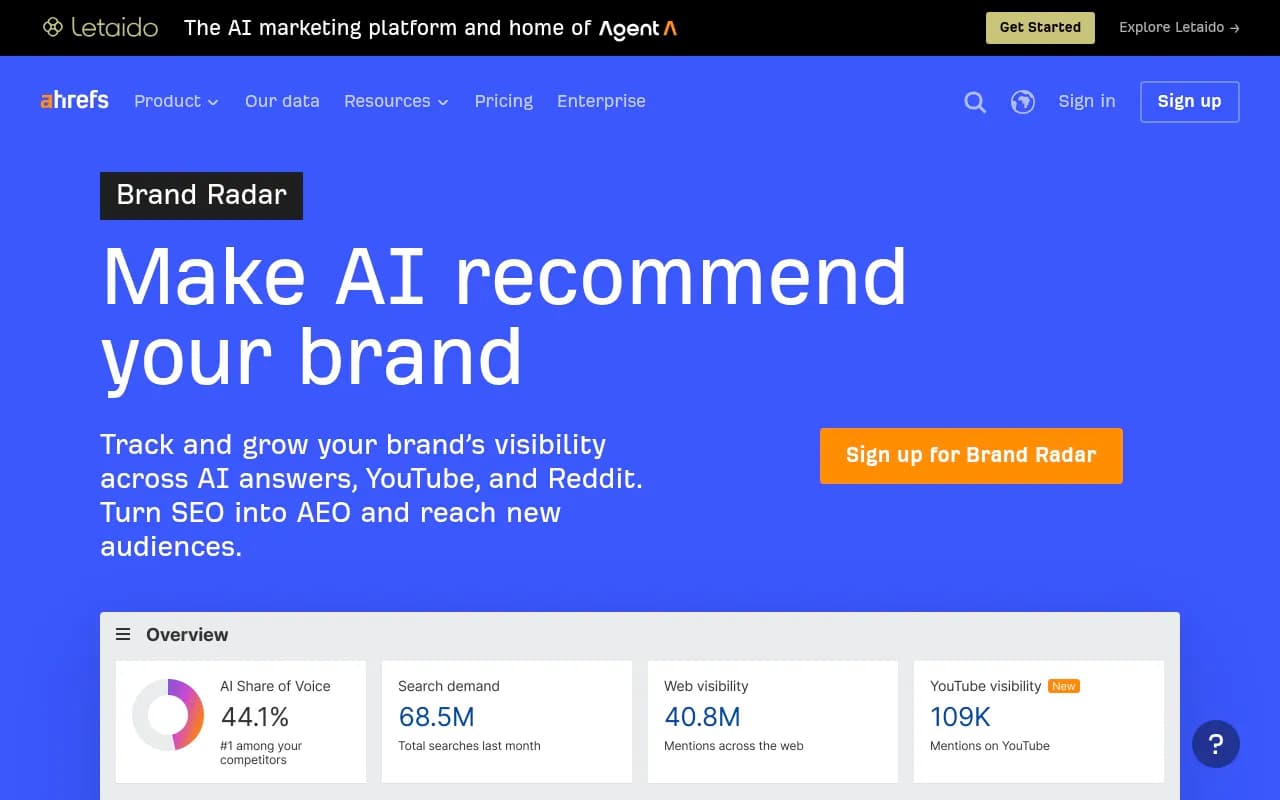
| Ahrefs Brand Radar | Measurement at scale | No | Priced by prompt-check volume |
| AthenaHQ | Tracking plus agents and action layer | Partly | Early-stage, credit-based |
| AirOps | Content engineering | Yes | Content-first, not monitoring-first |
Profound

Otterly.AI


Where Promptwatch fits
If I had to pick a tool that kept pace with the last 12 months, it is the one built around the whole loop rather than a single dashboard. Promptwatch monitors the real interfaces of ChatGPT, Google AI Overviews, AI Mode, Gemini, Perplexity, Copilot, and others, and runs monitors daily, which matters after the August 8 fanout change. It also logs IP-verified AI crawler hits, tracks AI-referred visitors, monitors ChatGPT ads and shopping placements, and has a Content Agent that plans, writes, and publishes to Webflow, Framer, or WordPress. The Action Board turns gaps into a prioritized list.

Two caveats. Business is where the automated Content Agent starts, so the full loop isn't the cheapest option. And the 2026 comparison of 22 platforms is Promptwatch's own, so weigh that accordingly. Confirm current plans at promptwatch.com/pricing.
For a wider look, the GEO software directory at bestgeosoftware.com lists many more options by category.
How to read any GEO vendor's changelog
When you open a vendor's release notes, check these things:
- Date stamps. If the changelog has no dates, you can't tell shipped from announced.
- Platform response. Did they react to the March citation drop, the May ads launch, and the August 8 operator shift? Ask them directly.
- Data source. Real UI output, or API output? User-facing answers and citations can differ from API responses.
- Evidence for recommendations. Every action should point to your own data.
- Proof of outcomes. Named customer numbers, not adjectives.
A useful rule: the more a vendor's page talks about "AI visibility scores" and the less it talks about what changed on a customer's site, the more likely it is a watch-stage tool.
What to watch for the rest of 2026
I expect three things to separate vendors. First, ad and shopping monitoring, since ChatGPT ads sit above 30% of citation-bearing responses. Second, crawler visibility, because site: queries only surface what is indexed. Third, per-engine reporting, because ChatGPT and AI Overviews now cite social sources at 0.46% and 12.2% respectively. A blended average hides that.
Before buying, run one test. Pick ten of your own prompts, check them daily for two weeks in any trial, and see whether the tool tells you something you can act on by Friday. If it only shows you a chart, it hasn't shipped what you need.
For more AI rank tracking options, the directory at ai-rank-tools.com is a reasonable place to start comparing.