Key Takeaways
- Citation data reveals what AI models actually cite: Instead of guessing topics, analyze 880M+ real citations to see which content structures, sources, and formats consistently get referenced by ChatGPT, Perplexity, and Claude
- Automated doesn't mean generic: AI writing agents trained on citation patterns, prompt volumes, and competitor gaps create content engineered for AI visibility—not keyword-stuffed blog posts
- The workflow is a closed loop: Find content gaps with Answer Gap Analysis → Generate optimized content with AI agents → Track citation improvements and traffic → Iterate based on results
- Traditional prompts fail because they lack context: Generic "write an article about X" prompts produce generic output. Real citation data provides the context AI needs to create content that ranks
- Measurement drives everything: Without tracking page-level citations, prompt volumes, and traffic attribution, you're publishing blind. The best systems close the loop between content creation and business results
Why Generic AI Prompts Produce Generic Content
In 2026, most companies are using AI to create content. The problem isn't the technology—it's the input. When you prompt ChatGPT or Claude with "write an article about email marketing best practices," you get exactly what everyone else gets: a competent but unremarkable piece that sounds like every other AI-generated article on the internet.
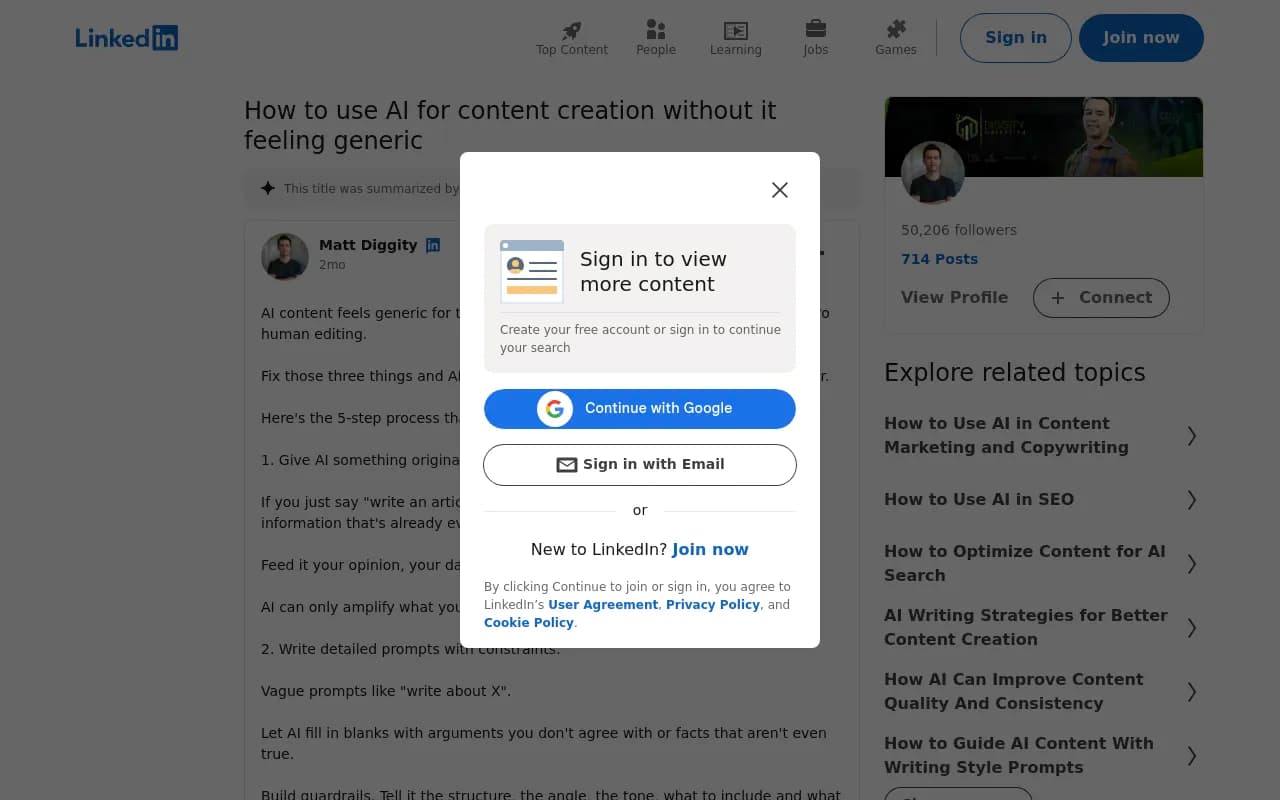
The issue is context. Generic prompts produce generic output because the AI has no specific information to work with. It defaults to the most common patterns in its training data—the same patterns that produced millions of mediocre blog posts.
Real citation data changes this equation completely. Instead of asking AI to write about a topic in the abstract, you're giving it concrete information about what actually works: which content gets cited by AI models, which prompts drive volume, which competitors dominate specific queries, and which gaps exist in the current landscape.
This isn't about gaming the system. It's about understanding what AI search engines value and systematically creating content that delivers it.
What Citation Data Actually Tells You
Citation data is fundamentally different from traditional SEO metrics. It's not about keywords or backlinks. It's about understanding how AI models discover, evaluate, and reference content when generating responses.
Modern AI visibility platforms track several key data points:
Citation Analysis: Which pages do AI models reference when answering prompts? Platforms like Promptwatch analyze hundreds of millions of AI responses to identify patterns. You see exactly which content structures get cited, which domains dominate specific topics, and which formats AI models prefer.

Prompt Volume & Difficulty: Not all prompts are equal. Some drive massive search volume but are dominated by established players. Others represent emerging opportunities with lower competition. Citation data reveals both the volume of searches for each prompt and the competitive landscape.
Query Fan-Outs: One prompt branches into dozens of related queries. Understanding these relationships helps you create comprehensive content that captures multiple entry points instead of narrow, single-topic articles.
Competitor Gap Analysis: See which prompts your competitors rank for but you don't. This isn't guesswork—it's a concrete list of content opportunities based on real AI search behavior.
Source Diversity: AI models cite various source types—official documentation, Reddit discussions, YouTube videos, research papers, and traditional websites. Citation data shows which formats work best for different topics.
Building the Automated Content Pipeline
The goal isn't to replace human oversight—it's to automate the research, structure, and initial drafting so your team can focus on refinement and strategic decisions. Here's how to build a system that generates content based on real citation data instead of generic prompts.
Step 1: Identify Content Gaps with Answer Gap Analysis
Start by understanding where you're invisible. Answer Gap Analysis compares your AI visibility against competitors across thousands of prompts. The output is a prioritized list of content opportunities—specific prompts where competitors get cited but you don't.
This isn't keyword research. You're not looking at search volume in Google. You're analyzing which questions AI models are answering, how often users ask them, and who's getting cited in the responses.
Platforms like Promptwatch automate this analysis by:
- Tracking your brand mentions across ChatGPT, Perplexity, Claude, Gemini, and other AI models
- Comparing your visibility to competitors for each prompt
- Calculating prompt volumes and difficulty scores
- Identifying query fan-outs that reveal related content opportunities
- Surfacing Reddit discussions and YouTube videos that influence AI recommendations
The result is a content roadmap grounded in real data. You know exactly which articles to create, which angles to cover, and which competitors you're competing against.
Step 2: Generate Content with AI Agents Trained on Citation Patterns
Once you've identified the gaps, the next step is content creation. This is where most automated systems fail—they use generic prompts that produce generic output.
The breakthrough is using AI writing agents that incorporate citation data directly into the generation process. Instead of "write an article about X," the prompt includes:
- Citation patterns: Which content structures consistently get cited for this topic? Long-form guides? Comparison tables? Step-by-step tutorials?
- Competitor analysis: What angles are competitors covering? What's missing from their content?
- Prompt context: What specific questions are users asking? What persona is asking them?
- Source diversity: Should this article include data from research papers? Reddit discussions? YouTube tutorials?
- Query fan-outs: Which related prompts should this article address to maximize coverage?
This level of context transforms the AI's output. Instead of generic filler, you get content engineered for AI visibility—articles that address the specific questions AI models want answers to, in the formats they prefer to cite.
Platforms with built-in AI writing agents (like Promptwatch's content generator) automate this process. The agent pulls citation data, analyzes competitors, identifies gaps, and generates drafts that incorporate all this context. You're not writing prompts manually—the system does it based on 880M+ citations analyzed.
Step 3: Optimize for Multiple AI Models
Different AI models have different preferences. ChatGPT favors comprehensive, well-structured content with clear headings. Perplexity prioritizes recent, authoritative sources with strong citations. Claude prefers nuanced, balanced perspectives.
Your automated system should account for these differences. When generating content, consider:
Structure: Use clear H2 and H3 headings that map to common user questions. AI models parse content hierarchically—good structure improves citation likelihood.
Recency: Include current data, recent examples, and up-to-date references. AI models prioritize fresh content for time-sensitive topics.
Authority signals: Link to authoritative sources, include data from research studies, and reference expert opinions. AI models evaluate source credibility.
Comprehensiveness: Cover the topic thoroughly. AI models prefer content that addresses multiple angles over narrow, single-focus articles.
Format diversity: Include tables, lists, code blocks, and examples where appropriate. Different formats serve different query types.
The best automated systems generate content that works across all major AI models, not just one. This maximizes your visibility and reduces the need for model-specific optimization.
Step 4: Track Results and Close the Loop
Automated content generation only works if you measure results. Without tracking, you're publishing blind—no idea if your content is getting cited, driving traffic, or generating revenue.
The measurement layer should include:
Page-level citation tracking: Which specific pages are AI models citing? How often? In response to which prompts? This tells you what's working and what's not.
Visibility score trends: Is your overall AI visibility improving? Track your score over time to see if your content strategy is moving the needle.
Prompt coverage: Are you closing the gaps identified in Step 1? Track how many high-priority prompts you've addressed and how your visibility has changed for each.
Traffic attribution: Connect AI visibility to actual website traffic. Use code snippets, Google Search Console integration, or server log analysis to see which AI citations drive clicks.
Revenue impact: For e-commerce and SaaS companies, tie AI visibility to conversions. Which AI-cited pages drive the most revenue?
This closed-loop system—identify gaps, generate content, measure results, iterate—is what separates optimization platforms from monitoring dashboards. Most competitors (Otterly.AI, Peec.ai, AthenaHQ, Search Party) stop at tracking. They show you data but leave you stuck. The best systems help you take action.
Otterly.AI


Advanced Techniques for Citation-Based Content Generation
Once you have the basic pipeline running, several advanced techniques can improve results:
Persona-Based Prompting
Different users ask the same question in different ways. A technical buyer asks "What's the API rate limit for X?" while a business buyer asks "How much does X cost at scale?" Citation data reveals these persona differences.
Advanced systems generate multiple versions of the same content, each optimized for a different persona. The technical version includes code examples, API documentation, and implementation details. The business version focuses on ROI, case studies, and pricing.
This isn't duplicate content—it's targeted content that addresses different user needs. AI models cite the version that best matches the user's query.
Reddit and YouTube Integration
AI models increasingly cite Reddit discussions and YouTube videos, especially for product recommendations and how-to queries. Your automated system should account for this.
Analyze which Reddit threads and YouTube videos AI models cite for your target prompts. What questions are users asking? What answers are getting upvoted? What content gaps exist?
Use these insights to inform your content strategy. If Reddit discussions dominate a topic, consider creating content that addresses the same questions with more depth and authority. If YouTube tutorials are getting cited, create video content or comprehensive written guides that complement the videos.
Multi-Language and Multi-Region Optimization
AI search is global. Users in different countries ask different questions, and AI models cite different sources based on language and region.
Advanced systems track AI visibility across multiple languages and regions. They identify country-specific content gaps and generate localized content that addresses regional differences.
This isn't machine translation—it's content creation that accounts for cultural context, local examples, and region-specific questions. The result is content that ranks in AI search globally, not just in your home market.
Crawler Log Analysis
AI models discover content by crawling websites, just like traditional search engines. But AI crawlers behave differently—they focus on different pages, crawl at different frequencies, and encounter different errors.
Platforms with crawler log analysis (like Promptwatch) show you exactly which pages AI models are reading, how often they return, and what errors they encounter. This reveals indexing issues that hurt AI visibility.
Use this data to optimize your automated content pipeline. If AI crawlers aren't discovering new content quickly, adjust your sitemap and internal linking. If they're hitting errors on key pages, fix the technical issues. If they're ignoring certain content types, adjust your format strategy.
Common Pitfalls and How to Avoid Them
Even with citation data, automated content generation can go wrong. Here are the most common mistakes and how to avoid them:
Pitfall 1: Over-Automation Without Human Review
Automation speeds up content creation, but it doesn't eliminate the need for human oversight. AI-generated content can be factually incorrect, tonally off-brand, or strategically misaligned.
The solution: build review into your workflow. Use automation to generate drafts, but have human editors review, refine, and approve before publishing. The goal is to 10x your output, not to eliminate quality control.
Pitfall 2: Ignoring Technical SEO
Citation data tells you what to write, but technical SEO determines whether AI models can find and cite your content. If your site has crawl errors, slow load times, or poor mobile experience, even great content won't get cited.
The solution: run regular technical audits. Fix crawl errors, optimize page speed, ensure mobile responsiveness, and maintain a clean site structure. Technical excellence is the foundation for AI visibility.
Pitfall 3: Chasing Every Prompt
Not all prompts are worth targeting. Some have low volume, high competition, or poor commercial intent. Trying to cover everything dilutes your efforts.
The solution: prioritize ruthlessly. Focus on high-volume, winnable prompts that align with your business goals. Use difficulty scores and competitive analysis to identify the best opportunities.
Pitfall 4: Neglecting Content Updates
AI models prioritize fresh content. Articles published six months ago may no longer get cited, even if they were initially successful.
The solution: build content updates into your workflow. Use citation tracking to identify pages that are losing visibility, then refresh them with new data, updated examples, and current references. Treat content as a living asset, not a one-time publication.
Pitfall 5: Ignoring Traffic Attribution
Visibility doesn't equal traffic. You can rank highly in AI responses but still see no website visits if users get complete answers without clicking.
The solution: track traffic attribution. Use code snippets, Google Search Console integration, or server log analysis to connect AI citations to actual clicks. Optimize for prompts that drive traffic, not just visibility.
Tools and Platforms for Citation-Based Content Automation
Several platforms support citation-based content generation, but they vary significantly in capabilities:
Full-Stack Optimization Platforms: These platforms (like Promptwatch) offer the complete workflow—gap analysis, AI content generation, citation tracking, crawler logs, and traffic attribution. They're designed for teams that want to optimize AI visibility end-to-end.
Monitoring-Only Dashboards: Platforms like Otterly.AI, Peec.ai, and AthenaHQ track AI citations but don't help you create content. They're useful for measurement but leave you stuck when it comes to taking action.

Traditional SEO Tools with AI Features: Semrush and Ahrefs have added AI search tracking, but their focus remains traditional SEO. They use fixed prompt sets and lack the depth needed for serious AI optimization.
Content Generation Tools: Platforms like Jasper, Copy.ai, and Writesonic generate content but don't incorporate citation data. They're useful for general content creation but not optimized for AI visibility.

The best choice depends on your goals. If you want to monitor AI visibility, a tracking dashboard works. If you want to actually improve AI visibility, you need a platform that helps you create and optimize content based on real citation data.
Measuring Success: KPIs for Citation-Based Content
How do you know if your automated content pipeline is working? Track these key metrics:
Citation Rate: What percentage of your target prompts cite your content? This is the core AI visibility metric.
Visibility Score Trends: Is your overall AI visibility improving over time? Track your score across all monitored prompts.
Content Gap Closure: How many high-priority gaps have you addressed? Track the percentage of target prompts where you've published content.
Traffic from AI Search: How many website visits come from AI citations? Use attribution tracking to measure actual traffic.
Revenue from AI Traffic: For e-commerce and SaaS, track conversions from AI-attributed traffic. This connects AI visibility to business results.
Content Velocity: How many AI-optimized articles are you publishing per month? Track output to ensure your pipeline is scaling.
Time to Citation: How long does it take for new content to get cited by AI models? Faster citation indicates better optimization.
These metrics tell you whether your automated system is delivering results or just generating content.
The Future of Citation-Based Content Automation
AI search is evolving rapidly. In 2026, we're seeing several trends that will shape the future of content automation:
Multimodal Content: AI models are increasingly citing images, videos, and audio alongside text. Future content systems will need to generate and optimize across all formats.
Real-Time Optimization: As AI models update more frequently, content optimization will need to happen in real-time. Static content strategies won't keep up.
Personalized Responses: AI models are getting better at tailoring responses to individual users. Content systems will need to generate variations optimized for different personas and contexts.
Deeper Integration: The line between content creation and AI visibility tracking will blur. The best systems will automatically identify gaps, generate content, publish it, and measure results—all without manual intervention.
Attribution Sophistication: As AI search matures, attribution will become more complex. Platforms will need to track not just citations but also the quality of citations, the context in which they appear, and the downstream impact on conversions.
The companies that win in AI search will be those that build systems capable of adapting to these changes. Citation-based content automation isn't a one-time setup—it's an ongoing process of measurement, optimization, and iteration.
Getting Started: Your First 30 Days
Ready to build your own citation-based content pipeline? Here's a practical 30-day roadmap:
Week 1: Audit Your Current AI Visibility
- Sign up for an AI visibility platform (Promptwatch offers a free trial)
- Add your domain and key competitors
- Run an initial Answer Gap Analysis to identify content opportunities
- Review which prompts competitors rank for but you don't
Week 2: Prioritize Content Opportunities
- Export your content gap data
- Score opportunities based on prompt volume, difficulty, and business relevance
- Select 10-15 high-priority prompts to target first
- Map each prompt to a content format (guide, comparison, tutorial, etc.)
Week 3: Generate and Publish Initial Content
- Use an AI writing agent to generate drafts for your priority prompts
- Review and refine each draft with human editors
- Optimize for technical SEO (structure, speed, mobile)
- Publish and submit to AI crawlers
Week 4: Measure and Iterate
- Track citation rates for your new content
- Monitor visibility score changes
- Analyze traffic attribution to see which content drives clicks
- Identify what's working and adjust your pipeline accordingly
After 30 days, you'll have a working system and real data on what works. From there, scale up—add more prompts, increase content velocity, and refine your optimization process.
Conclusion: From Generic Prompts to Citation-Driven Content
The difference between generic AI content and content that actually ranks in AI search comes down to one thing: context. Generic prompts produce generic output because they lack the specific information AI needs to create valuable content.
Citation data provides that context. It shows you what AI models actually cite, which prompts drive volume, which competitors dominate specific topics, and which gaps exist in the current landscape. Armed with this information, AI writing agents can generate content that's optimized for AI visibility from the start.
The workflow is simple: find gaps with Answer Gap Analysis, generate optimized content with AI agents trained on citation data, track results with page-level citation tracking and traffic attribution, and iterate based on what works. This closed-loop system—identify, create, measure, optimize—is what separates companies that win in AI search from those that publish blind.
In 2026, AI search isn't a future trend—it's the present reality. 60% of AI searches end without a click. Users get complete answers from ChatGPT, Perplexity, and Claude without ever visiting a website. For brands, this means AI visibility is no longer optional. It's the difference between being part of the conversation and being invisible.
The companies that succeed will be those that build systems capable of understanding what AI models want, creating content that delivers it, and measuring the results. Citation-based content automation isn't about replacing human creativity—it's about giving humans the data and tools they need to create content that actually ranks.
Start with the basics: audit your AI visibility, identify content gaps, generate optimized content, and measure results. Then scale up. The opportunity is massive, and the companies that move first will build an advantage that's hard to overcome.