Key takeaways
- Brandlight does not publish pricing. Third-party estimates put entry around $199–$750/month, with enterprise contracts reportedly ranging from $4,000 to $15,000+ per month, and engagements start with a paid 3-month pilot rather than a free trial.
- G2 reviewers report an average of 2 months to implement and 7 months to see ROI. That payback window matters more than the sticker price when you model the real cost.
- Surprisingly, mid-market reviewers (51–1,000 employees) are Brandlight's largest reviewer segment on G2: 110 of 194 reviews, about 57%.
- AI citation results are volatile. ChatGPT's Reddit citation share dropped from roughly 4% to 0.5% in a single day in August 2026, which means any visibility score can swing for reasons that have nothing to do with your content.
- Brandlight is worth it if you have a dedicated AI marketing owner, multiple markets or brands, and procurement that can absorb a sales-led contract. For everyone else, self-serve platforms with transparent pricing often deliver 80% of the value at 20% of the cost.
What Brandlight actually is
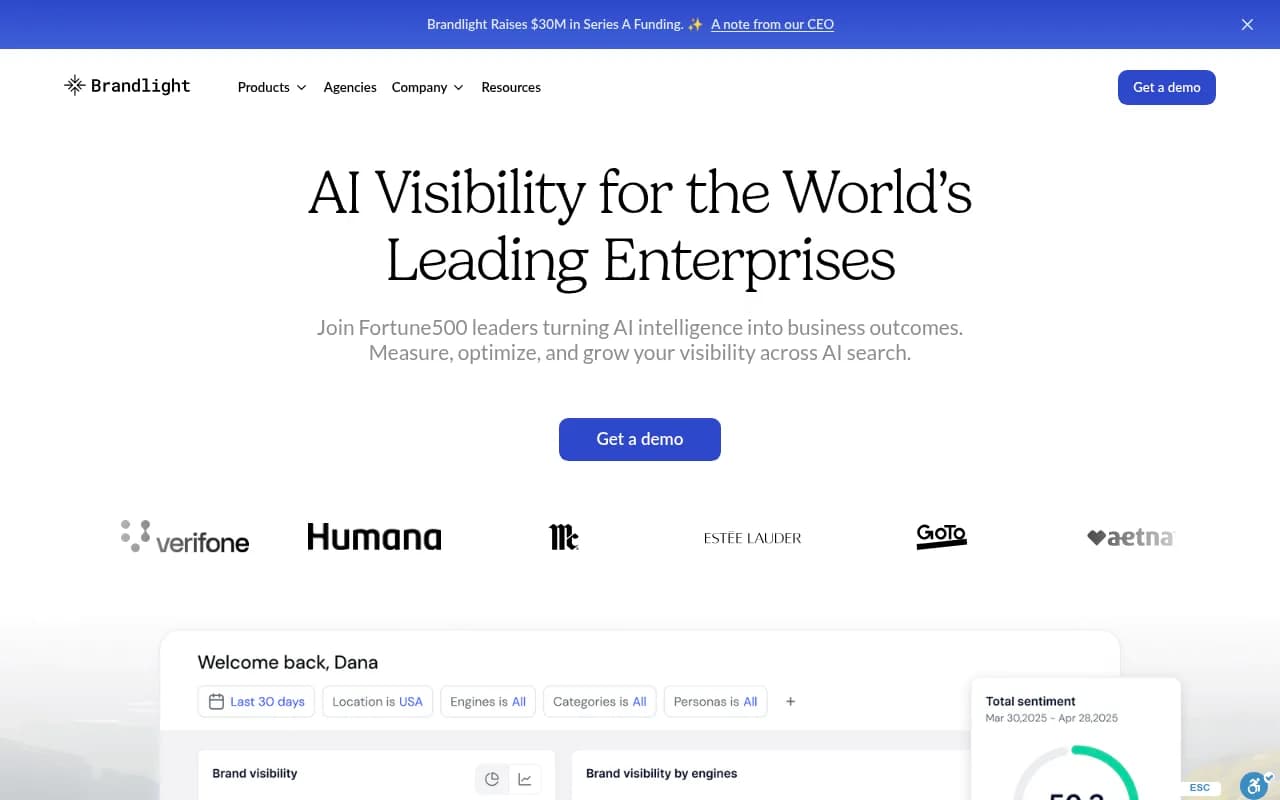
Brandlight is an enterprise AI visibility platform that tracks how brands appear in AI-generated answers across ChatGPT, Gemini, Claude, Perplexity, Microsoft Copilot, and Google's AI surfaces. It layers sentiment analysis, citation tracking, competitive benchmarking, technical health audits, and a multi-brand command center on top of that monitoring. Its own framing is a four-stage loop: See, Shape, Act, Transform.
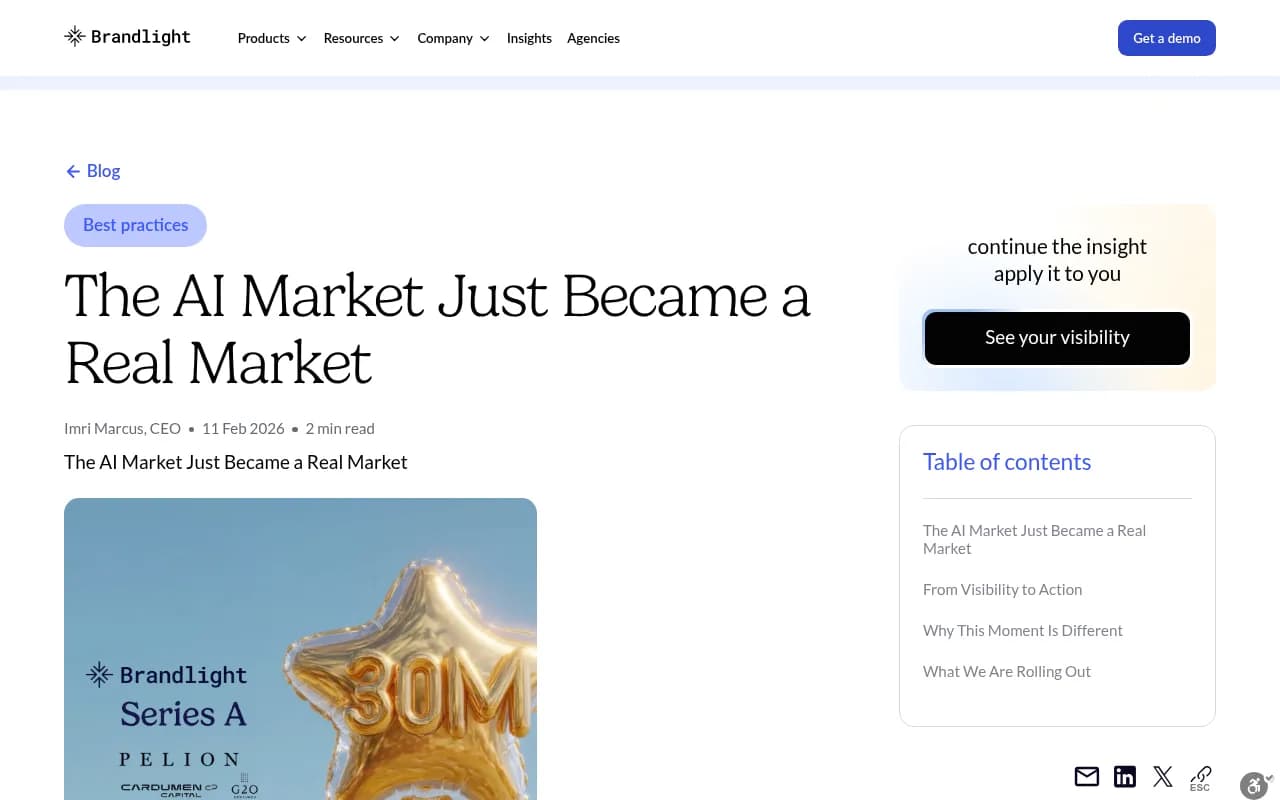
The company raised a $30M Series A in February 2026, led by Pelion Ventures, and is expanding from visibility monitoring into AI Ads and AI Commerce. CEO Imri Marcus's framing is blunt: in 2025 AI became the dominant discovery surface, and in 2026 it becomes the store. That's a credible thesis, and the customer list backs up the enterprise positioning: Volkswagen, LG, TD Bank, Estée Lauder, and a Kimberly-Clark engagement where Brandlight reports moving 12 of 12 brands into the top three across major LLMs.
This is a serious product built by a well-funded team. The question for a mid-market buyer is not whether Brandlight works. It's whether the way it's sold and scoped fits a team of 20, 50, or 200 people.
The pricing reality for mid-market teams
Here's the first wall you hit: Brandlight publishes no pricing. Its /pricing page returns a 404, G2 confirms there's no free trial and no listed tiers, and the company's own blog states that engagements typically begin with a paid 3-month pilot scoped to dashboards, markets, and lines of business.
Third-party estimates fill the gap, and they vary widely:
| Source | Estimated Brandlight pricing |
|---|---|
| LLM Pulse comparison | ~$199/mo entry, $4K–$15K/mo enterprise |
| getaiso.com | $199/mo to $750+/mo tiers |
| G2 reviewer comment | "can reach $750/month" |
| CheckThat.ai summary | Custom quote, sales-led |
Treat all of these as directional. The point is that you cannot budget for Brandlight without a sales call, and the entry point is not the number that matters. Pricing scales on prompt volume, brand count, and team size, so a mid-market team with two markets and a handful of competitors can easily land well above the advertised floor.
There's also a hidden cost the pricing conversations never mention: time to value. G2's user-submitted data puts average implementation at 2 months. Add the sales cycle itself, plus the pilot, and you're realistically 4–6 months from first demo to a working dashboard. For a Fortune 500 marketing org, that's Tuesday. For a mid-market team that needed answers last quarter, it's a real cost.
What the G2 data actually says
The review data is where this gets interesting, because it complicates the "enterprise-only" narrative.
Brandlight sits at 4.8/5 from 194 reviews on G2, with 96% five-star ratings. And the company-size breakdown of those reviewers: 110 mid-market (51–1,000 employees), 42 small business, 36 enterprise. Mid-market buyers are the majority of people actually reviewing the product.
That cuts both ways. It suggests mid-market teams do buy and like Brandlight. It also suggests a lot of them went through the sales process and came out the other side, which means the pricing is survivable at that tier, at least for teams with real budgets. G2's own AI-generated pricing summary puts it well: the platform suits "mid-market and enterprise organizations with dedicated marketing, SEO, PR, or content teams," while small businesses and lightweight agencies may find the pricing and feature depth disproportionate.
The two numbers I'd anchor any ROI model to:
- Time to implement: 2 months (G2 average)
- Return on investment: 7 months (G2 average)
Seven months to payback is not bad for a marketing technology investment. But it means your first year is mostly cost, and your ROI case rests entirely on what happens in months 8 through 12 and beyond.
A realistic ROI model for a mid-market team
Let's build the math with plausible mid-market assumptions. Say you're a 150-person B2B SaaS company with one primary market and two secondary ones.
Costs:
| Item | Estimate |
|---|---|
| Platform (mid-tier, 2 markets) | $1,500–$4,000/mo |
| Paid 3-month pilot (upfront) | $4,500–$12,000 |
| Internal time: 0.5 FTE to act on insights | $4,000–$6,000/mo |
| First-year total | roughly $30K–$60K+ |
The internal time line is the one everyone forgets. A visibility platform that tells you what to fix still needs someone to fix it. Brandlight's content generation runs through a multi-agent workflow with brand and legal guardrails, which helps, but drafts still route to humans for review rather than auto-publishing. That's the right design for an enterprise with a legal department. It's also a reminder that the platform doesn't replace the work.
Returns: This is where honest modeling gets hard, because AI visibility ROI is indirect. Seer Interactive found brand search volume correlates with AI mentions at just 0.18, and Ahrefs' study of 75,000 brands found branded search volume correlates with AI Overview visibility at 0.392. Those are modest correlations. AI visibility mostly works through delayed, indirect effects: buyers ask ChatGPT for a shortlist, your name shows up, and weeks later they search for you directly. There's no clean last-click attribution, which is why Similarweb argues AI mentions should be valued like reach-based advertising rather than performance marketing.
A reasonable mid-market framing: if AI-assisted discovery influences even 20–30 additional deals or purchases a year at your average deal size, the platform pays for itself. If your average deal is $500 a year, it probably doesn't. High-LTV B2B, finance, and e-commerce brands clear the bar easily. Low-ticket, high-volume businesses need to think harder about it.
The volatility problem nobody prices in
Here's the part of the ROI conversation that most vendors gloss over, and it matters for evaluating any platform's reported results, Brandlight included.
AI citations are wildly unstable month to month. Profound's research found that 40–60% of cited domains change monthly across answer engines, even for the same questions. And Promptwatch's data documented reddit.com's share of ChatGPT Search citations collapsing from roughly 4% to 0.5% in a single day in August 2026. Reddit had been the single most-cited domain in ChatGPT Search, holding 3.71% of all citations in June 2026, more than six times the runner-up. That share evaporated overnight because of a change OpenAI made, not anything any brand did.
The practical implication: a visibility score can swing significantly with zero change in your underlying content. If your vendor shows you a before-and-after chart with a 3-month window, ask how much of that movement is them and how much is the engine reshuffling its sources. Any ROI case built on a short observation window is mostly noise.
The other structural fact worth knowing: there just aren't many slots to win. Promptwatch's analysis of average sources per response found ChatGPT cites roughly five sources per web-search answer, while Google AI Overviews cites around ten. Every answer is a much smaller inventory than a ten-blue-link SERP, and even the top domain holds under 4% of ChatGPT citations. The good news for mid-market teams: the majority of citations go to a long tail of smaller, specialized sites, so AI search is far less winner-take-all than Google ever was. You can compete. You just can't expect dominance.
One more data point that justifies spending on AI visibility regardless of vendor: Ahrefs found only about 12% of URLs cited by AI assistants also rank in Google's top 10. Your classic SEO metrics won't predict your AI citation performance. This is a separate discipline, and it needs its own measurement.
When Brandlight is worth it (and when it isn't)
Brandlight makes sense if:
- You have a dedicated owner for AI search, even a single person whose job includes acting on the insights
- You operate multiple brands, markets, or lines of business that need a command-center view
- Your procurement process handles sales-led contracts fine and your budget is $40K+/year for this category
- You need enterprise compliance posture (closed-network processing, SOC 2-level review) to get the purchase approved
- You're a consumer brand that cares about the AI Commerce and retail-recommendation surfaces Brandlight is building toward
It's probably the wrong buy if:
- You're still trying to figure out whether AI search matters for your category (start with a free or cheap tracker instead)
- You need to show results within a quarter. The 2-month implementation plus 7-month payback makes that impossible
- You're an agency that needs to evaluate before committing client money to a pilot
- Your team would use 10% of the feature set and pay for the other 90%
How the alternatives stack up
The AI visibility market has matured fast, and mid-market teams have real options with published pricing. Here's the honest comparison:
| Tool | Entry price | Free trial | Public pricing | Best for |
|---|---|---|---|---|
| Brandlight | Custom (~$199–$750+/mo est.) | No, paid 3-month pilot | No | Enterprise, multi-brand, multi-market |
| Profound | $99/mo (ChatGPT-only), $399/mo for 3 platforms | Trial available | Partial | Enterprise with self-serve entry |
| Promptwatch | $95/mo, most plans under $600/mo | 7-day free trial | Yes | Teams that want tracking plus automated content fixes |
| Peec AI | ~€89/mo, unlimited seats | No-credit-card trial | Yes | Agencies and mid-market, budget-conscious |
| LLM Pulse | €49/mo | Yes | Yes | Small teams, straightforward monitoring |
| Scrunch AI | $250/mo Core | 7 days | Yes | Technical SEO crossover, enterprise |
| AthenaHQ | Free tier, $295/mo Starter | Free plan | Yes | Content-led teams |
A few notes on the standouts:
Profound is the closest enterprise rival, with a $96M Series C at a $1B valuation and customers like Indeed, Expedia, and Uber. It has self-serve entry pricing, which immediately lowers the barrier Brandlight puts up. If you want the enterprise-grade route without the mandatory sales call, start here.
Profound

Promptwatch takes a different angle on the ROI problem: instead of stopping at monitoring, its agents plan, write, and publish GEO-optimized content to your CMS and generate a prioritized action list from your visibility data. That matters for the payback math above, because the internal content labor line is where mid-market ROI goes to die. If a platform can close the gap between "here's what's wrong" and "here's the fixed page," your 7-month payback shrinks. It also tracks surfaces most competitors ignore, including Reddit and YouTube citations, ChatGPT shopping results, and AI crawler logs showing when bots visit your pages and what they read.
Promptwatch starts at $95/month with published tiers up to $579/month, and agency plans with unlimited projects. For a mid-market team, that's a monthly line item instead of a procurement project.

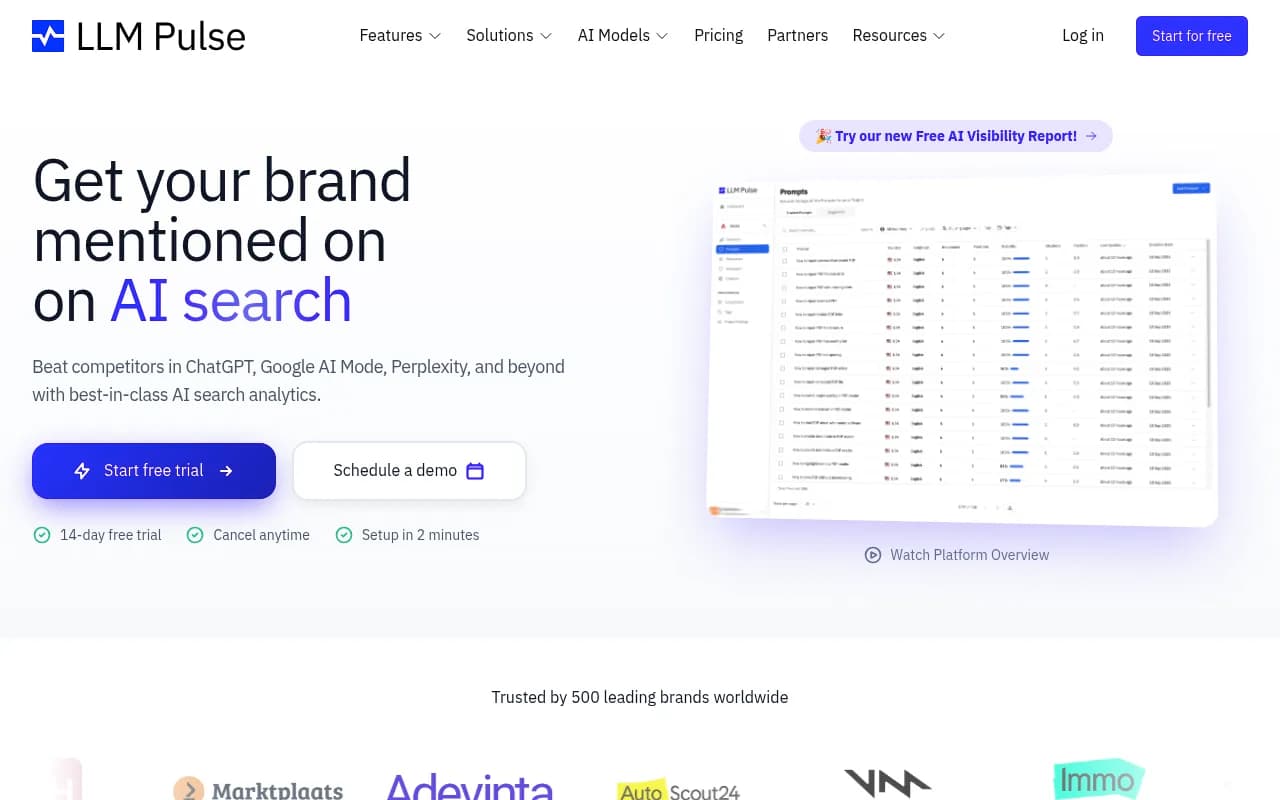
Peec AI and LLM Pulse are the budget end, both with published pricing and trials. Peec AI's unlimited seats are genuinely useful for mid-market teams where three people need dashboard access without a per-seat multiplier. LLM Pulse at €49/month is the cheapest credible option if you just need to know where you stand.

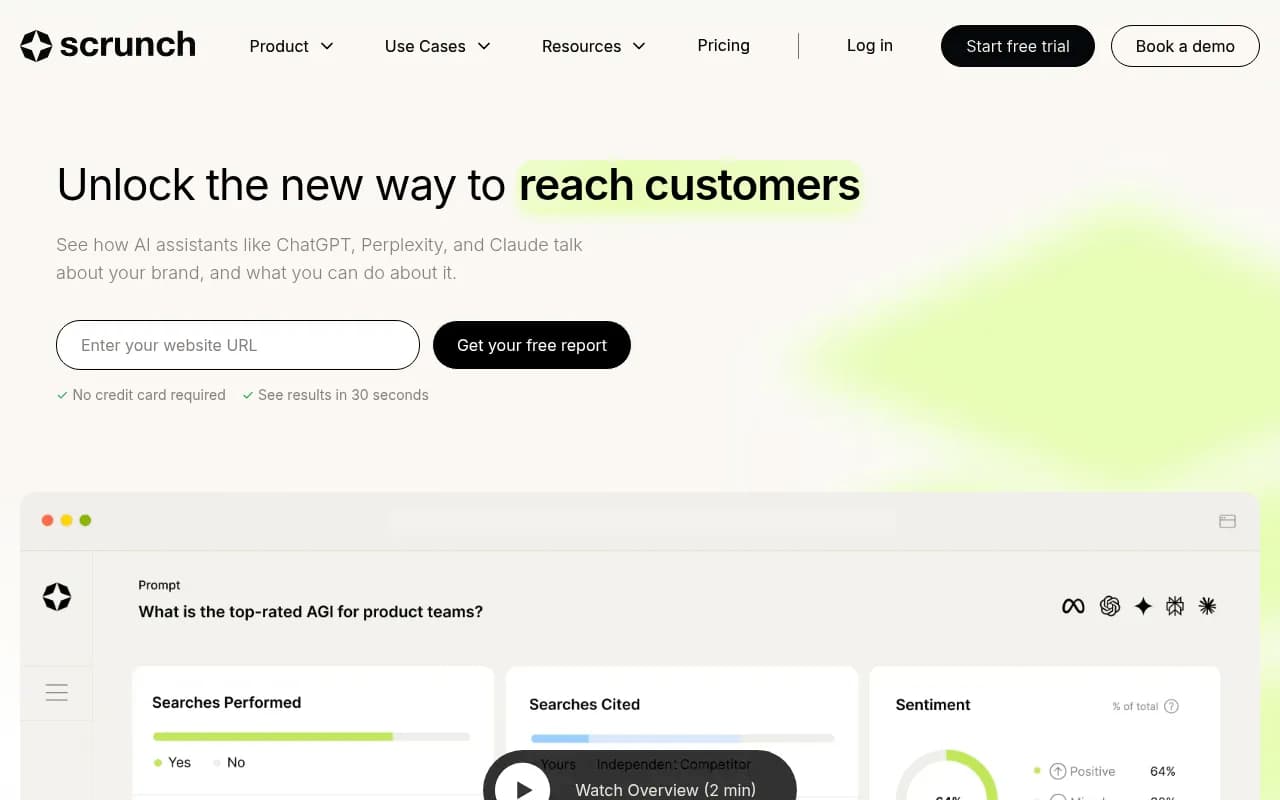
Scrunch AI sits in the middle at $250/month with a technical SEO emphasis, which suits teams whose AI visibility problems are crawlability problems. And AthenaHQ has a free tier, which makes it the natural first step if you're not yet sure this category deserves budget at all.

If you want to browse the full category rather than take my word for it, the GEO software directory at bestgeosoftware.com covers most of the credible players with pricing details.
A decision framework you can actually use
Before you book any demo, run this sequence:
- Establish a baseline for free. Run your brand through a free AI visibility report or a free-tier tool. If ChatGPT, Gemini, and Perplexity already recommend you for your core prompts, your problem is optimization, not discovery, and you may not need an enterprise platform to fix it.
- Define the prompts that matter commercially. Not 500 prompts. The 15–25 buying-intent prompts where appearing or not appearing moves revenue. Any platform's value is concentrated here.
- Set the measurement window before you buy. Given that 40–60% of cited domains churn monthly, commit to month-over-month deltas against a benchmark over at least two quarters. Reject any vendor case study built on a shorter window.
- Price the internal labor honestly. A monitoring tool with no execution capacity costs you a content team's time. A platform that generates and publishes fixes changes that math. This is often a bigger cost difference than the subscription itself.
- Match the contract to your certainty level. If you're past step 3 and know you need enterprise depth, Brandlight's pilot model is fine. If you're still forming a hypothesis, buy a $95–$400/month self-serve tool and revisit in six months.
The verdict
Brandlight is a good product from a well-capitalized company, and the G2 data shows mid-market teams genuinely like using it. But "worth it" depends on what you're buying. If you're buying enterprise-grade visibility infrastructure for a multi-brand, multi-market organization with a dedicated owner, the 7-month payback is defensible and the sales-led process is a fair trade for the depth you get.
If you're a mid-market team buying your first AI visibility tool, the honest answer is that Brandlight is more platform than you need at a price you can't verify without a sales call, attached to an implementation timeline that eats half your evaluation year. Start with a self-serve platform, prove that AI-driven discovery moves your numbers, and graduate to an enterprise contract when the data, not the demo, tells you to.