Key takeaways
- MCP (Model Context Protocol) lets an AI assistant call your GEO and SEO tools directly, so a prompt can pull live citation data instead of asking the model to guess.
- The 15 prompts below are grouped into citation gaps, competitor analysis, and content briefs. Each one names the data it needs and the output you should demand.
- Split every gap analysis by intent (commercial, informational, branded). Promptwatch Data shows each intent rewards a different mix of content types.
- Ask for evidence in every prompt: prompt text, cited URL, competitor, and a suggested action. Prompts that return only a summary are hard to act on.
- Run a full benchmark quarterly and a lighter gap check monthly. News content decays fast, so check it more often.
Why MCP changes how you write GEO prompts
Most GEO prompts you find online are written for a chat window with no data behind it. You paste "analyze my competitors' AI citations" into a model and it produces a confident essay built from its training data. That essay is not your data.
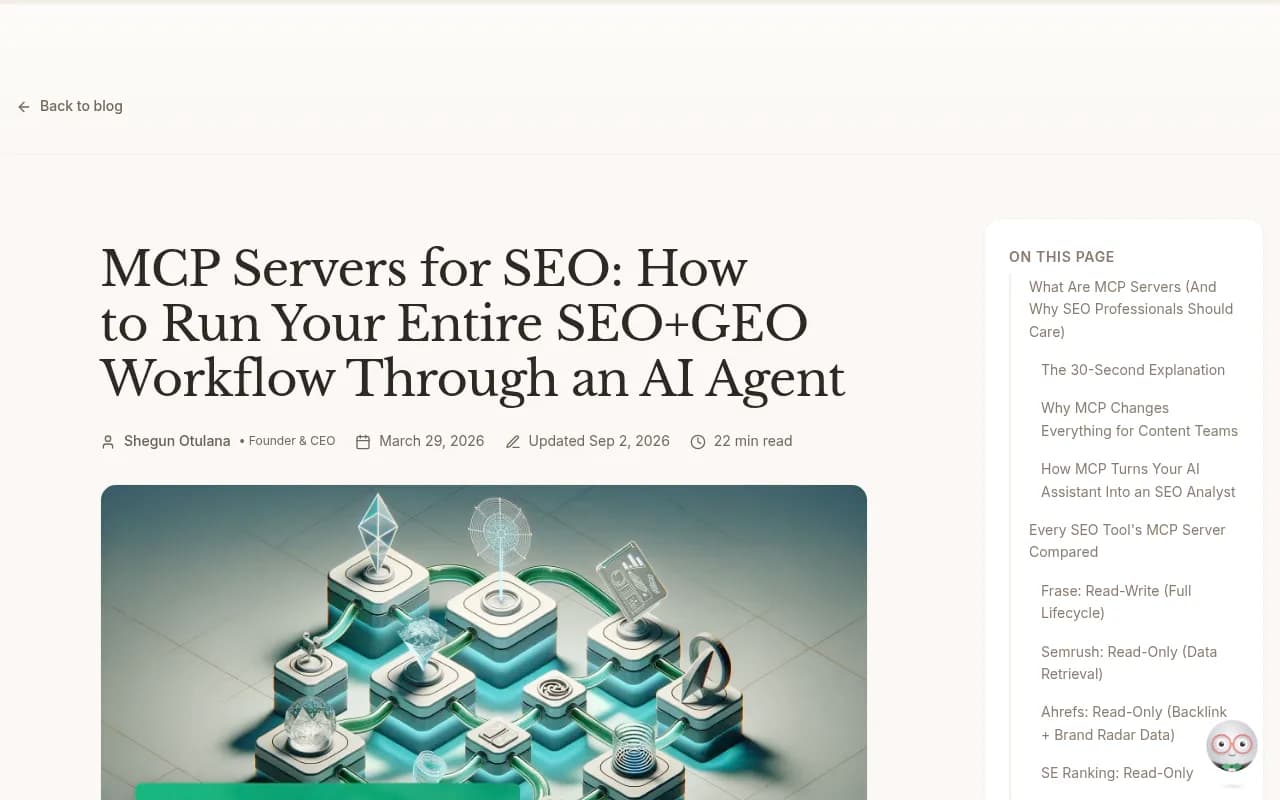
MCP fixes this. Model Context Protocol is an open standard Anthropic released in November 2024. It connects an AI assistant to external tools, so the assistant can call a keyword tool, an AI visibility tracker, or a crawler log and work with the real response. Frase's write-up on MCP servers for SEO describes the practical upside: you describe the job in plain English, and the assistant pulls live data and runs the workflow in one conversation.
That changes how you write prompts. With MCP, a good prompt does three things:
- Names the data source or tool call ("use the citation report", "pull crawler logs").
- Defines the scope (date range, country, model, prompt set).
- Specifies an output you can act on (a table, a ranked list, a brief).
Every prompt below follows that shape. Swap the bracketed placeholders for your own brand, competitors and topics.
What you need connected first
The prompts assume your assistant (Claude, Cursor, or another MCP client) has access to at least one AI visibility source. If you use Claude, you add an MCP server in settings and authorize it.
Promptwatch runs a hosted MCP server with 110+ tools covering prompts, citations, crawler logs, traffic, and content actions, plus an official Claude Connector, so the prompts below work against live data without custom glue code.

Other tools in this space also expose data to assistants or have APIs you can wire up. Check each vendor's docs for current MCP support before you commit, because coverage varies a lot and I did not verify the details for every tool.
| Data you want | What to look for in an MCP server | Prompt sections that use it |
|---|---|---|
| Prompt-level visibility and citations | Tools that list tracked prompts, answers, and cited URLs | Citation gaps, competitor analysis |
| AI crawler logs | Verified bot requests per page, with errors | Prompts 4 and 12 |
| Search Console and Bing data | Per-page clicks and queries | Prompts 5 and 13 |
| Content publishing | Draft and publish actions to your CMS | Content briefs |
Before you start: three rules that make these prompts work
Split by intent
Promptwatch Data's analysis of ChatGPT citations (Sep 28 to Oct 4, 2026) found that product pages are the most cited type at 22.4%, followed by landing pages at 16.8% and listicles at 13.6%. But the mix shifts a lot by intent. For commercial prompts, product pages hit 26.0% and landing pages 20.6%. For informational prompts, how-tos (10.7%) and documentation (8.5%) climb. For branded prompts, reviews reach 5.6%, about three times their share across all prompts.
So a single "where are we missing?" prompt blends three different problems. Run the gap analysis once per intent, or tell the assistant to segment it.
Use real prompt data, not keywords
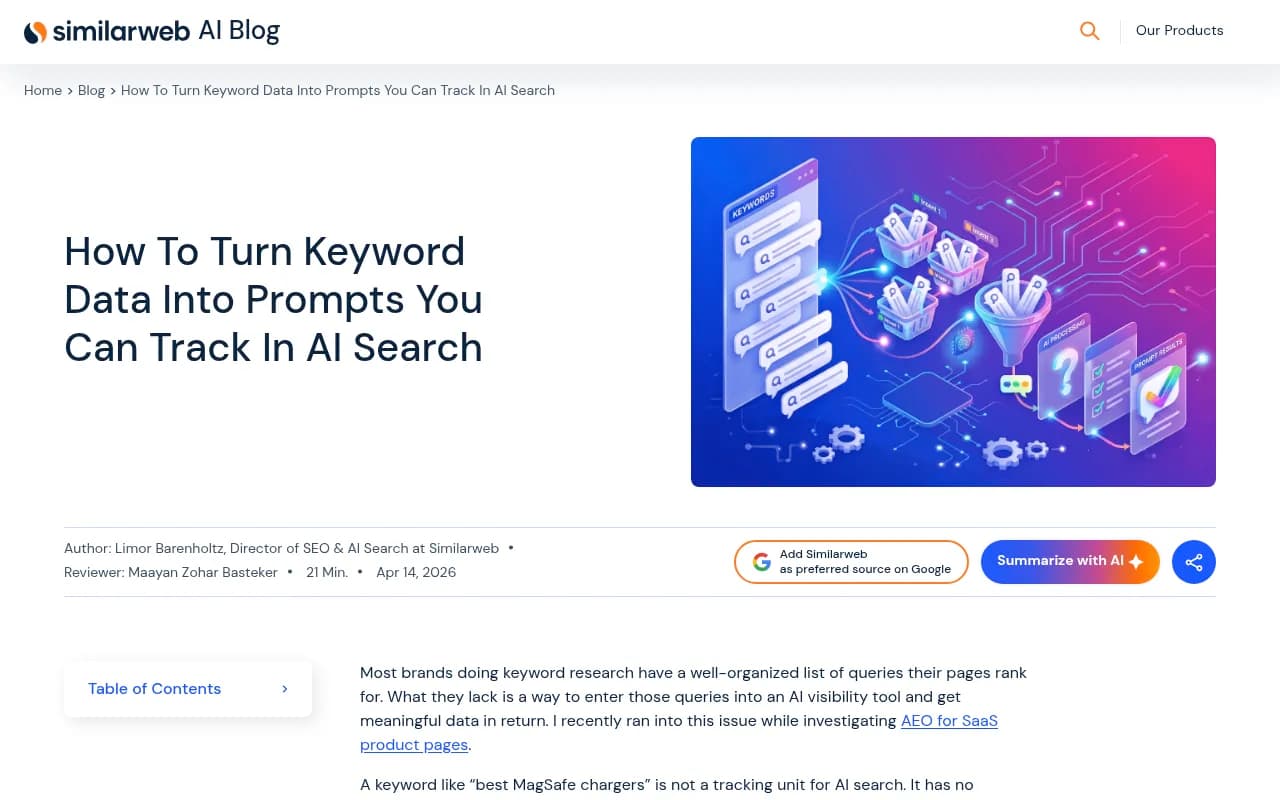
A keyword like "best MagSafe chargers" is not a trackable unit in AI search. Similarweb's walkthrough makes the point that you need a full conversational question, roughly 10 to 25 words, phrased the way a real user would type it into ChatGPT or Perplexity. Keep that in mind when a prompt below says "tracked prompts".
Demand evidence
Every prompt asks for the underlying row of data: the prompt text, the model, the cited URL, and the competitor. If the assistant cannot supply them, it is guessing, and you should say so and rerun.
Citation gap prompts (1 to 5)
A citation gap is a prompt where AI engines cite other sources and not you. As Presspage notes in its GEO content strategy guide, GEO gaps are not SEO gaps: look at AI mentions and citations, not just rankings. These prompts hunt for them.
Prompt 1: the baseline gap list
Using my AI visibility data for [brand] over the last 30 days, list every tracked prompt where at least one competitor is cited and [brand]'s domain is not. For each, return: prompt text, AI model, country, the competitors cited, and the URLs cited. Sort by prompt volume descending. Return the top 25 as a table.
This is your starting point. Sorting by volume keeps you from chasing prompts nobody asks.
Prompt 2: gaps by intent
Take the gap list above and classify each prompt as commercial, informational, or branded. For each intent, tell me which content types (product page, landing page, listicle, how-to, documentation, comparison, FAQ, review) the cited competitor URLs fall into. Summarize the dominant content type per intent and what that implies for what we should publish.
This applies the intent split. If competitors win commercial prompts with comparison pages and you only have blog posts, you now know why.
Prompt 3: mentioned but not cited
Find prompts where [brand] is mentioned in the AI answer but our own domain is not cited as a source. For each, list which third-party URLs were cited instead and whether they are reviews, listicles, forums, or news. Flag any where the third-party page names us without linking.
Being named without being cited usually points to a content or crawlability problem on your own site. It can also mean a third-party page does the job better than yours. Promptwatch's Offsite Mentions report is built for the "named without a link" part of this.
Prompt 4: the crawl check
For the top 10 pages that should be cited for [topic] but are not, pull AI crawler logs for the last 30 days. Show which bots (GPTBot, OAI-SearchBot, ChatGPT-User, ClaudeBot, PerplexityBot) requested each page, the HTTP status they received, and any errors. Tell me which gaps look like access problems rather than content problems.
It is tempting to rewrite content when the page was never fetched. Check access first. Verified crawler logs matter here, since spoofed bot traffic will mislead you.
Prompt 5: ranks in Google, never cited by AI
Compare Search Console and Bing Webmaster data against AI citation data for [domain]. List pages with strong organic clicks over the last 90 days that were never cited in an AI answer. For each, show the top queries and suggest whether the page is missing a direct answer, a comparison, or structured facts.
This is a good one to run monthly. Pages that already rank are your cheapest GEO wins.
Competitor analysis prompts (6 to 10)
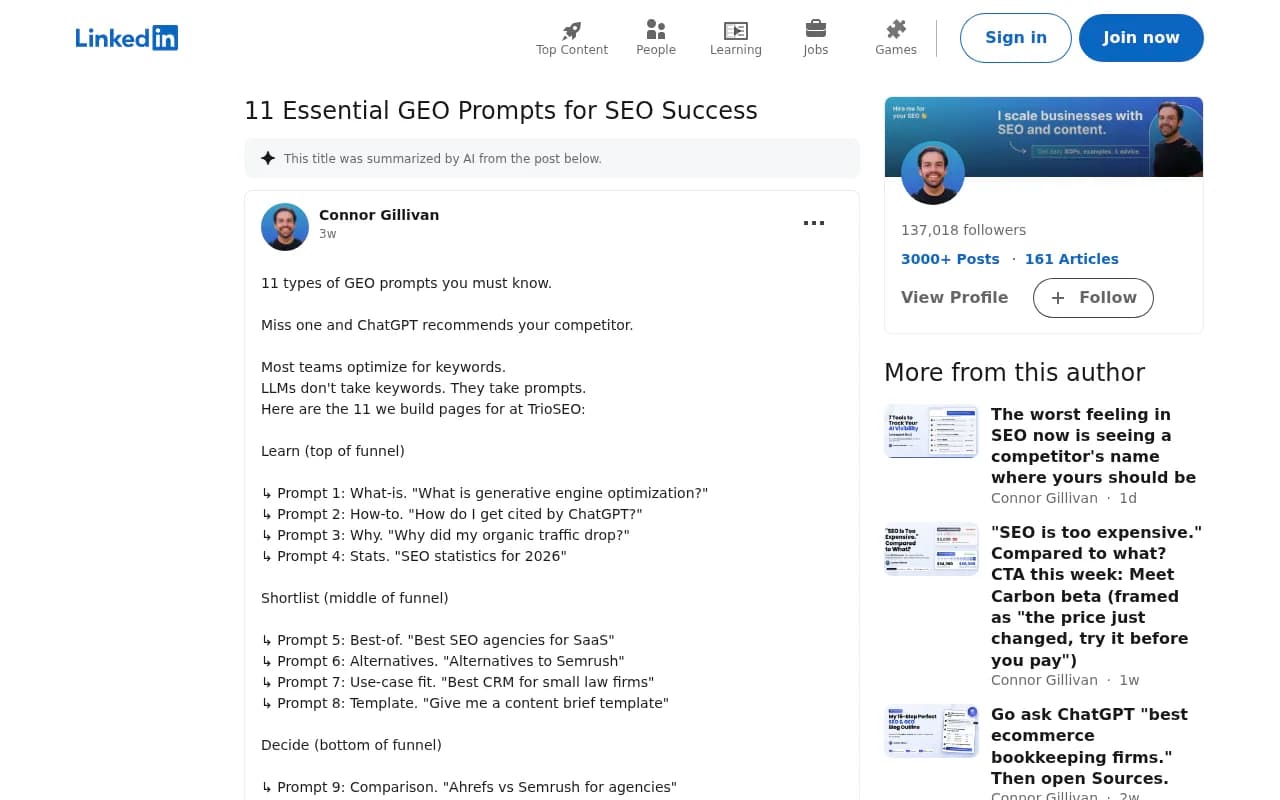
A useful competitor prompt shows why they win, not only that they do. LinkedIn's 11 types of GEO prompts post frames it well: you want keyword gaps, top pages, backlinks, SERP features, and AI citations in one view.
Prompt 6: who is winning share of voice
For the prompt set [topic or tag], rank [brand] and these competitors: [A], [B], [C], by share of voice, average position in the answer, and visibility score. Show the 30-day trend for each. Call out any competitor that gained more than 5 points and tell me which prompts drove the change.
Prompt 7: why a competitor gets cited
Take the top 10 competitor URLs most cited for [topic]. For each, summarize: content type, word count, heading structure, whether it contains a comparison table, pricing, original data, or a direct definition in the first 100 words, and when it was last updated. Then list the patterns shared by the five most-cited pages.
This is the prompt people skip, and it is the most useful. Patterns beat individual page opinions.
Prompt 8: comparison prompt gaps
List prompts containing "vs", "alternatives", "compared to", or "best" where [competitor] is cited and we are not. Group by the competitor named. For each group, tell me what page we would need (comparison, alternatives, or pricing page) and whether we already have a URL that could be improved.
OptimizeGEO argues the comparison category is where the fastest competitive gains sit. That matches what I see: these pages are specific, easy to scope, and tied to buying intent.
Prompt 9: off-site sources
For prompts where [competitor] is recommended, list the third-party domains cited alongside them: Reddit threads, YouTube videos, review sites, listicles, news. Rank domains by how often they appear. Identify the five off-site placements most worth pursuing for [brand].
Check the platform before you spend effort. Promptwatch's October 2026 data shows ChatGPT drew just 0.46% of its citations from social platforms, while Google AI Overviews drew 12.2%. A Reddit strategy pays off differently depending on the model. Reddit's share in ChatGPT also fell from about 4% to 0.5% on August 14, 2026.
Prompt 10: model-by-model differences
Build a heatmap of [brand] vs [competitor A] and [competitor B] across ChatGPT, Google AI Overviews, Google AI Mode, Perplexity, and Gemini on visibility and position. Where we lose in one model but win in another, explain the likely reason using the cited sources.
A competitor that dominates one model and is invisible in another usually has a source strategy, not a content strategy.
Content brief prompts (11 to 15)
The Medium guide on competitor analysis research prompts includes a simple brief prompt: target keyword, intent, title, H2 outline, internal links, word count. It works as a skeleton. Below I add the AI-search parts: fan-outs, evidence, and the questions the page must answer.
Prompt 11: brief from a citation gap
Take the prompt "[exact prompt]". Write a content brief for a page that could be cited for it. Include: target intent (commercial, informational, or branded), recommended content type based on what is being cited today, working title, H1 and H2s written as search-style queries, the direct answer to put in the first 100 words, facts and data points we must include, internal links, and 5 questions the page must answer. Base the content type on the cited competitor URLs, not on a generic template.
Prompt 12: brief with fan-outs
For the prompt "[exact prompt]", list the query fan-outs AI runs behind the scenes (the actual web searches). Group them into sub-questions. Then draft a brief where each sub-question gets its own H2 or a dedicated supporting page. Flag which sub-questions we already cover and which URLs cover them.
Promptwatch's fan-out data recommends headings that read like search queries and front-loading the entity and category in titles. One caveat: its report intro says a prompt can trigger 3 to 8+ searches, while the chart shows measured averages of roughly 1.8 to 2.2 per response in early 2026. Trust your own tool's numbers and treat the bigger figure as a ceiling.
Prompt 13: refresh brief for an existing page
For [URL], compare it against the three most-cited pages for [prompt]. List what is missing: sections, facts, tables, freshness, schema, and internal links. Return a prioritized edit list with the exact text to add or change, ordered by expected impact.
Refreshes are often cheaper than new pages. Freshness matters more for some types than others: Promptwatch Data's content half-life study found that news lost half its cited pages within 36 days, while landing pages and docs stayed cited much longer. So refresh news and trend content first.
Prompt 14: unified SEO and GEO brief
Create a content brief for [topic] that serves both Google and AI search. Include primary keyword, three supporting keywords, the prompts this page should win, the target citation type, a direct-answer paragraph, a comparison table spec, FAQ questions, schema to add, and a success metric for each: ranking, AI citation, and AI-referred visits.
The GEO content brief template from Indexable AI takes a similar approach, starting from the prompts where engines cite someone else. Your success metrics should include a citation and a visit, not only a ranking.
Prompt 15: the monthly report
Produce a monthly GEO brief for [brand]: (1) visibility score and share of voice vs last month, (2) five new citation gaps by intent, (3) pages that gained or lost citations, (4) crawler errors on key pages, (5) the three highest-impact content actions with a draft brief for each. Keep it to one page and cite the data behind each claim.
Schedule this one. Some platforms let you run a prompt like this on a schedule and deliver it in Slack.
Which prompt to run when
| Cadence | Prompts | Why |
|---|---|---|
| Weekly | 1, 4 | Catch new gaps and crawl errors early |
| Monthly | 2, 3, 5, 6, 8, 15 | Intent splits, share of voice, comparison gaps |
| Quarterly | 7, 9, 10 | Deeper benchmark of why competitors win and where |
| Per content project | 11, 12, 13, 14 | Briefs and refreshes |
Common mistakes
A few things go wrong repeatedly.
First, asking for conclusions without data. If the assistant has no tool access, it will still answer. Add "If you cannot retrieve the data, say so" to every prompt.
Second, mixing intents. A blended gap list tells you to write everything. Segment it.
Third, ignoring the model. ChatGPT, AI Overviews, and Perplexity cite differently. Promptwatch's data on domain rank shows sites with DR 46 to 75 earned almost half of ChatGPT citations in August 2026, so you do not need a giant domain to win. But that is one model in one month.
Fourth, writing briefs before checking crawl access. See Prompt 4.
Where to find tools that support this workflow
If you are still choosing a platform, the GEO software directory lists AI visibility and optimization tools side by side. The tools that matter for these prompts are the ones that expose prompt-level citations, crawler data, and content actions through an API or MCP server, since a dashboard you cannot query from an assistant does not help here.
For the exact numbers behind AI citation behavior, the Promptwatch Data hub publishes regularly updated research you can drop into briefs.
Final thought
Start with Prompts 1, 2 and 4 this week. They take minutes and tell you whether your problem is coverage, content type, or access. Everything else on the list builds on that answer.