Key takeaways
- Citation rate by page is the share of tracked prompts where a specific URL appears as a source, not just where your brand is mentioned.
- You can build a working scorecard in about half an hour: 20 seed prompts, two or three AI engines, and one spreadsheet.
- Score pages by type. Promptwatch Data shows product and landing pages earn 39% of ChatGPT citations, so a blog-only scorecard misses most of the picture.
- Use a rolling 30 to 90 day window and refresh by page type, because news decays far faster than docs or landing pages.
- Mentions and citations are different signals. Track both, and read the gap between them.
Why a page-level scorecard beats a brand-level score
Most AI visibility reporting answers one question: did the brand come up? That is useful, but it hides the thing you can actually change. You can't edit a brand. You can edit a page.
A citation is when an AI engine names a specific URL as a source behind part of its answer. A mention is when it says your name without pointing anywhere. Those two diverge a lot. In a freeCodeCamp experiment across 7 sites, Ahrefs (DR 88 at audit time) hit 100% visibility but only 5% citation, while a site with DR under 10 reached 15% citation by structuring content as direct answers. That is one small test, not a law of nature, but it shows why you should measure the two signals separately.
A page-level scorecard gives you a ranked list of URLs: which ones get cited, which get ignored, and which prompts they win. That turns a vague "we should do more GEO" into a to-do list.

Define your terms before you collect anything
Scorecards fall apart when two people count differently. Pin these down first.
Citation
A URL on your domain appears in the source list or inline links of an AI answer. A brand name with no link is a mention, and goes in a separate column.
Citation rate by page
For a given URL: the number of tracked responses that cite it, divided by the total responses you ran in the window. If you ran 20 prompts across 2 engines (40 responses) and a page was cited 6 times, its citation rate is 15%.
Counting method
Promptwatch Data's content type report counts a page cited in several responses once per citation, and reports share of all classified citations. That is a share metric, different from a per-page rate. Pick one and stick with it. For a small site, per-page rate is easier to read. Also decide how to treat several URLs from one domain in a single answer. The unique-domains report counts them once per domain; for a page scorecard you will usually want each URL logged separately, plus a domain-level flag.
Step 1: Pick 20 seed prompts
Twenty is enough to see patterns and small enough to run by hand. Choose prompts that look like real buyer questions, not your keyword list pasted into a chat box.
A decent mix:
- 8 commercial prompts ("best X for Y", "X vs Y", "alternatives to Z")
- 6 informational prompts ("how do I...", "what is...")
- 3 branded prompts (your name, your product, your name plus "reviews")
- 3 problem-led prompts that describe a pain without naming a category
Intent matters because the cited content type shifts with it. In Promptwatch Data's report for Sep 28 to Oct 4, 2026, commercial prompts cited product pages 26.0% and landing pages 20.6% of the time, while informational prompts spread across product pages (19.1%), landing pages (13.9%), listicles (13.6%), and how-tos (10.7%). Branded prompts leaned on product pages (23.3%) and landing pages (22.8%), with reviews rising to 5.6%. See the full breakdown in Promptwatch's ChatGPT content type citation data.
If you want help finding prompts, Google Search Console queries, People Also Ask boxes, and sales call transcripts are all good sources. Tools like Google Search Console cost nothing and give you the raw phrasing.
Step 2: Run the prompts and log every response
Run each prompt on at least two engines. ChatGPT and Perplexity are the easy pair; add Google AI Overviews or Microsoft Copilot if your buyers use them. Use a clean session, same location, same logged-out or logged-in state every time. Answers vary run to run, so if you have the patience, run each prompt twice and log both.
A single prompt tells you little. Promptwatch Data found almost half of ChatGPT responses with citations (47.6%, Sep 28 to Oct 4, 2026) cite 10 or more unique domains, and 66.1% cite at least 8. Answers are crowded. Your page is one of many, so you need volume across prompts before any single result means something. Details are in Promptwatch's unique domains per response report.
For each response, record:
- Prompt, engine, date
- Whether your brand was mentioned (yes/no)
- Each of your URLs cited (one row per URL)
- Position in the source list
- How the answer described you (positive, neutral, wrong)
- The top competing domains cited
Step 3: Build the scorecard
Put the raw log on one sheet and the scorecard on another. The scorecard has one row per page.
| Column | What it holds | Why it matters |
|---|---|---|
| URL | The page address | The unit you can actually edit |
| Page type | Product, landing, docs, how-to, listicle, comparison, news | Different types decay at different speeds |
| Prompts cited for | Count of distinct prompts | Breadth of relevance |
| Citation rate | Cited responses / total responses | Your headline number |
| Avg. position | Mean place in source list | Prominence |
| Mentioned without link | Count | Signals a crawl or content problem |
| Last cited | Date | Freshness and decay |
| Last updated | Date you edited the page | Lets you test refreshes |
| Action | Keep, refresh, rewrite, consolidate | The point of the exercise |
A formula for the rate in a spreadsheet is simple:
citation_rate = COUNTIFS(log[url], A2) / total_responses
Add a second tab that rolls pages up by type. That tab is often more revealing than the page list.
Step 4: Interpret the gap between mention and citation
This is where the scorecard earns its keep. Read three patterns.
High mentions, low citations. The engine knows who you are, probably from training data or third-party pages, but doesn't send readers to you. Your own pages may not answer the question directly, or may not be crawlable. Check robots.txt and rendering first.
High citations, few mentions. Your content is used as a source but the brand isn't named. That is common with generic how-to content. It builds traffic more than brand recall.
Neither. You aren't in the consideration set for that prompt. That's a content gap, and it goes straight onto the roadmap.
The freeCodeCamp author's lesson was that structure matters: pages written as direct answers punched above their domain strength. A SE Ranking study via Search Engine Journal, cited in PRsay, found pages with 120 to 180 word sections got 70% more ChatGPT citations than pages with sections under 50 words. Treat that as a hypothesis to test on your own pages, not a rule.
Step 5: Score by page type, not just by page
If your scorecard only lists blog posts, it will tell you blog posts rarely get cited, and you'll draw the wrong conclusion. Promptwatch Data's figures for Sep 28 to Oct 4, 2026 show where ChatGPT actually looks:
| Content type | Share of ChatGPT citations |
|---|---|
| Product pages | 22.4% |
| Landing pages | 16.8% |
| Listicles | 13.6% |
| How-to guides | 8.7% |
| Documentation | 7.5% |
| General articles | 6.1% |
| Comparisons | 5.9% |
| News | 5.7% |
| FAQ | 3.3% |
| Reviews | 1.7% |
Product and landing pages together take 39%. Editorial formats add up to about 43%. So include your pricing page, feature pages, docs, and comparison pages in the scorecard. They are probably your highest-leverage URLs, and most teams never look at them in an AI context. Pricing pages are classified as landing or product pages in that dataset.
The report's own recommendations are worth borrowing: treat product and landing pages as the main citation surface, keep docs public and crawlable, map content to prompt intent, and collect reviews for branded prompts.
Step 6: Use a rolling window and refresh by type
Citations decay. Promptwatch Data tracked every page ChatGPT cited on July 6, 2026 for 90 days, and the curves differ a lot by type:
- After 30 days, 78% of landing pages, 76% of docs and 72% of comparisons were still cited.
- After 60 days: 69%, 67% and 63%.
- Product pages, reviews and how-tos had 55% still cited at 60 days, with a half-life around 74 to 77 days.
- Listicles held 60% at day 60.
- News fell fastest: half its pages were gone after 36 days.
The window ends at 90 days, so the last week of every line drops artificially, and the real half-life for landing pages, docs, comparisons and listicles is probably longer. Full methodology is in the ChatGPT content half-life report.
Practical consequence: score on a rolling 30 to 90 day window, and set refresh cadence by type. News and timely posts get reviewed monthly. Product, landing and comparison pages quarterly. Docs when the product changes. Add a "days since last cited" column and sort by it.
Step 7: Turn the scorecard into actions
A scorecard that nobody acts on is a hobby. Sort and filter it like this:
- Pages cited often: protect them. Don't rewrite them casually, and note what they have in common.
- Pages mentioned but never cited: check crawlability, then add a direct answer near the top.
- Pages with zero citations that target a prompt you care about: rewrite, or merge into a stronger page.
- Prompts where competitors dominate and you have no page: write the page.
- Pages whose last cited date is old: refresh and log the update date to see whether citation returns.
That last column is how you learn. Change one thing, log it, check four weeks later.
Doing this by hand vs with a tool
The manual version works well for 20 prompts. Beyond that it becomes a chore, answers drift, and you can't see crawler activity or traffic. There are a lot of options, and the category is crowded.
| Approach | Good for | Limits |
|---|---|---|
| Spreadsheet plus manual runs | First audit, small sites | Doesn't scale, no history, no crawler data |
| Prompt trackers (Otterly.AI, Peec AI, Rankshift) | Ongoing mention and citation monitoring | Mostly monitoring, little on why or what to fix |
| SEO suite add-ons (Semrush, Ahrefs Brand Radar) | Teams already in those suites | Fixed prompt sets, thinner AI-specific data |
| End-to-end GEO platform | Page-level tracking plus action | Costs more than a spreadsheet |
Otterly.AI




For the page-level view specifically, Promptwatch tracks citations per page, shows where each page lands in the source list, and pairs that with IP-verified AI crawler logs so you can tell whether a page was never read or was read and skipped. That distinction is exactly what the manual scorecard can't give you.

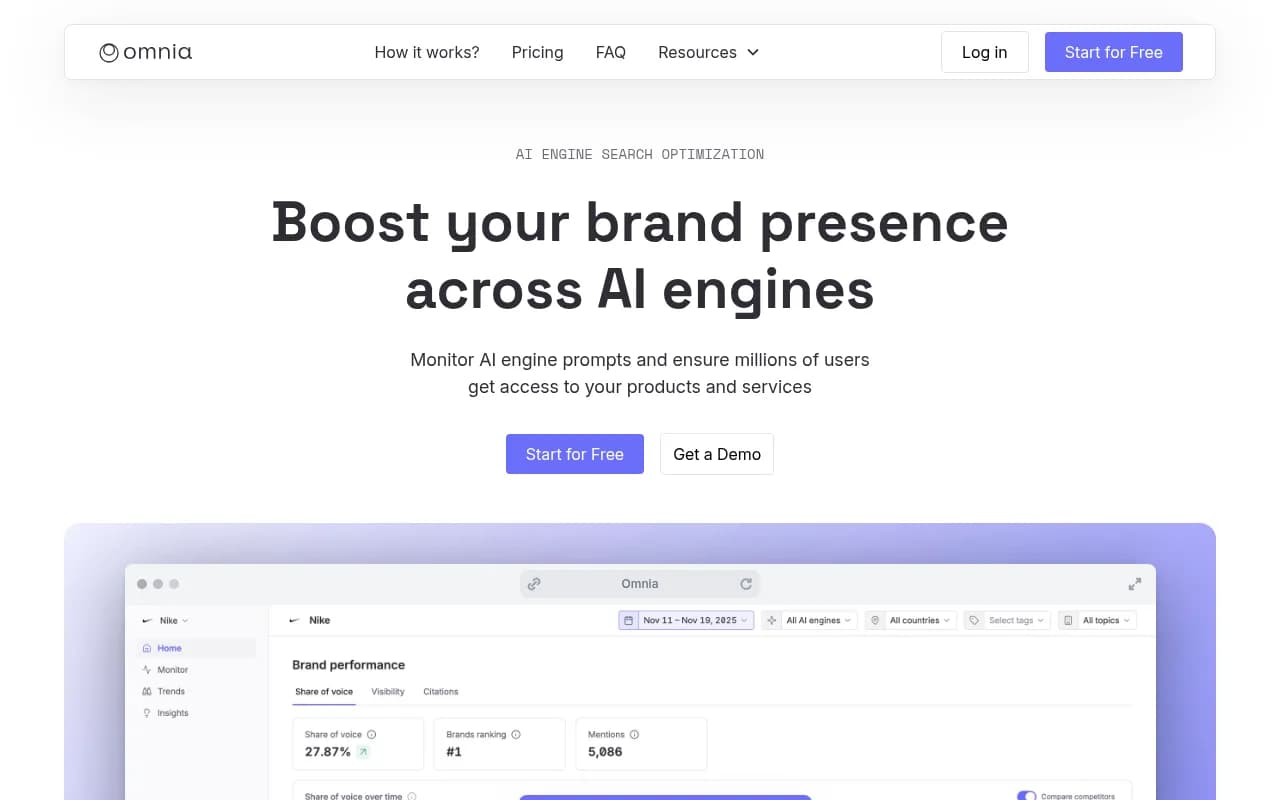
If you're just comparing options, the directory at bestgeosoftware.com lists GEO platforms side by side. Omnia and Moz also publish useful walkthroughs on the tracking basics.
Common mistakes
- Running 3 prompts and drawing conclusions. Answers are crowded and vary run to run.
- Counting mentions as citations. Keep separate columns.
- Ignoring product, pricing and docs pages because they feel un-editorial.
- Comparing a news post to a landing page. Their decay curves differ.
- Changing five things at once, then not knowing what worked.
- Treating one engine as "AI". ChatGPT, AI Overviews and Perplexity cite differently. Promptwatch Data found ChatGPT drew 0.46% of its citations from social platforms Sep 28 to Oct 4, 2026, while Google AI Overviews drew 12.2%, per the social citations report. A single blended score hides that.
A 30-minute starter checklist
- Write 20 prompts: 8 commercial, 6 informational, 3 branded, 3 problem-led.
- Run them on ChatGPT and Perplexity in clean sessions.
- Log each cited URL, position, and whether your brand was named.
- Build the scorecard tab with one row per page and a page type column.
- Add the roll-up by page type.
- Mark every page with an action: keep, refresh, rewrite, consolidate.
- Put a re-run date on the calendar, 30 days out.
The first run will probably be humbling. A handful of pages will carry nearly everything, and a lot of your content will show zero. That is the useful part. You now know which URLs to fix first.
If you'd rather have a team build and run this for you, 1001 SEO Media does AI search and GEO work alongside technical SEO and content. For everything else, start with the spreadsheet. Twenty prompts, one afternoon.