Key takeaways
- Similarweb, Amplitude and Lebesgue all bolt AI visibility tracking onto an existing analytics product. None started life as a GEO platform.
- Similarweb is the broadest market-intelligence play. Plans run from $99/month (annual) with 150 tracked prompts, and the Knowledge Center says you can currently track only one brand.
- Amplitude AI Visibility is included at no extra cost for Amplitude customers, with a free limited version. Its strength is tying visibility to funnels, conversion and revenue. Verify engine coverage, since its FAQ still names only ChatGPT and Google AI Overviews.
- Lebesgue is a Shopify-focused analytics and ads tool. GEO tracking sits in its $149/month Ultimate AI tier, and I could not find the prompt count, engine list or methodology.
- If AI visibility is the main job rather than a side feature, a dedicated platform is usually a better fit than any of these three.
Why analytics vendors are moving into GEO
It makes sense. A company that already holds your traffic, conversion or competitive data has an obvious next question to answer: "Is ChatGPT recommending us, and does it matter for revenue?" Adding a visibility tracker is cheaper than building a new product category, and it gives existing customers a reason to stay.
The catch is that tracking a brand in AI answers is a different job from counting sessions. Answers vary by engine, by country and by phrasing. Promptwatch Data shows how different the engines are: for Sep 28 to Oct 4, 2026, social platforms made up 0.46% of ChatGPT's citations but 12.2% of Google AI Overviews citations. A tool that covers only some engines will tell you a partial story, and scores from two tools are rarely comparable.
How many sources an answer cites also differs by engine. Promptwatch's average sources per response data shows ChatGPT citing about 5 sources per web-search answer, while Google AI Overviews and Perplexity sit near 10. That affects how much room there is to win a citation on each.
So the question for each of these three vendors is simple: what does the analytics DNA give you, and what does the missing GEO depth cost you?
At a glance
| Similarweb AI Brand Visibility | Amplitude AI Visibility | Lebesgue (Ultimate AI) | |
|---|---|---|---|
| Core product | Digital and market intelligence | Product and behavioral analytics | Shopify store, profit and ads analytics |
| Entry price for AI visibility | $99/mo annual, $129 monthly | Included for Amplitude customers, free limited version | $149/mo |
| Prompt cap | 150 on self-serve plans | Not stated in sources I found | Not found |
| Engines | Reviews disagree, check Similarweb docs | ChatGPT and Google AI Overviews per FAQ | Described only as "ChatGPT and AI search" |
| Standout strength | Competitive and traffic context | Visibility tied to conversion and revenue | Store-level data for e-commerce owners |
| Main weakness | Prompt cap, one brand, estimated traffic | Narrow engine list on the public FAQ | Thin, undocumented GEO feature |
| Best for | Mid-market and enterprise digital teams | Teams already on Amplitude | Shopify merchants already using Lebesgue |
I did not find independent head-to-head benchmarks of the three, so treat this as a comparison of what each vendor documents, not of measured accuracy.
Similarweb AI Brand Visibility
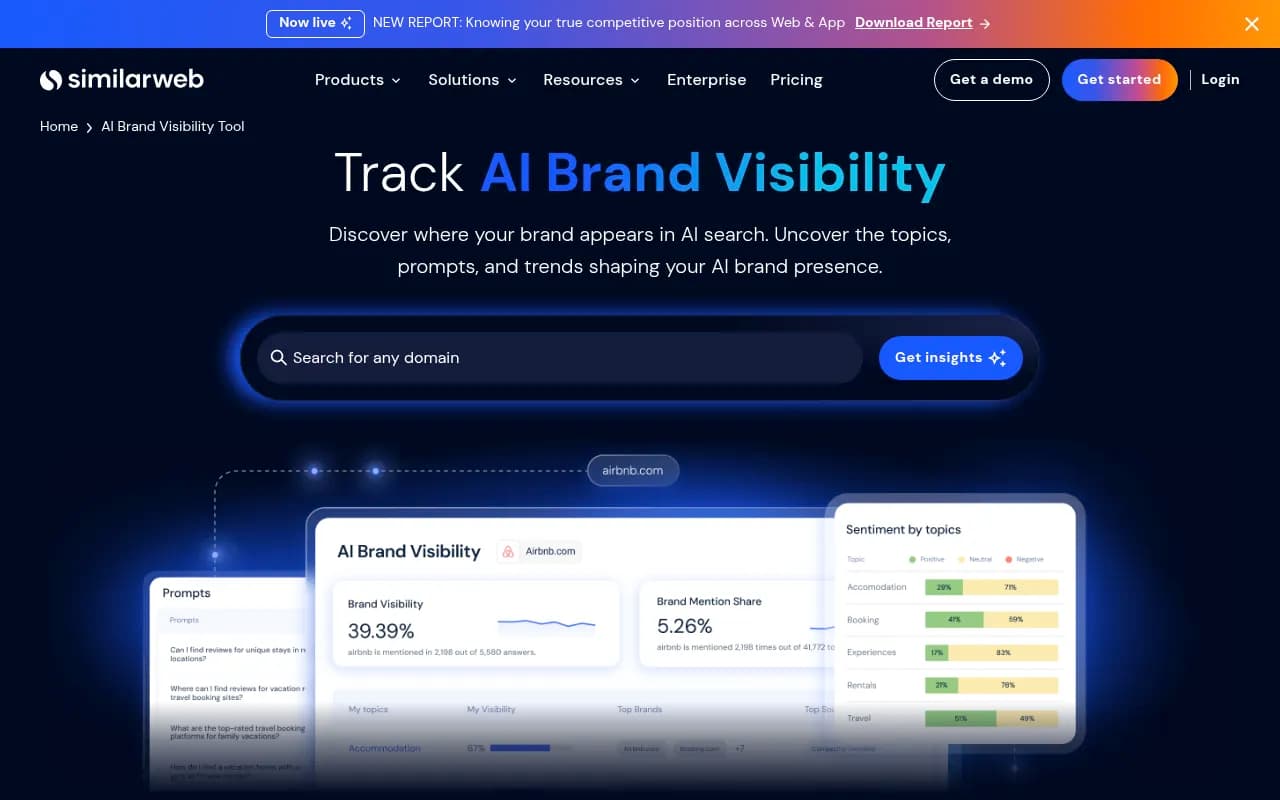
Similarweb is best known for estimating website traffic and competitive intelligence. Its AI Search Intelligence package extends that into AI answers.
What you get
Similarweb describes four tools: AI Brand Visibility, Prompt Analysis, Citation Analysis and Sentiment Analysis. The product page says it shows the top 30 brands for each topic you track, so you can compare your visibility against rising competitors. Citation Analysis ranks the exact cited URLs by an "influence score", which is a useful way to see which pages are doing the work.
The real pitch is combining AI answer visibility with referral-traffic and market intelligence. If you already live in Similarweb for competitor traffic, having AI visibility next to it is convenient.
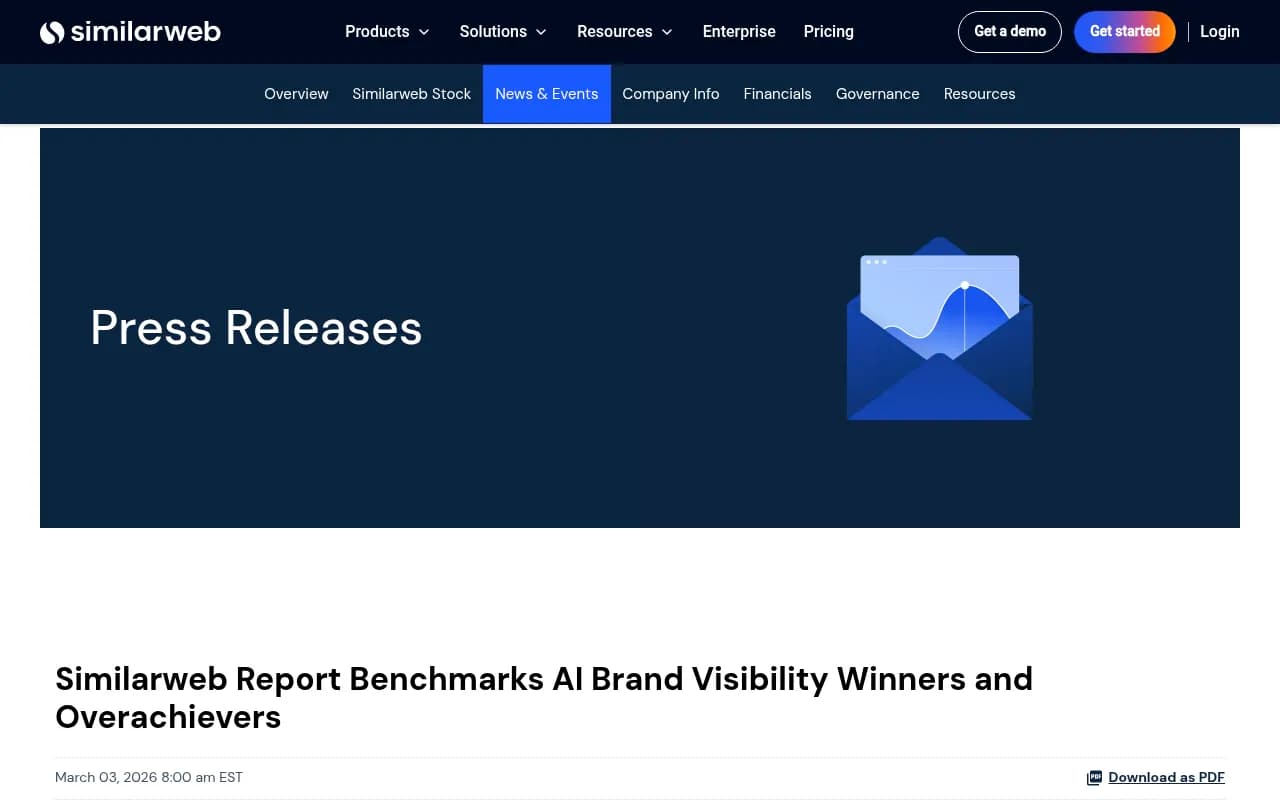
Similarweb also publishes original research. Its 2026 Generative AI Brand Visibility Index, announced March 3, 2026, covers Finance, Travel, Consumer Electronics, Beauty, Fashion and News. One finding: specialist retailers like B&H, Adorama and iFixit are overperforming relative to their branded search demand in Consumer Electronics. That is a good read for anyone who thinks AI search only favors incumbents.
Pricing
According to Similarweb's packages page, the self-serve tiers are:
| Plan | Annual | Monthly | Notes |
|---|---|---|---|
| AEO Intelligence | $99/mo | $129 | 1 user, 3 months history, 150 prompts, sentiment, citation analysis, AI traffic |
| AEO + SEO + Competitive Intel | $333/mo | $399 | 6 months history, adds SEO and competitive intelligence |
| AEO + SEO + Ads + Competitive Intel | $542/mo | $649 | Adds Ad Intelligence |
All three are single-user. Enterprise pricing is custom and adds an API, AI Agents and MCP.
Limits to know about
- The Knowledge Center says you can currently select only one brand to track. Topics are auto-suggested and editable.
- 150 prompts is tight if you cover several product lines or markets. Ansvisor's third-party review makes the same point.
- Ansvisor also says brand visibility covers four engines, without Copilot or Google AI Overviews, and that traffic numbers are estimates. EchoWi's review says four engines for visibility and four more for referral traffic. These accounts do not fully agree, so check Similarweb's current docs before buying.
Amplitude AI Visibility
Amplitude is a product analytics platform, and its AI Visibility feature launched around October 29, 2025.
What you get
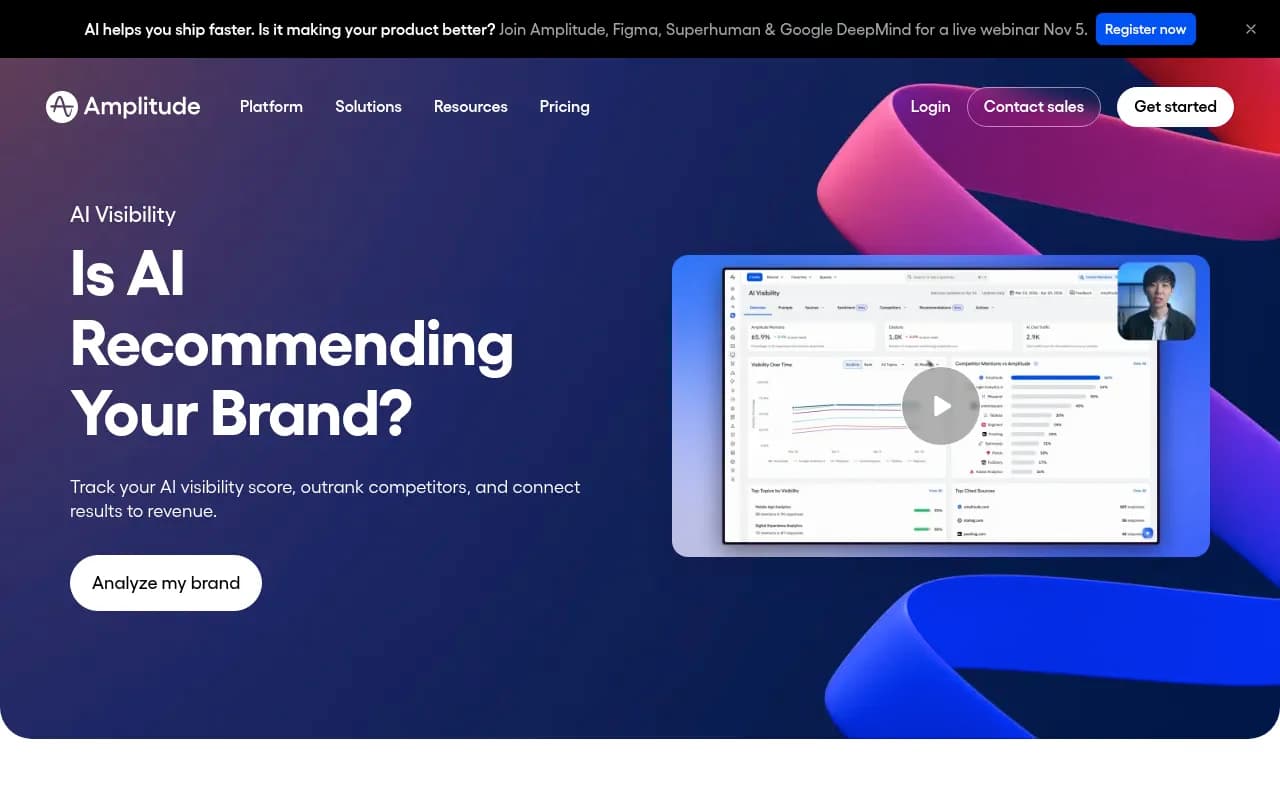
The product gives you a visibility score, competitive rankings and the sources LLMs use to build answers. Amplitude frames it in three steps: analyze (share of voice, prompts, sentiment), optimize (recommendations, content generation, simulated changes) and convert (tie it to traffic and revenue).
The version 1.5 release added blog-post generation in a custom brand voice, AI-chat traffic analysis (ChatGPT, Perplexity, Gemini, Claude) when connected to Amplitude Analytics, week-over-week reporting by topic and model, a relevancy score, competitor and URL drill-downs, report history, and domain-name input for brands LLMs do not recognize. Amplitude says more than 27,000 brands used the free tool and customers created over 70,000 reports in three months.
The real differentiator
This is the one thing Amplitude does that a pure tracker cannot. Visibility scores can be viewed next to AI-referred traffic, then pushed through funnels, journeys and cohorts. If your team already instruments its product in Amplitude, you can ask "do visitors from ChatGPT convert better?" without exporting anything. Amplitude also exposes this through its Global Agent and MCP tools, and an Amplitude employee has described Claude using those MCP tools to act on visibility insights.
Pricing and caveats
It is included at no additional cost for all Amplitude customers on every plan, and a free limited version exists.
The caveat is engine coverage. At the time of the expansion post, only ChatGPT and Google AI Overviews were supported, with Perplexity, Gemini, Claude, sentiment analysis and recommendations listed as coming soon. The current product FAQ still names only ChatGPT and Google AI Overview. Some of the roadmap items may have shipped since, so confirm in the product before you rely on it. A tool that tracks two engines will miss Perplexity-specific patterns, as the citation data above suggests.
Lebesgue
Lebesgue is the odd one out. It is an e-commerce analytics and ads tool, focused on Shopify, that claims 10,000+ businesses. GEO and AEO tracking arrived as a paid add-on tier rather than a core product.
Pricing
| Tier | Price | What matters here |
|---|---|---|
| Free | $0 | Store and profit tracking, automated ad audits for Meta, Google, TikTok |
| Ultimate | $79/mo | LTV and retention, up to 3 competitors, 10 Henri AI questions/month |
| Ultimate AI | $149/mo | AI visibility tracking for GEO and AEO, automatic blog generation, competitor-ad insights, unlimited Henri AI, up to 7 competitors |
The Shopify App Store listing also shows $149/month with "GEO & AEO: track your brand in AI search". The pricing page is inconsistent, since it also lists an older Analytics scheme (Advanced $59, Ultimate $79, and Le Pixel tiers), so check the live page.
What I could not verify
The pricing page says only "Track how your brand appears in ChatGPT and AI search". I found no prompt count, no list of engines and no methodology. I would not assume any specifics. If you are a Shopify merchant already paying for Lebesgue, the add-on is a low-friction way to get a first look at AI visibility. As a standalone GEO decision, it is hard to evaluate on what is public.
How to choose
Pick based on where your data already lives, not on feature checklists.
- You already use Similarweb for competitive research: the AI tier slots in naturally, and the market context is genuinely useful. Budget for the prompt cap.
- You already run product analytics in Amplitude: the free or included tier costs nothing to try, and the revenue link is the best of the three. Verify engine coverage first.
- You run a Shopify store on Lebesgue: the add-on is a convenience, not a research-grade tool.
- AI visibility is a core channel for you: none of these three is built around it.
Questions to ask any vendor
- Which engines are tracked, in the real user interface or via API? Answers can differ between the two.
- How many prompts, and how many brands, can I track?
- Which countries and languages are covered?
- Are traffic numbers measured on my site or estimated?
- Does the tool tell me what to fix, or only what happened?
When a dedicated GEO platform makes more sense
Analytics add-ons tend to answer "were we mentioned?" A dedicated platform goes further into why you are or are not cited, and what to do about it. Promptwatch is one example. It tracks real user interfaces across ChatGPT, Google AI Overviews, AI Mode, Gemini, Perplexity, Copilot and more, shows IP-verified AI crawler logs, ties AI traffic to your site, and has a content agent and action board for the fixes. Pricing starts at $95/month for Essential, and you should confirm current plans at promptwatch.com/pricing.

Other dedicated trackers in the same space include Profound, Peec AI and Otterly.AI, and some analytics-minded teams pair a tracker with their analytics stack instead of replacing it.
Profound


Otterly.AI

If you want to browse more options, the GEO software directory at bestgeosoftware.com lists dozens of them.
Practical tips whichever tool you choose
- Track the same prompt set across tools before you trust any single score. Scores from different vendors are not comparable.
- Separate branded prompts from non-branded ones. Branded visibility is easy. Non-branded is where growth happens.
- Look at citations, not only mentions. Which URLs get cited tells you what to publish or refresh.
- Check content freshness. Promptwatch's half-life data shows news losing half its cited pages within 36 days, while landing pages and docs stay cited longest.
- Measure traffic on your own site. Estimated referral numbers are fine for direction, but your own analytics settle arguments.
Bottom line
Analytics vendors bring real strengths: Similarweb's market context, Amplitude's revenue link, Lebesgue's store data. They also bring the usual add-on limits: prompt caps, narrower engine lists and thinner documentation. Use them when the surrounding product is already your daily tool, and check engine coverage before you commit. If AI search is becoming a real revenue channel for you, plan on a dedicated platform as the primary system and treat these as supporting views.