Key takeaways
- A tracker shows that a monitored answer included a citation at the moment of the test. It does not prove the cited page supports the claim, or that the result is stable.
- Many "drops" are platform changes, not content problems. ChatGPT's citations per response fell roughly 27% in a single day after the GPT-5.3 rollout on March 4, 2026.
- Validate in layers: a manual baseline, a repeatability check, a cross-check against server and analytics data, and a platform-event check before you act on any dip.
- Track citations per response alongside your own citations, so you can tell "we lost visibility" from "the model cites fewer sources everywhere."
- Screenshot spot checks give false confidence. Run the same prompts repeatedly and read trends, not single snapshots.
Why this question matters now
You open your dashboard on Monday and the number is down 30%. Someone in the meeting asks what happened to the content. Someone else suggests a rewrite. Two weeks later the number comes back, or it never does, and nobody can say whether the rewrite did anything.
This is the core problem with AI citation data. The numbers feel as precise as rank-tracking numbers, but the underlying system is different. Answers are generated, not retrieved from a fixed list. The same prompt can produce different sources on consecutive runs. The platforms themselves change behavior without announcement.
That does not make citation tracking useless. It makes validation a required part of the job. This guide walks through what can go wrong, how to test your tracker, and how to decide when a movement in the data is real.
What a citation tracker can and cannot prove
Start with the boundaries. Atlas Workspace states it plainly in its write-up on citation tracking tools: tracking can prove that a monitored answer included a brand, domain, URL, or citation at the time of the test. It cannot prove that the cited source supports the answer. AI systems can cite a real page for the wrong reason.
So there are really two separate questions:
- Visibility: was my brand, domain, or URL cited for this prompt, in this engine, at this time?
- Source support: does the cited passage actually say what the AI claimed it says?
Trackers answer the first. Only a human (or a source-grounded workflow) answers the second. If you are reporting visibility to a CMO, the first is enough. If you are reusing an AI-cited claim in your own research or content, you need the second.
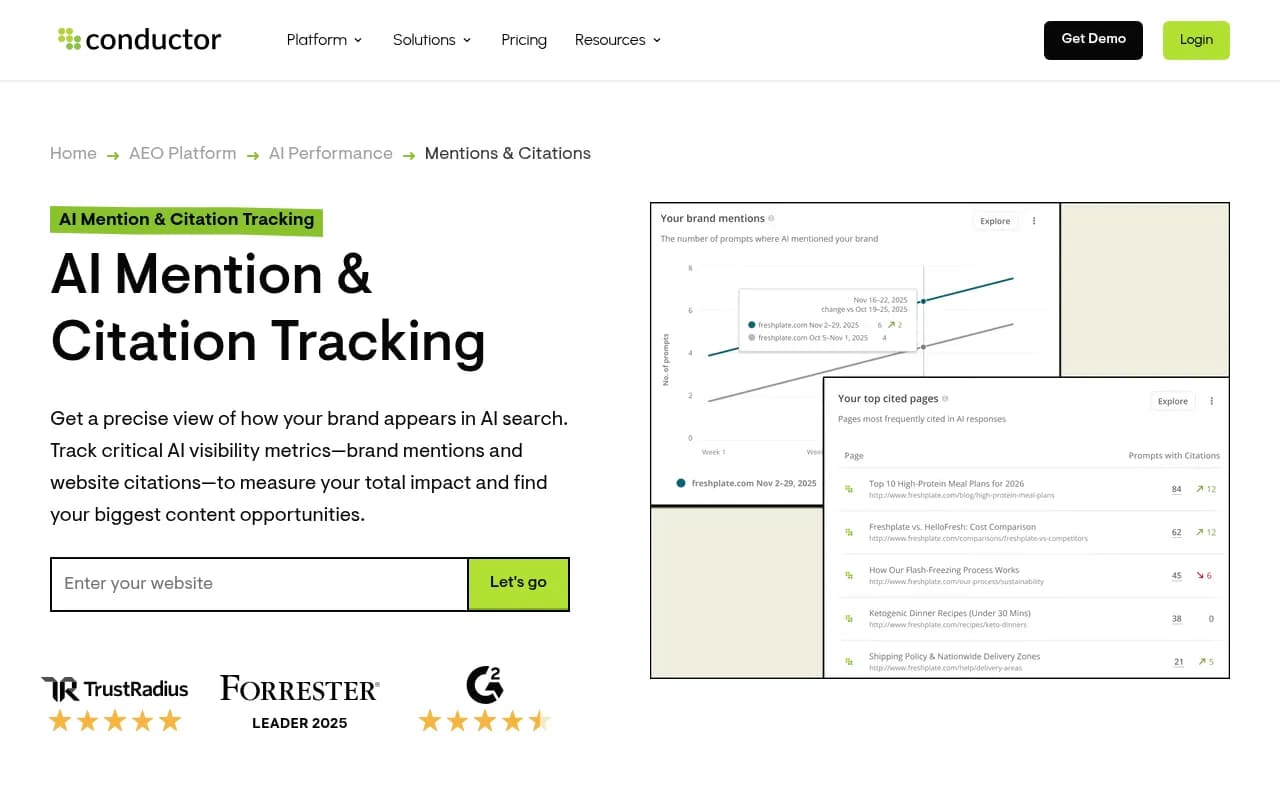
It also helps to separate mentions from citations. Conductor draws the line this way: a mention is your brand named in the response text, while a citation is the AI explicitly sourcing your website, usually with a link. A brand that is mentioned often but cited rarely has a different problem than one that is cited but never named. Check that your tracker reports them as separate metrics, because blended numbers hide exactly the gap you want to see.
Where inconsistency comes from
Useomnia's guide names five main sources of inconsistency in AI citation tracking and argues you should build around them instead of being misled by them. Whatever list you use, these are the ones I see cause the most confusion in practice.
The model itself changes
Promptwatch Data tracked what happened around the GPT-5.3 rollout on March 4, 2026. In the week before, ChatGPT cited about 6.4 sources per search-enabled response. By late March it had settled at roughly 4.7 to 4.9, about 27% fewer, and there was no recovery a month later. The shift hit GPT-5.3, GPT-5.4 and GPT-5-Mini together and happened within a day, not gradually. You can read the details in Promptwatch's ChatGPT citation drop report.
If your dashboard showed a 25% dip that week, your content was probably fine. The ground moved.
Similar step changes keep happening. Promptwatch Data on the site: operator shows ChatGPT jumping from about 0.4% to about 17% of fanout queries on August 8, 2026, with searches per response nearly doubling. And reddit.com's share of ChatGPT citations fell from roughly 4% to 0.5% on August 14, 2026. Any tracker watching a Reddit-heavy category would have shown a cliff overnight.
Engines behave very differently from each other
Average citations per response vary by platform. Promptwatch's average sources per response report (dated September 2025, so treat the figures as a baseline, not current truth) found ChatGPT at about 5, Google AI Overviews at about 10 and steady, and Perplexity at almost exactly 10 every day. Copilot swung from under 2 to nearly 17 within weeks before settling low.
Two practical consequences. First, Perplexity makes a decent test bench, because its citation count barely moves, so big swings in your numbers there are more likely to be real. Second, judge volatile engines like Copilot on monthly trends, not weekly snapshots.
Prompts are not what users type
ChatGPT often rewrites a prompt into sub-queries before searching. Promptwatch's query fanout data shows the average at 2.15 fanout queries per response in early December 2025, easing to about 1.84 by early March 2026, with query length falling from about 117 characters to the high 80s and later to about 53. Your tracker's prompt is the input. The searches the model actually runs are a different thing, and they change in steps tied to platform updates.
Different collection methods
Trackers collect data in different ways. Some call model APIs. Some drive the real user interface. Conductor argues an API-first approach is more reliable and compliant than scraper-based tools. Promptwatch collects from the real UIs of ChatGPT, Gemini, Perplexity, AI Overviews and others, on the basis that user-facing answers and citations can differ from API output. Both sides have an argument, and I have not seen a clean independent study of API versus UI accuracy. So don't take either claim on trust. Test it, using the checks below.
Sampling and single snapshots
One run of one prompt is an anecdote. Useomnia is blunt that screenshot-based spot checks give false confidence, and I agree. If your tracker reports a number from a handful of runs per prompt, the confidence interval is wider than the chart implies.

A five-step validation workflow
Here is the sequence I would run before trusting any new tracker, and again every quarter.
Step 1: Build a manual ground-truth baseline
Both Atlas and Otterly recommend manual monitoring before you buy anything. It is slow, but it gives you ground truth. Atlas suggests 20 to 50 revenue-relevant prompts across the engines your buyers use. Log each prompt, the engine, the date, the answer text, every cited URL, and a screenshot.
Keep the prompt set fixed. You will compare this against the tracker's output.
Step 2: Test repeatability
Run the same 10 prompts three to five times in one day, in the same engine, and note how much the cited sources change. If your own domain appears in two of five runs, a tracker that reports it as "cited" or "not cited" from a single run is flattening something probabilistic.
This tells you the noise floor. Any movement smaller than the run-to-run variance is not a signal.
Step 3: Compare tracker output with your manual log
Pull the tracker's results for the same prompts and compare. Check:
- Does it report the same cited URLs, or the same domains?
- Is the engine and country the same as your manual test?
- Does it count a brand mention without a link as a citation?
- Are the answer snapshots stored so you can read them?
Disagreements are not automatically tracker bugs, because of the variance you measured in step 2. But a tracker that never matches, or cannot show you the underlying answer, is a problem.
Step 4: Cross-check against first-party data
A citation is an event inside an AI answer. Your own systems see the other side of it. Compare tracker claims against:
- Server or CDN logs for AI crawler hits (GPTBot, OAI-SearchBot, ChatGPT-User, ClaudeBot, PerplexityBot and others). A page that is "cited" but never fetched deserves suspicion, or at least a note that it may come from the model's training data.
- Referral traffic in your analytics from chatgpt.com, perplexity.ai and similar sources.
- Google Search Console and Bing Webmaster Tools, which show whether the page is even indexed and getting impressions.
None of these is complete. Search Console does not separate AI Overview citations from ordinary impressions, as Otterly points out, and AI referrals are undercounted wherever referrer data gets stripped. But when three independent sources roughly agree, you can trust the picture more.
Step 5: Check the calendar before you blame content
When a metric drops, check the date against model releases and known platform changes first. Then look at citations per response across all your tracked prompts, including ones where you never appeared. If everyone's citations fell, it is the platform. If only yours fell, look at your pages.
This is the single most useful habit in the whole workflow, and it costs five minutes.
Metrics that make validation easier
Some metrics are more robust than others. A rough guide:
| Metric | How stable it is | Validation tip |
|---|---|---|
| Citation of your domain for one prompt, one run | Low | Never act on it alone |
| Citation rate across 50+ prompts, repeated runs | Medium | Compare against run-to-run variance |
| Citations per response (all brands) | Medium | Use as a platform-change detector |
| Share of voice vs competitors | Medium to high | Relative measures cancel out some platform shifts |
| Cited URLs and cited domains by source type | Medium | Spot-check manually each month |
| AI crawler hits on your pages (logs) | High | Independent of the tracker, good for cross-checking |
| Referral clicks from AI platforms | High but undercounted | Treat as a floor, not a total |
Relative metrics tend to survive platform shifts better than absolute ones. If ChatGPT starts citing 27% fewer sources, your absolute citation count falls, but your share against competitors may hold steady. That is another reason to read share of voice and citations per response together.
Verifying that a citation supports the claim
The second question, source support, is its own job. A cited URL is not proof the statement is correct. If you plan to reuse what an AI told you, open the cited page, find the passage, and check that it says what the answer claims. If it does not, narrow or drop the claim.
This matters in three situations: research and analysis, content that quotes AI answers, and brand monitoring where the AI is describing your product. In the last case, a wrong claim attached to a real citation to your own site is worth a ticket, because it often points to ambiguous copy on the cited page.
Some tools are built for this. LLMClicks advertises hallucination detection, which is a different feature from visibility tracking.

Questions to ask any tracker vendor
You can learn a lot from how a vendor answers these.
- Do you collect from the real UI, from APIs, or both? Can I see which for each engine?
- How many runs per prompt per day, and how do you handle variance?
- Do you store the full answer text and the cited URLs so I can audit them?
- Do you separate mentions from citations?
- Do you report citations per response, so I can tell platform shifts from my own changes?
- Can I export raw data?
- Do you annotate or flag known model updates on trend charts?
- Can you connect citations to crawler logs or real traffic?
A vendor that cannot answer number 3 is asking you to trust a black box.
How different tools handle validation
I have not benchmarked these head to head, and pricing and feature sets change quickly, so confirm details on each vendor's site. This table reflects what the vendors say about themselves.
| Tool | Approach worth checking | Validation angle |
|---|---|---|
| Promptwatch | Real-UI collection, IP-verified crawler logs, visitor analytics, citations per response data | Lets you cross-check citations against actual AI crawler visits and traffic |
| Conductor | API-first data collection, separate mentions and citations | Argues for data integrity over scraping |
| Omnia | Citation tracking built around prompt sets and competitor comparisons | Useful for the manual-baseline-then-scale workflow |
| Otterly.AI | Monitoring across ChatGPT, Perplexity and AI Overviews; publishes a manual tracking guide | Good for building a baseline before scaling |
| Profound | Enterprise tracking across many engines | Worth asking about run counts and raw-data export |
| Peec AI | Prompt-based visibility tracking | Basic tracking; ask about answer snapshots |
Promptwatch is the one I would point to for the cross-checking step, because crawler logs and visitor analytics sit next to citation data in the same product. That means "cited but never crawled" or "crawled but never cited" is something you can see directly instead of reconstructing from three tools. It also publishes the platform-shift data referenced throughout this guide.

Otterly.AI

Profound


If you are still shortlisting, the GEO software directory at bestgeosoftware.com lists many more options, and ai-rank-tools.com focuses on AI rank trackers.
Common mistakes
Treating one week as a trend
Copilot's citation counts swung wildly over a few weeks. ChatGPT's changed in a day. Look at monthly windows, and mark platform events on your charts.
Reporting absolute numbers without context
If you tell leadership "citations fell 25%" without noting that citations per response fell 27% platform-wide, you have given them the wrong story.
Ignoring the third-party problem
Otterly's State of AI Search research found that 95% of AI citations come from third-party websites. Your own domain's citation count is therefore only part of the picture. Validate that the third-party pages your tracker lists are real, current, and actually mention you. Omnia's guide adds that when a directory or review site keeps appearing across your prompts, it has already earned AI trust in your category, which is worth checking by hand.
Assuming prompts equal real demand
A tracker prompt that nobody types is a vanity metric. Where your tool offers prompt volume estimates or Search Console-derived suggestions, use them to weight what you validate first.
Skipping the manual audit because tools exist
The manual audit is how you learn what "normal" looks like for your category. Without it you cannot tell a tracker error from real behavior.
A simple monthly routine
If you want something lightweight to maintain:
- Weekly: glance at citations per response and share of voice. Check the calendar for model releases before reacting.
- Monthly: manually re-run 10 to 20 priority prompts and compare with the tracker. Review AI crawler logs and referral traffic for your top pages.
- Quarterly: repeat the full 20 to 50 prompt baseline, re-test repeatability, and ask your vendor anything that changed.
If you want a second pair of hands on the strategy side, an agency like 1001 SEO Media works on GEO and AI search measurement, but the routine above is something an in-house team can run alone.
Bottom line
Trust your citation data the way you would trust a poll: useful in aggregate, risky for any single reading. Fix a prompt set, measure the noise, cross-check against crawler logs and traffic, and always look at what the platform did that week. The next time ChatGPT changes how many sources it cites, you will know within minutes whether your dashboard is telling you about your content or about OpenAI.