Key takeaways
- Surfer SEO is the most feature-complete option for teams that want SERP analysis, content scoring, and keyword research in one place — but the pricing scales fast and the page-by-page workflow becomes a bottleneck at volume.
- Clearscope is the cleanest, most writer-friendly tool of the three. It's expensive for what you get, but editorial teams love it because it stays out of the way.
- NeuronWriter punches well above its price point, especially for solo creators and small agencies. The lifetime deal makes it hard to ignore.
- None of these tools track how your content performs in AI search engines like ChatGPT or Perplexity — that's a separate problem requiring a separate tool.
Content optimization tools have been around long enough that the category feels mature. But "mature" doesn't mean "settled." In 2026, the three names that keep coming up in SEO forums, agency Slack groups, and Reddit threads are Surfer SEO, Clearscope, and NeuronWriter. They all do roughly the same thing: analyze top-ranking pages for a keyword, surface the terms and topics you should cover, and score your draft as you write.
The differences, though, are real enough to matter. Choosing the wrong one can mean paying for features you'll never use, or getting stuck with a workflow that slows your team down. This guide breaks down exactly what each tool does well, where it falls short, and who should be using it.
What these tools actually do
Before getting into comparisons, it's worth being clear about what content optimization tools are and aren't.
They analyze the top-ranking pages for a target keyword and use NLP (natural language processing) to identify the terms, entities, and topics that appear frequently across those pages. Then they give you a score as you write, pushing you to cover the right ground.
What they don't do: they don't guarantee rankings, they don't replace good writing, and they don't tell you whether your content will appear in AI-generated answers. That last point matters more than it used to — but more on that later.
Surfer SEO
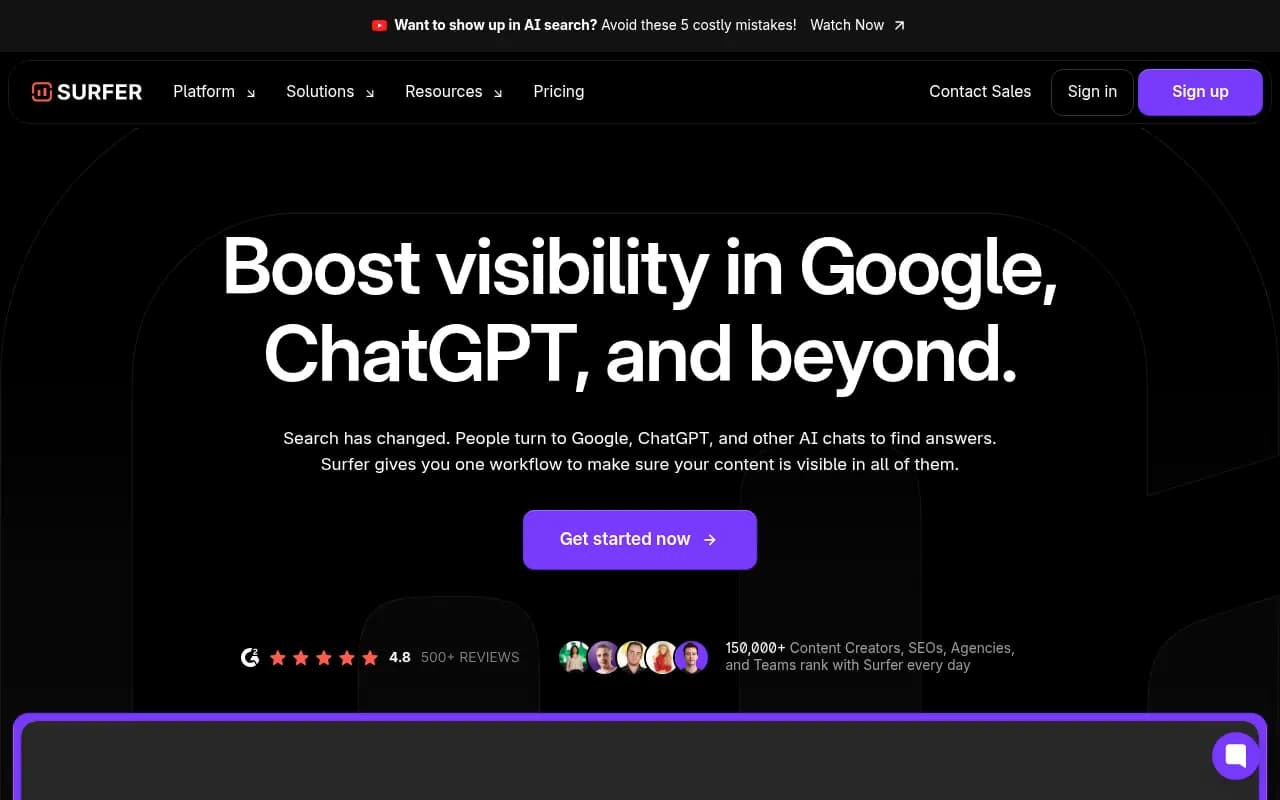
Surfer SEO is the tool that essentially created this category. It launched the content scoring model that most competitors have since copied, and it's still the most feature-dense of the three.
What it does well
The Content Editor is genuinely good. You enter a keyword, Surfer analyzes the top-ranking pages, and you get a real-time score as you write, along with NLP term suggestions, recommended word counts, heading structures, and image counts. The SERP Analyzer gives you a detailed breakdown of competitor pages — their structure, word count, and keyword usage.
Surfer also has a Keyword Research tool, a Topical Map feature for building content clusters, and Grow Flow, which gives weekly suggestions based on your existing rankings. The Google Docs and WordPress integrations work well, and there's a decent AI writing assistant built in.
For a single writer optimizing one article at a time, Surfer's workflow is fast and intuitive.
Where it falls short
The architecture is page-centric. You open a keyword, optimize that page, close it, repeat. At 5 articles a month, that's fine. At 50, it becomes a real bottleneck. There's no native content brief workflow, limited team collaboration, and no content strategy layer in the traditional sense.
The pricing has also crept up. The Essential plan is $99/month, and the credits-based system means costs scale quickly with volume. The AI writing features are functional but haven't kept pace with AI-native platforms. Several SEO teams on Reddit have noted they're paying for Surfer primarily for the content editor while using other tools for everything else — which is a sign the tool has become narrower in practice than it looks on paper.
The content score itself can become a vanity metric. You hit the target, the score turns green, and the article still doesn't rank because it reads like a SERP digest rather than something a human actually wrote.
Pricing
- Essential: $99/month
- Scale: $219/month
- Enterprise: custom
Clearscope

Clearscope takes the opposite approach to Surfer. It's minimal, clean, and entirely focused on the writing experience. There's no keyword research, no SERP analyzer, no AI writer. Just a content editor that tells you what terms to include.
What it does well
The term recommendations are solid. Clearscope grades each suggested term (A+ through F) based on how well you've covered it, and the interface is clean enough that writers don't feel like they're being micromanaged by an algorithm. The Google Docs integration is the best of the three — it works seamlessly and doesn't require switching tabs.
Editorial teams at larger companies tend to love Clearscope because it fits into existing workflows without disruption. You're not being asked to change how you write; you're just getting a checklist of terms to weave in naturally.
The reporting is also clean. You can track content scores over time and share reports with clients or stakeholders.
Where it falls short
Clearscope is expensive relative to what it offers. The Essentials plan starts at $189/month for one user and 50 reports. That's nearly double Surfer's entry price for a tool that does significantly less.
There's no AI writing, no keyword research, no topic clustering. If you want those things, you're paying for other tools on top of Clearscope. For solo creators or small teams, that math rarely works out. The tool is really built for enterprise content teams with dedicated writers and editors who need a clean, reliable optimization layer — not for people who need an all-in-one solution.
The content scoring is also less sophisticated than Surfer or NeuronWriter. It's good, but it's not doing anything the others can't do.
Pricing
- Essentials: $189/month (1 user, 50 reports)
- Business: $399/month (3 users, 150 reports)
- Enterprise: custom
NeuronWriter

NeuronWriter is the youngest of the three and the most aggressive on price. It combines NLP-based content optimization with AI writing, SERP analysis, and a content planner — all at a price point that makes Surfer and Clearscope look expensive.
What it does well
The content editor uses a combination of NLP, SERP data, and Google NLP to generate term recommendations. The scoring is detailed and the suggestions are genuinely useful. NeuronWriter also pulls in competitor content directly in the editor, so you can see what the top-ranking pages are actually saying without switching tabs.
The AI writing features are more capable than Surfer's. You can generate outlines, paragraphs, and full drafts based on your target keyword, and the output is grounded in the SERP data rather than just generating generic content.
There's also a content planner for managing multiple projects, internal linking suggestions, and a Chrome extension. The interface is busier than Clearscope's, but it's not unusable.
The biggest draw is the lifetime deal. NeuronWriter has been available on AppSumo for a one-time payment, which makes it extremely attractive for freelancers and small agencies who want a capable tool without a monthly subscription.
Where it falls short
The UI can feel cluttered compared to Clearscope, and some of the AI writing output needs more editing than you'd hope. The tool is newer, which means the feature set is still evolving and some edges are rougher than Surfer's more polished experience.
The content scoring is good but not quite as refined as Surfer's SERP-driven model. For high-stakes content where you need the most precise optimization, Surfer still has a slight edge.
NeuronWriter also doesn't have the brand recognition of Surfer or Clearscope, which matters if you're presenting tools to clients or stakeholders who want to see familiar names.
Pricing
- Bronze: $23/month (2 projects, 25 queries)
- Silver: $45/month (5 projects, 50 queries)
- Gold: $69/month (unlimited projects, 75 queries)
- Lifetime deals available via AppSumo
Head-to-head comparison
| Feature | Surfer SEO | Clearscope | NeuronWriter |
|---|---|---|---|
| Content editor | Yes, excellent | Yes, excellent | Yes, good |
| NLP term suggestions | Yes | Yes | Yes |
| AI writing | Yes (functional) | No | Yes (capable) |
| SERP analysis | Yes, detailed | No | Yes |
| Keyword research | Yes | No | Limited |
| Topic clustering | Yes | No | Yes |
| Content planner | Limited | No | Yes |
| Google Docs integration | Yes | Yes (best-in-class) | Yes |
| WordPress integration | Yes | Yes | Yes |
| Team collaboration | Limited | Good | Limited |
| Entry price | $99/month | $189/month | $23/month |
| Lifetime deal | No | No | Yes (AppSumo) |
| Best for | Teams scaling content | Enterprise editorial | Freelancers, small agencies |
Which tool should you use?
The honest answer depends on your situation.
If you're a solo creator or small agency and price is a real constraint, NeuronWriter is the obvious choice. The lifetime deal is genuinely good value, and the feature set covers most of what Surfer does at a fraction of the cost. The rough edges are manageable.
If you're running a large editorial team where writers need a clean, distraction-free optimization layer and you already have keyword research and strategy tools in place, Clearscope is worth the premium. The Google Docs integration alone makes it the smoothest experience for writers who don't want to think about SEO.
If you're a mid-size team that wants one tool to handle content optimization, keyword research, and some degree of content strategy, Surfer SEO is the most complete package. Just go in knowing the costs will climb as you scale, and the page-centric workflow has real limits.
One thing worth noting: all three tools are built around traditional search. They analyze Google SERPs, optimize for Google rankings, and measure success by content scores. None of them tell you whether your content is being cited in ChatGPT, Perplexity, or Google AI Overviews.
That's a separate question, and in 2026 it's becoming harder to ignore. If AI search visibility matters to your business, you'll need a tool built for that specifically. Promptwatch tracks how brands appear across 10 AI search engines, identifies which content gaps are costing you citations, and has content generation tools grounded in real prompt data rather than just SERP analysis.

These are complementary problems, not competing ones. Content optimization tools help you rank in Google. AI visibility platforms help you get cited in AI-generated answers. The teams doing well in 2026 are thinking about both.
A note on content scoring as a metric
One thing that comes up repeatedly in honest reviews of all three tools: the content score can become a trap.
You optimize for the score. The score turns green. The article reads like every other article on the topic because you've covered the same NLP terms as every other page that ranked. And then it either ranks or it doesn't, and the score had nothing to do with it.
The tools know this. Surfer's Grow Flow tries to add strategy on top of optimization. NeuronWriter's AI writing tries to generate content that's more than a term-stuffing exercise. Clearscope's simplicity is partly a deliberate choice to avoid over-engineering the process.
But the underlying issue is real. Content optimization tools are most valuable when they're used as a floor, not a ceiling. They tell you the minimum you need to cover. What you do on top of that — the original research, the specific examples, the point of view — is still on you.
The best results come from writers who use these tools to check their work, not to determine what to write.
Bottom line
Surfer SEO, Clearscope, and NeuronWriter are all legitimate tools. None of them are bad choices. The differences come down to price, workflow fit, and how much you need beyond the core content editor.
NeuronWriter for budget-conscious teams who want more features. Clearscope for editorial teams who want less friction. Surfer for teams that want the most complete single-tool solution and can absorb the cost.
And if you're starting to think about how your content performs in AI search — not just Google — that's a different conversation worth having separately.