Key takeaways
- All four platforms track brand mentions across AI search engines, but they differ significantly in what they do with that data.
- Otterly.AI is the most accessible entry point, starting at $29/month, but stays firmly in monitoring territory.
- AthenaHQ and Scrunch offer stronger analytics depth but stop short of helping you create content that actually improves your visibility.
- Promptwatch is the only platform in this group with a built-in content generation loop -- it finds gaps, generates content engineered for AI citations, and tracks whether it worked.
- If your goal is to understand your AI visibility, any of these will help. If your goal is to improve it, the choice narrows quickly.
The AI search visibility category has exploded. Two years ago, there were maybe a handful of tools tracking how brands appeared in ChatGPT or Perplexity. Now there are dozens, and the marketing around most of them sounds nearly identical: "track your brand across AI engines," "monitor your share of voice," "see who's citing you."
The problem is that monitoring and optimizing are very different things. A dashboard that tells you you're invisible in ChatGPT is useful. A platform that tells you why you're invisible and helps you fix it is worth paying for.
This guide focuses on four platforms that get compared most often by mid-market teams: Otterly.AI, AthenaHQ, Scrunch, and Promptwatch. They're all in a similar price range, they all target similar buyers, and they all claim to help you win in AI search. But they're not the same product.
What these platforms actually do (and don't do)
Before diving into each tool, it helps to understand the three layers of AI visibility work:
- Monitoring -- tracking whether your brand appears in AI responses, how often, and in what context
- Analysis -- understanding why competitors appear more than you, which prompts you're missing, and what content gaps exist
- Optimization -- actually creating or improving content so AI models start citing you more
Most platforms in this space do layer one well. Some do layer two reasonably well. Very few do layer three at all.
Otterly.AI
Otterly.AI is probably the most-discussed entry-level option in this space. Its Lite plan at $29/month makes it accessible to solo marketers and small teams who want to dip their toes into AI visibility tracking without a big commitment.
Otterly.AI

The core product monitors brand mentions across ChatGPT, Perplexity, and Google AI Overviews. You set up prompts, it runs them on a schedule, and you get a dashboard showing how often your brand appears versus competitors. The UI is clean and the onboarding is fast -- you can be up and running in under an hour.
Where Otterly.AI runs into limits is depth. Prompt volumes, difficulty scores, and query fan-outs (the sub-queries that branch off a main prompt) aren't part of the picture. There's no content gap analysis, no built-in writing tools, and no crawler log data. You can see that you're losing to a competitor on a given prompt, but the platform won't tell you what to do about it.
That's not a knock on Otterly.AI -- it's priced accordingly. But for a mid-market team with real pipeline pressure, "you're not appearing here" without "here's how to fix that" gets frustrating quickly.
Best for: Teams that want a low-cost way to start tracking AI visibility and don't yet need to act on the data.
AthenaHQ
AthenaHQ sits a step up from Otterly.AI in terms of analytical depth. It covers more AI engines, offers more granular brand mention tracking, and has a cleaner competitive comparison view.

The platform's strength is in its monitoring breadth. You get visibility across a solid range of LLMs, and the competitive heatmaps give you a reasonable picture of where you stand relative to named competitors. For teams that need to report AI visibility metrics to leadership, AthenaHQ's dashboards are presentable.
The gap is the same one that shows up across most monitoring-focused tools: AthenaHQ tells you what's happening but doesn't help you change it. There's no content generation, no answer gap analysis that surfaces specific missing topics, and no crawler log data to understand how AI engines are actually reading your site. It's monitoring-focused, which is fine if that's all you need -- but mid-market teams usually need more.
Pricing is in the mid-range for this category. It's not the cheapest option, which makes the monitoring-only positioning feel more limiting at that price point.
Best for: Teams that need clean competitive reporting and don't have an in-house content team ready to act on gap data.
Scrunch
Scrunch takes a more analytics-heavy approach. The platform has invested in deeper data infrastructure and covers a wider set of AI engines than most competitors at this price tier.
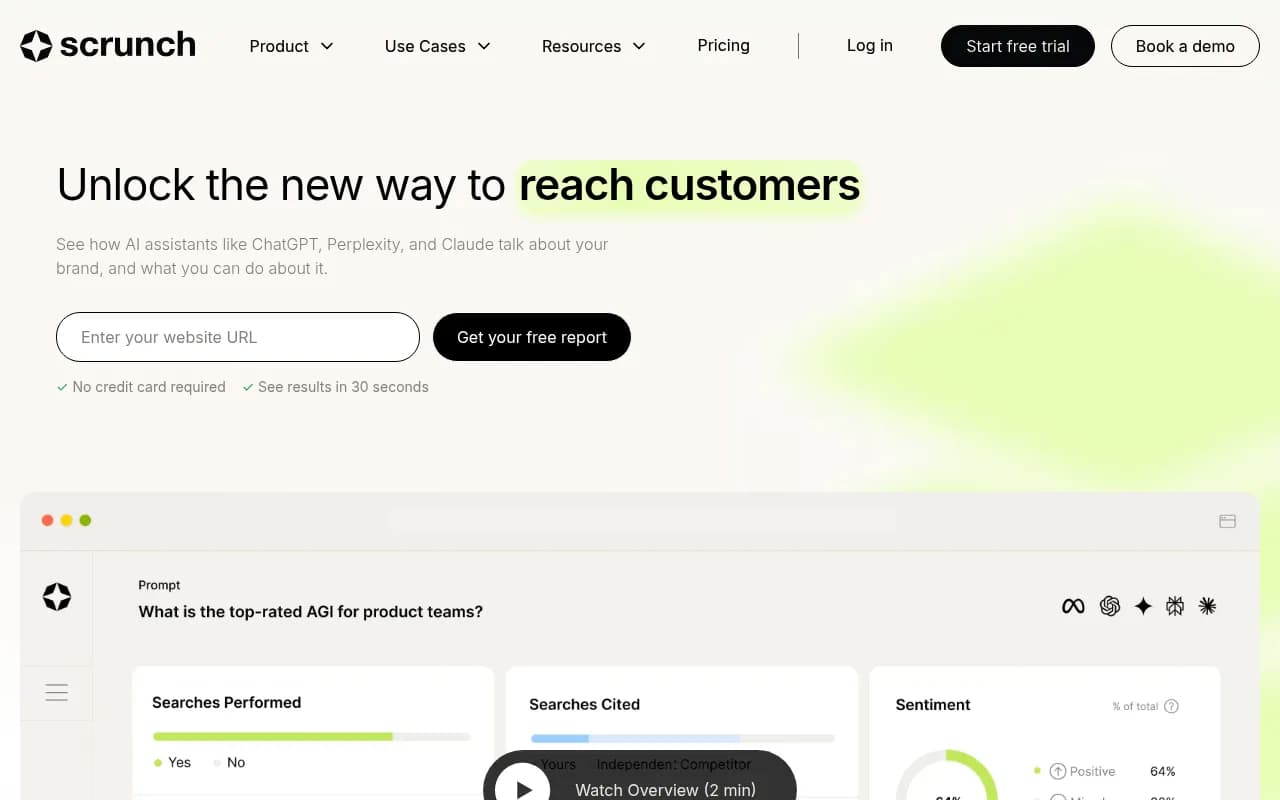
What Scrunch does well is citation analysis -- seeing which sources AI models are actually pulling from, and how your content compares to what's getting cited. That's genuinely useful data. If you're trying to understand why a competitor keeps appearing in Perplexity responses about your category, Scrunch can help you trace it back to specific content or domains.
The pricing is higher than Otterly.AI and AthenaHQ, which positions it closer to Profound territory. That's defensible if you need the data depth. But Scrunch still doesn't close the loop -- there's no Reddit or YouTube tracking (two channels that heavily influence AI recommendations), no built-in content generation, and no traffic attribution to connect visibility data to actual revenue. You're getting better data, but you're still the one who has to figure out what to do with it.
Best for: Teams with strong in-house analysts who can interpret citation data and translate it into content strategy independently.
Promptwatch
Promptwatch is the outlier in this comparison, and not just because it has more features. The fundamental difference is architectural: it's built around a loop rather than a dashboard.

The loop works like this. Answer Gap Analysis shows you exactly which prompts competitors are appearing for that you're not -- not just "you're missing here" but the specific topics, questions, and angles that AI models want to answer but can't find on your site. Then the built-in AI writing agent generates content grounded in citation data from over 880 million citations analyzed. That content is engineered to get cited, not just to rank in Google. Then you track whether it worked, down to the page level, across 10 AI models.
That third step is where most platforms stop at step one.
A few specific capabilities worth calling out:
AI Crawler Logs -- real-time logs of when ChatGPT, Claude, Perplexity, and other AI crawlers hit your site, which pages they read, and what errors they encounter. This is rare in the category and genuinely useful for diagnosing why certain pages aren't getting cited despite being well-written.
Prompt Intelligence -- volume estimates and difficulty scores for each prompt, plus query fan-outs showing how a single prompt branches into related sub-queries. This lets you prioritize high-value prompts instead of tracking everything equally.
Reddit and YouTube tracking -- surfaces discussions that directly influence AI recommendations. Most platforms ignore these channels entirely, but they're a significant part of why certain brands keep appearing in AI responses.
ChatGPT Shopping tracking -- monitors when your brand appears in ChatGPT's product recommendation carousels. Relevant for e-commerce and consumer brands.
Traffic attribution -- connects AI visibility to actual site traffic and revenue through a code snippet, Google Search Console integration, or server log analysis. This is the piece that lets you answer "is this actually working?" rather than just "are we appearing more?"
Pricing runs from $99/month (Essential: 1 site, 50 prompts, 5 articles) to $249/month (Professional: 2 sites, 150 prompts, 15 articles, crawler logs) to $579/month (Business: 5 sites, 350 prompts, 30 articles). There's a free trial, and annual billing brings the cost down.
Best for: Teams that want to actually improve their AI visibility, not just measure it. Especially strong for brands where AI search is becoming a meaningful traffic and revenue channel.
Side-by-side comparison
| Feature | Otterly.AI | AthenaHQ | Scrunch | Promptwatch |
|---|---|---|---|---|
| Brand mention monitoring | Yes | Yes | Yes | Yes |
| AI engines covered | 3-4 | Multiple | Multiple | 10+ |
| Competitor heatmaps | Basic | Yes | Yes | Yes |
| Answer gap analysis | No | No | No | Yes |
| Prompt volume/difficulty scores | No | No | No | Yes |
| Query fan-outs | No | No | No | Yes |
| AI crawler logs | No | No | No | Yes |
| Built-in content generation | No | No | No | Yes |
| Reddit/YouTube tracking | No | No | No | Yes |
| ChatGPT Shopping tracking | No | No | No | Yes |
| Traffic attribution | No | No | No | Yes |
| Starting price | $29/mo | Mid-range | Higher | $99/mo |
| Free trial | Yes | Yes | Yes | Yes |
The real question: monitoring or optimization?
Here's the honest framing. If you're early in your AI visibility journey -- you don't yet know which prompts matter for your category, you haven't benchmarked yourself against competitors, and you just need to understand the landscape -- Otterly.AI or AthenaHQ will get you there at a reasonable cost.
But if you've been tracking for a while and you're staring at a dashboard that tells you competitors are winning and you're not, the monitoring-only tools start to feel like a weather app that tells you it's raining but doesn't have an umbrella.
Scrunch is a reasonable middle ground for data-heavy teams, but the price-to-action ratio is harder to justify when you still have to do all the optimization work yourself.
Promptwatch is the only platform in this group that treats AI visibility as something to be fixed, not just observed. The citation data, the content generation, the crawler logs, the traffic attribution -- these aren't separate features. They're a connected workflow that lets you go from "we're invisible here" to "we published content, it's getting cited, and here's the traffic it's driving."
For mid-market teams with limited headcount and real growth targets, that difference matters.
Which one should you pick?
- Pick Otterly.AI if you're under $100/month budget and need basic monitoring to start building internal awareness around AI visibility.
- Pick AthenaHQ if you need clean competitive dashboards for stakeholder reporting and don't yet have a content team ready to act on gap data.
- Pick Scrunch if you have strong in-house analysts and need deep citation data to inform a content strategy you'll execute independently.
- Pick Promptwatch if you want to close the loop -- find gaps, generate content that gets cited, and track the revenue impact. It's the only platform here that does all three.
The AI search channel is moving fast. The brands that are winning in ChatGPT and Perplexity right now aren't just the ones tracking their visibility -- they're the ones publishing content that AI models actually want to cite. That's a content strategy problem as much as a monitoring problem, and only one of these platforms is built to solve both.