Key takeaways
- Peec AI is a capable AI visibility tracker, but it's primarily a monitoring tool -- it shows you where you appear, not how to improve it
- Most alternatives fall into two camps: deeper monitoring (more engines, more data) or full optimization platforms that help you create content that gets cited
- If you need to actually move the needle on AI search rankings, look for platforms with content gap analysis and built-in content generation, not just dashboards
- Pricing across the category ranges from ~$29/month for basic trackers to $579/month+ for full optimization suites
- Promptwatch is the only platform in this comparison rated as a "Leader" across all categories in a 2026 review of 12 GEO platforms
Peec AI had a good run as an early mover. When AI Overviews and ChatGPT-style search first started eating into traditional SERP traffic, Peec was one of the few tools that let you track brand presence across those engines at a prompt level. For a lot of teams, it was the first tool that made AI visibility feel measurable.
But it's 2026, and the market has moved fast. The teams I've spoken to -- in SEO Slack communities, on Reddit's r/SEO, at agencies -- keep running into the same wall: they can see they're invisible in AI search, but Peec doesn't tell them what to do about it. The monitoring is fine. The action is missing.
There's also the cost problem. As prompt sets grow, Peec's pricing scales in ways that get uncomfortable quickly for larger keyword sets. And coverage gaps across newer AI engines (Grok, DeepSeek, Meta AI) are becoming harder to ignore.
This guide covers 9 alternatives worth considering in 2026. Some are better monitors. Some go much further. I've tried to be honest about what each one actually does well.
What to look for in a Peec AI alternative
Before diving into specific tools, it's worth being clear about what separates a good AI visibility platform from a mediocre one.
Multi-engine coverage is table stakes now. You need ChatGPT, Perplexity, Google AI Overviews, Claude, and Gemini at minimum. Bonus points for Grok, DeepSeek, Copilot, and Meta AI.
Prompt-level data matters more than aggregate scores. Knowing your brand appears in "30% of AI responses" is nearly useless without knowing which prompts, which competitors are winning the ones you're losing, and why.
Actionability is where most tools fail. Monitoring is easy to build. Telling you what content to create, which gaps to fill, and then helping you create it -- that's the hard part, and most platforms skip it entirely.
Traffic attribution is the final piece. If you can't connect AI visibility to actual website traffic and revenue, you're flying blind on ROI.
Keep those four things in mind as you read through the options below.
The 9 best Peec AI alternatives in 2026
1. Promptwatch -- best for teams that want to actually improve AI rankings
Promptwatch is the most complete platform in this category, and the one I'd recommend first for any team that's serious about AI search visibility rather than just reporting on it.

The core difference from Peec AI (and most other tools here) is that Promptwatch is built around an action loop, not a dashboard. It finds the specific prompts where competitors are visible but you're not, helps you understand what content is missing, and then has a built-in AI writing agent that generates articles, listicles, and comparisons grounded in real citation data. After you publish, it tracks whether your new content starts getting cited.
That cycle -- find gaps, create content, track results -- is what makes it an optimization platform rather than a monitoring tool.
A few things that stand out beyond the basics: AI Crawler Logs show you in real time which pages ChatGPT, Claude, and Perplexity are actually reading on your site, and which ones they're ignoring or hitting errors on. Prompt Intelligence gives volume estimates and difficulty scores for each prompt, so you can prioritize the winnable ones instead of spreading effort thin. And Reddit and YouTube tracking surfaces the discussions that directly influence AI recommendations -- a channel most tools ignore entirely.
Promptwatch monitors 10 AI models: ChatGPT, Perplexity, Google AI Overviews, Google AI Mode, Claude, Gemini, Meta/Llama, DeepSeek, Grok, Mistral, and Copilot. It's used by 6,700+ brands and agencies including Booking.com and Center Parcs.
Pricing starts at $99/month (Essential: 1 site, 50 prompts, 5 articles), $249/month (Professional: 2 sites, 150 prompts, 15 articles, crawler logs), and $579/month (Business: 5 sites, 350 prompts, 30 articles). Free trial available.
2. Profound -- best for enterprise AI visibility tracking
Profound is a strong enterprise-grade option with solid multi-engine coverage and detailed attribution mapping. It's particularly good at entity extraction -- understanding how AI models describe your brand, which attributes they associate with you, and how that compares to competitors.
Profound

Where Profound shines is depth of data. The prompt-level analytics are detailed, and the competitor benchmarking is genuinely useful for understanding why you're losing visibility on specific queries. The interface is clean and the data exports are solid for teams that need to feed insights into broader reporting workflows.
The main limitation: like most enterprise tools, it's primarily a monitoring and analysis platform. It doesn't help you create content to close the gaps it identifies. You'll need a separate workflow for that. Pricing starts around $99/month, but enterprise plans scale significantly.
3. AthenaHQ -- best for multi-engine brand monitoring
AthenaHQ covers Google AI Overviews, Perplexity, ChatGPT, and Claude with a focus on brand narrative analysis. It's particularly useful for teams that care about how AI models describe their brand -- not just whether they mention it, but the sentiment and framing of those mentions.

The competitive intelligence features are well-built. You can see which brands are winning for specific prompts, how their positioning differs from yours in AI responses, and track changes over time. For brand and comms teams who need to understand the "narrative" angle of AI visibility, AthenaHQ is worth a look.
Starting price is around $295/month, which puts it in the mid-to-upper range. It's monitoring-focused -- no content generation or optimization tools built in.
4. Otterly.AI -- best for affordable AI search monitoring
Otterly.AI is one of the more accessible options in the category. It covers the major AI engines, tracks prompt-level visibility, and has a GEO audit feature that helps identify content gaps. For smaller teams or those just getting started with AI visibility tracking, it's a reasonable entry point.
Otterly.AI

The interface is straightforward, and the onboarding is faster than most enterprise tools. The GEO audit is genuinely useful for surfacing quick wins -- pages that are close to being cited but missing specific entities or coverage.
The trade-off is depth. Otterly.AI doesn't have the crawler log visibility, Reddit tracking, or content generation capabilities of more complete platforms. It's a solid monitor, not an optimizer.
5. Scrunch AI -- best for enterprise brand narrative analysis
Scrunch AI takes a different angle than most tools here. Rather than focusing purely on citation frequency, it analyzes how AI models describe and characterize your brand -- the language, associations, and descriptors that appear in AI-generated responses.
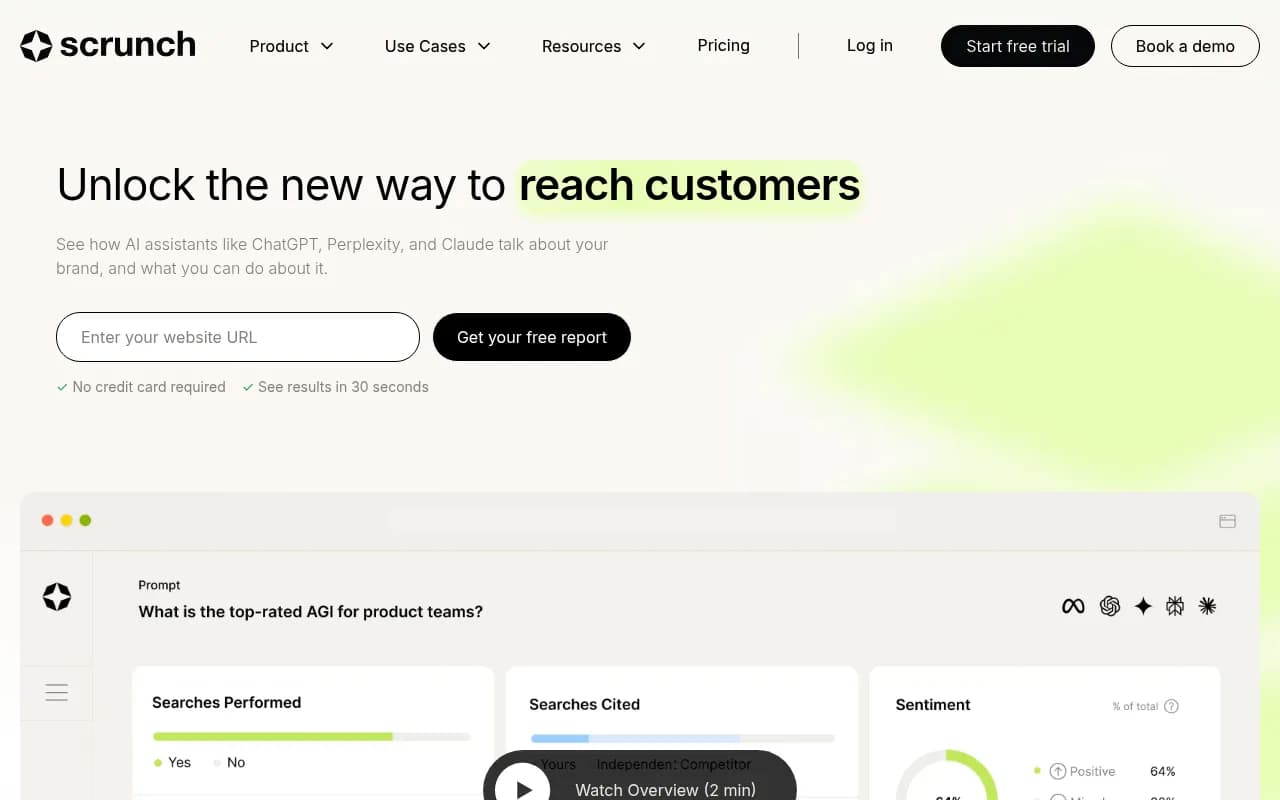
For enterprise brands where reputation and narrative control matter as much as raw visibility, this is a compelling differentiator. Scrunch is particularly strong for large organizations that need to monitor AI brand presence across multiple product lines, regions, or languages.
It's positioned as an enterprise product, so pricing reflects that. If you're a smaller team, the cost-to-value ratio probably doesn't work out.
6. SE Visible -- best for AI visibility inside an existing SEO workflow
SE Visible is SE Ranking's dedicated AI visibility tracking module. If your team already uses SE Ranking for traditional SEO, adding AI visibility tracking through SE Visible is a natural extension rather than a separate tool to manage.
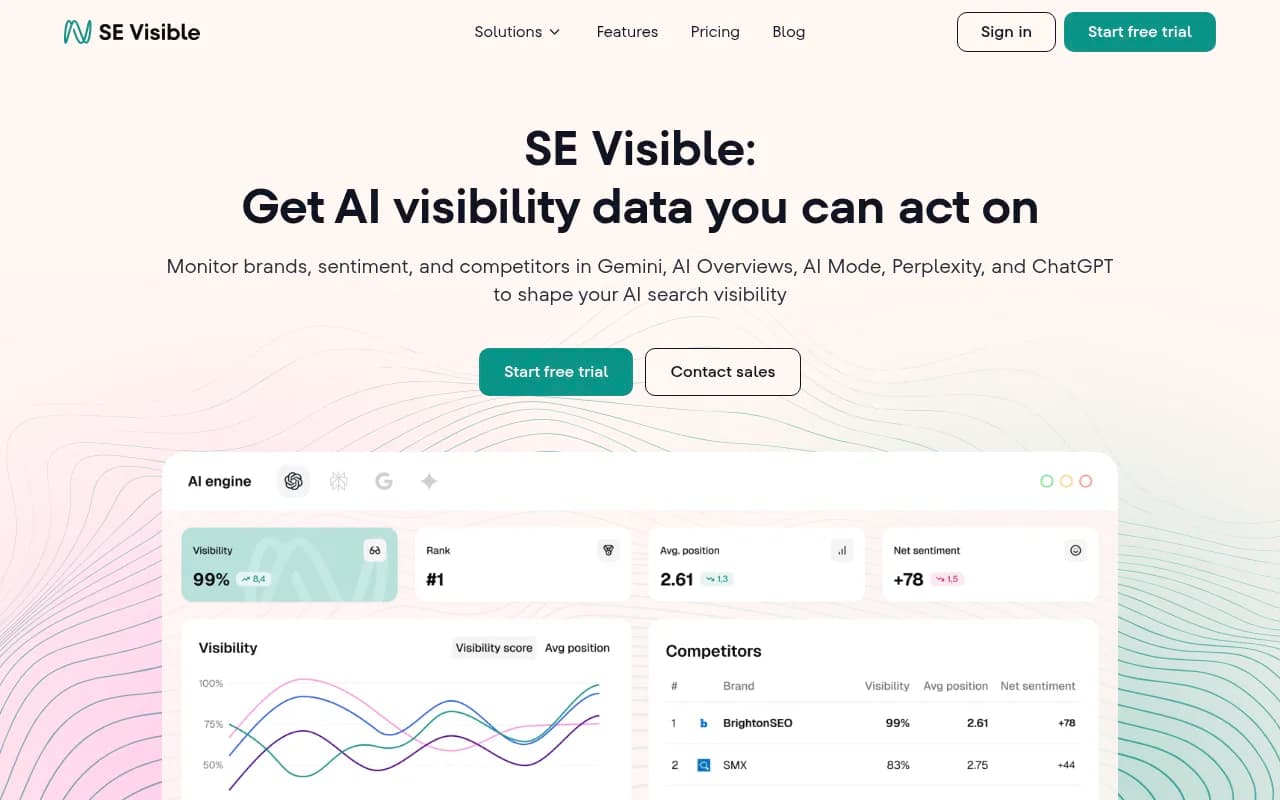
The coverage is solid across Google AI Overviews and the major LLMs. The integration with SE Ranking's keyword research, site audit, and rank tracking means you can see AI visibility in the context of your broader SEO data -- which is genuinely useful for prioritizing work.
The limitation is that it's still primarily a monitoring tool. It shows you the data but doesn't have the content generation or gap-filling workflows that a dedicated GEO platform offers. Starting price is around $189/month for the AI visibility features.
7. LLM Pulse -- best for lightweight brand monitoring
LLM Pulse is a focused tool for tracking brand mentions across ChatGPT, Perplexity, and other AI engines. It's lighter than the enterprise options, which makes it faster to set up and easier to use for teams that just need core monitoring without a lot of complexity.
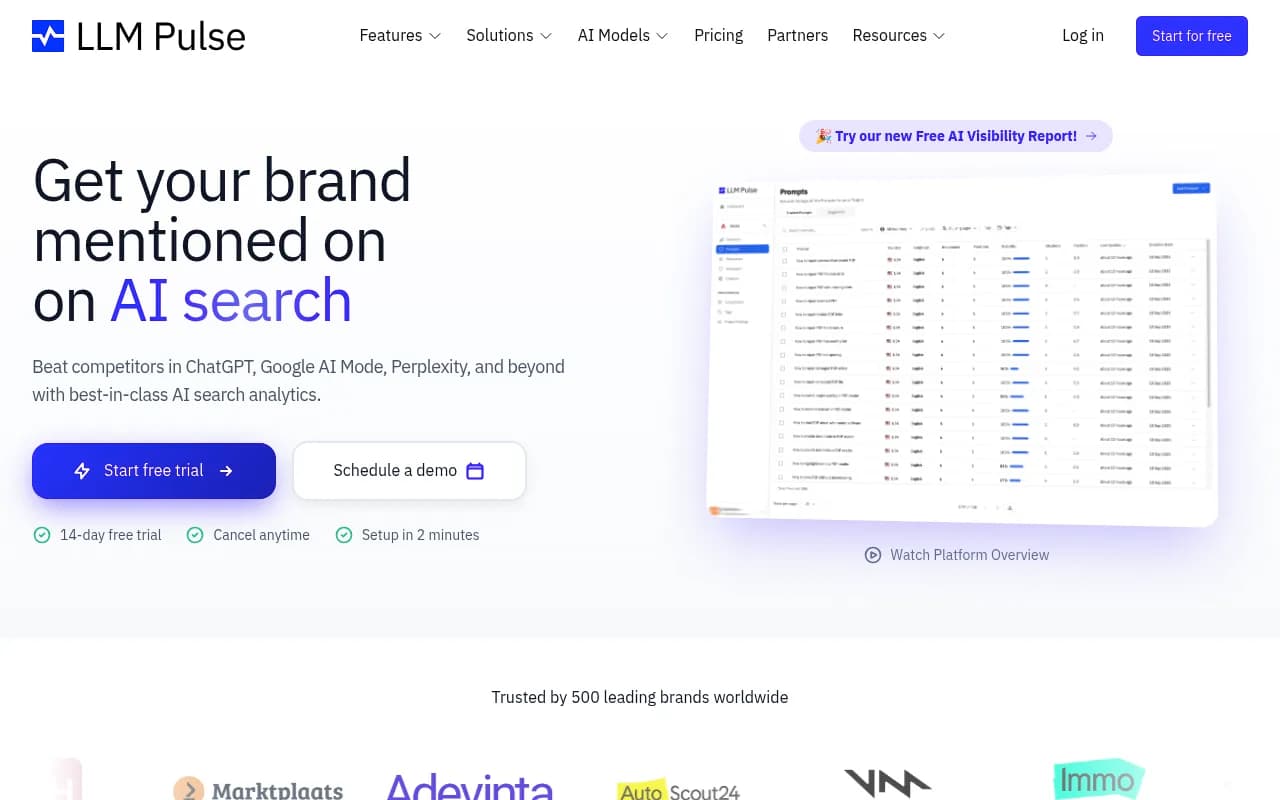
It's a reasonable option for brands that want to know when and how they're being mentioned in AI responses without committing to a full platform. The reporting is clean and the alerts are useful.
What it doesn't do: content optimization, gap analysis, crawler monitoring, or traffic attribution. It's a monitor, not an optimizer.
8. ZipTie -- best for deep citation and source analysis
ZipTie takes a research-heavy approach to AI visibility. Rather than just tracking whether your brand appears, it goes deep on which sources AI models are citing -- which pages, domains, Reddit threads, and YouTube videos are influencing AI responses in your category.
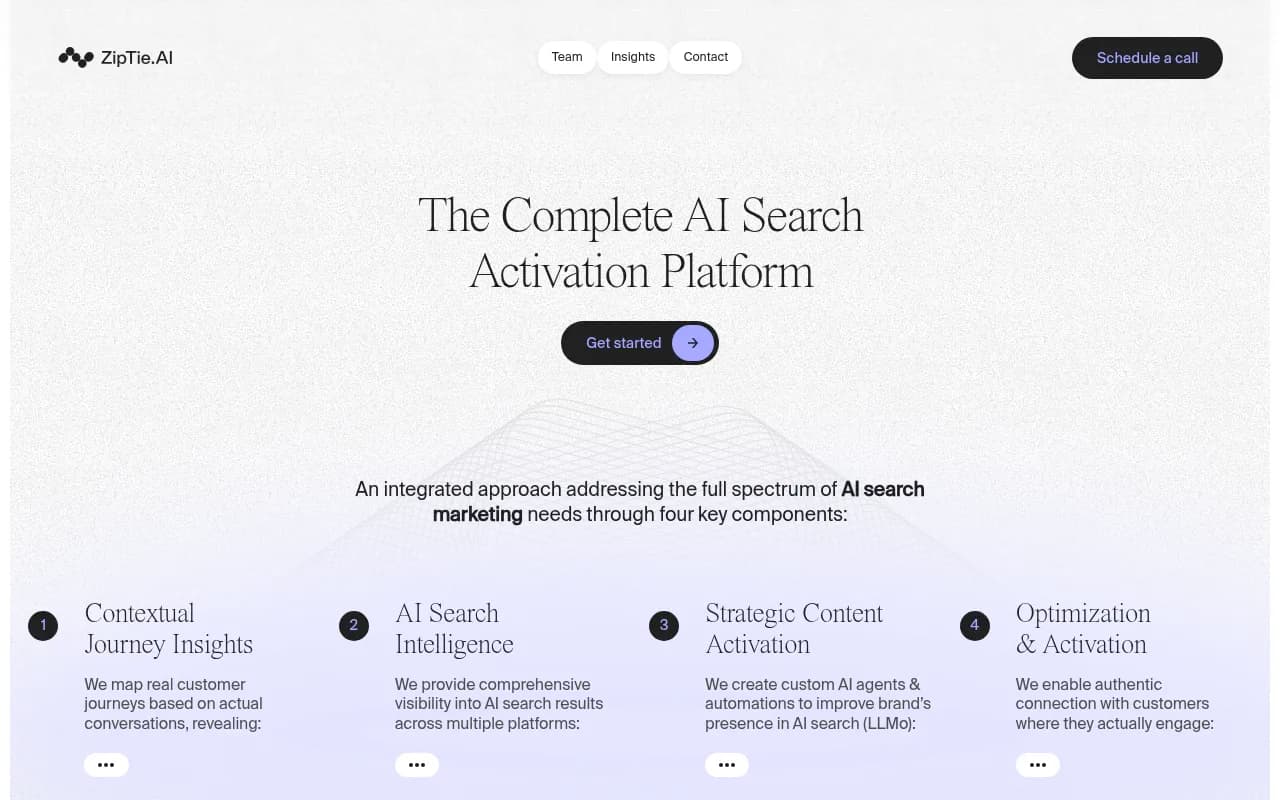
This is genuinely useful intelligence if you're trying to understand the citation ecosystem around your topic area. Knowing that Perplexity is heavily citing a specific Reddit thread or a competitor's blog post gives you a concrete target to address.
The platform is more analytical than operational -- it's better for research and strategy than for day-to-day tracking. Worth considering as a complement to a more action-oriented platform.
9. Rankscale -- best for agencies tracking AI visibility at scale
Rankscale is built with agencies in mind. It handles multi-client AI visibility tracking efficiently, with white-label reporting and the ability to manage multiple brands and prompt sets from a single dashboard.
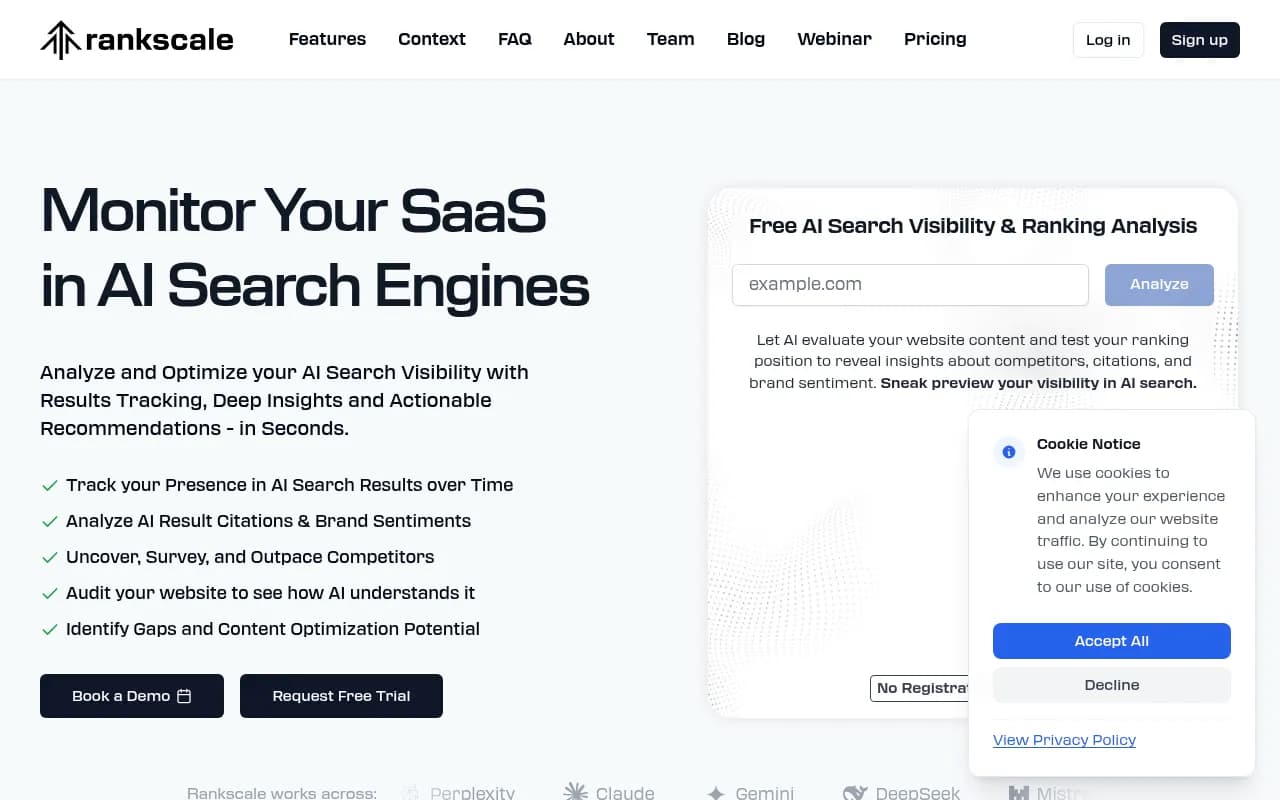
For agencies that need to report AI visibility to clients without building custom dashboards, Rankscale is a practical option. The pricing is competitive -- starting around $20/month for basic plans -- which makes it accessible for smaller agencies or those just adding AI visibility to their service offering.
The depth of data is more limited than enterprise platforms, and there's no content generation capability. But for agencies focused on reporting and monitoring rather than optimization, it gets the job done.
How these tools compare
Here's a quick breakdown of the key dimensions across all nine alternatives:
| Tool | Multi-engine coverage | Content gap analysis | Content generation | Crawler logs | Traffic attribution | Starting price |
|---|---|---|---|---|---|---|
| Promptwatch | 10 engines | Yes | Yes (built-in AI writer) | Yes | Yes | $99/mo |
| Profound | 9+ engines | Partial | No | No | Partial | $99/mo |
| AthenaHQ | 4 engines | Partial | No | No | No | $295/mo |
| Otterly.AI | Major engines | Basic (GEO audit) | No | No | No | Lower tier |
| Scrunch AI | Enterprise-wide | Partial | No | No | No | Enterprise |
| SE Visible | Major engines | No | No | No | No | $189/mo |
| LLM Pulse | Core engines | No | No | No | No | Lower tier |
| ZipTie | Core engines | Citation-focused | No | No | No | Varies |
| Rankscale | Core engines | No | No | No | No | $20/mo |
The pattern is pretty clear. Most tools in this category are monitoring dashboards. They show you data. Promptwatch is the only one in this list that closes the loop from "here's where you're invisible" to "here's the content you need to create" to "here's proof it's working."
Which tool should you actually use?
It depends on what you're trying to accomplish.
If you're just starting out and need basic monitoring to understand where your brand stands in AI search, Otterly.AI or LLM Pulse will get you there without a big budget commitment.
If you're an agency managing multiple clients and need efficient reporting, Rankscale is worth a look for the price.
If you're an enterprise brand focused on narrative and reputation in AI responses, AthenaHQ or Scrunch AI have specialized depth there.
If you're already on SE Ranking and want to add AI visibility without switching tools, SE Visible is the path of least resistance.
But if your goal is to actually improve your AI search rankings -- not just measure them -- the honest answer is that most of these tools will leave you stuck. They'll show you a gap and then leave you to figure out what to do about it.
Promptwatch is the only platform here that takes you from gap identification to content creation to results tracking in a single workflow. That's the difference between a reporting tool and an optimization platform.
For most marketing and SEO teams in 2026, that distinction is what matters.
What Peec AI does well (and where it falls short)
To be fair to Peec AI: it's a solid tool for what it does. The UI-level scraping approach gives more realistic results than API-based monitoring for some engines. The prompt tracking is clean. For teams that just need to know "are we showing up in AI answers for these queries," it works.

The issues that push teams toward alternatives:
- Cost scales uncomfortably as prompt sets grow beyond starter plans
- No content generation or optimization -- it identifies gaps but doesn't help close them
- Coverage gaps on newer engines (Grok, DeepSeek, Meta AI) compared to more complete platforms
- No crawler log monitoring, so you can't see how AI engines are actually crawling your site
- No traffic attribution to connect AI visibility to actual revenue
None of these are fatal flaws for every team. But for teams that have moved past "we need to understand our AI visibility" and into "we need to improve it," Peec AI starts to feel like the wrong tool.
The bottom line
The AI visibility tool market in 2026 is full of monitoring dashboards. Most of them will show you where you're invisible and then leave you to figure out the rest. That was fine in 2024 when just measuring AI visibility was novel. It's not enough anymore.
The tools worth investing in are the ones that help you close the gap between "we're not showing up" and "we're getting cited." That means content gap analysis, content generation grounded in real citation data, and traffic attribution that connects the work to revenue.
If that's what you're looking for, start with Promptwatch. If you have more specific needs -- agency reporting, enterprise narrative analysis, or just basic monitoring on a tight budget -- the other options in this list each have their place.