Key takeaways
- Peec AI is a capable monitoring tool, but it caps out at 100 prompts and 9,000 AI answers per month on its Pro plan, with Claude, Gemini, and AI Mode locked behind enterprise pricing
- Most alternatives reviewed here are also monitoring-only — the real differentiator is whether a platform helps you act on what it finds
- Promptwatch is the only platform in this comparison that closes the full loop: find gaps, generate content, track results
- For teams that just need clean monitoring data, Otterly.AI and LLMrefs are solid, affordable options
- For enterprise scale, Profound and Scrunch AI offer depth — but neither generates content or fixes gaps automatically
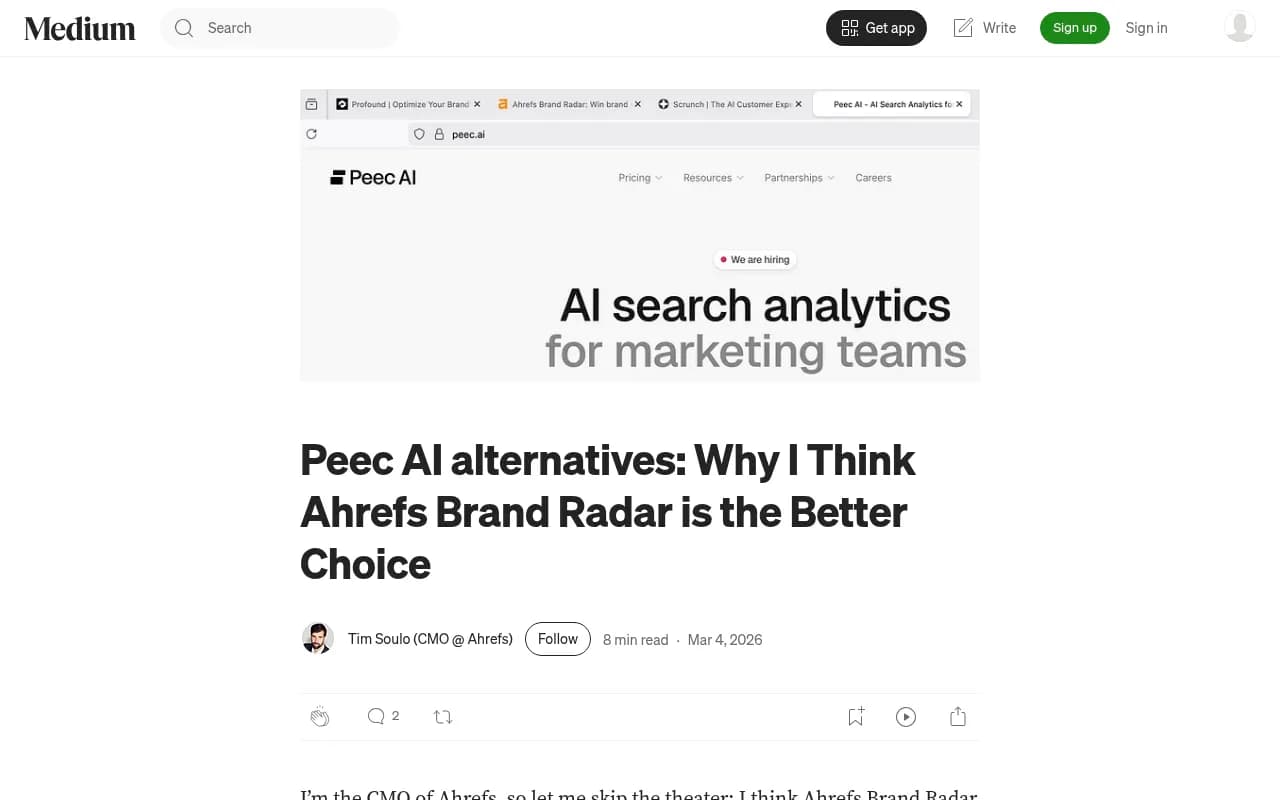
Peec AI does one thing well. It tracks how your brand appears across ChatGPT, Perplexity, Google AI Overviews, and DeepSeek, with UI-level scraping that reflects what real users actually see. Unlimited countries and languages at no extra cost is a genuine advantage. For teams just starting to think about AI visibility, it's a reasonable entry point.
But it has a ceiling.
The Pro plan (€199/month) covers four base AI engines. Claude, Gemini, and Google AI Mode are enterprise add-ons with custom pricing. You're capped at 100 prompts and 9,000 AI answers per month. There's no content creation tooling, no site audits, no crawler logs, and no way to actually fix the gaps it finds. You get a dashboard. What you do with it is entirely up to you.
That's fine if monitoring is all you need. But most teams reach a point where they want to know: "OK, I'm invisible for these prompts — now what?"
That's the question this guide is built around. Not just which tools track AI visibility, but which ones help you do something about it.

How these 8 platforms were selected
The shortlist focuses on tools with meaningful differentiation from Peec AI — either broader model coverage, better data quality, content generation capabilities, or a lower price point for comparable monitoring. Generic SEO tools with a thin "AI visibility" badge didn't make the cut.
The ranking criterion is simple: what can you actually do with the data?
The comparison at a glance
| Platform | AI engines covered | Content generation | Crawler logs | Prompt limits | Starting price |
|---|---|---|---|---|---|
| Promptwatch | 10+ | Yes (Content Agents) | Yes | 50–350/mo | $99/mo |
| Profound | 9+ | No | No | Custom | Custom |
| Scrunch AI | 8+ | No | Limited | Custom | Custom |
| Otterly.AI | 5+ | No | No | 50–500/mo | ~$49/mo |
| AthenaHQ | 6+ | Limited | No | Custom | Custom |
| LLMrefs | 9+ | No | No | Varies | Free tier |
| SE Ranking | 5+ | Yes (separate module) | No | Varies | ~$65/mo |
| Ahrefs Brand Radar | 6+ | No | No | 2,500–25,000 checks | $50/mo |
1. Promptwatch — best overall for teams that want to act, not just watch
Promptwatch is the platform that changes the conversation from "where am I invisible?" to "here's how to fix it."
Most tools in this space stop at monitoring. They show you a visibility score, a list of prompts where competitors appear and you don't, and maybe a chart of how things have changed over time. That's useful data. But it leaves you stuck at the hardest part: figuring out what to actually do.
Promptwatch is built around a three-step loop. First, Answer Gap Analysis shows you exactly which prompts competitors are being cited for that you're not — the specific topics and questions where AI models want an answer but can't find one on your site. Second, Content Agents generate articles, listicles, comparisons, and briefs grounded in that gap data, using real prompt volumes, citation patterns, competitor analysis, and your own brand guidelines. Third, page-level tracking shows you when those new pages get crawled, when they start being cited, and what effect they have on visibility scores.
That cycle — find gaps, create content, track results — is what separates Promptwatch from every other tool in this list.
A few other things worth noting: it tracks 10+ AI models including ChatGPT, Perplexity, Claude, Gemini, Google AI Overviews, Google AI Mode, Grok, DeepSeek, Copilot, and Meta AI. It has real AI crawler logs showing which pages ChatGPT, Claude, and Perplexity are actually reading, how often, and whether they're hitting errors. It tracks Reddit and YouTube as citation sources (most competitors ignore these entirely). And it connects AI visibility to actual traffic and revenue through website integrations with Cloudflare, Vercel, Fastly, and Google Search Console.
Pricing starts at $99/month for the Essential plan (1 site, 50 prompts, 5 articles). The Professional plan at $249/month adds crawler logs, state/city tracking, and 15 articles per month.
For any team that's moved past "let's just see what's happening" into "let's actually improve our AI visibility," Promptwatch is the right tool.

2. Profound — best for enterprise teams that need deep data
Profound is one of the more serious platforms in the GEO space. It covers 9+ AI engines, tracks sentiment alongside citations, and gives enterprise teams the kind of depth that smaller tools can't match. The competitive benchmarking is solid, and the prompt coverage is genuinely broad.
The limitation is the same one that affects most enterprise tools: it's a monitoring platform. Profound will tell you a lot about where you stand. It won't help you change it. There's no content generation, no crawler logs, and no built-in workflow for turning gap data into published content.
Pricing is custom, which typically means it's positioned for larger marketing teams with dedicated budgets. If you're at that scale and primarily need a robust data layer to feed into your own content workflows, Profound is worth evaluating.
Profound

3. Scrunch AI — best for enterprise-wide brand monitoring
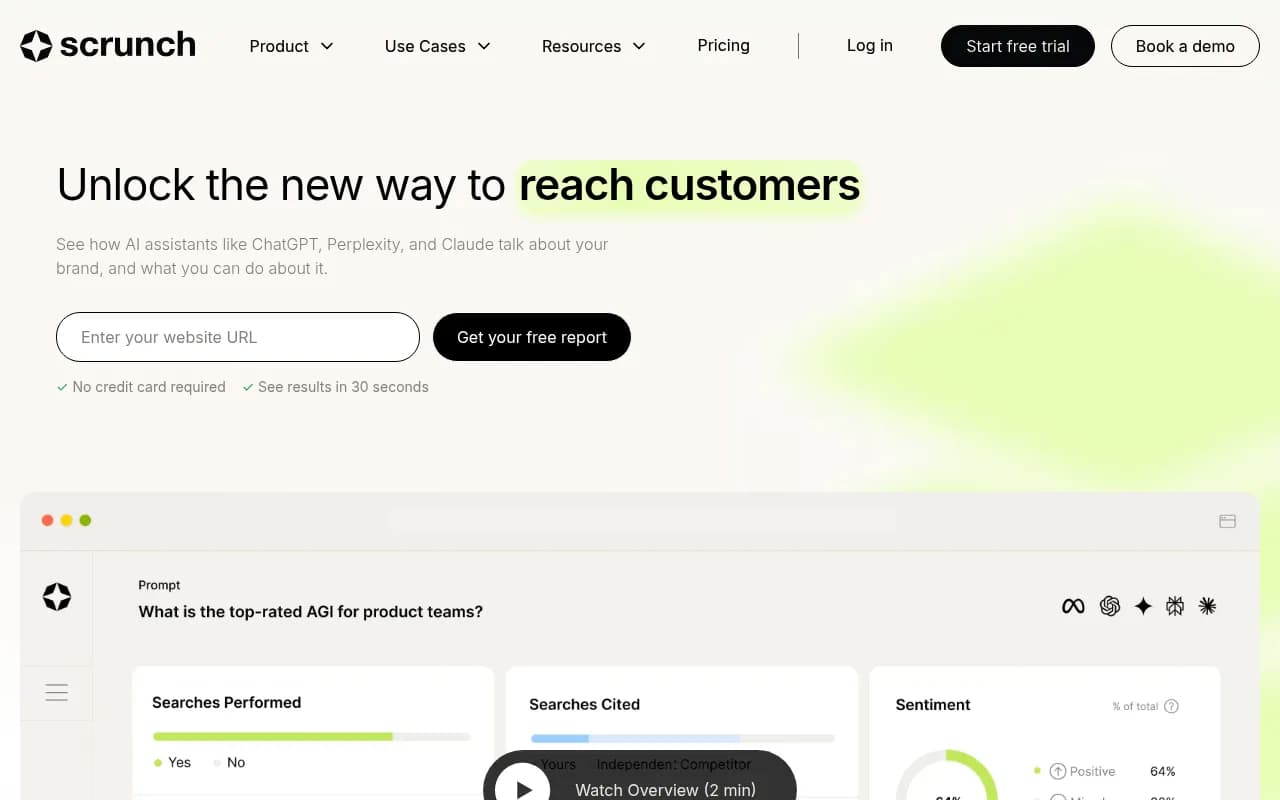
Scrunch AI takes a broader view of AI visibility than most tools. It's built for enterprise teams that need to monitor brand presence across a wide range of AI surfaces — not just ChatGPT and Perplexity, but the full landscape of AI-generated content.
The platform handles multi-brand and multi-region monitoring well, which makes it useful for large organizations with complex brand architectures. The reporting is clean and the data coverage is wide.
Like Profound, though, Scrunch AI is fundamentally a monitoring tool. The data is good. The action layer isn't there. You'll need to bring your own content team and your own workflow to turn what you see into something that moves the needle.
4. Otterly.AI — best for focused monitoring on a budget
Otterly.AI is probably the most direct Peec AI alternative for teams that want clean, straightforward AI visibility monitoring without the enterprise price tag.
It tracks brand mentions across ChatGPT, Perplexity, and Google AI Overviews, with a simple interface that's easy to get started with. The prompt tracking is solid for the price, and it covers the core use cases most mid-market teams actually need.
The ceiling is clear: no crawler logs, no content generation, no site-level optimization tools. It's a monitoring layer, and it's priced like one. If Peec AI's €89/month starter plan feels like too much for what you get, Otterly.AI is worth a look.
Otterly.AI

5. AthenaHQ — best for optimization-focused teams
AthenaHQ sits somewhere between pure monitoring and optimization. It's more actively focused on helping teams improve their AI search presence than tools like Otterly or LLMrefs, with features oriented around ongoing AI search growth rather than just reporting.
The platform covers 6+ AI engines and has decent competitive analysis capabilities. Where it falls short is in the content generation side — it can point you toward gaps and suggest optimization directions, but it doesn't generate the content itself. You still need to bring your own writers or tools to close the loop.
For teams that want something more action-oriented than a basic monitoring dashboard but aren't ready for the full Promptwatch workflow, AthenaHQ is a reasonable middle ground.

6. LLMrefs — best for citation and source tracking
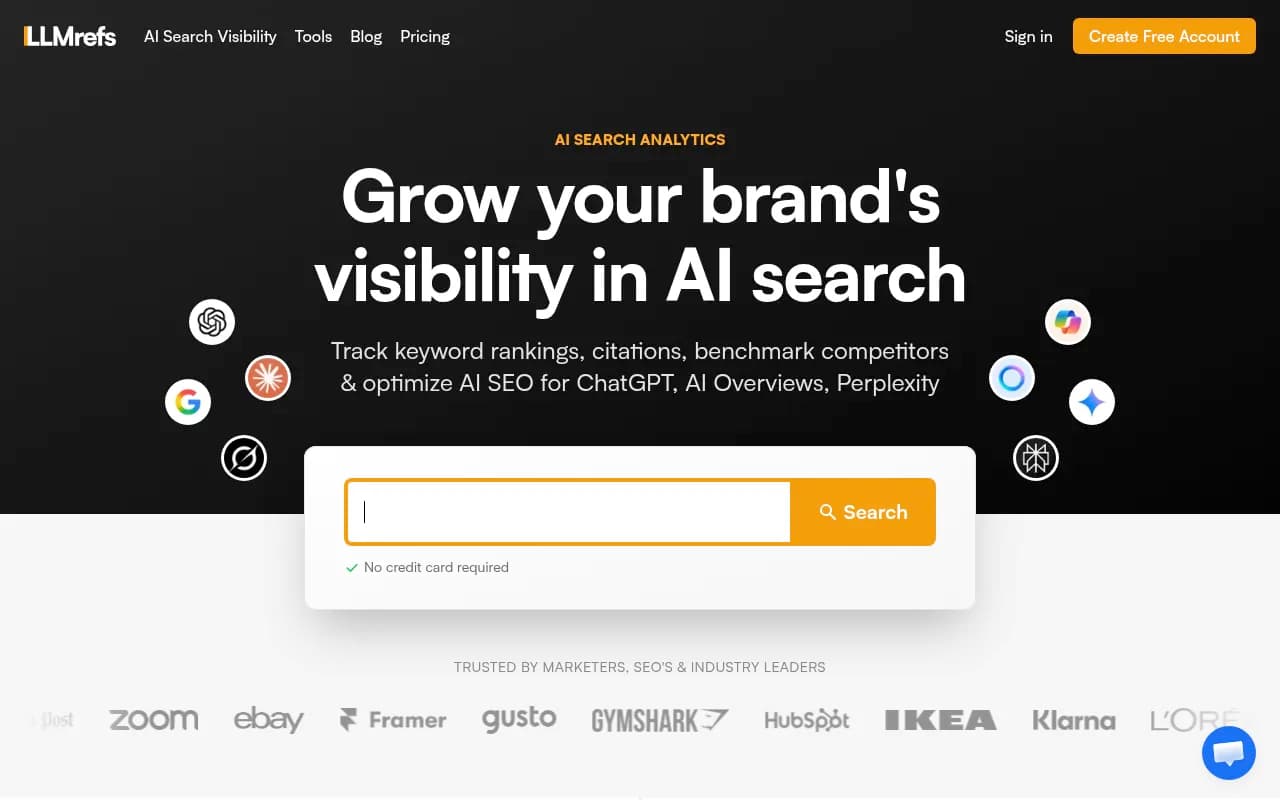
LLMrefs takes a different angle from most tools in this space. Rather than focusing primarily on brand mentions and visibility scores, it emphasizes citation tracking — which specific pages, domains, and sources AI models are actually linking to when they answer relevant queries.
That's genuinely useful data. Understanding which external sources are driving AI citations in your category tells you where to publish, what to optimize, and which third-party placements are worth pursuing. It covers 9+ AI engines and has a free tier that makes it accessible for smaller teams.
The limitation is scope. LLMrefs is a specialized tool for a specific use case. It doesn't do the broader brand monitoring, competitive benchmarking, or content generation that a full GEO platform provides. Think of it as a useful complement to a primary platform rather than a standalone solution.
LLMrefs
7. SE Ranking — best for teams that want AI visibility inside a full SEO suite
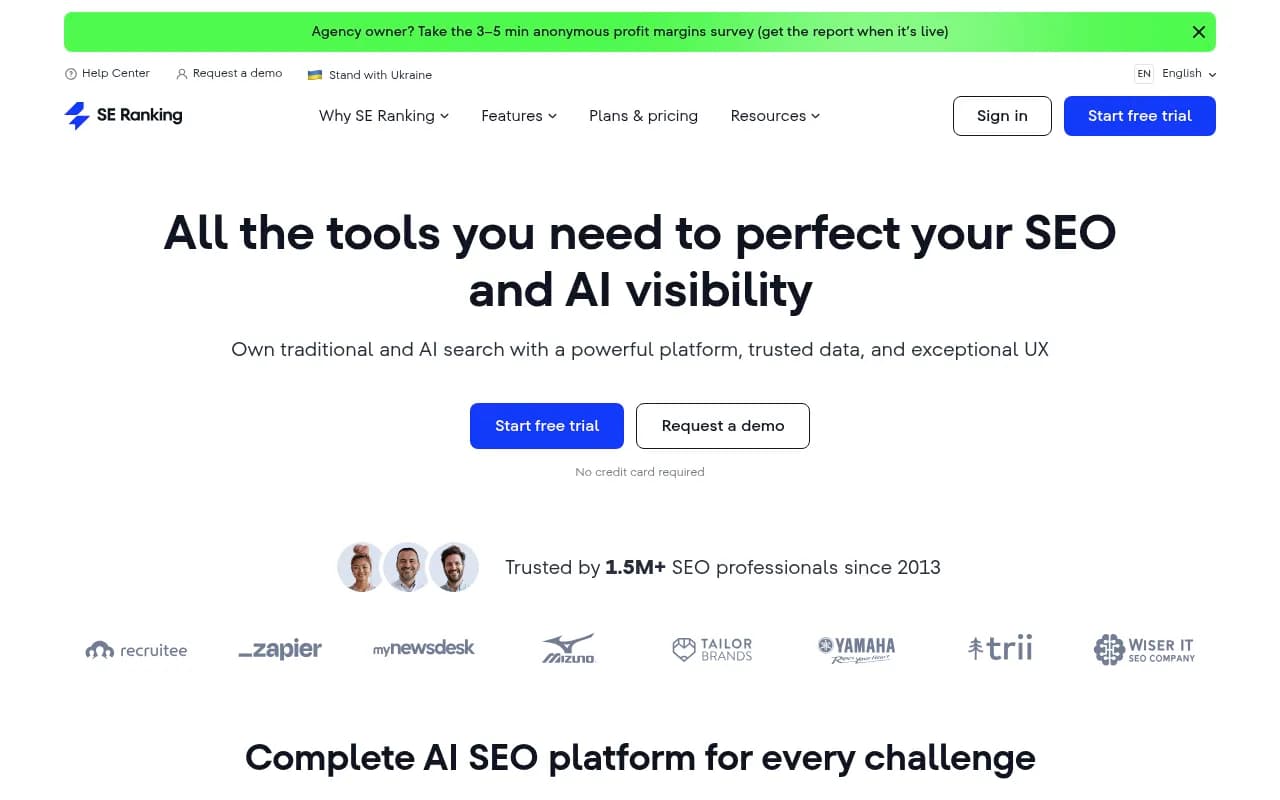
SE Ranking is primarily an SEO platform — rank tracking, site audits, keyword research, content tools — that has added meaningful AI visibility features. If your team is already paying for an SEO suite and wants AI monitoring without adding another tool to the stack, SE Ranking is worth evaluating.
The AI visibility module covers 5+ engines and integrates with the platform's existing content optimization tools. The content side is stronger than most pure-play AI monitoring tools, though it's built around traditional SEO content optimization rather than specifically engineering content for AI citations.
The trade-off is depth. SE Ranking's AI visibility features are solid but not as specialized as dedicated GEO platforms. If AI search is your primary focus, you'll probably outgrow what it offers. If it's one of several priorities alongside traditional SEO, the bundled approach makes sense.
8. Ahrefs Brand Radar — best for data quality purists
Ahrefs Brand Radar takes a meaningfully different approach to prompt selection. Most tools construct their own queries — they guess what users might ask, run those prompts against AI engines, and report the results. Brand Radar's prompts come from real search data: "People Also Ask" questions with measurable search volume behind them. The visibility scores reflect how AI responds to queries that real people have actually typed.
That's an architectural difference, not a feature difference. It means every metric — mention counts, citation data, competitive benchmarks — is anchored in actual behavior rather than simulated scenarios.
Coverage is broad: ChatGPT, Perplexity, Gemini, Copilot, Google AI Overviews, and Google AI Mode, plus YouTube, TikTok, and Reddit. Pricing starts at $50/month for 2,500 checks, which is accessible for smaller teams.
The gap is the same one that affects most tools here: Brand Radar is a monitoring and analysis platform. There's no content generation, no crawler logs, no workflow for turning gap data into published content. If data quality is your primary concern and you have a content team to act on what you find, it's a strong choice.
What Peec AI gets right (and where it falls short)
It's worth being direct about Peec AI's actual strengths. The UI-level scraping approach — tracking what AI engines show in their actual interfaces rather than just querying APIs — is a genuine differentiator. API outputs and user-facing responses can differ, and Peec captures the latter. Unlimited countries and languages at no extra cost is also unusual in this space.
The limitations are structural. The Pro plan's four-engine coverage and 100-prompt cap will feel tight for teams doing serious GEO work. The enterprise add-on pricing for Claude and Gemini means the real cost of comprehensive coverage is higher than the headline price suggests. And like most tools in this list, Peec AI is fundamentally a monitoring platform — it shows you data but doesn't help you act on it.
How to choose the right alternative
The decision really comes down to one question: do you need to monitor, or do you need to optimize?
If you're in the early stages of understanding AI visibility — figuring out which engines matter, how often your brand appears, where competitors are showing up — a monitoring-focused tool like Otterly.AI, LLMrefs, or Ahrefs Brand Radar will serve you well. They're affordable, focused, and easy to get started with.
If you've moved past that stage and you're actively trying to improve your AI visibility — creating content to fill gaps, tracking whether it's working, connecting visibility to revenue — you need a platform with an action layer. That's where Promptwatch is the clear choice. It's the only platform in this comparison that takes you from "here's where you're invisible" to "here's the content that will fix it" to "here's proof it worked."
For enterprise teams with complex brand architectures and large monitoring needs, Profound and Scrunch AI offer the depth and scale that smaller tools can't match — though you'll still need to bring your own content workflow.
For teams already invested in traditional SEO tooling, SE Ranking's bundled approach avoids adding another platform to the stack.
The monitoring-only tools aren't bad. They're just incomplete. AI visibility is only useful if you do something with it.
Final verdict
Peec AI is a reasonable starting point. But "reasonable starting point" isn't the same as "best tool for the job."
If you're serious about AI search visibility in 2026 — not just tracking it but actually improving it — the gap between monitoring platforms and optimization platforms is significant. Most of the tools in this list will tell you where you're invisible. Only one of them will help you fix it.
That's the real question to ask when evaluating any GEO platform: what happens after you see the data?