Key takeaways
- Peec AI is a solid monitoring tool that shows you where your brand appears (or doesn't) across AI engines like ChatGPT and Perplexity
- Promptwatch goes further: it identifies content gaps, generates AI-optimized content, tracks crawler activity, and closes the loop with traffic attribution
- If your goal is to watch your AI visibility, Peec AI works. If your goal is to improve it systematically and automate that process, Promptwatch is the stronger choice
- The automation gap between the two platforms is significant: Promptwatch's built-in content agent and API support workflows that Peec AI simply can't replicate
- For agencies and marketing teams managing multiple brands, Promptwatch's multi-site support, Looker Studio integration, and custom API access make it the more scalable option
AI search is no longer a side channel. According to Similarweb's 2025 Generative AI Report, AI platforms generated over 1.1 billion referral visits in June 2025 alone, up 357% year-over-year. If your brand isn't showing up in ChatGPT, Perplexity, or Google AI Overviews, you're losing buyers who never even see your organic rankings.
That's why the GEO (Generative Engine Optimization) tool market has exploded. Two names that come up constantly in this space: Peec AI and Promptwatch. Both track AI visibility. Both monitor how AI engines cite your brand. But they're built for very different goals, and choosing the wrong one can leave you stuck staring at dashboards with no clear path to improvement.
This guide breaks down exactly where each platform excels, where each falls short, and which one makes sense depending on how seriously you want to automate your AI search strategy.
What Peec AI actually does
Peec AI is a brand visibility tracker for AI search engines. You set up prompts, it runs them across models like ChatGPT, Claude, and Perplexity, and it tells you whether your brand appears in the responses.

The core use case is monitoring: are you being cited? How often? By which models? Peec AI handles this reasonably well. It gives you a visibility score, tracks changes over time, and lets you compare your brand against competitors across different AI engines.
Where it gets limiting is what happens after you see the data. Peec AI shows you the problem. It doesn't help you solve it. There's no built-in content generation, no gap analysis that surfaces the specific prompts you're missing, and no crawler log monitoring to understand how AI engines are actually reading your site. You get the "what" but not the "so what" or the "now what."
For teams that just need a simple dashboard to report AI visibility metrics to stakeholders, that might be enough. For teams that want to actually move the needle, it creates a frustrating loop: you see you're invisible for a prompt, then you have to go figure out why and what to write, then you have to go write it somewhere else, then you wait and hope.
What Promptwatch actually does
Promptwatch is built around a different premise: monitoring is only useful if it leads to action.

The platform tracks your brand across 10 AI models (ChatGPT, Perplexity, Claude, Gemini, Google AI Overviews, Google AI Mode, Meta/Llama, DeepSeek, Grok, Mistral, and Copilot), but that's just the starting point. What makes it different is the action loop it's built around:
-
Find the gaps: Answer Gap Analysis shows you the specific prompts where competitors are visible and you're not. Not just "you're missing coverage in this topic area" but the actual prompts, with visibility data attached.
-
Create content that ranks in AI: A built-in AI writing agent generates articles, listicles, and comparisons grounded in citation data from over 880 million citations analyzed. This isn't generic content -- it's engineered to get cited by AI models based on what those models actually pull from.
-
Track the results: Page-level tracking shows which specific pages are being cited, how often, and by which models. Traffic attribution (via code snippet, Google Search Console integration, or server log analysis) connects AI visibility to actual revenue.
The platform also includes AI Crawler Logs -- real-time logs of when ChatGPT, Claude, Perplexity, and other AI crawlers hit your site, which pages they read, and what errors they encounter. Most competitors don't have this at all. It's the difference between knowing you're not being cited and knowing why you're not being cited.
The automation question
This is where the comparison gets most interesting, because the title of this guide isn't just about features -- it's about what you can actually automate.
Peec AI's automation story is limited. You can schedule prompt runs and get alerts when your visibility changes. That's roughly where it stops. There's no API that lets you build custom workflows, no content generation you can trigger programmatically, and no way to close the loop from "visibility drop detected" to "content fix deployed" without leaving the platform and doing a lot of manual work.
Promptwatch has a proper API and Looker Studio integration, which means you can build workflows around it. A marketing team could, for example, set up an automated pipeline where:
- Promptwatch detects a new prompt where a competitor is visible and you're not
- The gap gets flagged and prioritized by prompt volume and difficulty score
- The built-in content agent drafts an article targeting that prompt
- The article gets published and Promptwatch tracks whether it starts getting cited
That's not hypothetical. That's what the platform is designed to enable. The API and integrations make it possible to wire this into your existing content operations stack rather than treating GEO as a separate manual process.
For agencies managing multiple brands, Promptwatch's multi-site support (up to 5 sites on the Business plan, custom on Agency/Enterprise) and white-label reporting options make this kind of automation genuinely scalable.
Feature comparison
| Feature | Peec AI | Promptwatch |
|---|---|---|
| AI visibility monitoring | Yes | Yes |
| Models tracked | ChatGPT, Perplexity, Claude, others | 10 models including Google AI Mode, Grok, DeepSeek, Mistral |
| Competitor visibility comparison | Yes | Yes (with heatmaps) |
| Answer gap analysis | No | Yes |
| Built-in content generation | No | Yes (AI writing agent) |
| AI crawler logs | No | Yes (Professional+) |
| Prompt volume & difficulty scores | No | Yes |
| Query fan-outs | No | Yes |
| Reddit & YouTube citation tracking | No | Yes |
| ChatGPT Shopping tracking | No | Yes |
| Traffic attribution | No | Yes (GSC, snippet, server logs) |
| Page-level citation tracking | Limited | Yes |
| Multi-language / multi-region | Limited | Yes |
| API access | Limited | Yes |
| Looker Studio integration | No | Yes |
| Free trial | Yes | Yes |
The monitoring capabilities are roughly comparable. Everything after "competitor visibility comparison" is where the gap opens up.
Pricing comparison
| Plan | Peec AI | Promptwatch |
|---|---|---|
| Entry level | ~$49/mo | $99/mo (Essential: 1 site, 50 prompts, 5 articles) |
| Mid tier | ~$99/mo | $249/mo (Professional: 2 sites, 150 prompts, 15 articles, crawler logs) |
| Higher tier | ~$199/mo | $579/mo (Business: 5 sites, 350 prompts, 30 articles) |
| Agency/Enterprise | Custom | Custom |
Peec AI is cheaper at the entry level. That's worth acknowledging. If you're a solo marketer who just wants to check whether your brand appears in AI responses and report that to your boss, Peec AI costs less for that specific use case.
But if you're a marketing team or agency that needs to actually improve AI visibility -- not just measure it -- the cost comparison changes. Promptwatch's built-in content generation replaces tools you'd otherwise pay for separately. The crawler logs replace manual technical audits. The traffic attribution replaces cobbled-together analytics setups. When you add up the stack you'd need to replicate Promptwatch's full workflow with Peec AI plus other tools, Promptwatch often comes out cheaper.
Who should use Peec AI
Peec AI makes sense if:
- You have a small budget and need basic AI visibility reporting
- Your primary goal is tracking and reporting, not optimization
- You're in an early stage of GEO and just want to understand the landscape before committing to a more comprehensive platform
- You already have a strong content team and separate tools for content strategy -- you just need the monitoring piece
It's a reasonable starting point. The problem is that most teams outgrow it quickly once they realize monitoring without optimization is like having a scale that tells you your weight but no information about what to eat.
Who should use Promptwatch
Promptwatch makes sense if:
- You want to move from tracking AI visibility to actually improving it
- You need to automate parts of your GEO workflow -- gap detection, content briefing, or performance tracking
- You're an agency managing multiple brands and need scalable reporting and multi-site support
- You want to understand not just whether AI models cite you, but why they do or don't (crawler logs, citation source analysis)
- You need to connect AI visibility to revenue, not just impressions
The platform is used by 6,700+ brands and agencies including Booking.com and Center Parcs, which gives some signal about the kind of scale it's built for. But the Professional plan at $249/month is accessible enough for mid-size marketing teams, not just enterprise.
A note on the MCP angle
The "MCP" in this guide's title refers to the broader question of how much control you have over your GEO workflow -- not just what you can see, but what you can do, what you can automate, and how tightly you can integrate AI visibility into your existing operations.
Peec AI gives you visibility. Promptwatch gives you visibility plus a mechanism to act on it, plus the data infrastructure to automate that action at scale.
In 2026, with AI search traffic growing at the pace it is, the teams winning in GEO aren't the ones with the best dashboards. They're the ones who've built repeatable systems for finding gaps, creating content that fills them, and tracking whether it worked. That's a workflow question as much as a tool question -- and Promptwatch is built around that workflow in a way Peec AI isn't.
Other tools worth knowing about
If you're evaluating this space more broadly, a few other platforms are worth a look depending on your specific needs:
Otterly.AI -- monitoring-focused, similar positioning to Peec AI, good for basic tracking without the optimization layer.
Otterly.AI

Profound -- stronger enterprise feature set, higher price point, no Reddit tracking or ChatGPT Shopping monitoring.
Profound

AthenaHQ -- monitoring-focused with some optimization features, but lacks content generation and crawler logs.

Scrunch AI -- solid tracking capabilities, but the action loop is incomplete compared to Promptwatch.
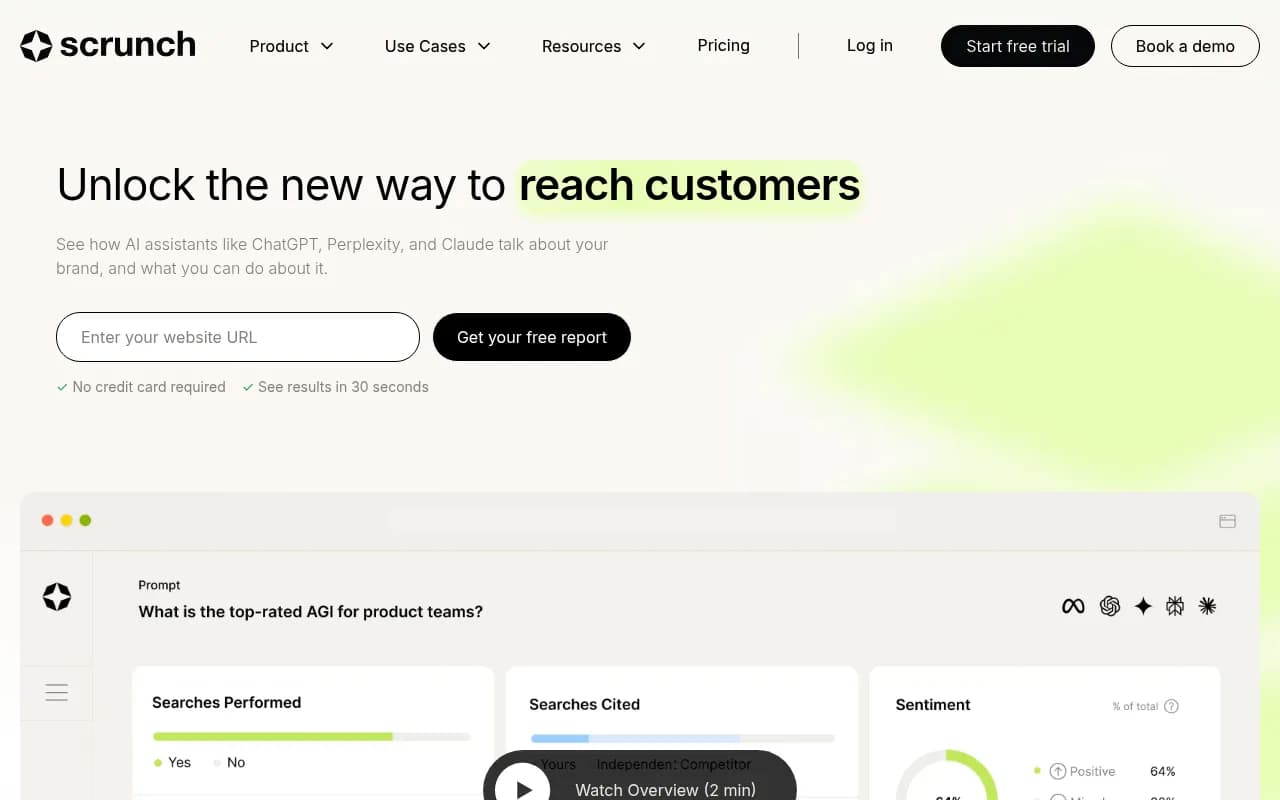
None of these close the full loop from gap detection to content creation to traffic attribution the way Promptwatch does. They're worth knowing about, but if automation is your goal, they'll leave you doing significant manual work.
The bottom line
Peec AI and Promptwatch are both legitimate tools for AI search visibility. The choice between them comes down to what you're trying to accomplish.
If you need a monitoring dashboard and you're comfortable doing the optimization work manually with other tools, Peec AI is cheaper and gets the job done. If you want a platform that shows you where you're invisible, helps you create content to fix it, and tracks whether that content actually gets cited -- all in one place, with API access to automate the workflow -- Promptwatch is the stronger choice.
The platforms aren't really competing on the same dimension. Peec AI is a tracker. Promptwatch is an optimization engine that happens to include tracking. In 2026, with AI search growing the way it is, that distinction matters.