Key takeaways
- Peec AI, Conductor, seoClarity, and BrightEdge all offer some form of AI search monitoring, but most treat it as a feature bolt-on rather than a core capability
- Promptwatch is the only platform in this comparison built specifically around the full cycle: finding visibility gaps, generating content to close them, and tracking the results
- BrightEdge and seoClarity are strong for enterprises that need traditional SEO depth alongside AI monitoring, but their AI tracking is relatively shallow compared to dedicated GEO platforms
- Conductor is more of a content intelligence platform than a true AI search tracker -- useful for large teams but not built for GEO optimization
- Peec AI is a clean, focused monitoring tool that works well for SaaS and B2B teams, but stops at the data layer
- If you're a marketing or SEO team that needs to actually improve AI visibility (not just measure it), Promptwatch is the most complete option in this group
The way people search has changed faster than most enterprise marketing stacks have adapted. ChatGPT, Perplexity, Google AI Mode, Claude -- these aren't niche tools anymore. They're how a growing share of your potential customers research products, compare vendors, and make decisions. And most of the platforms that enterprise teams have relied on for years weren't built with any of this in mind.
So where does that leave you? Probably evaluating a mix of your existing tools (BrightEdge, seoClarity, Conductor) against newer entrants (Peec AI, Promptwatch) and trying to figure out which combination actually covers what you need.
This guide compares all five across the dimensions that matter most in 2026: AI search coverage, content optimization capabilities, pricing, and who each platform is actually built for.
What you actually need from an AI search platform in 2026
Before getting into the tools, it's worth being specific about what "AI search tracking" means -- because vendors use the term loosely.
At minimum, a useful AI search platform should tell you whether your brand appears in AI-generated answers across the major engines (ChatGPT, Perplexity, Google AI Overviews, Claude, Gemini, etc.). That's table stakes.
Beyond that, the platforms that create real value do at least some of the following:
- Show you which prompts your competitors are visible for that you're not (gap analysis)
- Help you understand why certain sources get cited and others don't
- Give you tools to create or optimize content specifically for AI citation
- Track changes in your visibility over time, at the page level
- Connect AI visibility to actual traffic and revenue
Most platforms in this comparison do the first item reasonably well. Very few do the rest.
The five platforms compared
Peec AI
Peec AI is a purpose-built AI visibility monitoring tool aimed at SaaS, B2B, and e-commerce teams. The pitch is simple: set up your brand, configure your prompts, and get a clean dashboard showing where you appear across ChatGPT, Perplexity, Google AI Overviews, and a handful of other engines.
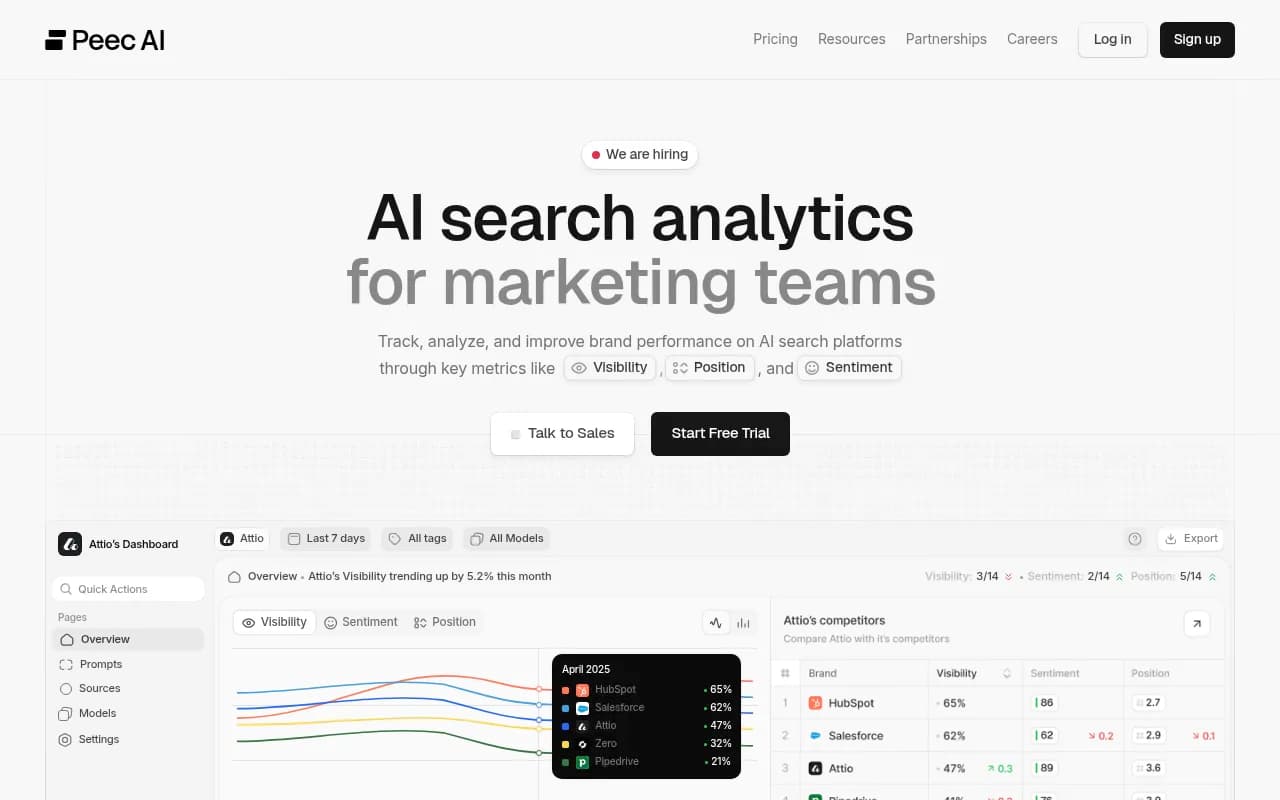
The interface is genuinely easy to use. You can get up and running in under an hour, and the competitor benchmarking is solid -- you can see how your visibility stacks up against named competitors across specific prompt categories. For teams that just need a clear answer to "are we showing up in AI search?", Peec AI does that well.
Where it falls short is everything that comes after the data. There's no content gap analysis, no built-in content generation, no crawler logs, no traffic attribution. You can see that you're invisible for a certain set of prompts, but the platform doesn't help you figure out what to do about it. For teams that want to move from monitoring to optimization, Peec AI requires you to take the data elsewhere.
Pricing starts at €89/month, which is reasonable for what it offers. It's a good fit for smaller teams or companies in the early stages of building an AI search strategy.
Promptwatch
Promptwatch takes a different approach entirely. Where most tools in this space are monitoring dashboards, Promptwatch is built around a closed loop: find the gaps, create content to fill them, track the results.

The Answer Gap Analysis feature is particularly useful -- it shows you the specific prompts where competitors are getting cited and you're not, along with the content your site is missing. That's actionable in a way that a simple visibility score isn't. The built-in AI writing agent then generates content (articles, listicles, comparisons) grounded in real citation data from over 880 million citations analyzed. This isn't generic SEO content; it's engineered to match what AI models actually want to cite.
On the tracking side, Promptwatch monitors 10 AI engines including ChatGPT, Perplexity, Claude, Gemini, Google AI Mode, DeepSeek, Grok, Copilot, Meta AI, and Mistral. Page-level tracking shows exactly which pages are being cited and by which models. The AI Crawler Logs feature (available on Professional and above) shows you in real time which AI crawlers are hitting your site, which pages they're reading, and what errors they're encountering -- something most competitors don't offer at all.
Traffic attribution closes the loop: you can connect AI visibility to actual sessions and revenue via a code snippet, Google Search Console integration, or server log analysis.
Pricing: Essential at $99/month (1 site, 50 prompts), Professional at $249/month (2 sites, 150 prompts, crawler logs), Business at $579/month (5 sites, 350 prompts). Agency and enterprise plans available.
For marketing and SEO teams that want to actively improve their AI search presence rather than just measure it, Promptwatch is the most complete option in this comparison.
Conductor
Conductor has been around for years as a content intelligence and organic marketing platform. It added AI search tracking capabilities more recently, positioning itself as a place to monitor brand authority and citations across AI engines alongside its traditional SEO feature set.
The platform is strong for large content teams. Its content guidance tools, workflow features, and integrations with CMS platforms make it genuinely useful for managing content operations at scale. The AI tracking layer shows brand mentions in AI responses and tracks how that changes over time.
But Conductor's AI search features feel like an addition to an existing product rather than a core capability. The depth of prompt coverage, the granularity of competitor analysis, and the ability to act on what you find are all more limited compared to dedicated GEO platforms. It's also priced for enterprise -- expect to negotiate a contract rather than sign up online.
If your team is already using Conductor for content strategy and wants basic AI visibility monitoring without adding another tool, it's a reasonable choice. If AI search is a primary concern, you'll likely find the dedicated platforms more capable.
seoClarity
seoClarity is a full-stack enterprise SEO platform that has added AI search visibility tracking to its existing suite of rank tracking, content optimization, and technical SEO tools.
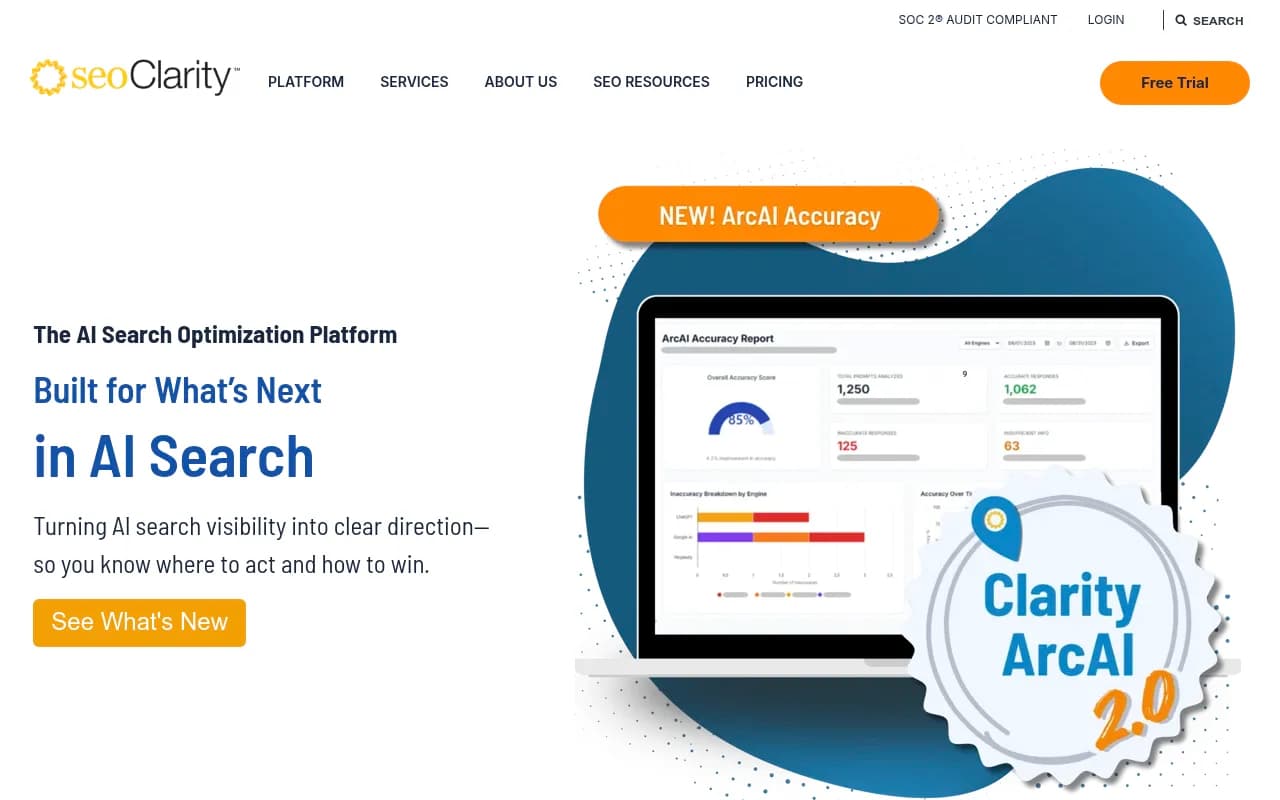
The platform's strength is breadth. If you need traditional SEO capabilities (rank tracking at scale, site audits, content scoring, competitive intelligence) alongside some AI search monitoring, seoClarity covers a lot of ground in one place. Large enterprise teams with complex SEO programs often find value in having everything in a single platform.
The AI tracking component monitors brand mentions across major AI engines and provides some competitive benchmarking. But like Conductor, it's not the core of what seoClarity does -- it's an addition to a traditional SEO platform. The AI-specific features (prompt volume data, citation analysis, content gap analysis for AI) are less developed than what you'd get from a dedicated GEO tool.
Pricing is enterprise-level, starting around $2,500/month. That makes sense if you're replacing multiple SEO tools, but it's hard to justify purely for AI search monitoring.
BrightEdge
BrightEdge is one of the oldest names in enterprise SEO, and it has been adding AI search features as the category has grown. The platform tracks brand presence in AI Overviews and other AI-generated results alongside its core rank tracking and content performance features.
BrightEdge's main advantage is its data scale and its integrations -- it connects to a wide range of enterprise systems and has deep historical data that large organizations rely on. For teams that have been using BrightEdge for years and want to add some AI visibility monitoring without switching platforms, the new features are a reasonable starting point.
The limitations are similar to seoClarity: the AI tracking is real but shallow compared to dedicated platforms. There's no content generation for AI search, no crawler logs, no prompt-level gap analysis. BrightEdge tells you where you stand; it doesn't help you improve.
Pricing is enterprise and contract-based, typically in the same range as seoClarity.
Feature comparison
| Feature | Peec AI | Promptwatch | Conductor | seoClarity | BrightEdge |
|---|---|---|---|---|---|
| AI engine coverage | 5-6 engines | 10 engines | 4-5 engines | 4-5 engines | 4-5 engines |
| Competitor benchmarking | Yes | Yes | Limited | Yes | Yes |
| Prompt/query gap analysis | No | Yes | No | Limited | No |
| Built-in content generation | No | Yes | No | No | No |
| AI crawler logs | No | Yes (Pro+) | No | No | No |
| Traffic attribution | No | Yes | Limited | Limited | Limited |
| Reddit/YouTube insights | No | Yes | No | No | No |
| ChatGPT Shopping tracking | No | Yes | No | No | No |
| Page-level citation tracking | No | Yes | No | Limited | Limited |
| Traditional SEO features | No | No | Yes | Yes | Yes |
| Starting price | €89/mo | $99/mo | Enterprise | ~$2,500/mo | Enterprise |
| Free trial | Yes | Yes | No | No | No |
Who should use which platform
The right choice depends heavily on what you're trying to accomplish and what you already have.
Peec AI makes sense if you're a SaaS or B2B team in the early stages of AI search monitoring, want a clean tool with minimal setup, and are comfortable doing your own content optimization work based on the data you get.
Promptwatch is the right choice if your goal is to actually improve your AI search visibility, not just measure it. The gap analysis, content generation, and traffic attribution make it the most actionable platform in this group. It's also the most accessible price-wise for teams that aren't at enterprise scale.
Conductor fits teams that are already invested in the platform for content operations and want to add basic AI monitoring without switching tools. Don't choose it primarily for AI search.
seoClarity and BrightEdge make sense for large enterprises with complex traditional SEO programs that want a single platform covering both SEO and AI monitoring. If you're already paying for one of these and want to add AI tracking, the incremental value is there. If you're starting fresh and AI search is the primary concern, the dedicated platforms will serve you better.
The monitoring-only problem
One thing worth naming directly: most platforms in this comparison -- and most of the broader market -- are monitoring tools. They show you data. They don't help you change the data.
That's fine as a starting point, but it creates a real gap. You can see that you're invisible for 40 prompts where a competitor is visible. Now what? Most platforms leave you to figure that out yourself.
The platforms that are starting to close this gap -- by connecting visibility data to content creation and then to traffic outcomes -- are the ones that will be most valuable as AI search continues to grow. Promptwatch is the clearest example of this in the current market, but it's a direction the whole category is moving.
Bottom line
If you're an enterprise team evaluating these five platforms, the honest answer is that they're solving different problems.
BrightEdge and seoClarity are traditional SEO platforms with AI monitoring added on. They're worth considering if you need the full SEO stack and want AI tracking included, but don't expect deep GEO capabilities.
Conductor is a content operations platform with some AI visibility features. Good for large content teams, not purpose-built for AI search.
Peec AI is a clean, focused monitoring tool. Good for getting started, limited for optimization.
Promptwatch is the only platform here built specifically to help you improve AI search visibility rather than just measure it. For teams where AI search is a strategic priority in 2026, that distinction matters.