Key takeaways
- Prompt data accuracy isn't just about how many AI engines a tool monitors -- it's about refresh frequency, how prompts are selected, and whether volume estimates are based on real signals or guesswork.
- Profound leads on enterprise-grade monitoring depth, but its price point puts it out of reach for most growth teams.
- Scrunch has improved its coverage but still lags on prompt volume intelligence and content optimization features.
- Promptwatch is the only platform in this comparison that closes the full loop: it finds prompt gaps, generates content to fill them, and tracks whether that content gets cited. The others mostly stop at monitoring.
- Rankshift is a solid mid-market option with decent prompt-level data, but it lacks the citation depth and content tooling that makes a real difference.
Prompt data is the foundation of everything in AI visibility. If the platform you're paying for is tracking the wrong prompts, refreshing them too slowly, or estimating search volume from thin air, you're flying blind. You might as well be guessing.
This comparison focuses on one specific question: which of these four platforms -- Profound, Scrunch, Promptwatch, and Rankshift -- actually gives you prompt data you can trust, and what can you do with it once you have it?
Let's get into it.
What "accurate prompt data" actually means
Before comparing tools, it's worth being precise about what we're evaluating. Prompt data accuracy has several dimensions:
- Prompt selection: Are the prompts tracked representative of how real users actually query AI engines? Or are they generic, hand-curated lists that miss the long tail?
- Refresh frequency: AI search results change constantly. A weekly refresh might be fine for traditional SEO rank tracking, but it's too slow for AI visibility.
- Volume and difficulty scoring: Does the platform tell you how often a prompt is actually used, and how hard it is to appear in the answer? Or does it just show you a yes/no visibility flag?
- Query fan-outs: One user prompt often branches into multiple sub-queries inside an LLM. Does the platform capture that complexity?
- Multi-engine consistency: A prompt might return very different results in ChatGPT vs Perplexity vs Google AI Overviews. Does the tool track each separately?
With that framework in mind, here's how each platform stacks up.
Profound
Profound

Profound is the enterprise standard in this space. It monitors 10+ AI engines, has strong data infrastructure, and is used by large brands that need comprehensive coverage. If you're a Fortune 500 company and budget isn't a constraint, Profound is genuinely impressive.
On prompt data specifically, Profound does well on multi-engine consistency -- it tracks responses across ChatGPT, Perplexity, Google AI Overviews, and several others, and it does so with reasonable freshness. The platform also surfaces citation sources, which is useful for understanding why a competitor is appearing.
Where Profound falls short for most teams is the action gap. The data is rich, but the platform is primarily a monitoring dashboard. You can see that a competitor is appearing for "best project management software for remote teams" and you're not -- but Profound doesn't help you figure out what content to create to change that. That's a significant limitation if your goal is actually improving visibility, not just measuring it.
Pricing is also a real barrier. Profound's Growth tier starts at a price point that makes sense for enterprise marketing teams but is hard to justify for a mid-sized SaaS company or a digital agency managing multiple clients.
Prompt data verdict: Strong on coverage and multi-engine consistency. Weaker on volume scoring and query fan-outs. No content optimization to act on what you find.
Scrunch AI
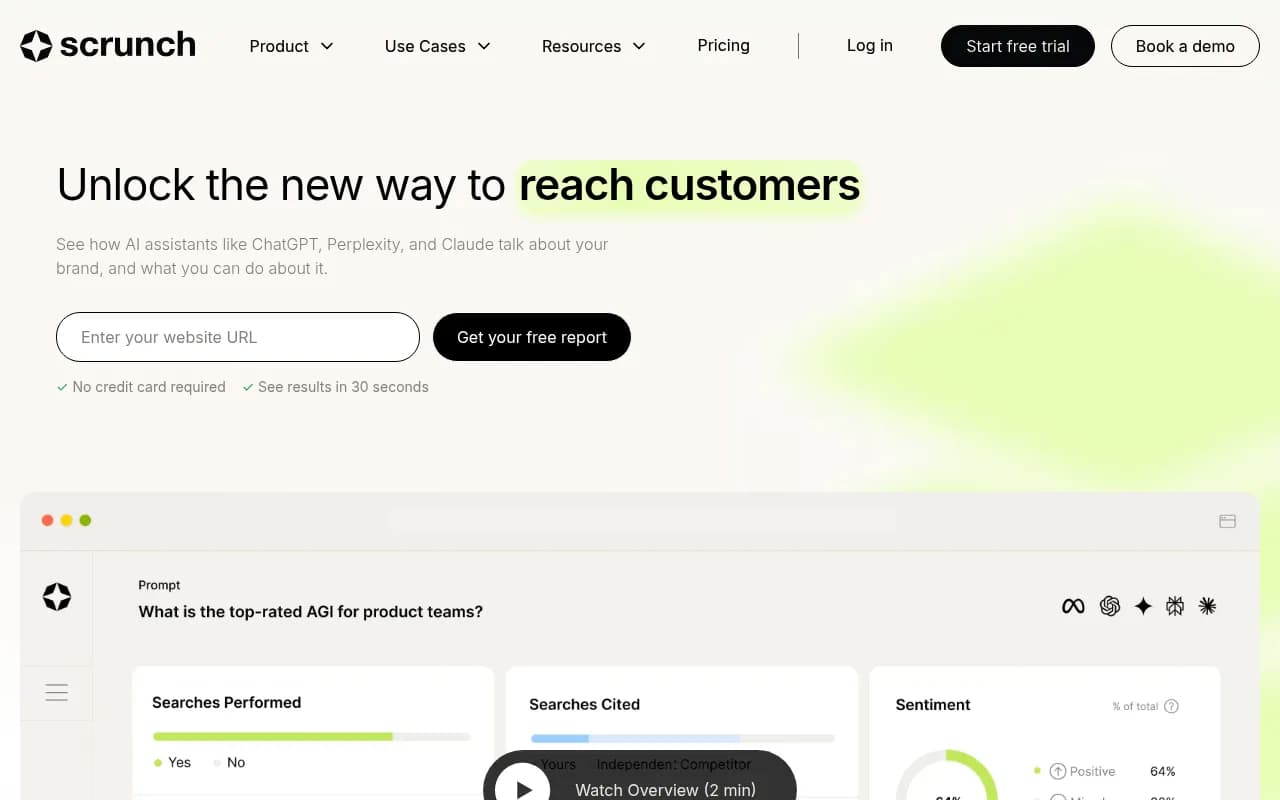
Scrunch has positioned itself as an AI search visibility platform with a focus on brand monitoring across LLMs. It covers the main engines and has a reasonably clean interface for tracking how your brand appears in AI-generated answers.
The honest assessment on prompt data: Scrunch is decent for basic monitoring but thin on the intelligence layer. You can track whether you appear for a set of prompts, but the platform doesn't give you meaningful volume estimates or difficulty scores. That matters because not all prompts are equal -- appearing for a high-volume, high-intent prompt is worth a lot more than appearing for an obscure one, and Scrunch doesn't help you prioritize.
According to a 2026 comparison by Nick Lafferty, Profound holds a 47.1% AI visibility score vs Scrunch's 4.7% -- which tells you something about the gap in data infrastructure between the two. Scrunch has been improving, but it's still catching up.
Scrunch also lacks crawler log analysis, which means you can't see how AI bots are actually crawling your site. That's a meaningful blind spot if you're trying to understand why certain pages aren't being cited.
Prompt data verdict: Adequate for basic monitoring. Limited on prompt intelligence, no volume scoring, no crawler insights.
Promptwatch
Promptwatch takes a different approach from the other three. It's not just a monitoring tool -- it's built around an optimization loop: find the gaps, create content to fill them, track whether it works.

On prompt data accuracy, Promptwatch is strong across several dimensions. It covers 10 AI models including ChatGPT, Perplexity, Claude, Gemini, Google AI Overviews, Google AI Mode, Grok, DeepSeek, Copilot, and Meta AI. Prompts are tracked with volume estimates and difficulty scores, so you can prioritize which gaps are worth pursuing. The platform also surfaces query fan-outs -- showing how a single user prompt branches into sub-queries inside an LLM -- which is something most competitors don't do at all.
The Answer Gap Analysis feature is particularly useful here. It shows you exactly which prompts competitors are appearing for that you're not, grounded in real citation data from over 880 million citations analyzed. That's not a curated list of generic prompts -- it's derived from actual AI response patterns.
What separates Promptwatch from the others is what happens after you find a gap. The built-in AI writing agent generates articles, listicles, and comparison pages engineered to get cited by AI models. It's not generic content -- it's built around the specific prompts, personas, and citation patterns that matter for your category. Then you track whether those pages start getting cited, with page-level visibility tracking across each AI engine.
The AI Crawler Logs feature is also worth calling out. Promptwatch shows you in real time which AI crawlers (ChatGPT, Claude, Perplexity, etc.) are hitting your site, which pages they're reading, and what errors they're encountering. Most competitors don't offer this at all, and it's genuinely useful for diagnosing why certain pages aren't being picked up.
Pricing is more accessible than Profound: Essential at $99/month, Professional at $249/month, Business at $579/month. A free trial is available.
Prompt data verdict: Strong on volume scoring, query fan-outs, and multi-engine coverage. The only platform in this comparison that helps you act on what you find.
Rankshift

Rankshift has been gaining traction with growth teams and mid-market companies looking for a more affordable alternative to Profound. It tracks brand visibility across ChatGPT, Perplexity, and other AI engines, and has prompt-level data that's more detailed than Scrunch.
User feedback from a 2026 Reddit thread in r/webmarketing suggests Rankshift is "way more useful than the monitoring-first tools" for teams that want prompt-level insights without enterprise pricing. The prompt-level tracking is a genuine differentiator compared to Scrunch.
That said, Rankshift is still primarily a monitoring tool. It doesn't have the content generation capabilities that Promptwatch offers, and its citation analysis is shallower -- you can see that a page is being cited, but you don't get the depth of source analysis (Reddit threads, YouTube videos, domain-level citation patterns) that helps you understand where to publish and what to optimize.
Rankshift also doesn't have crawler log analysis, which limits your ability to diagnose technical issues with AI crawling.
For teams that just want to track visibility and don't need to act on it immediately, Rankshift is a solid choice. For teams that want to actually improve their AI visibility, it's a starting point, not a complete solution.
Prompt data verdict: Better than Scrunch on prompt intelligence, but shallower than Profound and Promptwatch on citation analysis. No content optimization tools.
Head-to-head comparison
| Feature | Profound | Scrunch AI | Promptwatch | Rankshift |
|---|---|---|---|---|
| AI engines covered | 10+ | 6-8 | 10 | 4-6 |
| Prompt volume scoring | Partial | No | Yes | Partial |
| Query fan-outs | No | No | Yes | No |
| Refresh frequency | Daily | Weekly | Daily | Daily |
| Answer gap analysis | Limited | No | Yes | No |
| AI crawler logs | No | No | Yes | No |
| Content generation | No | No | Yes | No |
| Citation source analysis | Yes | Limited | Yes | Limited |
| Reddit/YouTube tracking | No | No | Yes | No |
| ChatGPT Shopping tracking | No | No | Yes | No |
| Traffic attribution | No | No | Yes | No |
| Starting price | ~$500+/mo | ~$99/mo | $99/mo | ~$79/mo |
| Best for | Enterprise | Basic monitoring | Growth to enterprise | Mid-market |
Which platform should you choose?
The right answer depends on what you actually need from prompt data.
Choose Profound if you're at an enterprise scale, have a dedicated analytics team to interpret the data, and need the deepest possible multi-engine coverage. The price is steep, but the data infrastructure is real.
Choose Scrunch if you're just getting started with AI visibility monitoring and want a low-cost way to see whether your brand appears in AI answers. Don't expect actionable intelligence from the prompt data -- it's more of a basic visibility check.
Choose Promptwatch if you want prompt data you can actually do something with. The combination of accurate volume scoring, query fan-outs, answer gap analysis, and built-in content generation makes it the most complete platform in this comparison. It's the only tool here that takes you from "we're invisible for this prompt" to "here's the content that will fix it" to "here's proof it worked." For most marketing teams and agencies, that's the loop that matters.
Choose Rankshift if you're between Scrunch and Promptwatch on budget and need better prompt-level data than Scrunch offers, but aren't yet ready to invest in content optimization tooling.
The prompt data accuracy problem nobody talks about
There's a broader issue worth naming. Most AI visibility platforms -- including some in this comparison -- present prompt data with more confidence than the underlying methodology warrants. Volume estimates for AI prompts are genuinely hard to calculate. Unlike Google, which publishes search volume data through tools like Keyword Planner, AI engines don't expose query frequency.
The platforms that do this well are deriving volume estimates from citation frequency, crawl patterns, and response analysis across large datasets. Promptwatch's 880M+ citation dataset gives it a meaningful edge here -- the larger the citation corpus, the more reliable the volume proxies.
Platforms that show you volume numbers without explaining the methodology deserve skepticism. Ask the vendor: where does this number come from? If they can't give you a clear answer, treat the data as directional at best.
Bottom line
Prompt data accuracy is what separates useful AI visibility tools from expensive dashboards. Profound has the deepest monitoring infrastructure but leaves you stuck with data and no clear path to action. Scrunch is fine for basic awareness but thin on intelligence. Rankshift is a reasonable mid-market option with better prompt-level data than Scrunch.
Promptwatch is the only platform in this group that treats prompt data as the beginning of a workflow rather than the end product. Finding that you're invisible for a high-volume prompt is only useful if you can do something about it -- and that's exactly what the answer gap analysis, AI content generation, and page-level tracking are built for.
If you're serious about AI search visibility in 2026, the question isn't just "which tool has the most accurate data?" It's "which tool helps me turn that data into results?" On that measure, the answer is clear.