Key takeaways
- Most GEO platforms were built for English-language markets first, and non-English support is often an afterthought -- or missing entirely.
- Promptwatch is the only platform in this comparison with explicit multi-language and multi-region monitoring, including customizable personas that match how real customers in different countries actually prompt AI models.
- Profound and Scrunch have enterprise-grade analytics but limited public documentation on non-English language depth.
- Peec AI adds multi-country tracking on its $495/month Advanced plan -- but "multi-country" doesn't always mean multi-language.
- Otterly.AI and AthenaHQ are solid monitoring tools but show little evidence of meaningful non-English prompt support.
- If your brand operates across multiple languages and regions, the platform choice matters enormously -- AI models behave differently in French, German, Japanese, and Spanish than they do in English.
If you're running marketing for a brand that operates in more than one country, you've probably already noticed that AI search isn't a monolith. ChatGPT answers differently in German than in English. Perplexity's citations in French often pull from entirely different sources. What Google AI Overviews surfaces in Japan has almost nothing to do with what it shows in the US.
This creates a real problem: most AI visibility platforms were designed by English-speaking teams, for English-speaking markets. They track English prompts, measure English citations, and report on English-language AI responses. If your customers are asking questions in Spanish, Dutch, or Mandarin, you're essentially invisible to your own monitoring tool.
This guide looks at six of the leading GEO platforms -- Promptwatch, Peec AI, Profound, Otterly.AI, AthenaHQ, and Scrunch -- specifically through the lens of non-English AI search visibility. Which ones actually support it? Which ones claim to but don't? And which one should you use if international markets matter to your business?
Why non-English AI visibility is harder than it sounds
Before getting into the platform comparison, it's worth understanding why this problem is genuinely difficult.
AI models don't just translate their English-language behavior into other languages. They're trained on different corpora, they cite different sources, and they respond to different framing. A prompt like "best project management software" asked in German might surface completely different brands than the same question in English -- because the German-language training data, the German-language web, and the German-language Reddit threads that AI models pull from are different ecosystems.
This means tracking your AI visibility in non-English markets requires:
- Running prompts in the target language (not just translated English prompts)
- Pulling responses from the correct regional version of each AI model
- Analyzing citations that come from local-language sources
- Understanding which local domains, forums, and publications AI models trust in each market
Most platforms don't do all of this. Some do none of it.
The platforms compared
Promptwatch
Promptwatch is the most complete platform in this comparison for non-English markets. It explicitly supports multi-language and multi-region monitoring, with customizable personas that let you define how your target customers in different countries actually prompt AI models.

This matters more than it might seem. A "persona" in Promptwatch isn't just a demographic label -- it shapes the language, phrasing, and regional context of the prompts being tracked. A French-speaking B2B buyer in Lyon prompts differently than an English-speaking one in London, even when asking about the same product category.
Promptwatch monitors 10 AI models (ChatGPT, Perplexity, Google AI Overviews, Google AI Mode, Claude, Gemini, Meta/Llama, DeepSeek, Grok, Mistral, Copilot) and tracks how they behave in real user interfaces -- not just through API calls. This distinction is important for non-English markets because the user-facing responses in, say, French or Dutch can differ significantly from what the API returns.
The platform's AI Crawler Logs (available on Professional and Business plans) show which pages AI crawlers are reading, in what language, and how often -- which helps you understand whether your non-English content is even being discovered. The Content Agents can generate content in multiple languages, grounded in real prompt data from those markets.
Pricing starts at $99/month (Essential), $249/month (Professional), and $579/month (Business). Multi-language tracking is available across plans, with state/city-level tracking on Professional and above.
Peec AI
Peec AI is a solid monitoring platform with a clean interface and good prompt tracking. Multi-country support exists, but it's gated behind the $495/month Advanced plan. Below that tier, you're tracking in a single market.

The key question with Peec AI is whether "multi-country" means multi-language. A platform can technically run prompts in multiple countries while still running those prompts in English. For markets where the primary language is English (UK, Australia, Canada), this distinction doesn't matter much. For markets where it does -- Germany, France, Japan, Brazil -- it matters a lot.
Peec AI's documentation doesn't make this distinction explicit, which is a yellow flag for international teams. The platform has no crawler logs, no visitor analytics, and no content generation capabilities. It's a monitoring tool, which means you'll see data about where you're invisible in non-English markets but won't have built-in tools to fix it.
Profound
Profound is an enterprise-grade platform with strong analytics, crawler logs, and visitor attribution. It's one of the more complete platforms in the market for English-language enterprise use cases.
Profound

For non-English markets, Profound's position is less clear. The platform tracks 9+ AI search engines and has solid competitor benchmarking, but public documentation on multi-language prompt support is limited. Enterprise customers can likely configure custom prompt sets in other languages, but this isn't a documented out-of-the-box feature.
Profound's strength is depth of analytics for large organizations -- it's the platform you'd choose if you need stakeholder-ready dashboards and want to connect AI visibility to revenue attribution. If your enterprise happens to operate primarily in English-speaking markets, it's a strong choice. If non-English markets are central to your business, you'd need to verify language support directly with their team before committing.
Otterly.AI
Otterly.AI is a well-regarded monitoring platform with solid multi-engine coverage and citation analysis. It's particularly strong on the analytics side -- engine comparison, citation depth, and competitor benchmarking are all well-executed.
Otterly.AI

For non-English visibility, Otterly.AI's position is similar to Peec AI: the platform tracks multiple AI engines but doesn't explicitly advertise multi-language prompt support as a core feature. The platform's MCP server integration is genuinely interesting for AI-native teams, but it doesn't solve the language problem.
Otterly.AI is a monitoring-focused tool. It doesn't have content generation or content gap analysis built in, which means even if it surfaces non-English visibility gaps, you're on your own to fix them.
AthenaHQ
AthenaHQ positions itself around technical SEO and AI visibility, with a focus on helping brands understand why they're being cited (or not). It has good prompt tracking and competitor benchmarking.

For non-English markets, AthenaHQ shows the least evidence of support among the platforms in this comparison. The platform appears primarily designed for English-language markets, and there's no public documentation suggesting multi-language prompt tracking or regional persona customization.
If your market is primarily English-speaking, AthenaHQ is a reasonable monitoring option. For international teams, it's probably not the right fit.
Scrunch
Scrunch is one of the more interesting platforms in this comparison because it combines monitoring with content generation -- which puts it closer to Promptwatch's end-to-end positioning than the pure monitoring tools.
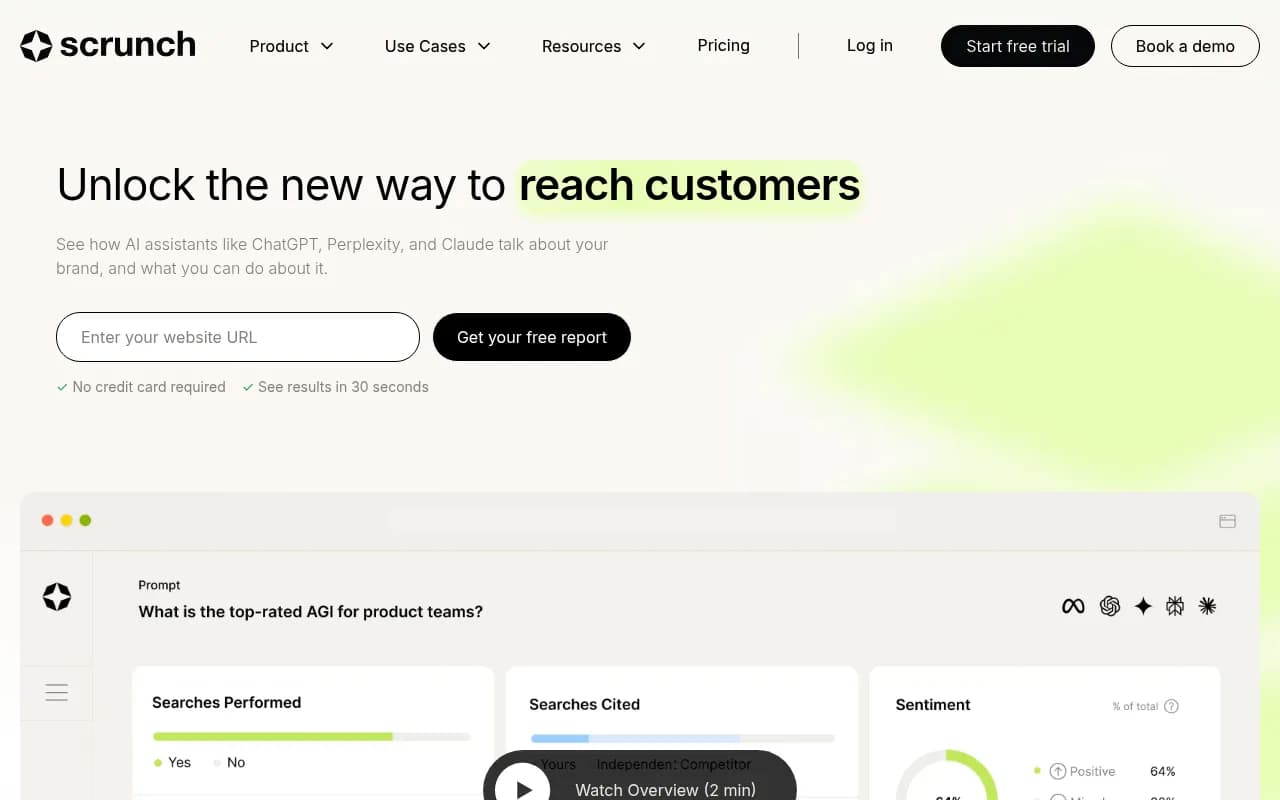
Scrunch has crawler logs, visitor analytics, and content generation capabilities, which gives it a more complete toolkit than Otterly.AI or AthenaHQ. For non-English markets, the picture is mixed: the platform has multi-engine coverage and competitor benchmarking, but explicit multi-language support isn't prominently documented.
The content generation side of Scrunch is worth noting for international teams -- if you're trying to create content that ranks in AI search in a specific language, having generation capabilities built into the same platform as your tracking is genuinely useful. Whether Scrunch's generation is language-aware (i.e., grounded in non-English prompt data) is a question worth asking their team directly.
Feature comparison table
| Feature | Promptwatch | Peec AI | Profound | Otterly.AI | AthenaHQ | Scrunch |
|---|---|---|---|---|---|---|
| Multi-language monitoring | Yes | Limited (Advanced plan) | Unclear | Limited | No evidence | Limited |
| Multi-region/country | Yes | Yes (Advanced plan) | Yes | Partial | Partial | Yes |
| Custom personas by language | Yes | No | No | No | No | No |
| AI crawler logs | Yes (Pro+) | No | Yes | Beta | No | Yes |
| Content generation | Yes | No | No | No | No | Yes |
| Answer gap analysis | Yes | No | Partial | No | No | No |
| Visitor analytics / traffic attribution | Yes | No | Yes | Limited | No | Yes |
| Reddit & YouTube tracking | Yes | No | No | No | No | No |
| ChatGPT Shopping tracking | Yes | No | No | No | No | No |
| Prompt volume & difficulty scores | Yes | No | No | No | No | No |
| Number of AI models tracked | 10 | 3-all (by plan) | 9+ | Multiple | Multiple | Multiple |
| Starting price | $99/mo | $95/mo | Custom | Custom | Custom | Custom |
How to think about this decision
The right platform depends on what you actually need from non-English AI visibility tracking.
If you need to monitor and fix visibility gaps in non-English markets, Promptwatch is the only platform in this comparison that gives you the full loop: track prompts in the target language, identify what content is missing, generate content grounded in that market's prompt data, and measure the results. The persona customization is particularly useful -- it lets you define not just the language but the framing and context of how your customers in different regions actually search.
If you need enterprise analytics and can verify language support directly, Profound is worth evaluating. It has the deepest analytics and attribution capabilities, and enterprise customers can likely configure custom prompt sets. But you'd need to have that conversation with their team.
If you're primarily in English-speaking markets and need solid monitoring with good citation analysis, Otterly.AI is a strong choice. It's not the right tool for non-English markets, but it's genuinely good at what it does.
If you want monitoring plus content generation and are willing to verify language capabilities, Scrunch is the most interesting alternative to Promptwatch. The combination of crawler logs and content generation puts it in a similar category, even if the non-English depth isn't as clearly documented.
Peec AI and AthenaHQ are both reasonable for English-language monitoring. For international teams, they're not the right starting point.
The real question: do you know what AI says about you in French?
Here's a test worth running. Take your brand name and a core product category, write a prompt in French (or German, or Japanese), and ask ChatGPT or Perplexity. Compare the response to what you get in English. The difference is often striking -- different competitors mentioned, different sources cited, sometimes your brand doesn't appear at all even if you rank well in English.
That gap is what non-English AI visibility tracking is trying to close. Most platforms in this comparison weren't built to close it. Promptwatch is the one that was.
If your business operates in multiple languages and you're serious about understanding your AI search presence in those markets, the platform choice is straightforward. Start with the one that was built for it.