Key takeaways
- AI visibility tools vary wildly in depth: some track mentions across 10+ models with content generation and crawler logs, others just show you a score and stop there.
- Promptwatch is the only tool in this comparison that closes the full loop: find gaps, create content, track results.
- Rankshift and LLM Pulse are solid mid-tier options for teams that need monitoring without the complexity of a full GEO platform.
- Omnia is worth a look if Google AI Overviews is your primary concern.
- TrackMyBusiness and AI Rank Checker are entry-level tools best suited for individuals or very small businesses testing the waters.
- Budget alone shouldn't drive your decision -- what matters is whether the tool helps you act on what it finds.
AI search has changed how people discover brands. Someone asks ChatGPT "what's the best project management tool for remote teams?" and gets a direct answer -- no clicking through ten blue links. If your brand isn't in that answer, you're invisible to that person. Full stop.
That's why AI visibility tools exist. They track how often your brand appears in AI-generated responses across ChatGPT, Perplexity, Gemini, Google AI Overviews, and others. But the tools themselves vary enormously -- from sophisticated optimization platforms to basic dashboards that just show you a number.
This guide compares six tools across the budget spectrum: Promptwatch, Rankshift, LLM Pulse, Omnia, TrackMyBusiness, and AI Rank Checker. We'll look at what each one actually does, what it costs, and who it's genuinely suited for.
What to look for in an AI visibility tool
Before diving into the tools, it helps to know what separates a useful platform from a monitoring dashboard that leaves you stuck.
The core capabilities worth evaluating:
- Model coverage: How many AI engines does it track? ChatGPT alone isn't enough in 2026.
- Prompt depth: How many prompts can you monitor, and can you customize them?
- Competitor benchmarking: Can you see how you compare to named competitors?
- Content gap analysis: Does it tell you why you're missing from certain answers?
- Content generation: Can it help you create content to fix those gaps?
- Crawler/agent logs: Does it show you when AI bots are hitting your site?
- Traffic attribution: Can it connect AI visibility to actual website visits and revenue?
- Pricing transparency: Are the limits clear upfront?
Most tools handle the first two. Very few handle all of them.
The tools at a glance
| Tool | Models tracked | Prompt limit (entry) | Content generation | Crawler logs | Starting price |
|---|---|---|---|---|---|
| Promptwatch | 10+ | 50 prompts | Yes (AI Content Agents) | Yes | $99/mo |
| Rankshift | ~5 | Varies | No | No | ~$49/mo |
| LLM Pulse | 5+ | Varies | No | No | €49/mo |
| Omnia | Google AIO focus | Varies | No | No | Free tier available |
| TrackMyBusiness | 3 (ChatGPT, Gemini, Perplexity) | Limited | No | No | Free / low-cost |
| AI Rank Checker | 3-5 | Very limited | No | No | Free / low-cost |
Promptwatch
Promptwatch is the most complete platform in this comparison -- and the only one built around optimization rather than just monitoring.

The core difference is what happens after you see your visibility data. Most tools show you that you're missing from certain AI responses and leave you to figure out what to do next. Promptwatch has a built-in action loop: Answer Gap Analysis identifies exactly which prompts competitors are winning but you're not, Content Agents generate articles and briefs grounded in that gap data, and page-level tracking shows you when new content starts getting cited.
A few things that stand out in practice:
Real prompt data, not API estimates. Promptwatch tracks how AI search engines behave in actual user interfaces -- the answers, citations, and shopping recommendations you see in ChatGPT or Perplexity when you type a query. API outputs can differ from what users actually see, so this distinction matters.
AI Crawler Logs. This is a feature most competitors don't have at all. You can see in real time when GPTBot, ClaudeBot, PerplexityBot, and others are crawling your site, which pages they're reading, and whether those pages eventually get cited. It's the closest thing to understanding how AI engines discover and evaluate your content.
Prompt Intelligence. Volume estimates and difficulty scores for each prompt, plus query fan-outs that show how one question branches into sub-queries. This helps you prioritize which gaps to fix first rather than guessing.
Reddit and YouTube tracking. AI models frequently cite Reddit threads and YouTube videos in their responses. Promptwatch surfaces which of these are influencing AI recommendations in your category -- a channel most competitors ignore.
ChatGPT Shopping tracking. If you sell products, this matters. Promptwatch monitors when your brand appears in ChatGPT's shopping carousels and product recommendations.
On pricing: Essential is $99/month (1 site, 50 prompts, 5 articles), Professional is $249/month (2 sites, 150 prompts, 15 articles, crawler logs), Business is $579/month (5 sites, 350 prompts, 30 articles). A free trial is available. It's not the cheapest option here, but it's the only one that can actually help you improve your visibility, not just measure it.

Best for: Marketing teams, SEO agencies, and brands that want to move from "we know we're invisible" to "we're fixing it."
Rankshift
Rankshift is a focused AI visibility tracker aimed at marketers who want clean, readable data without a steep learning curve.

The pitch is straightforward: connect your brand, set up prompts across ChatGPT, Perplexity, and a handful of other models, and get a dashboard showing your mention rate, sentiment, and how you compare to competitors. The interface is clean and the setup is fast -- you can be tracking within minutes.
Where Rankshift falls short is depth. There's no content generation, no crawler logs, and no traffic attribution. You can see that you're missing from certain responses, but the tool doesn't help you understand why or what to do about it. For teams that already have a content strategy and just need visibility data to inform it, that's fine. For teams that need the full picture, it's limiting.
Pricing is in the mid-tier range, roughly comparable to LLM Pulse. The exact limits on prompts and models depend on the plan you choose.
Best for: Marketers who want a clean monitoring dashboard without the complexity of a full GEO platform.
LLM Pulse
LLM Pulse has been positioning itself as a strong all-rounder in the mid-market, and based on what's publicly available, it earns that reputation for monitoring depth.
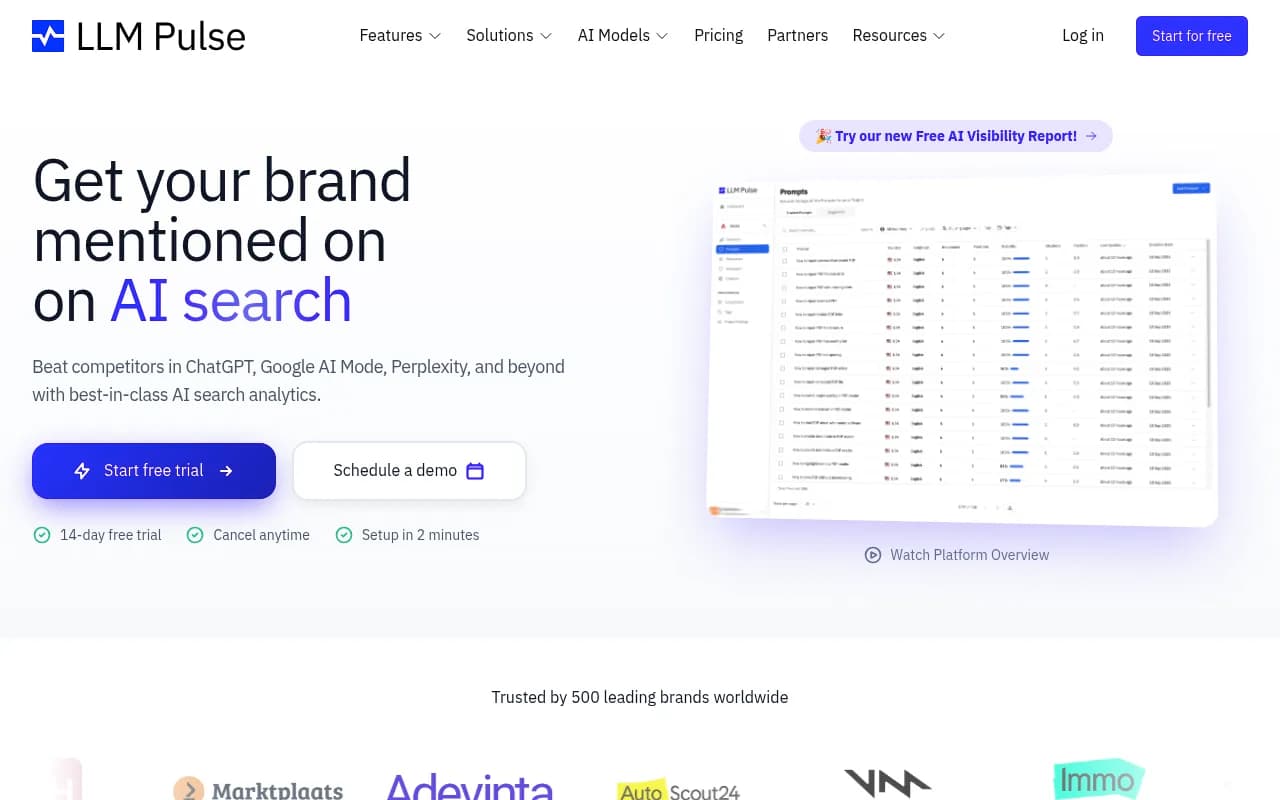
The tool covers 5+ AI models, includes real-time sentiment analysis, share of voice tracking, and prompt-level audits. The pricing starts at €49/month with a 14-day free trial, which makes it one of the more accessible options for smaller teams.
LLM Pulse's strength is in the granularity of its monitoring data. You can drill into individual prompts, see how sentiment shifts over time, and benchmark against competitors with reasonable precision. For a team that primarily needs to understand their current AI visibility position, it's a solid choice.
The gap is the same as Rankshift: no content generation, no crawler logs, no traffic attribution. LLM Pulse will tell you where you stand; it won't help you change it.
Best for: Smaller marketing teams or solo practitioners who need solid monitoring data at a reasonable price point.
Omnia
Omnia takes a slightly different angle -- it's built specifically around AI Overviews tracking, which is Google's AI-generated answer layer that appears above traditional search results.
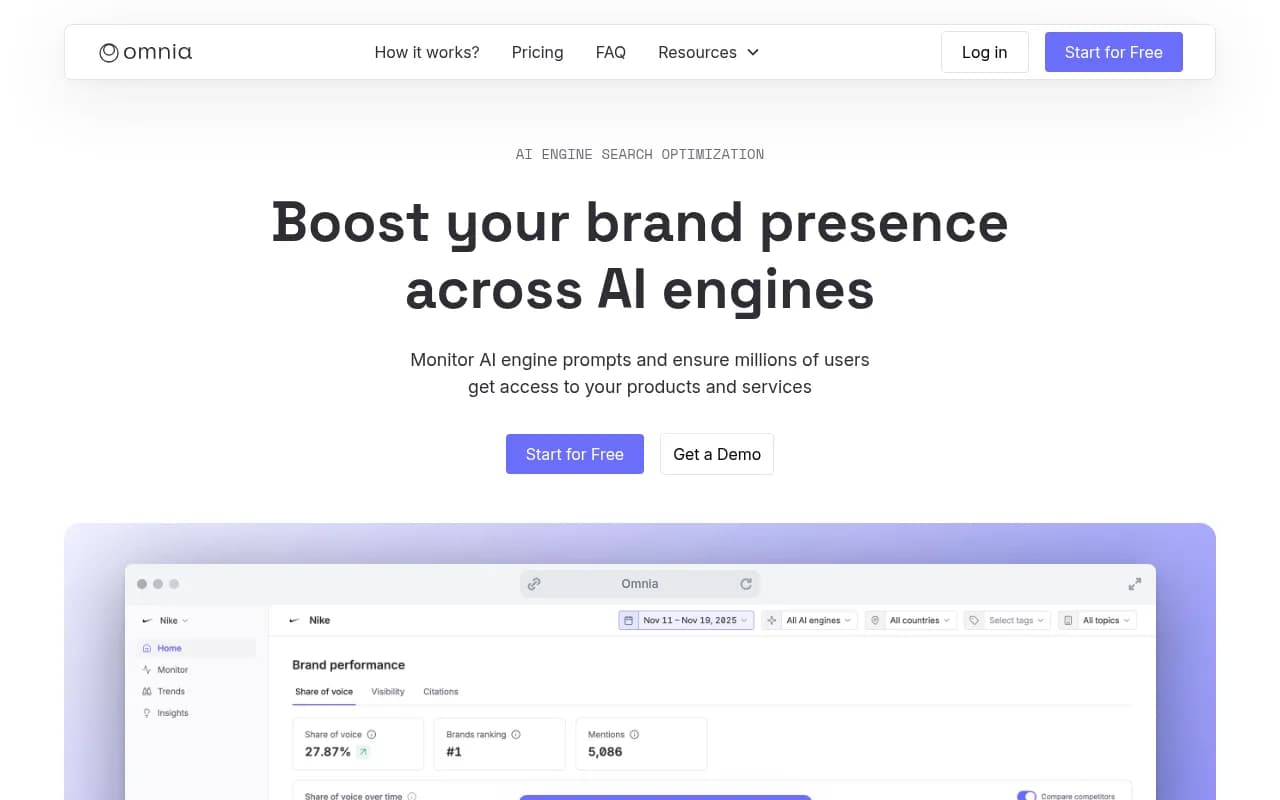
If Google AI Overviews is your primary concern (which it is for many brands with strong Google traffic), Omnia's focused approach has real advantages. The platform tracks citation extraction at the URL level, monitors presence and absence by country, and handles the volatility problem that makes AI Overview tracking tricky -- AI responses aren't static, so Omnia uses re-runs and sampling to give you reliable data rather than a snapshot.
The "action layer" Omnia describes -- turning AIO tracking into content, placement, and fixes -- is a step in the right direction, but it's less developed than what Promptwatch offers. You get guidance on what to do, but the execution is largely on you.
Omnia has a free tier available, which makes it worth testing if Google AI Overviews is your main battleground. For broader AI search coverage across ChatGPT, Perplexity, Claude, and others, you'll need to supplement it with another tool.
Best for: SEO teams focused specifically on Google AI Overviews who want dedicated, reliable tracking for that channel.
TrackMyBusiness
TrackMyBusiness is a lightweight tool aimed at small business owners and individuals who want a simple answer to "what does ChatGPT say about my business?"
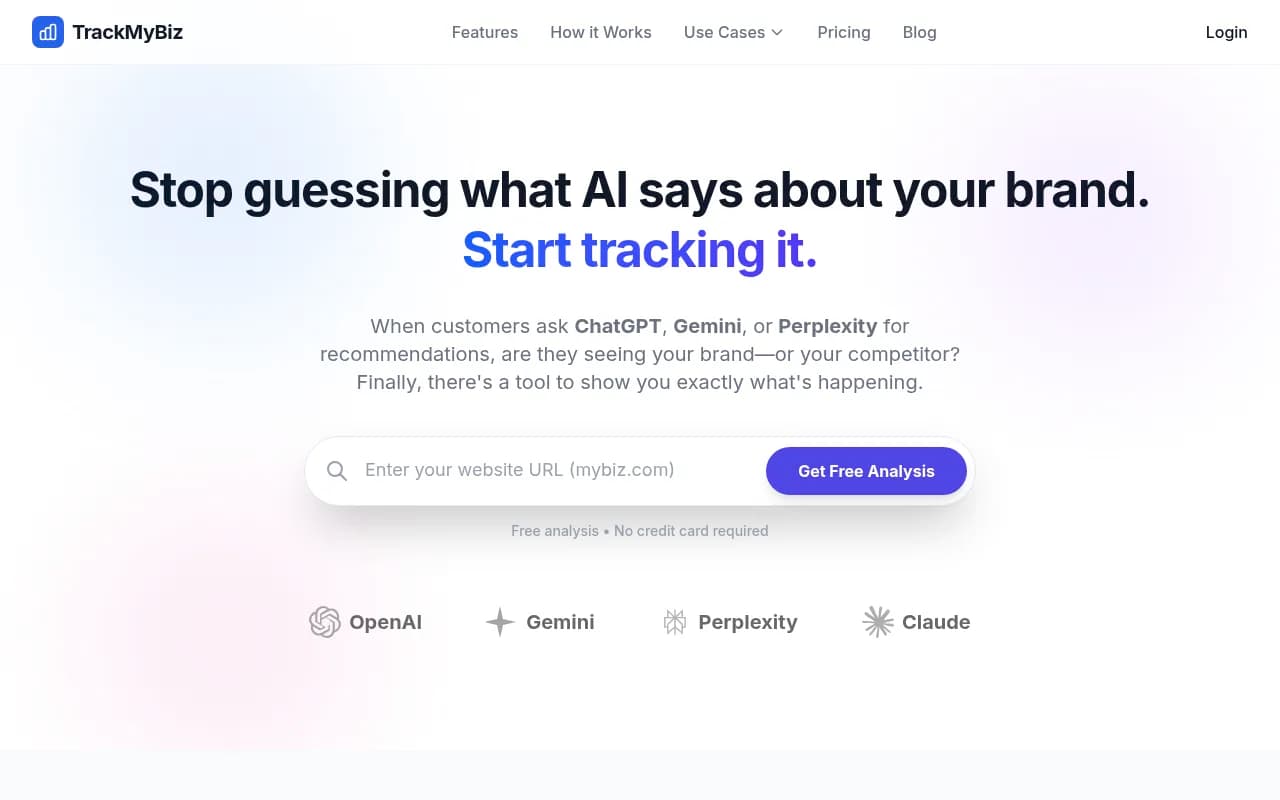
The tool covers ChatGPT, Gemini, and Perplexity -- the three most commonly used AI search engines. Setup is minimal, and the interface is designed for people who aren't deep in SEO or marketing. You enter your business name, set up a few prompts, and get a basic report on how you appear.
The limitations are significant if you're a marketing professional. There's no competitor benchmarking beyond basic comparisons, no content guidance, no crawler data, and the prompt volume is quite limited. It's genuinely useful for a local business owner who wants to know if they're showing up in AI recommendations -- it's not the right tool for a marketing team running a GEO strategy.
Best for: Small business owners who want a simple, low-cost way to check their AI visibility without technical complexity.
AI Rank Checker
AI Rank Checker sits at the entry level of this market -- a free or very low-cost tool for basic AI search visibility checks.
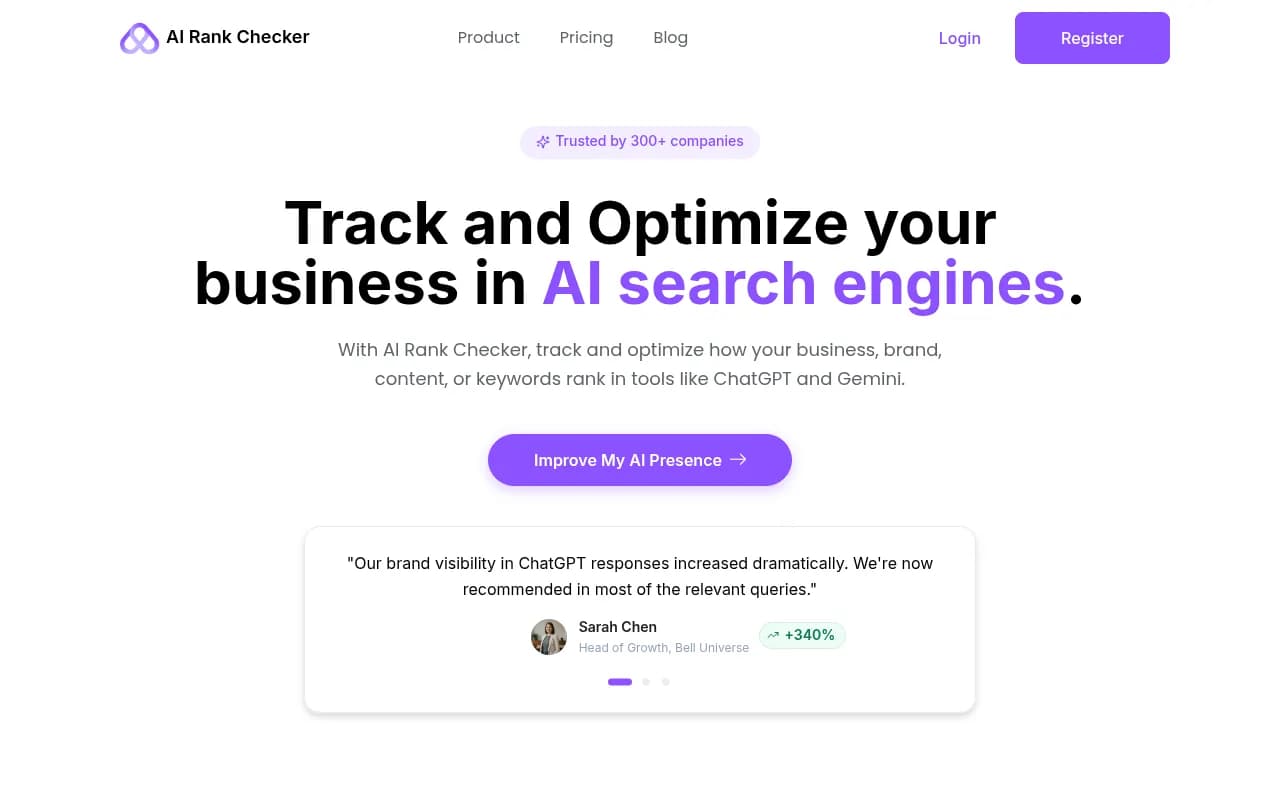
The core function is checking whether your brand or website appears in AI-generated responses for specific queries. It covers a handful of models and gives you a pass/fail type result for each prompt you test. For someone who's never tracked AI visibility before and wants to understand the concept, it's a reasonable starting point.
In practice, the limitations become apparent quickly. Prompt volume is very restricted, there's no historical tracking, no competitor data, and no path to improvement. It's a diagnostic tool, not a monitoring platform. You can use it to confirm that a problem exists; you can't use it to solve the problem.
Best for: Anyone who wants a free, zero-commitment way to check if their brand appears in AI search results before committing to a paid tool.
Side-by-side: which tool handles what
| Capability | Promptwatch | Rankshift | LLM Pulse | Omnia | TrackMyBusiness | AI Rank Checker |
|---|---|---|---|---|---|---|
| Multi-model tracking (5+) | Yes (10+) | Partial | Yes | Google AIO focus | No (3) | Partial |
| Competitor benchmarking | Yes | Yes | Yes | Yes | Basic | No |
| Content gap analysis | Yes | No | No | Partial | No | No |
| AI content generation | Yes | No | No | No | No | No |
| Crawler / agent logs | Yes | No | No | No | No | No |
| Traffic attribution | Yes | No | No | No | No | No |
| Reddit / YouTube tracking | Yes | No | No | No | No | No |
| ChatGPT Shopping tracking | Yes | No | No | No | No | No |
| Free tier / trial | Free trial | Varies | 14-day trial | Free tier | Free / low-cost | Free |
| Entry price | $99/mo | ~$49/mo | €49/mo | Free+ | Free / low-cost | Free |
How to choose
The honest answer is that the right tool depends on what you're trying to accomplish.
If you're a marketing or SEO team that needs to actually improve AI visibility -- not just measure it -- Promptwatch is the only tool here that closes the full loop. The combination of gap analysis, content generation, and crawler logs means you're not just watching your visibility score; you're doing something about it.
If you need solid monitoring data at a lower price point and you have your own content strategy to execute, LLM Pulse or Rankshift are reasonable choices. Both give you clean data on where you stand without the overhead of a full optimization platform.
If Google AI Overviews is your specific focus, Omnia's dedicated approach is worth testing -- especially given the free tier.
If you're a small business owner who just wants to know what ChatGPT says about you, TrackMyBusiness is a fine starting point. And if you want to dip your toe in before spending anything, AI Rank Checker gives you a basic sanity check for free.
One thing worth noting: the gap between monitoring and optimization is significant. Knowing you're invisible in AI search is useful. Having a platform that helps you become visible is what actually moves the needle.
A note on the broader market
These six tools represent a cross-section of what's available, but the AI visibility space has grown fast. There are now 30+ tools claiming some version of AI search tracking. Most of them are monitoring-only dashboards. A smaller number -- Promptwatch being the clearest example -- are built around the idea that tracking is only useful if it leads to action.
When evaluating any tool in this space, the question to ask is: "After I see this data, what can I do with it?" If the answer is "look at it and then figure out the next steps yourself," that's a monitoring tool. If the answer includes content gap analysis, content generation, and closed-loop tracking, that's an optimization platform.
Both have their place. Just know which one you're buying.