Key takeaways
- The AI visibility tools market has split into three clear tiers: entry-level monitors ($29-99/mo), mid-market platforms ($99-579/mo), and enterprise suites ($300-500+/mo with custom pricing)
- Most tools only monitor -- they show you where you're invisible but don't help you fix it. Mid-market B2B teams need platforms that close that loop
- Promptwatch, Peec AI, Otterly.AI, and Scrunch AI are the most relevant options for mid-market B2B budgets, each with different strengths
- For B2B brands specifically, prompt intelligence (volume, difficulty, query fan-outs) matters more than raw citation counts -- you need to know which prompts are worth winning
- The right tool depends on whether your priority is tracking, optimizing, or both
If you're running marketing at a mid-market B2B company, you've probably noticed something uncomfortable: your customers are asking ChatGPT, Perplexity, and Google's AI Overviews questions that your product should be answering -- and your brand isn't showing up.
The AI visibility tools market has exploded in response. There are now dozens of platforms claiming to solve this. The problem is that most of them were built for either startups (simple, cheap, limited) or Fortune 500 enterprises (complex, expensive, overkill). The mid-market -- companies with real marketing budgets, real competitive pressure, and real need to show ROI -- often gets left with tools that don't quite fit.
This guide is specifically for that gap. We're looking at platforms that make sense for B2B brands with marketing teams of 3-15 people, budgets in the $200-800/month range for tooling, and a genuine need to both track and improve AI visibility.
Why mid-market B2B is a different problem
Enterprise brands like Lenovo or Penn State can absorb $500+/month for a monitoring dashboard and justify it as brand insurance. Startups can get away with a $29/month Otterly plan and manually check a handful of prompts.
Mid-market B2B brands have neither luxury. You're competing against well-funded SaaS companies for AI citations in a category where the top 3 cited brands capture the vast majority of clicks. Your buyers are asking AI engines questions like "what's the best [your category] tool for [your use case]" -- and if you're not in the answer, you're not in the consideration set.
The stakes are real. McKinsey reported that 50% of consumers now use AI-powered search to guide buying decisions. ChatGPT alone reaches 800 million weekly users. For B2B, where buying cycles are long and consideration sets are small, missing from AI answers is a meaningful revenue problem.
What mid-market B2B teams actually need from an AI visibility platform:
- Coverage across the AI engines their buyers actually use (ChatGPT, Perplexity, Google AI Overviews at minimum)
- Prompt tracking that maps to real buyer questions, not generic industry terms
- Competitor benchmarking so you know if you're gaining or losing ground
- Some form of content guidance -- knowing you're invisible is only useful if you know what to do about it
- Pricing that doesn't require a procurement process to approve
The platform landscape in 2026
The market has consolidated around a few meaningful players. Here's an honest breakdown of where things stand.
Promptwatch: the most complete mid-market option
Promptwatch sits at the top of what mid-market B2B teams can realistically use. Its Professional plan at $249/month covers 2 sites, 150 prompts, 15 AI-generated articles per month, crawler logs, and state/city-level tracking. The Business plan at $579/month scales to 5 sites and 350 prompts.
What separates it from everything else in this price range is the action loop. Most platforms show you a dashboard of where you're invisible. Promptwatch shows you that, then tells you exactly which prompts competitors are winning that you're not (Answer Gap Analysis), then generates content engineered to close those gaps (Content Agents), then tracks whether that content gets crawled and cited.
For B2B specifically, a few features matter a lot:
The AI Crawler Logs show you which pages ChatGPT, Claude, and Perplexity are actually reading on your site, how often they return, and whether those pages are getting cited. This is genuinely rare -- most competitors don't have this at all. If you've published content and it's not being cited, the crawler logs tell you why.
Prompt Intelligence gives you volume estimates and difficulty scores for each prompt, plus query fan-outs that show how one buyer question branches into related sub-queries. For B2B, this means you can prioritize the prompts that actually drive consideration, not just the ones that are easy to win.
The Reddit and YouTube tracking surfaces discussions that directly influence AI recommendations. In B2B, community discussions on Reddit often end up in AI citations -- knowing which threads are driving visibility for competitors is genuinely useful intelligence.

Peec AI: strong analytics, growing fast
Peec AI has raised $29 million and hit $4M+ ARR in ten months, which tells you something about the demand. It's positioned as the mid-market analytics platform -- strong on data visualization, share-of-voice tracking, and competitive benchmarking.
For B2B teams that primarily need to measure and report on AI visibility (think: quarterly board decks, marketing attribution, competitive analysis), Peec AI is a serious option. It's particularly strong if you need to track visibility across multiple markets or languages.
The gap is on the action side. Peec AI is primarily a monitoring and analytics platform. It doesn't generate content or provide the kind of gap-to-fix workflow that Promptwatch does. If your team has the capacity to take data and act on it independently, that's fine. If you need the platform to help you close the loop, it's a limitation.

Otterly.AI: best entry point, but you'll outgrow it
Otterly.AI is the most accessible option in the market, starting at $29/month. For teams just starting to measure AI visibility, it's a reasonable first step. The interface is clean, setup is fast, and it covers the major AI engines.
The honest limitation: it's monitoring-only. No content generation, no crawler logs, no prompt intelligence, no gap analysis. For a startup or a solo marketer, that's acceptable. For a mid-market B2B team with real competitive pressure, you'll hit the ceiling quickly.
It's worth starting here if you're in "prove the concept" mode and need to show leadership that AI visibility matters before getting budget for a more complete platform. But plan for the upgrade.
Otterly.AI

Scrunch AI: enterprise-grade, enterprise-priced
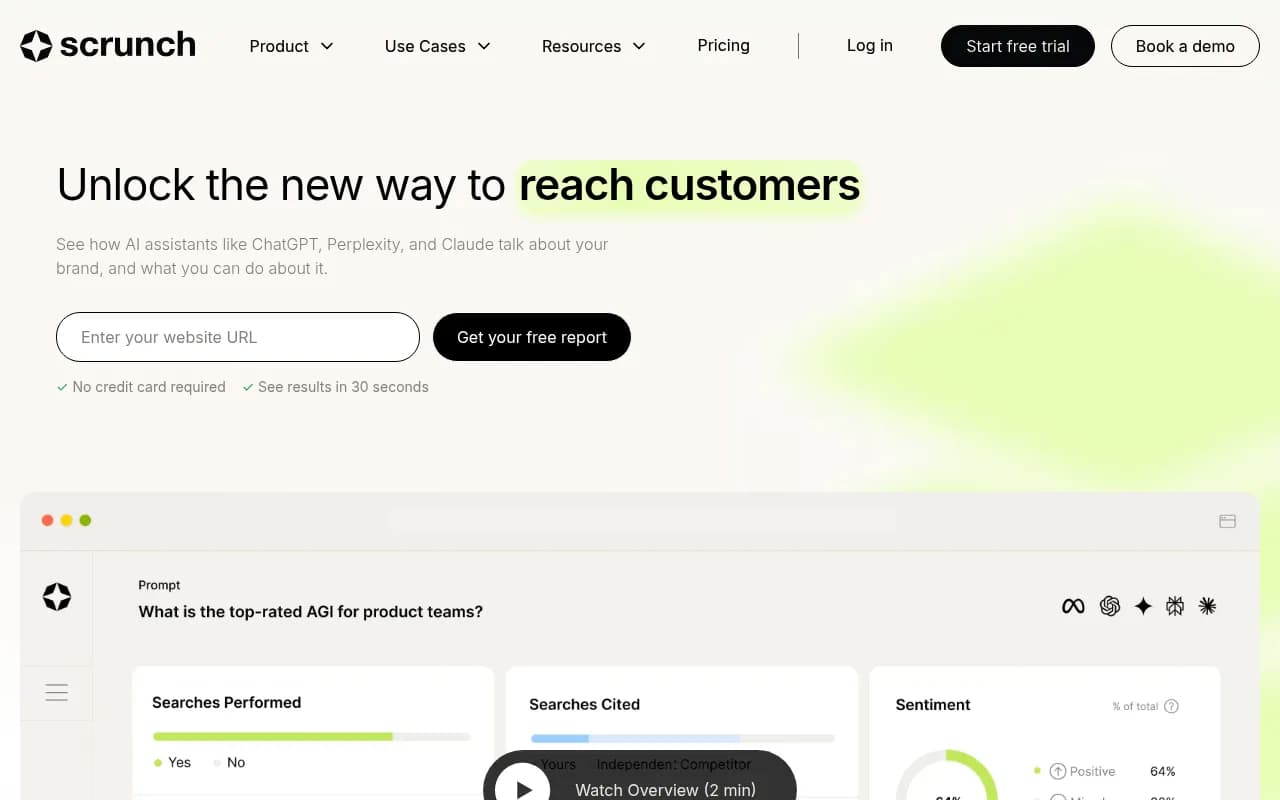
Scrunch AI has raised $19 million and serves 500+ brands including Lenovo. Its Starter plan is $300/month (350 prompts, 3 users), Growth is $500/month. It's SOC 2 Type II compliant and has strong enterprise governance features.
For mid-market B2B, the pricing is the main friction. $300/month for the entry tier is defensible if you need the compliance certifications (regulated industries, enterprise sales cycles where vendors get security reviewed) or the detailed prompt-level segmentation. If neither of those applies, you're paying for features you don't need.
The other limitation: like most platforms, Scrunch AI is primarily monitoring-focused. The Agent Experience Platform (AXP) for serving AI-optimized content to crawlers is in pilot phase as of mid-2026, so it's not a full optimization platform yet.
Profound: the enterprise leader, probably not for you
Profound has raised $155 million, hit a $1 billion valuation, and serves Fortune 500 clients. It's the category leader by most measures. It's also priced and built for enterprise procurement cycles.
If you're at a mid-market company with 200+ employees and a CMO who needs to justify AI visibility investment to a board, Profound might make sense. For most mid-market B2B marketing teams, it's overkill and overpriced.
Profound

Ahrefs and Semrush: familiar but shallow
Both Ahrefs and Semrush have added AI visibility features to their existing platforms. If your team already pays for one of these, the AI monitoring modules are worth turning on -- they're better than nothing.
The honest assessment: these are traditional SEO tools with AI monitoring bolted on. Semrush uses fixed prompt sets, Ahrefs Brand Radar has fixed prompts and no AI traffic attribution. Neither has crawler logs, content gap analysis, or content generation for AI visibility. They're useful for teams that want one platform for everything and can accept shallower AI features.
Feature comparison: what actually matters for mid-market B2B
| Feature | Promptwatch | Peec AI | Otterly.AI | Scrunch AI | Profound |
|---|---|---|---|---|---|
| Starting price | $99/mo | ~$99/mo | $29/mo | $300/mo | Enterprise |
| AI engines covered | 10+ | 6+ | 5+ | 7 | 9+ |
| Prompt intelligence (volume/difficulty) | Yes | Partial | No | Yes | Yes |
| Competitor benchmarking | Yes | Yes | Basic | Yes | Yes |
| Content gap analysis | Yes | No | No | No | Partial |
| AI content generation | Yes (15-30/mo) | No | No | No | No |
| Crawler logs / agent analytics | Yes | No | No | No | No |
| Reddit & YouTube tracking | Yes | No | No | No | No |
| ChatGPT Shopping tracking | Yes | No | No | No | No |
| Traffic attribution | Yes | No | No | Partial (GA4) | No |
| Multi-language / multi-region | Yes | Yes | Limited | Yes | Yes |
| Free trial | Yes | Yes | Yes | No | No |
| Best for | Full optimization loop | Analytics & reporting | Entry-level monitoring | Enterprise compliance | Fortune 500 |
How to choose based on your situation
The right platform depends less on features and more on where your team actually is.
If you're starting from zero and need to prove ROI first: Start with Otterly.AI or Peec AI's free tier. Run it for 60 days, document where competitors are showing up that you're not, and use that data to make the case for a proper budget. Don't over-invest before you understand the problem.
If you have budget and need to both track and improve: Promptwatch's Professional plan at $249/month is the most complete option in this price range. The combination of gap analysis, content generation, and crawler logs means you're not just collecting data -- you're acting on it. For B2B teams where content is a core channel, the 15 AI-generated articles per month alone can justify the cost.
If you're in a regulated industry or have enterprise security requirements: Scrunch AI's SOC 2 compliance and governance features are worth the premium. The $300/month entry point is steep, but if your security team needs to sign off on vendors, Scrunch AI has done the work.
If your team already lives in Semrush or Ahrefs: Turn on their AI visibility features and use them as a baseline. They're not comprehensive, but they're better than flying blind, and the incremental cost is low if you're already paying for the platform.
The monitoring-only trap
One pattern worth naming explicitly: most AI visibility platforms are monitoring dashboards. They show you a score, a share-of-voice chart, and a list of prompts where you're not appearing. Then they stop.
This is useful for awareness. It's not useful for improvement. Knowing you're invisible in 40% of relevant prompts doesn't tell you what content to create, which pages to optimize, or why your existing content isn't being crawled.
The platforms that go beyond monitoring -- that help you identify specific gaps, generate content to fill them, and track whether that content gets picked up -- are genuinely more valuable for mid-market B2B teams. You don't have the luxury of a dedicated GEO team. You need the platform to do more of the work.
That's the core reason Promptwatch stands out in this comparison. The action loop (find gaps, create content, track results) is built into the product rather than left as an exercise for the user.
What to look for in your first 90 days
Whichever platform you choose, here's what a useful first 90 days looks like:
Set up 30-50 prompts that map to real buyer questions in your category. Not generic industry terms -- actual questions your buyers ask when they're evaluating solutions. "What's the best [category] tool for [specific use case]" is more valuable than "[category] software."
Run a competitor baseline in week one. Before you do anything else, understand where your top 3 competitors are appearing that you're not. This becomes your benchmark and your content roadmap.
Identify your highest-value gap. Pick one prompt cluster where you're invisible, competitors are visible, and the buyer intent is high. Create one piece of content specifically designed to answer that prompt. Track whether it gets crawled and cited over the following 4-6 weeks.
Connect visibility to traffic. If your platform supports it (Promptwatch does, most others don't), connect AI citations to actual site traffic. This is the data that makes the investment defensible to leadership.
The AI visibility space is moving fast. Platforms that were monitoring-only six months ago are adding optimization features. Pricing is compressing as competition increases. The brands that start building this muscle now -- tracking, optimizing, iterating -- will have a meaningful advantage over those that wait for the market to stabilize.
For mid-market B2B, the window to establish AI visibility before your category gets crowded is probably 12-18 months. The tools exist. The question is whether you use them.