Key takeaways
- Several legitimate AI visibility platforms exist under $100/month, but most at this price point are monitoring-only — they show you data without helping you act on it.
- Prompt limits, engine coverage, and the absence of content tools are the most common constraints at entry-level pricing.
- Promptwatch's Essential plan at $99/month is the only sub-$100 option that includes content generation alongside monitoring.
- If you're an SMB just getting started, a basic monitoring tool is fine for orientation — but you'll hit the ceiling fast if you want to actually improve your visibility.
- The gap between "monitoring" and "optimization" is where most cheap tools fall short.
AI search is eating into traditional search traffic faster than most marketing teams expected. Google AI Overviews now appear in nearly 48% of all searches. Perplexity's user base has grown dramatically. ChatGPT is recommending products, services, and brands every day to millions of people — and most of those sessions end without a click to your website.
That's the problem. If you're not in the AI answer, you're not in the consideration set.
So naturally, a whole category of tools has emerged to help brands track and improve their AI search visibility. The challenge: many of the best platforms are priced for enterprise teams with five-figure annual budgets. What do you actually get if you're working with under $100/month?
This guide breaks it down honestly.
Why the entry tier matters (and where it usually falls short)
The AI visibility tool market has stratified pretty clearly into three tiers:
- Free or near-free tools ($0–$49/month): Basic brand mention tracking, limited prompts, often just one or two AI engines
- Mid-market entry ($50–$99/month): More engines, more prompts, sometimes competitor benchmarking
- Mid-market full ($100–$299/month): Crawler logs, content gap analysis, share-of-voice data, actionable recommendations
- Enterprise ($300/month+): Full platform access, custom prompts, API, white-label, dedicated support
The $100 threshold is a real dividing line. Below it, you typically get monitoring. Above it, you start getting tools that help you do something about what you're monitoring.
That said, "monitoring" isn't worthless. If you've never measured your AI visibility before, even a basic tool will show you things that surprise you. The question is whether the tool can grow with you.
What to look for before spending anything
Before comparing specific tools, it's worth being clear about what actually matters at the entry tier:
Engine coverage. Does the tool track ChatGPT, Perplexity, Google AI Overviews, Claude, Gemini, Grok, and Copilot? Or just one or two? Partial coverage creates blind spots that can mislead you.
Prompt limits. Most entry plans cap you at 20–100 prompts per month. That sounds like a lot until you realize a single product category might need 30–50 prompts to cover properly.
Frontend vs. API monitoring. Tools that query AI models via API often miss what users actually see. Real frontend monitoring captures live citations, shopping recommendations, and current sentiment — not just what the model returns in a raw API call.
Competitor benchmarking. Knowing your own visibility score in isolation is almost meaningless. You need to know how you compare to your actual competitors.
Actionability. This is the big one. Does the tool tell you what to do next, or just show you a dashboard? Most sub-$100 tools stop at the dashboard.
The tools worth considering under $100/month
Otterly.AI — $29/month entry
Otterly is consistently cited as the most accessible entry point in the market. At $29/month, you get basic monitoring across four platforms with a limit of around 15 prompts. It's clean, fast to set up, and good for getting a first read on your brand's AI presence.
The honest limitation: it's monitoring-only. There's no competitor benchmarking at the entry tier, no content recommendations, and no crawler data. If you want to understand why you're not appearing in AI answers — and what to do about it — Otterly doesn't get you there.
Otterly.AI

Rankshift — entry-level pricing
Rankshift focuses on brand visibility tracking across ChatGPT, Perplexity, and other AI search engines. It's positioned as a budget-friendly option with reasonable engine coverage for the price.

LLM Pulse — entry tier
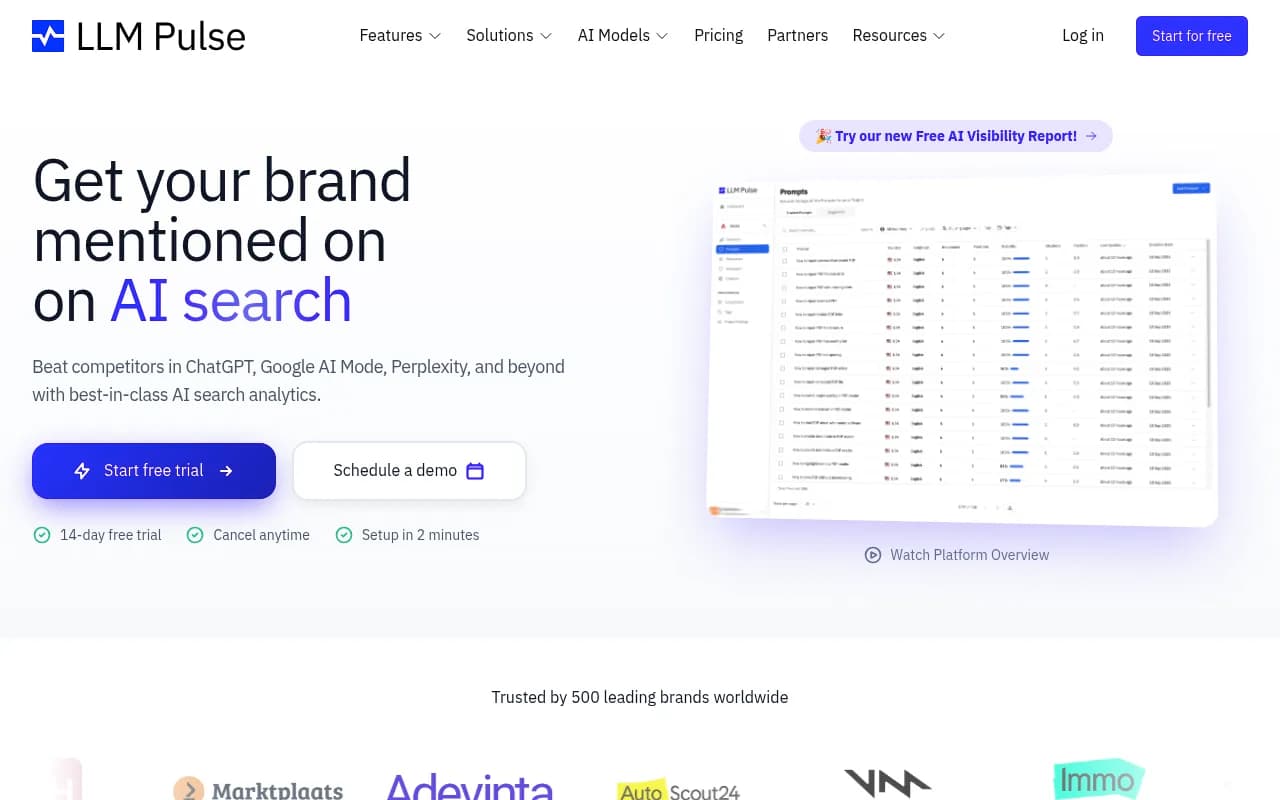
LLM Pulse tracks brand visibility across ChatGPT, Perplexity, and a handful of other models. It's a straightforward monitoring tool without the complexity of enterprise platforms.
Promptmonitor — basic monitoring
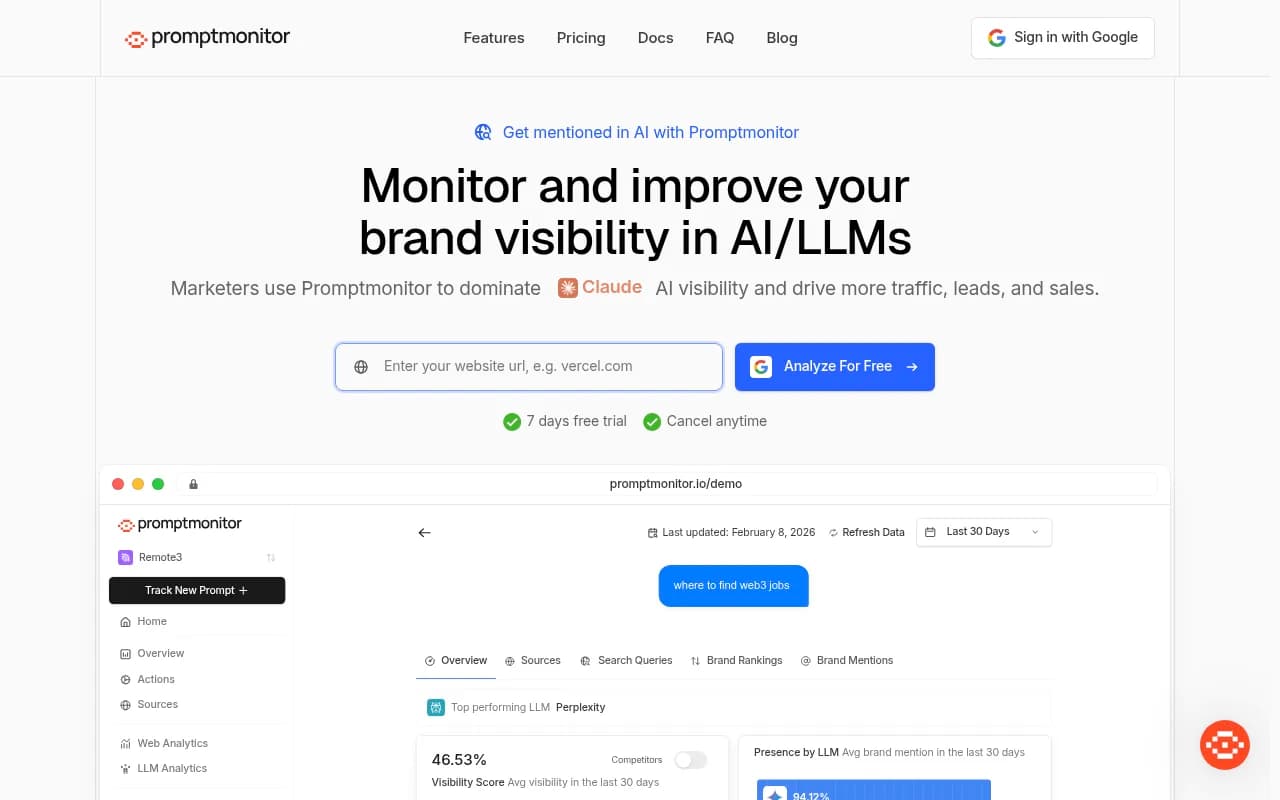
Promptmonitor offers AI visibility tracking at the entry level. Coverage is limited compared to mid-market platforms, and it lacks the content optimization features you'd need to actually improve your rankings.
Promptwatch Essential — $99/month
This is where things get interesting. Promptwatch's Essential plan sits right at the $99/month mark and is the only option at this price point that includes content generation alongside monitoring. You get one site, 50 prompts, and 5 articles per month — plus tracking across 10 AI models including ChatGPT, Perplexity, Google AI Overviews, Claude, Gemini, Grok, DeepSeek, Copilot, Meta AI, and Mistral.
The difference from pure monitoring tools: Promptwatch's Content Agents generate articles grounded in real prompt data, citation analysis, and competitor gaps. So instead of just seeing that you're invisible for a set of prompts, you get content engineered to close those gaps. That's a meaningful step up from what any other sub-$100 tool offers.

Peec AI — ~€85/month entry
Peec AI is a fast-growing challenger in the mid-market analytics space. At roughly €85/month, it covers ChatGPT, Perplexity, and Google AI Overviews with add-on options. It's stronger on analytics than most entry-tier tools, with share-of-voice data and competitor benchmarking. No content generation.

Goodie AI — entry-level monitoring
Goodie AI offers basic AI search visibility monitoring. It's functional for getting started but doesn't offer the depth needed for ongoing optimization work.
Feature comparison: what you actually get
| Tool | Starting price | AI engines covered | Prompt limit | Competitor tracking | Content generation | Crawler logs |
|---|---|---|---|---|---|---|
| Otterly.AI | $29/mo | 4 | ~15 | No | No | No |
| Rankshift | Entry tier | 3–5 | Limited | Basic | No | No |
| LLM Pulse | Entry tier | 3–4 | Limited | No | No | No |
| Promptmonitor | Entry tier | 3–4 | Limited | No | No | No |
| Peec AI | ~€85/mo | 3+ (add-ons) | Moderate | Yes | No | No |
| Promptwatch Essential | $99/mo | 10 | 50 | Yes | Yes (5 articles) | No* |
| Profound Growth | $99/mo | 10+ | Moderate | Yes | No | No |
*Crawler logs are available on Promptwatch's Professional plan at $249/month.
A few things stand out from this table. First, engine coverage varies a lot. If you're only tracking 3–4 engines, you're missing significant chunks of the AI search landscape — particularly Google AI Overviews and AI Mode, which together account for a huge share of AI-influenced search behavior.
Second, content generation is essentially absent below $99/month. That's the real ceiling of the entry tier: you can see the problem, but you can't fix it with the tools you're paying for.
The monitoring-only trap
Here's the thing that doesn't get said enough: monitoring your AI visibility without the ability to act on it is a bit like checking your blood pressure every day without any way to lower it. The data is useful for orientation, but it doesn't move the needle.
Most tools under $100/month are monitoring dashboards. They'll show you:
- Which prompts your brand appears in
- How often you're cited vs. competitors
- Which AI engines mention you most
What they won't show you:
- Which specific content gaps are causing you to miss prompts
- What topics and angles AI models want answers to but can't find on your site
- Which pages on your site are actually being crawled by AI agents
- How to generate content that closes those gaps
That's the jump from monitoring to optimization, and it's where the real value sits.
Who should start with a sub-$100 tool
Not everyone needs a full optimization platform on day one. A basic monitoring tool makes sense if:
- You've never measured AI visibility before and want to understand your baseline
- You're at an early-stage company with limited budget and just need to know whether you're appearing at all
- You're doing a quick audit for a client before recommending a larger investment
- You want to validate that AI search is actually relevant to your category before committing to a bigger tool
In these cases, starting with Otterly.AI at $29/month or a similar entry-level tool is completely reasonable. Spend a month or two understanding your visibility landscape, then upgrade when you know what you're trying to fix.
If you're already past that orientation phase and you know you have gaps to close, jumping straight to a platform with content generation capabilities will save you time.
Who should skip the entry tier entirely
Some teams will waste time and money at the entry tier. Skip it if:
- You're in a competitive category where your competitors are already investing in GEO. A monitoring-only tool won't help you catch up.
- You have an existing content team that can act on recommendations immediately. In that case, you need the recommendations, not just the data.
- You're managing multiple brands or client accounts. Entry-tier tools typically support one site, which doesn't scale.
- You need to show ROI to stakeholders. Basic monitoring dashboards don't connect visibility to traffic or revenue.
For agencies especially, the math often works out better at the Professional tier — more sites, more prompts, and the content tools needed to actually deliver results for clients.
What the $99/month ceiling actually buys you in 2026
The honest summary: $99/month in 2026 gets you a real starting point for AI visibility work, but not a complete solution.
At the pure monitoring end (Otterly.AI, Rankshift, LLM Pulse), you're paying for awareness. You'll know where you stand. You won't know how to improve.
At the Promptwatch Essential tier, you're getting the beginning of an optimization workflow: 10-engine monitoring, 50 prompts, competitor benchmarking, and 5 AI-generated articles per month grounded in real citation and prompt data. That's genuinely useful for a small team or a single brand trying to build AI search presence.
For anything more — crawler logs, page-level citation tracking, higher prompt volumes, multi-site management — you're looking at $249/month and up. That's where the full action loop (find gaps, create content, track results) becomes available.
The market is moving fast. Tools that were "good enough" six months ago are already being outpaced by platforms that connect monitoring to content creation to traffic attribution. If you're evaluating entry-tier tools right now, the most important question isn't just "what does this show me?" It's "what can I actually do with this information?"
Quick recommendations by situation
- Just getting started, tight budget: Otterly.AI at $29/month for baseline monitoring
- Ready to act on data, single site: Promptwatch Essential at $99/month for monitoring + content generation
- Mid-market team, need analytics depth: Peec AI at ~€85/month for share-of-voice and competitor data
- Agency or multi-site: Promptwatch Professional at $249/month or higher
The AI search visibility category is still young enough that even a modest investment in the right tool can give you a real advantage over competitors who aren't measuring this at all. But "measuring" and "improving" are different things — and the tools you choose should be able to do both.