Key takeaways
- Sitecore's acquisition of Scrunch AI in 2026 pushed the platform toward enterprise CMS workflows, leaving smaller marketing teams looking for alternatives.
- Profound is the strongest pure-monitoring platform for enterprise, but its pricing and complexity make it a poor fit for most non-enterprise teams.
- Otterly.AI is the cheapest entry point but gives you data without any path to acting on it.
- Promptwatch is the only platform in this comparison that closes the loop -- tracking visibility, identifying gaps, and generating the content to fix them.
- Your choice really comes down to one question: do you want to monitor your AI visibility, or do you want to improve it?
The Sitecore deal changed the math for a lot of marketing teams. Scrunch AI was a popular choice for teams that wanted broad AI engine coverage without committing to enterprise pricing -- clean dashboards, solid prompt tracking, good stakeholder reporting. Then Sitecore acquired it, and the product roadmap started drifting toward CMS integration and enterprise workflows that most mid-market teams have no use for.
So now teams are asking the obvious question: where do we go instead?
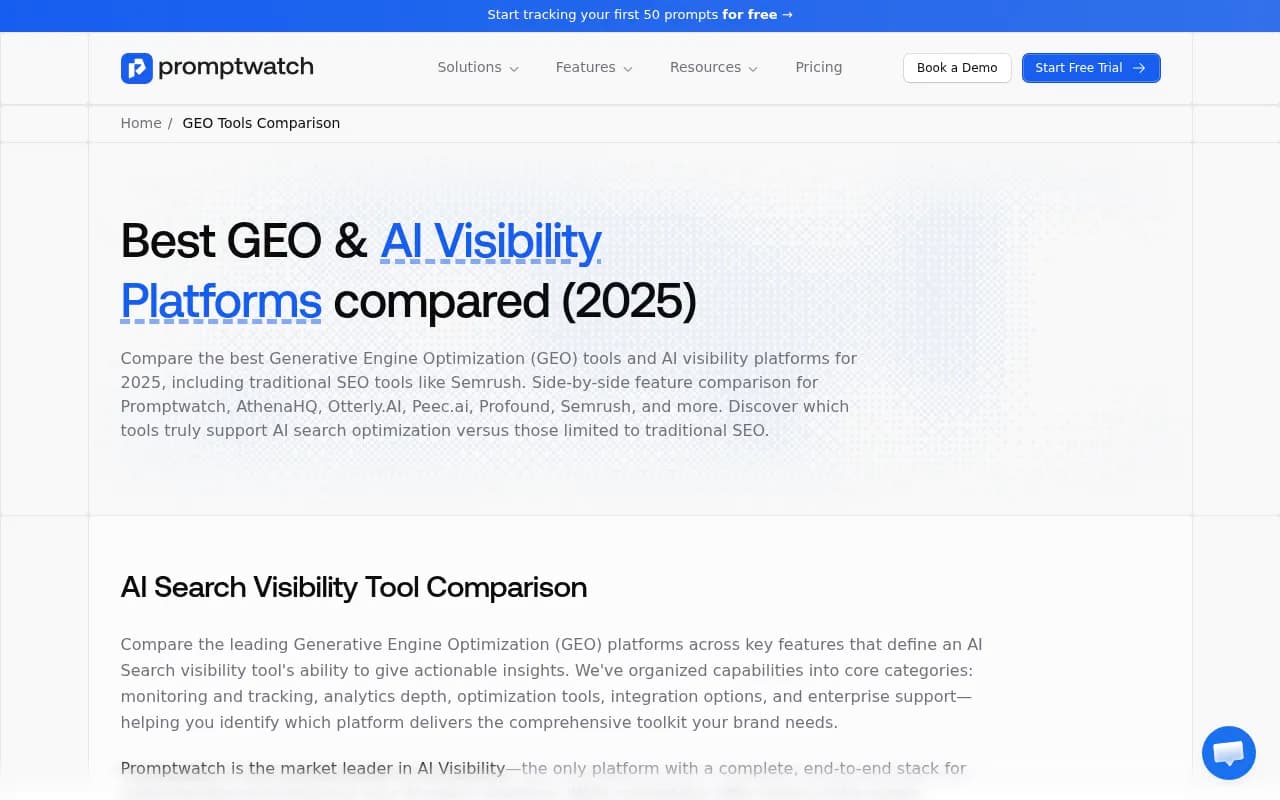
This guide breaks down the four platforms that keep coming up in that conversation -- Scrunch AI, Promptwatch, Profound, and Otterly.AI -- with a specific focus on what non-enterprise teams actually need in 2026.
What non-enterprise teams actually need from a GEO platform
Before getting into the platforms, it's worth being clear about what "non-enterprise" means here. We're talking about marketing teams at growth-stage SaaS companies, digital agencies managing multiple client accounts, and in-house SEO teams at mid-market brands. These teams share a few common constraints:
- Budget is real. Spending $2,000+/month on a monitoring tool that requires a separate content team to act on the data doesn't make sense.
- Headcount is limited. You need the platform to do more of the work, not just surface more data for someone else to interpret.
- Speed matters. You're not running quarterly governance reviews -- you need to find gaps and publish content on a weekly cycle.
- You're tracking multiple AI engines. ChatGPT, Perplexity, Google AI Overviews, Gemini -- your customers are using all of them.
With that in mind, here's how the four platforms stack up.
Scrunch AI: what it was, and what it's becoming
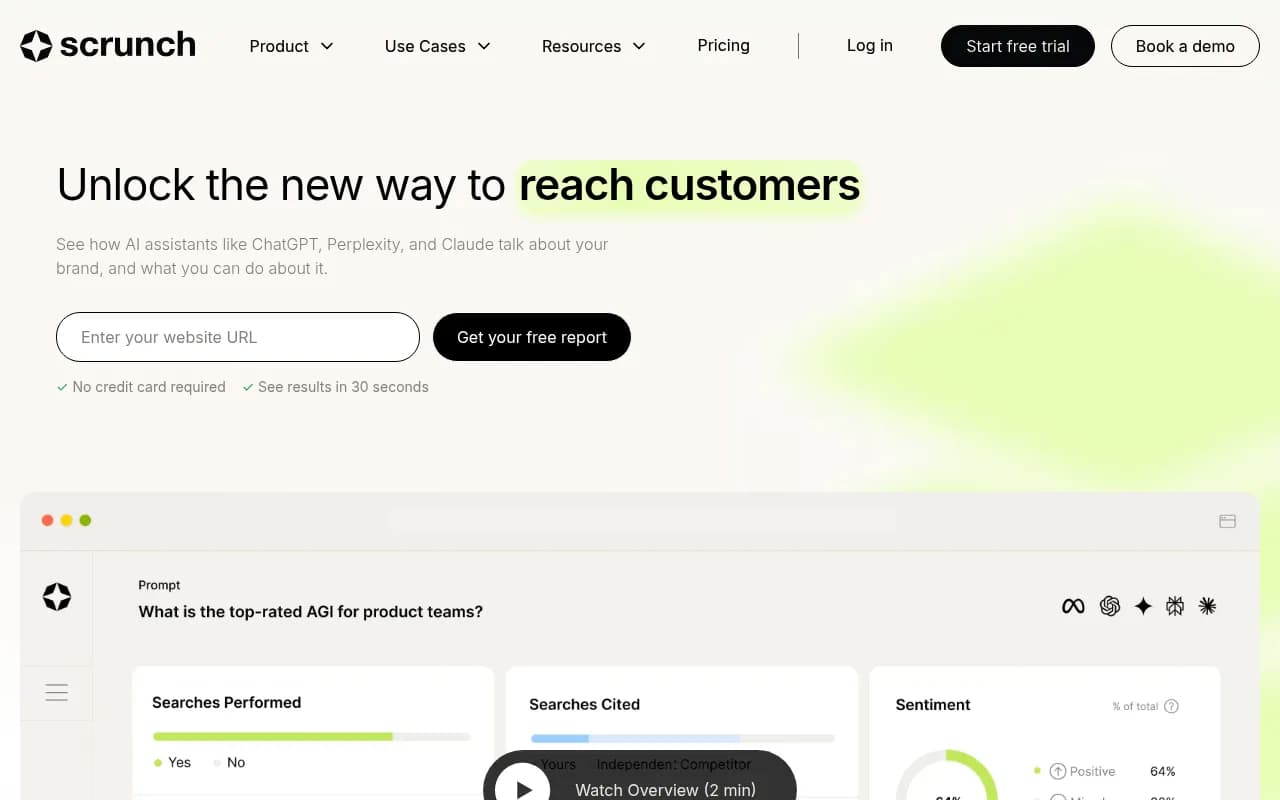
Scrunch built a strong reputation as an "AI visibility command center." The pitch was simple: one dashboard, broad AI engine coverage, clean reporting that you could put in front of a CMO without a 20-minute explanation. It worked well for teams that needed consistent week-over-week visibility tracking and competitor benchmarking.
The weaknesses were always there, though. Multiple reviews noted that Scrunch was better at showing you what was happening than telling you what to do about it. It was a monitoring tool, not an optimization tool. That gap was manageable when the price was in the $300-500/month range and the product was actively being developed for marketing teams.
Post-Sitecore, the picture is murkier. The acquisition makes strategic sense for Sitecore -- they're building AI visibility into their broader CMS and DXP offering. But for a standalone marketing team that doesn't run on Sitecore infrastructure, the roadmap alignment is getting worse, not better. You're increasingly paying for a product that's being built for someone else's use case.
If you're already on Scrunch and it's working, there's no immediate reason to panic. But if you're evaluating it fresh in 2026, the trajectory matters.
Profound: the enterprise benchmark, with enterprise trade-offs
Profound is the platform that comes up whenever someone asks "what's the most serious AI visibility tool?" And that reputation is earned. It tracks 9+ AI engines, has strong governance features, and goes deep on the "why did we appear?" question -- understanding which sources and signals drove a citation, not just whether you were cited.
The pricing reflects that depth. Based on community reports, Profound starts around $399/month for three-engine tracking (ChatGPT, Perplexity, AI Overviews) and scales to custom enterprise pricing from there. That's before you factor in the onboarding complexity and the expectation that you have a dedicated analyst or SEO strategist to work with the data.
For a Fortune 500 brand with a full digital marketing team, Profound makes sense. For a 5-person marketing team at a Series B SaaS company, you're paying for capabilities you won't use and complexity you don't have the headcount to manage.
Profound also doesn't have Reddit tracking or ChatGPT Shopping monitoring -- two channels that increasingly influence what AI models recommend, especially in consumer and SMB markets.
Profound

Otterly.AI: the cheapest entry point, with real limitations
Otterly.AI is where teams land when they want to start tracking AI visibility without committing serious budget. At $29/month for the entry tier, it's genuinely accessible. You get brand mention tracking across ChatGPT, Perplexity, and Google AI Overviews, basic competitor comparison, and a clean enough interface.
The limitation is that Otterly stops there. There's no content gap analysis. No crawler logs showing you which pages AI engines are actually reading. No content generation tools. No Reddit or YouTube tracking. No prompt volume data to help you prioritize which queries are worth targeting.
You can see that you're not being cited for a particular query. You cannot see why, and you cannot do anything about it from within the platform.
For teams that are just starting to understand their AI visibility and need a low-cost way to get a baseline, Otterly is fine. But most teams outgrow it quickly. The moment you want to move from "we know we have a problem" to "we're fixing the problem," you need something else.
Otterly.AI

Promptwatch: the platform built around the action loop
Promptwatch takes a different approach to the whole category. Most GEO platforms are built around monitoring -- they show you data and leave the rest to you. Promptwatch is built around what happens after you see the data.
The core workflow is a loop: find gaps, create content, track results.
The Answer Gap Analysis shows you exactly which prompts competitors are appearing for that you're not. Not just "you're missing coverage in this topic area" -- the specific questions AI models are being asked where your competitors get cited and you don't. That's the input to your content strategy.
From there, Content Agents generate articles, comparisons, listicles, and briefs grounded in that prompt data. The output isn't generic SEO filler -- it's content built to answer the specific gaps the analysis identified, with real prompt volumes, competitor citation data, and persona targeting baked in.
Then you track whether it worked. Page-level tracking shows which pages are being cited, by which models, and how often. The crawler log feature (available from the Professional plan at $249/month) shows you when AI crawlers hit your pages, which errors they encountered, and the timeline from publish to crawl to citation. That's a feedback loop most platforms don't even attempt.

Promptwatch also covers channels that competitors largely ignore. Reddit and YouTube tracking surfaces the discussions and videos that directly influence what AI models recommend. ChatGPT Shopping tracking monitors when your brand appears in product recommendation carousels. These aren't edge cases -- they're increasingly central to how AI engines form recommendations.
On the model coverage side, Promptwatch tracks 10 AI engines: ChatGPT, Perplexity, Google AI Overviews, Google AI Mode, Claude, Gemini, Meta/Llama, DeepSeek, Grok, Mistral, and Copilot. That's the broadest coverage in this comparison.
Side-by-side comparison
| Feature | Scrunch AI | Profound | Otterly.AI | Promptwatch |
|---|---|---|---|---|
| AI engines tracked | Multiple (broad) | 9+ | 3 (ChatGPT, Perplexity, AI Overviews) | 10 |
| Prompt volume & difficulty | Limited | Yes | No | Yes |
| Competitor visibility | Yes | Yes | Basic | Yes |
| Content gap analysis | No | Partial | No | Yes |
| AI content generation | No | No | No | Yes (Content Agents) |
| AI crawler logs | No | No | No | Yes (Pro+) |
| Reddit & YouTube tracking | No | No | No | Yes |
| ChatGPT Shopping tracking | No | No | No | Yes |
| Traffic attribution | No | Partial | No | Yes |
| Entry price | ~$300/mo | ~$399/mo | $29/mo | $99/mo |
| Best for | Monitoring + reporting | Enterprise depth | Budget baseline | End-to-end optimization |
| Post-Sitecore trajectory | Uncertain | Stable | Stable | Active development |
Which platform fits which team
The honest answer is that these tools are solving different problems, and the right choice depends on what you're actually trying to do.
If you just need a baseline and have almost no budget
Start with Otterly.AI. It's $29/month, it'll show you whether you're being cited in the major AI engines, and it costs almost nothing to run. Just go in knowing that you'll hit its ceiling quickly.
If you're an enterprise team with dedicated analysts
Profound is worth evaluating seriously. It has the depth and governance features that large organizations need, and the pricing is less of an obstacle at that scale.
If you were on Scrunch and liked the reporting layer
The monitoring features you valued are available in Promptwatch, and you get the optimization layer on top. The Professional plan at $249/month is comparable to what Scrunch was charging for team plans, and you're getting significantly more capability.
If you want to actually improve your AI visibility, not just track it
Promptwatch is the only platform in this comparison that gives you the full loop. The gap analysis tells you what to fix. The content tools help you fix it. The crawler logs and page-level tracking tell you whether it worked. That's a fundamentally different product from a monitoring dashboard.
The question that matters most
There's a framing that clarifies this whole decision: do you want a report, or do you want results?
Monitoring tools give you reports. They show you share of voice, citation rates, competitor comparisons. That data is useful, but it doesn't move the needle by itself. Someone still has to figure out what to do with it, then go do it, then wait and see if it worked.
Platforms built around optimization -- and Promptwatch is the clearest example of this in 2026 -- compress that cycle. The gap analysis, content generation, and tracking are all in one place, which means a small team can actually run an AI visibility improvement program without a dedicated analyst and a separate content team.
That's the real story of the Sitecore deal. It didn't just change Scrunch's ownership -- it clarified what non-enterprise teams actually need from this category. Not a monitoring dashboard that's slowly being absorbed into an enterprise CMS. A tool that helps you show up in AI search and tells you exactly how to get there.
A few other tools worth knowing about
If you're doing a thorough evaluation, a few other platforms are worth a look depending on your specific situation.
Peec AI offers solid monitoring at a lower price point (around €89/month) and is worth considering if you're primarily focused on European markets.

AthenaHQ has a strong monitoring layer but, like most competitors, stops before the optimization work begins.

Rankshift is a lighter-weight option for teams that want to track ChatGPT and Perplexity visibility without a lot of setup overhead.

None of these change the fundamental calculus for non-enterprise teams in 2026. The gap between monitoring-only tools and optimization platforms is real, and it's getting wider as the category matures. The teams that are winning in AI search aren't just tracking their visibility -- they're systematically finding gaps and publishing content to fill them. The platform you choose should make that process easier, not leave it entirely to you.