
Key takeaways
- Searchable is a beginner-friendly AI visibility platform that bundles prompt tracking, content writing, site audits, and GA4/GSC analytics. Pro costs $125/month for 100 prompts, Scale $400, Enterprise from $999.
- The three base engines (ChatGPT, Google AI Overviews, Perplexity) are included everywhere. Other engines are add-ons, and the reviews I read disagree on exactly how they are gated, so check the pricing page before you buy.
- Setup is fast. One tester reported under 20 minutes to connect GA4 and Search Console and load 50+ prompts.
- Data depth is the weak spot: no real prompt volume data, no persona segmentation, and no side-by-side engine comparison, according to the reviews I found.
- After 30 days you get a solid baseline and a content/audit workflow. Teams that need crawler-to-citation proof or deeper fixing loops will outgrow it.
What Searchable is
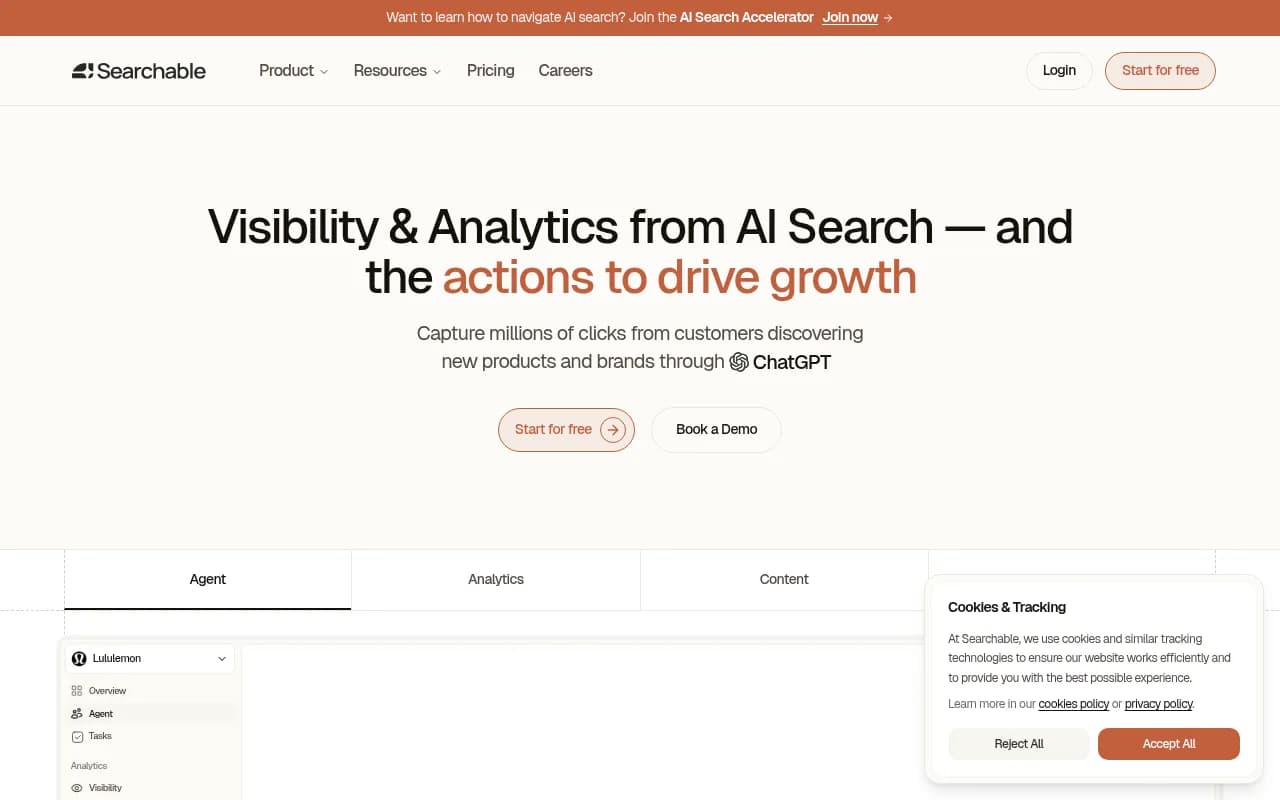
Searchable is an AI search visibility platform founded in 2025 by Chris Donnelly, Sam Hogan, and Arya Nagabhyru. It tracks how AI engines mention and cite your brand, then tries to turn that into work: a content studio, technical AEO audits, crawler analytics, and an AI agent you can ask questions about your own data.
It has grown quickly. According to its own announcements, it raised $4M in December 2025, then $14M led by Headline in May 2026 at an $85M valuation, and acquired the New York startup Meridian in September 2026. The about page claims more than 1,000 brands and 500 agencies use it. Treat those as vendor claims. Also, don't confuse it with Searchable.ai, an unrelated enterprise search company from 2019. This review covers searchable.com.
A note on sources: I did not run Searchable myself for this guide. What follows is a synthesis of several independent reviews, including a 30-day test from Aboah Reviews, a pricing teardown from MentionsAPI (which sells competing data and says so), and a hands-on piece from Profound (also a competitor). Where those sources disagree, I say so.
Pricing and plans
Pricing below comes from the MentionsAPI review, which checked it on November 25, 2026. I did not verify the pricing page directly, so confirm before you commit.
| Plan | Monthly | Annual (per month) | Prompts | Projects |
|---|---|---|---|---|
| Pro | $125 | $100 | 100 | 1 |
| Scale | $400 | $320 | 500 | 10 |
| Enterprise | from $999 | from $799 | 1,250 | Unlimited |
| Custom | Quote | Quote | Quote | Quote |
Every plan has unlimited seats, and Pro and Scale come with a 14-day trial. Annual billing takes 20% off the plan price but not off add-ons.
Agencies get their own track: Launch at $250/month (200 prompts, 5 client projects), Growth at $400 (500 prompts, 10 projects), and Enterprise Agencies from $999. All include white-label reports, Looker Studio, and separate "pitch prompts" for prospects.
The one-project limit on Pro matters more than it looks. Aboah's verdict was blunt: most brands will end up on the $400 Scale plan to use the product properly, especially if they have multiple domains, regions, or product lines.
Cost per answer
MentionsAPI worked out about 1.4 cents per AI answer on Pro and 0.9 cents on Scale, assuming three engines, daily tracking, and 9,000 answers a month on Pro or 45,000 on Scale. That is a fair way to compare trackers, because prompt count alone hides how many engines and runs you get.
Engine coverage: read this part carefully
ChatGPT, Google AI Overviews, and Perplexity are included on every plan. Beyond that, the sources conflict.
MentionsAPI says seven more engines are paid add-ons: Claude, Gemini, Google AI Mode, Copilot, Grok, DeepSeek, and Meta Muse. Add-on prices only show inside a dropdown, which is annoying when you are trying to budget. Aboah, on the other hand, wrote that full nine-engine coverage required the Custom tier. Both might be partially true depending on when each writer looked, but you should not assume the base plan covers Gemini or Claude.
Two more details worth knowing:
- "Claude Lite" and "Grok Lite" track answers with web search turned off. That shows what the model knows from training, but it gives no live citations.
- Profound's review flagged that you can only view engines one at a time. There is no side-by-side comparison. Aboah made the same complaint.
Setup: what the first day looks like
Setup is the strongest part of the experience. Aboah reported under 20 minutes to connect Google Analytics 4 and Search Console and configure an initial set of 50+ prompts. Profound's tester described the data as clean and readable, with navigation that makes sense without prior AEO knowledge.
A sensible first-day sequence:
- Connect GA4 and Search Console so AI traffic and search data sit beside visibility data.
- Build your prompt set. Split branded prompts (those naming your company) from unbranded category prompts. Searchable's own guidance on AI visibility metrics makes the same point: record a baseline before you change any content.
- Add your closest two or three competitors so share of voice means something.
- Run a first site audit and note the schema and structured data gaps it flags.
- Save the baseline numbers somewhere outside the tool. You will want them on day 30.
Google Search Console and Google Analytics are the two connections that matter most here.
What you actually get after 30 days
Based on the tests I read, here is a realistic picture of month one.
A visibility baseline you can trust directionally
The Visibility view shows how often your brand appears across tracked prompts over 7, 30, 90, or 365 days, compared with competitors (per Drew Garrett's agency write-up). After 30 days of daily runs you have enough points to see whether a trend exists. You also get sentiment, citations, share of voice, sources, and query fan-out.
I would be careful with the word "accurate." I could not verify claims about prompt-run variance or accuracy against manual checks. AI answers vary from run to run, so any tracker is a sampling tool. Use it for trends, not for single-prompt verdicts.
Fan-out data, with a caveat
Searchable tracks query fan-out, which shows the sub-searches an engine runs behind a prompt. That is useful, but fan-out behavior moves. Promptwatch's ChatGPT query fanout data measured about 2.15 distinct web searches per response in early December 2025, easing to about 1.84 by early March 2026, with average query length falling from roughly 117 characters to the high 80s. Whatever a tracker shows you, expect it to shift over a quarter. Don't build a content plan on one week of fan-out screenshots.
A content and audit workflow
This is where Searchable earns its price. Pro includes 20 articles a month in the content studio and 200 site audits. Scale raises articles to 80. If you will use those, the $125 starting point is good value compared with tools that only report. If you only want mention tracking, you are paying for features you will not touch.
The AI agent
The built-in agent answers plain-language questions about your own visibility data and lets you save repeatable workflows. Aboah credited it with cutting time spent cross-referencing reports. That matches Profound's description. It is a convenience, not a substitute for judgment.
Reporting
Looker Studio is available from Scale, and agency plans include white-label reports. Sources disagree on API and MCP access: MentionsAPI says all plans, Aboah says Scale and above. Ask support if it matters for your stack.
Where it falls short
- No real prompt volume data and no persona segmentation (Profound).
- No side-by-side engine view (Profound, Aboah).
- Hard to scale workflows for high-volume AEO programs.
- Add-on pricing is hidden until you open a dropdown.
- Refund policy is not publicly specified, per Aboah.
There is one more data point I found odd. MentionsAPI asked ChatGPT, Claude, Gemini, and Perplexity four buyer questions about AI visibility tools, 20 answers in all. Searchable was named in 0 of 10 answers to generic prompts such as "best AI visibility tool." Profound, Peec AI, and Otterly appeared in all 10. That is a small test by a competitor, so don't overread it. Still, it shows how hard it is to earn AI mentions, even for a company selling AI visibility.
Ratings and verdicts from other reviewers
| Source | Verdict |
|---|---|
| Aboah Reviews | 7.6/10. Strong if you use content and audit features, overpriced for mention tracking only |
| Profound | Strong starting point, but you will likely outgrow it |
| MentionsAPI | Good value if you use the whole suite. Cheaper trackers may do if you only track |
| Derivatex | Positive for mid-market B2B SaaS. Cites a 4.8/5 G2 rating from 90 reviews (I did not verify this) |
Note that two of these are from competitors, so weigh the tone accordingly.
Who Searchable fits
Good fit:
- Small agencies adding AEO to their services, thanks to white-label reports and pitch prompts.
- In-house SEO or content teams who want tracking, drafts, and audits in one subscription.
- Beginners who want clean data without learning the mechanics first.
Poor fit:
- Solo bloggers or anyone who just wants to know if they show up in ChatGPT.
- Teams that need persona-level analysis, prompt volumes, or high-volume workflows.
- Teams that need proof of whether AI crawlers actually read their pages.
Alternatives worth comparing
If Searchable's depth is the issue, the usual comparison set is below. For a wider look, the GEO software directory lists dozens more.
| Tool | Strength | Where it differs from Searchable |
|---|---|---|
| Promptwatch | Monitoring plus content agents, crawler logs, and traffic attribution | Closes the loop from tracking to fixing to measuring |
| Profound | Deep monitoring, enterprise focus | Higher price, more data depth |
| Peec AI | Clean, simple tracking | Tracking only, no content studio |
| Otterly.AI | Basic monitoring at low cost | Less breadth |
| Rankshift | AI visibility tracking | Narrower feature set |
I would look hard at Promptwatch if your problem is not "where am I visible" but "what do I do about it, and did it work." It tracks real ChatGPT, AI Overviews, Gemini, Perplexity, and other interfaces, then adds IP-verified AI crawler logs, visitor analytics, and a Content Agent that writes and publishes to WordPress, Webflow, or Framer. That gives you evidence for the crawl-to-citation path that Searchable's reviewers did not describe. There is a head-to-head page at Promptwatch vs Profound if Profound is also on your shortlist, and the 7-day free trial on paid plans is the quickest way to test it against your own prompts.

Profound


Otterly.AI


For a full comparison across platforms, see Promptwatch's 2026 GEO platform comparison.
How to run your own 30-day test
Don't take any review's word, including this one. Use the trial.
- Day 1: pick 50 to 100 prompts, split branded and unbranded, and note your current mention rate by hand for 10 of them.
- Day 3: compare the tool's results against your manual checks. Expect differences. Look for direction, not exact matches.
- Day 7: check whether the engines you care about are actually included in your plan, not just listed on the marketing page.
- Day 14: use the content or audit features on one real page. Measure the time saved versus your current process.
- Day 30: look at the trend line, the competitor gap, and whether anything in the dashboard changed what you did that month. If nothing did, the tool is a report, not a workflow.
If the answer to that last question is no, you are probably paying for the wrong category of product.
Verdict
Searchable is an easy, affordable way to start tracking AI visibility, and the bundled content studio and audits make the $125 entry price reasonable if you use them. It is weaker if you need engine comparisons, prompt volume data, or deep workflows, and the engine add-on pricing deserves a direct question to sales before you sign. Run the 14-day trial, keep your own baseline, and decide on day 14 whether you are buying a tracker or a full workflow.
FAQ
How much does Searchable cost in 2026?
Pro is $125/month ($100 billed annually), Scale is $400/month, and Enterprise starts at $999/month. Agency plans start at $250/month. Confirm on the vendor's pricing page.
Which AI engines does Searchable track?
ChatGPT, Google AI Overviews, and Perplexity are on every plan. Claude, Gemini, AI Mode, Copilot, Grok, DeepSeek, and Meta Muse are described as paid add-ons by MentionsAPI, while another reviewer says full coverage requires the Custom tier.
How long does setup take?
About 20 minutes in one 30-day test, including connecting GA4 and Search Console and adding 50+ prompts.
Is there a free trial?
Yes, 14 days on Pro and Scale, self-serve with no sales call.
Is Searchable worth it?
Yes if you will use content, audits, and reporting. Probably not if you only need to know whether you show up in ChatGPT.