
Key takeaways
- Sentiment (is the tone positive, neutral, or negative?) and narrative (which specific claims does AI repeat about you?) are different jobs. Most tools in this comparison do the first better than the second.
- A third-party matrix rates AthenaHQ "Excellent" on narrative analysis, Profound "Very Good" and Searchable "Good". The source is a vendor-style blog, so treat it as one opinion, not a benchmark.
- Pricing differs sharply. Searchable starts around $125/month, AthenaHQ around $245/month billed annually ($295 monthly), and Profound is sales-led with no published price on its trial-to-enterprise path.
- Nobody has published an independent test of sentiment accuracy for any of these three. Almost every head-to-head claim online comes from one of the vendors.
- Narrative is shaped by the sources AI cites, so whichever tool you pick, check that it shows you those sources.
Why sentiment and narrative need separate treatment
Sentiment is a score. Profound's own definition is simple: whether the AI's description of your brand, when it does appear, reads as positive, neutral, or negative. That is useful for trend lines and for alerting when something goes sideways.
Narrative is more specific. It is the list of claims. "Affordable for small teams." "Support is slow." "The mobile app lacks features." A sentiment score of 62 tells you nothing about which of those sentences is costing you deals.
When I compare these platforms, I ask two questions. Can it tell me how I am described, in aggregate? And can it show me the individual statements, which models make them, and where they came from? Most dashboards answer the first. Fewer answer the second.
A caveat on everything below: I could not find Profound's actual price, any independent test of sentiment accuracy, or documentation of how each tool computes its sentiment score. What follows is built from vendor pages, vendor-written comparisons, and one third-party matrix. I flag the bias where it matters.
The three tools at a glance
| Searchable | AthenaHQ | Profound | |
|---|---|---|---|
| Entry price | From $125/month (Pro), up to $999/month (Enterprise), custom plans available | About $245/month annual, $295/month monthly | Sales-led, free trial before a demo |
| Pricing model | Tiered plans | 3,600 credits/month, 1 credit = 1 AI response | No published prompt or credit volumes |
| Self-serve | Yes | Yes, card on file | No, demo required |
| Narrative analysis (Arobis rating) | Good | Excellent | Very Good |
| Mention tracking (Arobis rating) | Excellent | Very Good | Excellent |
| Notable sentiment-adjacent features | Chat agent over visibility data | Hallucination detection, regional tracking | FactCheck accuracy, personas as a core dimension |
| Best fit | Growing SaaS teams | Product marketing, mid-market | Large enterprises |
The Arobis ratings come from a blog that names Searchable best for growing SaaS, Profound best for enterprise and AthenaHQ best for product marketing. Subjective, but a reasonable starting frame.
Searchable
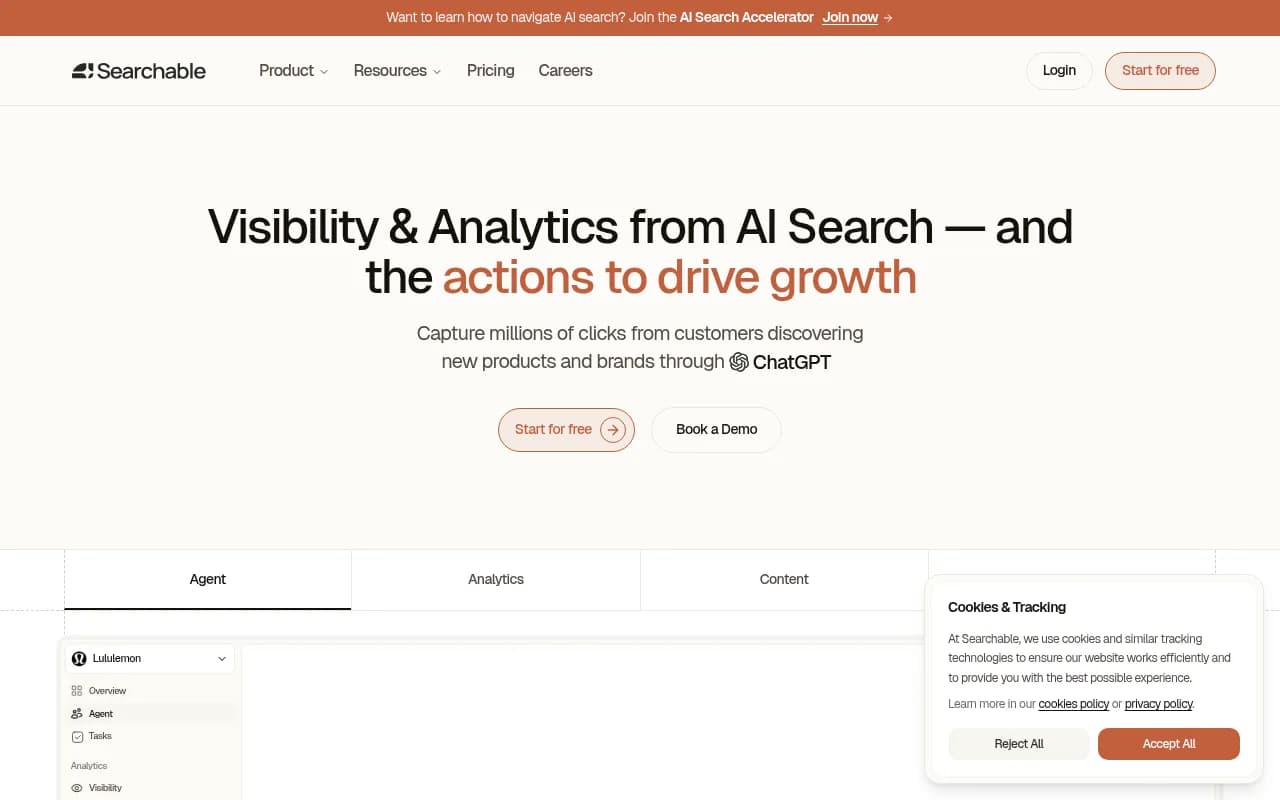
Searchable pitches itself as an AI search visibility platform with built-in content generation. Its monitoring side shows share of voice and how often you appear as the definitive answer, and its analytics side ties AI visibility to Google Analytics or Search Console data.
On sentiment and narrative specifically, public detail is thin. The Searchable site has testimonials that mention seeing "how our brand is being represented across AI-powered search platforms," which suggests representation tracking exists, but I could not verify native sentiment scoring or claim-level narrative features beyond the Arobis "Good" rating.
Profound's competitor review makes a few sharper claims, and since Profound is a rival, weigh them accordingly:
- Base plans track only three engines (ChatGPT, AI Overviews, Perplexity), with other engines as paid add-ons until the custom tier.
- Visibility data cannot be segmented by persona.
- Searchable does have an AI agent for chatting with your data and saving repeatable workflows.
The persona point matters for narrative work. A CFO and a developer will get different descriptions of the same product, and a tool that averages them hides the gap.
The case for Searchable is price and speed to start. It is the cheapest of the three, it has a free trial, and an API is listed. The case against, for this specific topic, is that you will probably need to do more manual reading of responses to extract narrative.
AthenaHQ

AthenaHQ is the one the Arobis matrix rates highest for narrative analysis, and its feature set backs up the direction even if the rating is subjective.
What is relevant here:
- Hallucination detection flags inaccurate claims about your brand across the models it tracks. That is the closest thing in this group to claim-level checking.
- Regional tracking lets you segment visibility by metro area, which matters because models respond differently in different markets.
- Shopping tracking across ChatGPT Shopping, Amazon Rufus, Google Shopping AI and Walmart includes brand positioning trends that show how a brand is perceived in shopping contexts. Profound notes the methodology is not disclosed.
- The Athena Citation Engine (ACE), an ML model that predicts how likely a page is to be cited, is an enterprise add-on alongside the API, SSO and white-glove onboarding.
AthenaHQ's own claims: 40% increase in brand mention rate, 85% faster response to brand mentions, and 50% less time spent on tracking. Those are vendor figures with no independent verification.
The friction point comes up repeatedly in reviews. Credits. Several reviewers say they underestimated how fast credits burn once a team monitors more engines, because responses cost 1 or 5 credits depending on the model. If you plan to track narrative across many models and markets, price that out before committing. The Starter plan covers 11 models and unlimited seats, which is generous.
Profound also argues that AthenaHQ's crawler checks are test fetches rather than real bot traffic. That is a crawlability point, not a sentiment one, but it affects the fix step: if you cannot see whether AI bots actually read the page that carries a bad claim, you are guessing.
Profound
Profound

Profound positions itself as an agentic marketing platform. Its monitoring pitch rests on a data foundation of 2B+ real user prompts, refreshed weekly, broken down by intent and demographics, which it contrasts with AthenaHQ's proprietary volume estimation model.
For narrative and sentiment:
- Sentiment is tracked as positive, neutral or negative in AI descriptions of your brand.
- FactCheck accuracy is one of the signals its AI Marketer agent monitors, then turns into ranked projects with evidence attached.
- Personas are a first-class dimension for Visibility Score and Share of Voice, so you can see how different buyer types hear about you.
- Agent Analytics shows real AI bot traffic on your domain with a GA4 integration.
The WHOOP case study is Profound's headline proof: 40+ agents, 100+ hours saved in under a month, visibility up 6.6% in six months, and appearances in 56% of AI answers for top prompts. It is a vendor-published case study, and the metric is visibility, not sentiment.
Pricing is the hard part. Profound's comparison page lists Starter at $99/month, Growth at $399/month (3 seats, 100 prompts, 9,000 responses, three engines), and custom Enterprise pricing. Third-party sources describe it as sales-led with a demo required and no published volumes. These do not fully agree, so confirm directly with Profound.
SourceForge users give Profound 3.5/5, and the written complaints include slow loading, prompts being re-created on plan upgrades, and slow support handoffs. That is a small sample from a review site, but it is one of the few non-vendor voices available.
Head-to-head on what matters for narrative
| Capability | Searchable | AthenaHQ | Profound |
|---|---|---|---|
| Positive/neutral/negative sentiment | Not confirmed in public sources | Yes | Yes |
| Claim-level accuracy checking | Not confirmed | Hallucination detection | FactCheck |
| Persona segmentation | No (per Profound) | Not confirmed | Yes |
| Regional or location segmentation | Not confirmed | Metro-area tracking | Demographic breakdown by prompt data |
| Engines on entry plan | 3 (per Profound) | 11 models on Starter | 3 on Growth |
| Real crawler traffic | Not confirmed | Test fetches (per Profound) | Agent Analytics |
| Self-serve start | Yes | Yes | No |
The honest summary: AthenaHQ gives the broadest model coverage per dollar and a hallucination feature. Profound gives the deepest segmentation and crawler data, at enterprise pricing and sales friction. Searchable is the cheapest on-ramp with the least documented narrative tooling.
What shapes the narrative in the first place
Here is the part vendors rarely mention. Narrative is downstream of sources. If you only monitor responses, you see the symptom.
Promptwatch Data's ChatGPT citation share report for November 2026, covering Nov 1 to 25, found Reddit as the most cited popular site at 0.23% of ChatGPT citations, with G2 and LinkedIn at 0.18% each. In June Reddit held 3.71%. Review sites such as G2, Gartner, BBB, Capterra and Trustpilot hold five of the top 10 spots, and the 20 tracked sites together earn under 2% of citations, with the rest spread across hundreds of thousands of domains.
Two implications for narrative tracking. First, ChatGPT's description of you now leans more on review sites and your own pages than on Reddit threads. Second, the long tail is enormous, so a tool that only reports top domains misses most of what shapes the answer. Promptwatch's Reddit citation data shows how quickly that mix can change: reddit.com's ChatGPT share fell from about 4% to 0.5% on August 14, 2026. Whatever tool you choose, ask whether it shows the cited sources behind each claim, not just the claim.
Where Promptwatch fits
If narrative is the main job, it is worth looking at Promptwatch alongside these three. Its Brand Narrative feature pulls individual claims out of every tracked response, groups repeated ones (a claim shows up once three AI answers make it), shows which models say each one, and files them under themes like Pricing, Features, Support or Reputation with a 0-100 score per theme you can compare against competitors. It is on every plan, including the free Explore plan.

Fact Check then tests each claim against pages crawled from your site and the 50 most-cited third-party pages for that claim, so you can see which page AI is learning the wrong thing from. It is available from the Business plan ($579/month), and the "Fix with content agent" step refreshes flagged pages using Agent Credits. Sentiment is scored separately from visibility, per response, with competitor heatmaps by topic. Check promptwatch.com/pricing for current plan details, and the Brand Narrative and Fact Check page for how verdicts work.
That is the tradeoff to weigh. Promptwatch covers the claim, the source, the fix and the re-check in one product, but it is not the cheapest route.
Other options worth a look
If none of the three fit, a few others in the same category are worth a short list:
- [tool:semrush] has an "Own your AI brand narrative" feature that benchmarks positive and negative sentiment per AI platform.
- [tool:peec-ai] is a prompt tracker at roughly 85 euros/month for 50 prompts.
- [tool:ahrefs-brand-radar] starts from about $199/month.
- [tool:aiclicks] is listed at around $59/month.
For broader browsing, the GEO software directory at bestgeosoftware.com lists more platforms by category.
How to choose
Pick Searchable if you are a small or mid-size SaaS team that wants a low-cost, self-serve start and plans to read responses by hand. Confirm sentiment features in a trial before paying.
Pick AthenaHQ if you want many models tracked from day one, hallucination flagging, and regional splits, and you can model the credit consumption honestly. Run your real prompt count through the 1-or-5-credit math first.
Pick Profound if you are an enterprise team with buyer personas that matter, a procurement process that tolerates a sales cycle, and a need for real crawler data next to sentiment.
Look beyond all three if you need claim-level narrative, source verification and a content fix loop in the same tool.
A short test before you buy
Vendor comparison pages will not settle this, so run your own check during any trial:
- Pick 20 prompts a real buyer would ask, including 5 competitor comparisons.
- Read 20 raw responses yourself and write down the claims you see.
- Compare your list with what the tool surfaces. Count misses.
- Pick one claim that is wrong and ask the tool where it came from. If it cannot name a source page, the narrative feature is a dashboard, not a diagnosis.
- Re-run after you change the source page, and see whether the claim moves.
That last step is the one nobody advertises, and it is the one that tells you whether you are buying measurement or improvement.
FAQ
Is sentiment tracking in AI search accurate?
No independent test exists for any of these three tools, and none of them publish how the score is computed. Treat the number as directional, and spot-check against raw responses.
Which tool is best for tracking brand narrative?
On the one third-party matrix available, AthenaHQ rates highest, then Profound, then Searchable. That matrix is from a vendor-style blog, so use it as a starting point and test with your own prompts.
How much do these tools cost?
Searchable runs from $125 to $999/month with custom plans. AthenaHQ starts around $245/month annual or $295 monthly. Profound's pricing is sales-led, though its own page lists Starter at $99 and Growth at $399 per month. Always confirm on the vendor sites.
Do I need a separate tool for hallucination detection?
Not necessarily. AthenaHQ includes hallucination detection and Profound has FactCheck. Fact checking against your own pages and cited third-party sources is the part that tells you what to fix.