Key takeaways
- Promptwatch is the only platform in this comparison that closes the full loop: it finds AI visibility gaps, generates content to fix them, and tracks the results -- most competitors stop at monitoring.
- Botify is the strongest choice for pure technical SEO at enterprise scale, but its AI visibility features are still catching up to dedicated GEO tools.
- seoClarity combines solid traditional SEO with some AI tracking, but lacks content generation and crawler log analysis for AI bots.
- Searchable offers AI-focused content generation alongside monitoring, but has a smaller footprint and fewer integrations than Promptwatch.
- If your team needs both technical SEO and AI visibility in one place, the right pick depends heavily on where you're starting from and what you're trying to fix.
The question sounds simple: which platform handles technical SEO and AI visibility best? But it gets complicated fast, because these four tools were built with very different problems in mind.
Botify was designed for enterprise crawl budgets and log file analysis. seoClarity grew up as a traditional SEO platform and has been bolting on AI features. Searchable entered the market with AI visibility as its core pitch. And Promptwatch was built from the ground up around a specific idea: tracking where you're invisible in AI search, then actually helping you fix it.
This guide goes through each platform honestly -- what they're genuinely good at, where they fall short, and which one makes sense depending on your situation.
What "combining technical SEO with AI visibility" actually means
Before comparing tools, it's worth being precise about what we're even asking for.
Technical SEO covers crawlability, indexation, Core Web Vitals, log file analysis, structured data, JavaScript rendering, internal linking, and site architecture. It's about making sure search engines can find and understand your pages.
AI visibility is a different problem. It asks: when someone types a question into ChatGPT, Perplexity, or Google AI Mode, does your brand appear in the answer? Which pages are being cited? Which competitors are being recommended instead of you? What content gaps are causing AI models to ignore you?
A platform that "combines" both needs to do more than check a box in each category. It needs to give you actionable data on both fronts -- and ideally, help you do something about what you find.
The four platforms at a glance
| Platform | Primary strength | AI visibility depth | Content generation | Crawler log analysis | Best for |
|---|---|---|---|---|---|
| Promptwatch | AI visibility + GEO optimization | Deep (10 models, real UI data) | Yes (Content Agents) | Yes (AI crawler logs) | Teams that want to find gaps and fix them |
| Botify | Technical SEO at scale | Limited | No | Yes (traditional logs) | Enterprise sites with crawl/indexation issues |
| seoClarity | Traditional SEO + some AI tracking | Moderate | No | No | SEO teams wanting one platform for both |
| Searchable | AI visibility + content generation | Moderate | Yes | No | Brands starting their GEO journey |
Promptwatch: the optimization platform, not just a tracker
Promptwatch monitors how brands appear across 10 AI models -- ChatGPT, Perplexity, Google AI Overviews, Google AI Mode, Claude, Gemini, Meta/Llama, DeepSeek, Grok, and Mistral. That's already a wider net than most competitors. But the monitoring is almost secondary to what happens next.

The core workflow is built around three steps. First, Answer Gap Analysis shows you exactly which prompts competitors are being cited for but you're not. Not vague category-level gaps -- specific questions and topics where AI models are already recommending someone else. Second, Content Agents generate articles, listicles, comparisons, and briefs grounded in that real prompt data. The output is calibrated to fill the specific gaps AI models are exposing, not generic SEO content. Third, page-level tracking shows whether your new content is actually getting crawled and cited, with a timeline from publish to crawl to citation.
What makes this different from a monitoring dashboard is that the loop closes. You don't just see the problem -- you have a path to fix it.
A few specific capabilities worth knowing about:
Promptwatch tracks AI search behavior in real user interfaces, not just through APIs. This matters because what ChatGPT shows a real user can differ from what the API returns. The platform also logs AI crawler activity in real time -- which pages ChatGPT, Claude, and Perplexity are hitting, how often, what errors they're encountering, and when pages move from crawl to citation. Most competitors don't have this at all.
Prompt Intelligence gives you volume estimates and difficulty scores for each prompt, plus query fan-outs showing how one question branches into sub-queries. That lets you prioritize high-value, winnable prompts instead of guessing.
On the technical SEO side, Promptwatch integrates with Cloudflare, Fastly, Vercel, server logs, and Google Search Console. It's not a replacement for a dedicated crawler like Screaming Frog, but the AI crawler log analysis fills a gap that traditional technical SEO tools don't address at all.
Pricing starts at $99/month (Essential: 1 site, 50 prompts, 5 articles), $249/month (Professional: 2 sites, 150 prompts, 15 articles, crawler logs), and $579/month (Business: 5 sites, 350 prompts, 30 articles). A free trial is available.
Botify: the technical SEO specialist
Botify is built for enterprise SEO teams managing sites with millions of pages. Its core strengths are crawl analysis, log file analysis, and rendering -- the kind of deep technical work that matters when you're trying to figure out why Google isn't indexing 40% of your product catalog.
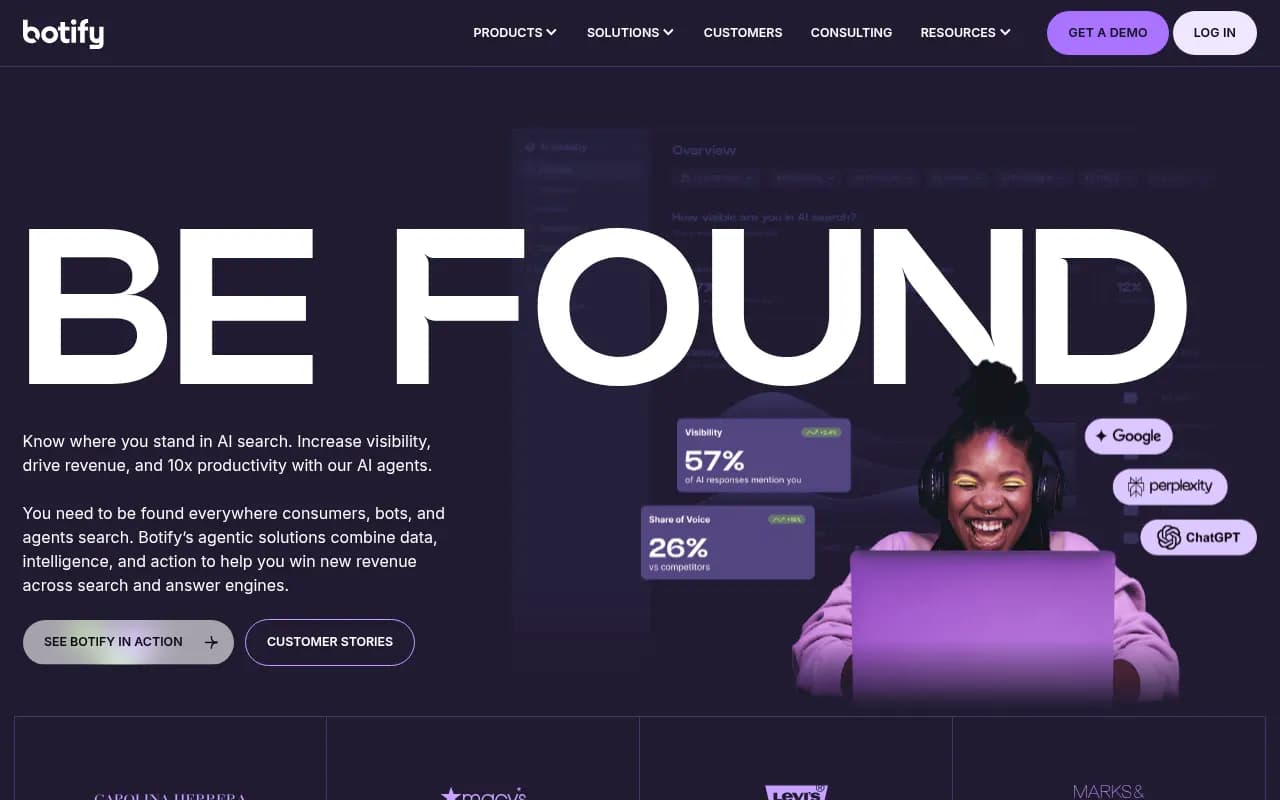
The platform's log file analysis is genuinely impressive. You can see exactly which pages Googlebot is crawling, how often, and whether your crawl budget is being wasted on low-value URLs. For large e-commerce sites, news publishers, or any site where crawl efficiency is a real problem, Botify is hard to beat.
Where Botify struggles in this comparison is AI visibility. The platform has been adding AI-related features, and it's positioned as an "AI search optimization platform" in its marketing, but the depth of AI monitoring is limited compared to dedicated GEO tools. There's no content generation tied to AI visibility gaps, no prompt volume data, and no tracking of how AI crawler behavior differs from traditional search bots.
If your primary problem is technical -- crawl budget, JavaScript rendering, indexation at scale -- Botify is excellent. If you need to understand why ChatGPT isn't recommending your brand and want to fix it, Botify isn't the right starting point.
seoClarity: traditional SEO with AI features added
seoClarity has been around long enough to have built a solid reputation as an enterprise SEO platform. Rank tracking, content analysis, site auditing, competitive intelligence -- it covers the traditional SEO stack well.
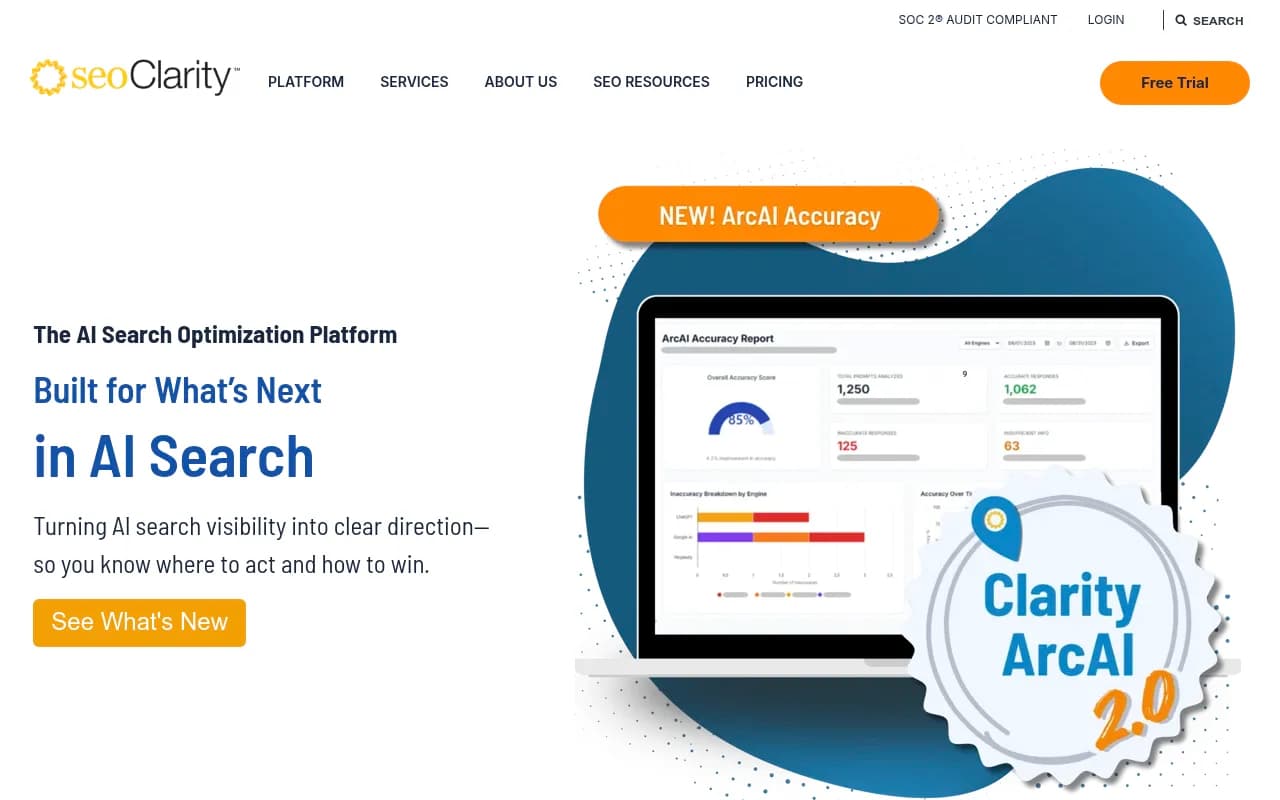
The platform has added AI visibility tracking, and it's more than a checkbox. You can monitor brand mentions across some AI engines and get some competitive benchmarking. But the depth is moderate compared to dedicated AI visibility platforms. There's no content generation tied to AI gaps, no AI crawler log analysis, and the prompt tracking doesn't reach the breadth of models that Promptwatch covers.
For teams that are already using seoClarity for traditional SEO and want to add some AI visibility monitoring without switching platforms, it's a reasonable option. For teams where AI visibility is a primary concern, the limitations become frustrating quickly.
The pricing is enterprise-tier and generally requires a custom quote, which puts it out of reach for smaller teams.
Searchable: AI visibility with content generation
Searchable entered the market with a focus on AI search visibility and built content generation into the platform from early on. That puts it in a similar conceptual space to Promptwatch -- both track AI visibility and help you create content to improve it.
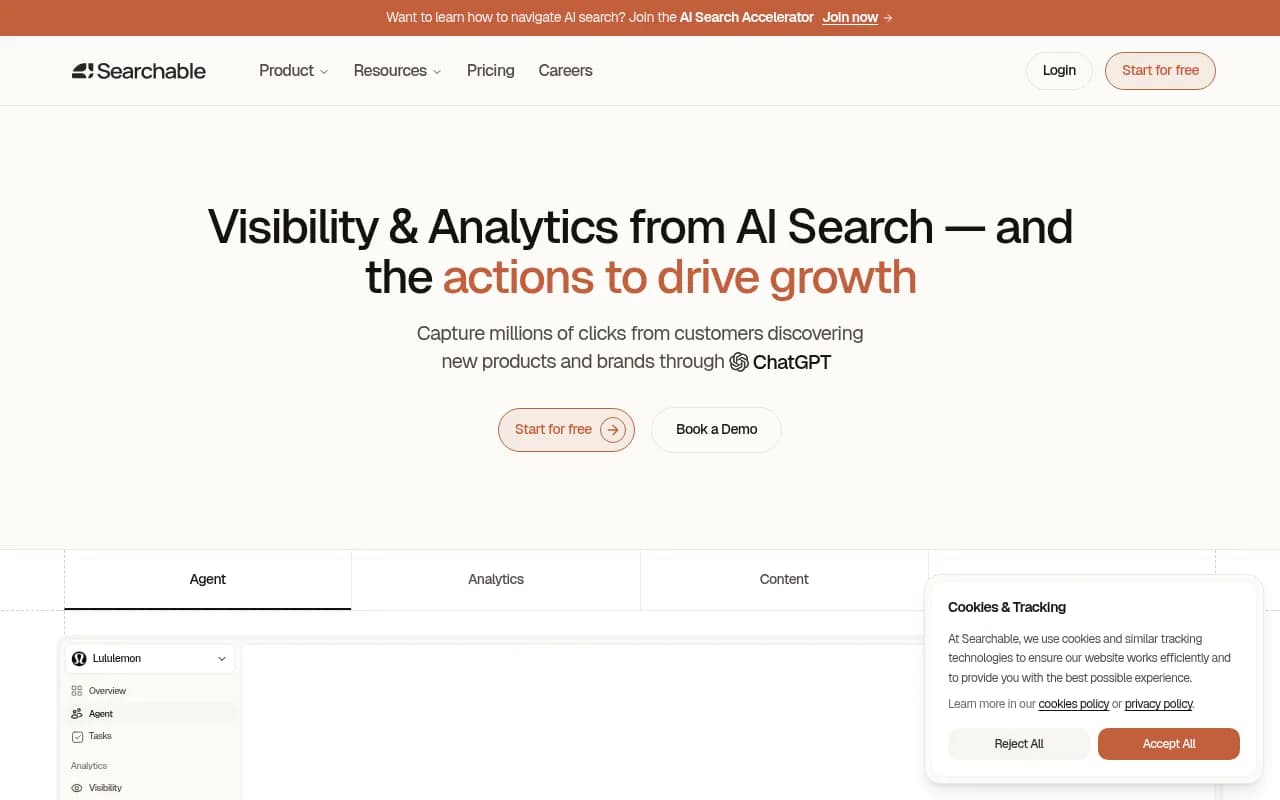
The platform covers the core monitoring use cases: tracking brand mentions across major AI engines, identifying competitor visibility, and surfacing content gaps. The content generation features help teams act on what they find rather than just staring at dashboards.
Where Searchable falls short relative to Promptwatch is depth and breadth. The AI crawler log analysis that Promptwatch offers -- real-time visibility into which pages AI bots are hitting and when -- isn't there. Prompt volume data and difficulty scoring are more limited. The number of AI models tracked is smaller. And the integrations (Cloudflare, Fastly, Vercel, Google Search Console) that Promptwatch uses to connect AI visibility to actual traffic attribution aren't present.
Searchable is a reasonable starting point for teams that are new to GEO and want something that covers the basics without a steep learning curve. For teams that need the full picture -- from crawl to citation to revenue -- it runs out of depth.
Head-to-head: which platform wins on specific use cases
You need to understand why AI models aren't recommending your brand
Promptwatch wins here. The Answer Gap Analysis is purpose-built for this question, and the prompt volume data helps you prioritize which gaps actually matter. Searchable covers this at a basic level. seoClarity and Botify don't answer this question well.
You need to fix a crawlability or indexation problem on a large site
Botify wins. Its log file analysis and crawl budget tools are best-in-class for this. Promptwatch's AI crawler logs are complementary (they show AI bot behavior specifically), but they're not a replacement for Botify's traditional technical SEO depth.
You need to generate content that improves AI visibility
Promptwatch and Searchable both offer content generation. Promptwatch's Content Agents are grounded in real prompt data, citation analysis, and competitor research -- the output is calibrated to fill specific AI visibility gaps. Botify and seoClarity don't generate content.
You need to track which pages are being cited by AI models
Promptwatch's page-level tracking and AI crawler logs are the strongest option here. You can see exactly which pages ChatGPT or Perplexity are reading, how often, and what happens after they crawl. seoClarity has some citation tracking. Botify and Searchable are weaker here.
You need one platform for traditional SEO and AI visibility
This is where the comparison gets honest. No single platform is perfect at both. seoClarity covers traditional SEO well and has some AI visibility. Botify is excellent at technical SEO but thin on AI visibility. Promptwatch is the strongest on AI visibility and has meaningful integrations with traditional SEO data sources, but it's not a full replacement for a dedicated technical SEO crawler.
For most marketing and SEO teams, the practical answer is Promptwatch for AI visibility (including the AI crawler logs that overlap with technical SEO) plus a dedicated crawler like Screaming Frog for traditional technical audits.
A note on what "AI visibility" actually requires in 2026
One thing that's become clear as this category has matured: monitoring alone isn't enough. Knowing that ChatGPT mentions your competitor instead of you is useful information, but it doesn't tell you what to do about it.
The platforms that are winning in 2026 are the ones that close the loop -- find the gap, create content to fill it, track whether it worked. That's the core distinction between Promptwatch and most of the monitoring-only tools in this space.
Botify and seoClarity were built in an era when "visibility" meant Google rankings. They're adapting, but the architecture of those platforms reflects their origins. Searchable was built for the AI era but hasn't reached the same depth on the action side. Promptwatch was designed around the full optimization cycle from the start.
Who should use what
- Large enterprise sites with complex crawl and indexation problems: Start with Botify for technical SEO, add Promptwatch for AI visibility.
- Marketing or SEO teams where AI search visibility is the primary concern: Promptwatch is the clearest choice.
- Teams already on seoClarity who want to add AI monitoring without switching: seoClarity's AI features are good enough to start with, but plan to evaluate dedicated GEO tools as AI search grows.
- Smaller teams or brands new to GEO who want a simpler starting point: Searchable is accessible, but you'll likely outgrow it as your needs get more specific.
The honest summary: if you're serious about AI search visibility and want to do more than watch a dashboard, Promptwatch is the platform that's built for that. If your primary problem is technical SEO at massive scale, Botify is still the specialist. The others sit somewhere in between -- useful, but not optimized for either end of the spectrum.
Final thought
The framing of "technical SEO vs AI visibility" is going to matter less over time. AI crawlers have their own behavior patterns, their own indexation logic, and their own content preferences. Understanding that behavior is becoming part of technical SEO -- it's just that most traditional tools weren't built to see it.
The platforms that will win this space are the ones that treat AI search as a distinct technical and content problem, not just a new tab in an existing dashboard.