Key takeaways
- Semrush, Ahrefs, and SE Ranking are excellent traditional SEO platforms that have added limited AI search features -- but none of them were built for AI visibility from the ground up.
- Dedicated AI visibility platforms like Promptwatch go beyond monitoring: they identify content gaps, generate AI-optimized content, and track whether that content gets cited by ChatGPT, Perplexity, Claude, and others.
- If your primary goal is Google rankings, Semrush or Ahrefs are still the strongest choices. If AI search visibility is a priority, you need a purpose-built tool.
- The biggest mistake teams make in 2026 is treating AI visibility as a checkbox feature inside their existing SEO platform -- and then wondering why they're invisible in ChatGPT responses.
The SEO tool landscape in 2026 is genuinely confusing. Every major platform now claims to support "AI search," but what that actually means varies wildly. Semrush added an AI Toolkit. Ahrefs launched Brand Radar. SE Ranking built SE Visible. Meanwhile, a new category of dedicated AI visibility platforms has emerged -- and they work very differently.
This guide breaks down what each approach actually does, where the gaps are, and how to decide which tool (or combination of tools) makes sense for your situation.
What we're actually comparing
Before getting into specifics, it's worth being clear about what "AI visibility" means, because the term gets used loosely.
Traditional SEO is about ranking in Google's blue-link results. You track keyword positions, build backlinks, optimize on-page content, and measure organic traffic.
AI visibility is about appearing in the responses generated by ChatGPT, Perplexity, Claude, Gemini, Google AI Overviews, and similar systems. When someone asks "what's the best project management tool for remote teams?" and ChatGPT gives a five-paragraph answer with specific recommendations, you want your brand in that answer. That's AI visibility -- and it works nothing like traditional SEO.
The tools we're comparing handle these two problems very differently.
The traditional SEO platforms: Semrush, Ahrefs, SE Ranking
These three tools have been around long enough to have real data, real track records, and real user bases. They're not going anywhere. But their AI search features are, at best, a first step.
Semrush
Semrush is the broadest platform of the three. It covers keyword research, backlink analysis, site audits, competitive intelligence, content marketing, and now an AI Toolkit that tracks brand mentions in AI-generated responses.
The AI Toolkit is genuinely useful for teams that already live inside Semrush. You can monitor how often your brand appears in AI answers and get some basic sentiment analysis. But there are real limitations: the prompts are fixed (you can't define your own), there's no AI traffic attribution, and there's no content generation tied to the gaps you find. You can see that you're invisible for certain queries -- but Semrush doesn't help you do much about it.
Pricing starts at $139.95/month for the Pro plan. The AI features are available on higher tiers, which pushes the real cost up further.
Ahrefs
Ahrefs is the tool most SEOs reach for when they want backlink data and keyword research done right. Its Brand Radar feature, added in 2025, tracks brand mentions across AI platforms including ChatGPT and Perplexity.
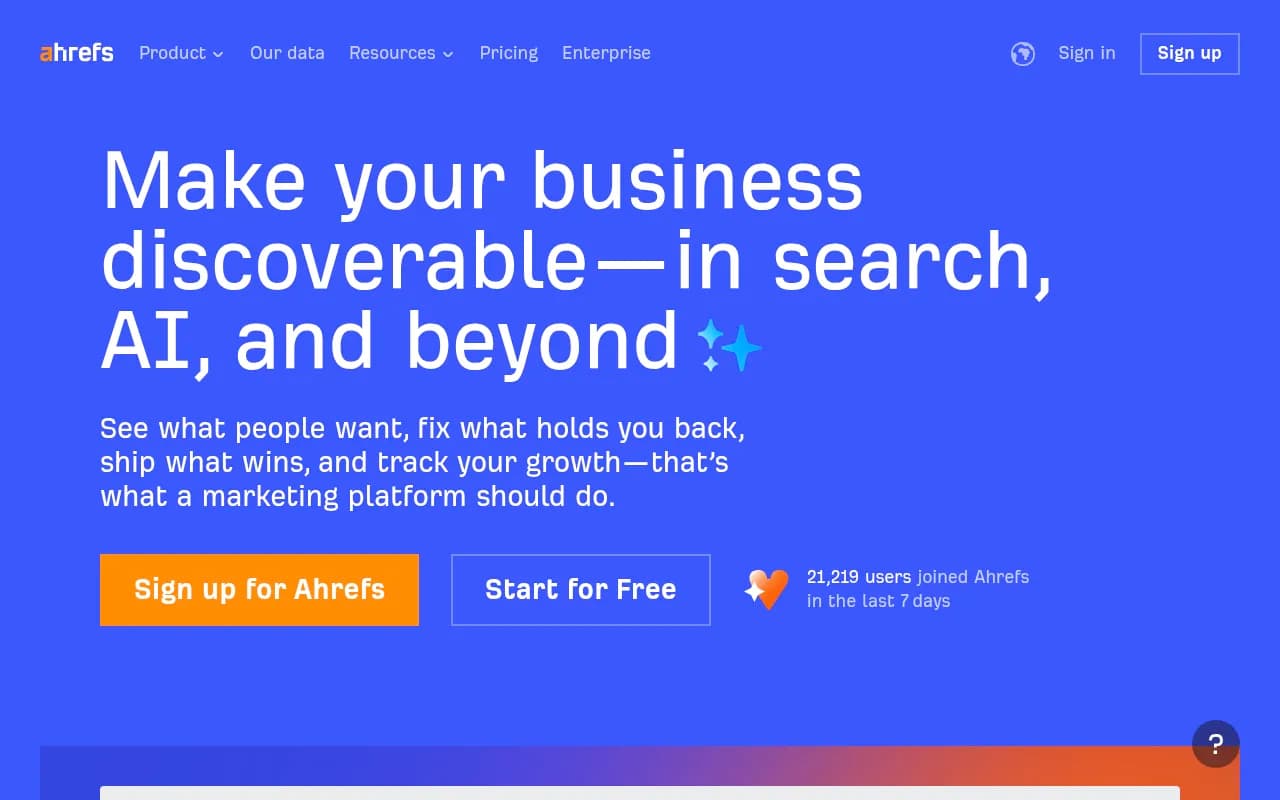
Brand Radar is a solid monitoring feature. It shows you where your brand appears in AI responses and lets you compare against competitors. The problem is the same as Semrush: fixed prompts, no AI traffic attribution, and no path from "you're not being cited" to "here's how to fix that." It's a dashboard, not a workflow.
Ahrefs starts at $129/month. There's no free trial, which is a real friction point for teams evaluating it.
SE Ranking
SE Ranking sits at a lower price point ($65/month) and has historically been popular with agencies for its white-label reporting. It built a separate product called SE Visible specifically for AI visibility tracking.
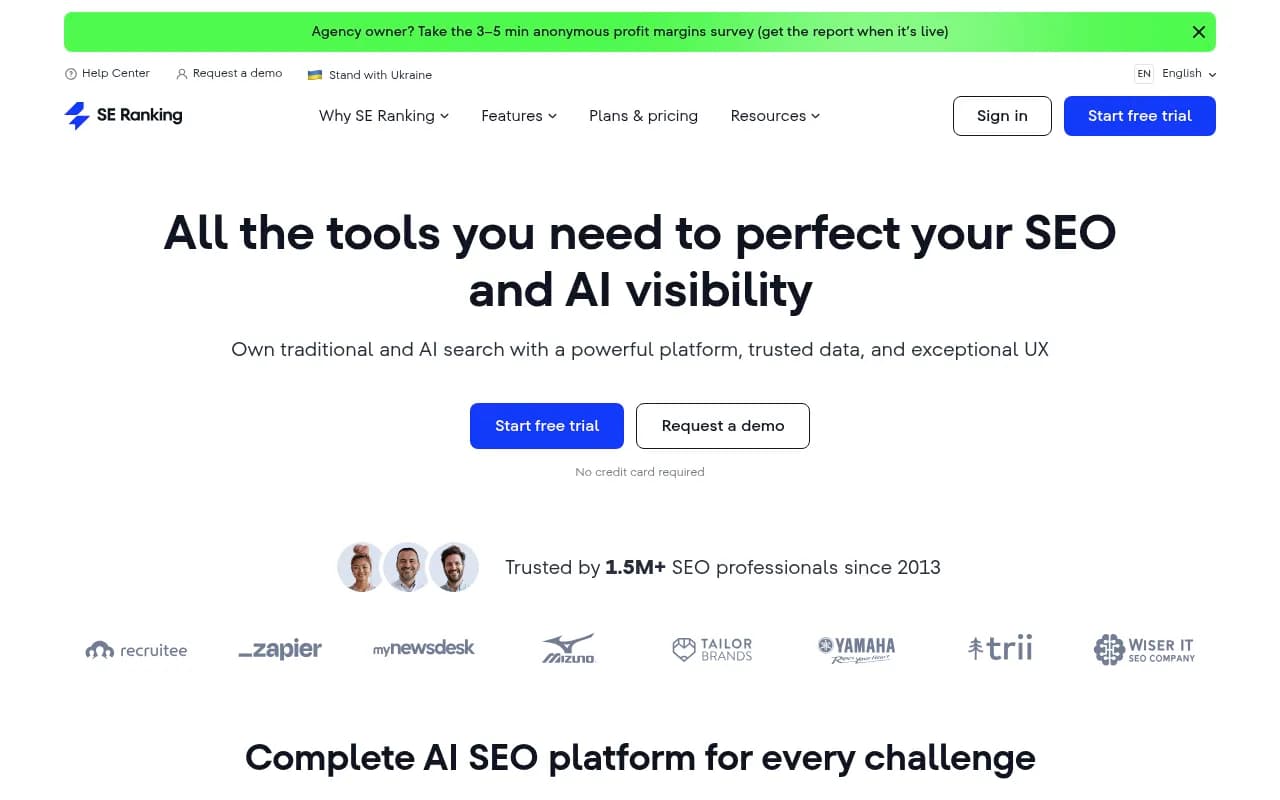
SE Visible tracks brand mentions across AI engines and gives you share-of-voice data. It's more focused than the AI features bolted onto Semrush or Ahrefs, but it's still fundamentally a monitoring tool. The content optimization loop isn't there.
The dedicated AI visibility platform: Promptwatch
Promptwatch was built specifically for AI search visibility -- not as an add-on to an existing SEO platform, but as a purpose-built system for understanding and improving how brands appear in AI-generated responses.

The core difference is what happens after you see the data. Most monitoring tools show you a gap and leave you there. Promptwatch is built around a three-step loop:
- Find the gaps -- Answer Gap Analysis shows exactly which prompts competitors appear for that you don't. You see the specific topics and questions AI models want to answer but can't find on your site.
- Create content that ranks in AI -- A built-in writing agent generates articles, listicles, and comparisons grounded in citation data from 880M+ analyzed citations, prompt volumes, and competitor analysis.
- Track the results -- Page-level tracking shows which pages are being cited, how often, and by which models. Traffic attribution connects AI visibility to actual revenue.
It monitors 10 AI models: ChatGPT, Perplexity, Claude, Gemini, Google AI Overviews, Google AI Mode, Grok, DeepSeek, Meta/Llama, Mistral, and Copilot. That's broader coverage than any of the traditional SEO platforms.
Some features that stand out beyond the core loop:
- AI Crawler Logs show you in real time which AI crawlers are hitting your site, which pages they're reading, and what errors they encounter. This is genuinely rare -- most competitors don't have it at all.
- Prompt Intelligence gives volume estimates and difficulty scores for each prompt, plus query fan-outs that show how one prompt branches into sub-queries. This lets you prioritize high-value, winnable prompts instead of guessing.
- Reddit and YouTube Insights surface discussions that directly influence AI recommendations -- a channel most platforms ignore entirely.
- ChatGPT Shopping Tracking monitors when your brand appears in ChatGPT's product recommendations and shopping carousels.
Pricing: Essential at $99/month (1 site, 50 prompts, 5 articles), Professional at $249/month (2 sites, 150 prompts, 15 articles, crawler logs), Business at $579/month (5 sites, 350 prompts, 30 articles). A free trial is available.
Head-to-head comparison
| Feature | Semrush | Ahrefs | SE Ranking | Promptwatch |
|---|---|---|---|---|
| Traditional rank tracking | Excellent | Excellent | Good | Not applicable |
| Backlink analysis | Excellent | Excellent | Good | Not applicable |
| AI visibility monitoring | Basic (fixed prompts) | Basic (fixed prompts) | Basic | Advanced (custom prompts) |
| AI models covered | Limited | Limited | Limited | 10 models |
| Custom prompt tracking | No | No | No | Yes |
| Content gap analysis | No | No | No | Yes |
| AI content generation | No | No | No | Yes |
| AI crawler logs | No | No | No | Yes |
| Prompt volume/difficulty | No | No | No | Yes |
| Reddit/YouTube insights | No | No | No | Yes |
| ChatGPT Shopping tracking | No | No | No | Yes |
| AI traffic attribution | No | No | No | Yes |
| Starting price | $139.95/mo | $129/mo | $65/mo | $99/mo |
| Free trial | 7 days | No | 14 days | Yes |
The gap in AI-specific features is significant. It's not that Semrush or Ahrefs are doing AI visibility badly -- it's that they're doing it as a side feature while their core product is traditional SEO. Promptwatch is doing it as the entire product.
Which tool is right for you?
The honest answer depends on what problem you're actually trying to solve.
You should stick with Semrush or Ahrefs if:
- Google rankings are your primary focus and AI search is secondary
- You need deep backlink analysis and keyword research
- Your team is already embedded in one of these platforms and switching costs are high
- You want one platform for everything, even if AI features are limited
You should use SE Ranking if:
- You're an agency that needs white-label reporting and cost efficiency
- Google tracking is the core need, with basic AI monitoring as a nice-to-have
- Budget is a constraint
You should use Promptwatch if:
- AI search visibility is a strategic priority, not just a curiosity
- You want to actually improve your AI visibility, not just monitor it
- You need to understand which content to create to get cited by ChatGPT and Perplexity
- You want to track AI crawler behavior on your site and fix indexing issues
- You're an agency or brand managing multiple sites with AI visibility goals
The combination approach: Many teams in 2026 run Semrush or Ahrefs for traditional SEO alongside Promptwatch for AI visibility. They're solving different problems. The cost of running both is often justified if AI search is driving meaningful traffic in your category.
The deeper issue with "AI features" in traditional SEO tools
There's a pattern worth naming. When a new channel emerges, established platforms add a feature for it. Sometimes that's enough. Sometimes the new channel is different enough that a bolt-on feature misses the point.
AI search is different enough. The way AI models decide what to cite has almost nothing to do with how Google decides what to rank. It's about entity recognition, training data, citation patterns, content structure, and the specific questions people ask AI systems. Monitoring that you're not being cited is useful. But knowing why you're not being cited, and what content would change that, requires a different kind of analysis.
That's the gap between monitoring tools and optimization platforms. Semrush and Ahrefs are monitoring tools for AI search. Promptwatch is an optimization platform.
A note on pricing reality
The pricing comparison looks straightforward on paper, but the real cost calculation is more nuanced.
Semrush at $139.95/month gets you a lot of traditional SEO capability. The AI features are limited but included. If you're already paying for Semrush, adding AI monitoring feels "free" -- but you're not actually getting the optimization capability.
Promptwatch at $99/month is cheaper than Semrush's entry price and gives you far more AI-specific capability. If AI visibility is your primary goal, it's better value. If you need both traditional SEO and AI visibility, you're looking at running two tools -- which is a real cost, but often the right call.
Ahrefs at $129/month with no free trial is the hardest to justify for teams that aren't already committed to it. Brand Radar is useful but not enough to choose Ahrefs over alternatives that offer trials.
What to actually do in 2026
If you're reading this trying to figure out your tool stack, here's a practical framework:
First, decide how important AI search is to your business right now. Check your analytics for traffic from ChatGPT.com, Perplexity.ai, and similar referrers. If it's already meaningful, AI visibility tools are urgent. If it's still small, you have time to plan but not to ignore it.
Second, audit what your existing tools actually do. If you're on Semrush or Ahrefs, check whether their AI features cover your specific prompts and competitors. If they don't, you have a gap.
Third, run a trial of a dedicated AI visibility platform. Promptwatch has a free trial. Use it to run Answer Gap Analysis on your top competitors and see what you find. The gap analysis alone is usually enough to make the case for dedicated tooling.
The brands that will win in AI search over the next two years are the ones treating it as a distinct channel with distinct tools and distinct content strategies -- not the ones assuming their existing SEO platform has it covered.
Other tools worth knowing
A few other platforms are worth mentioning depending on your specific needs:
Otterly.AI

Otterly.AI is a monitoring-focused AI visibility tool that tracks brand mentions across ChatGPT, Perplexity, and Google AI Overviews. It's simpler than Promptwatch and lacks content generation, but it's a reasonable entry point for teams that just want basic monitoring.
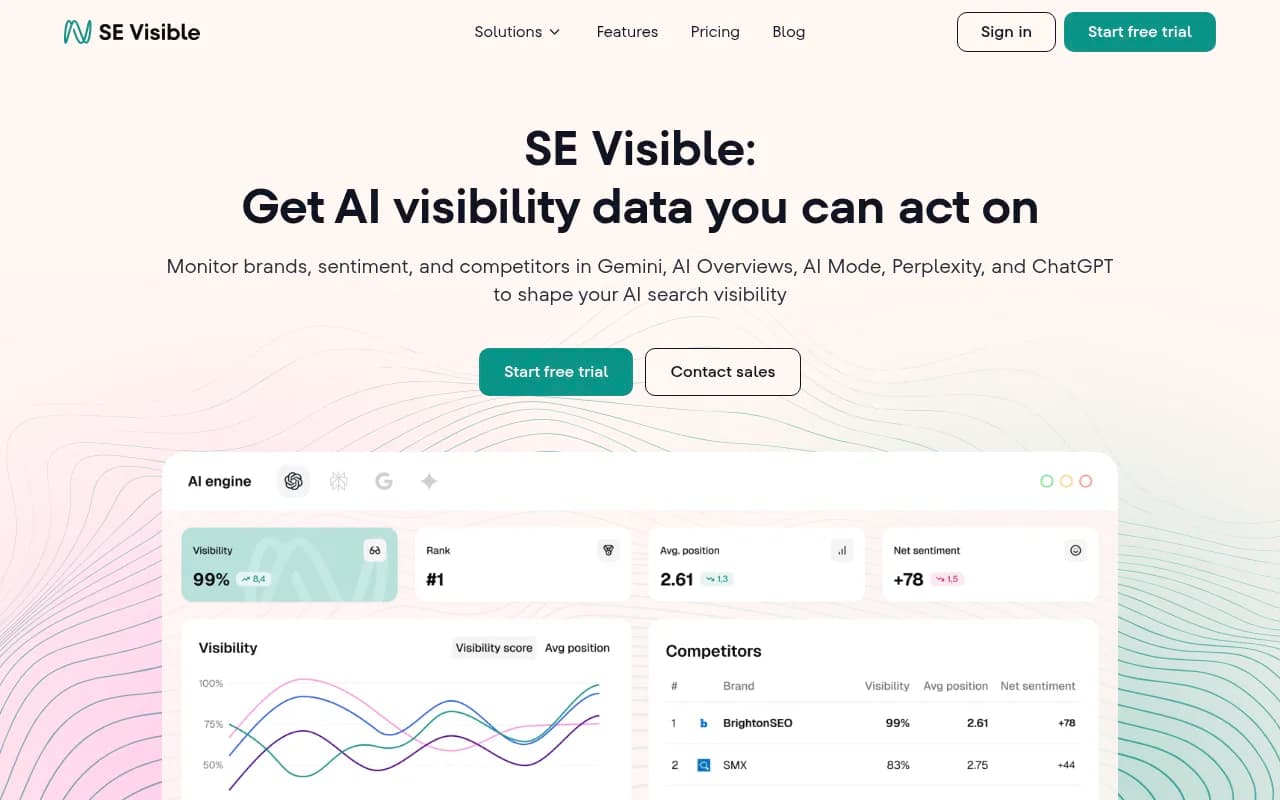
SE Visible (from SE Ranking) is worth considering if you're already in the SE Ranking ecosystem and want AI monitoring without switching platforms. It's limited but integrated.
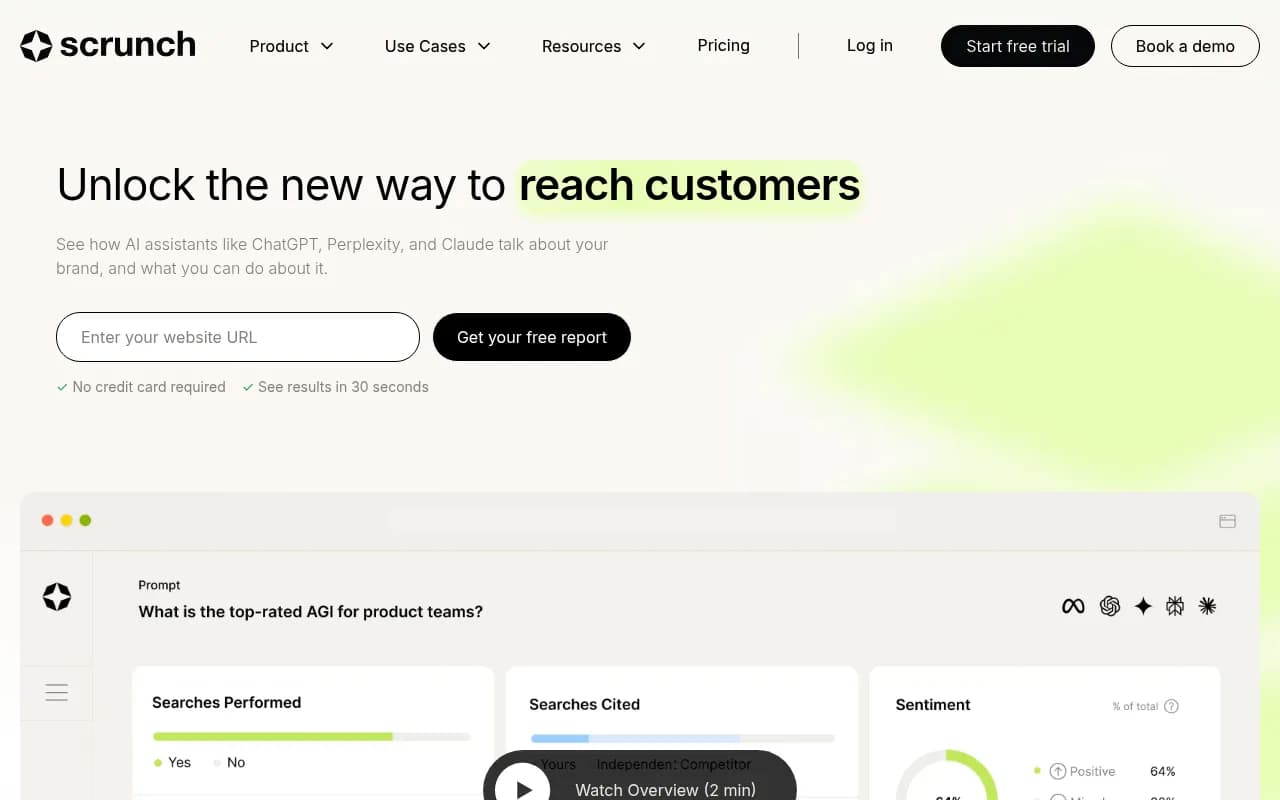
Scrunch AI is another dedicated AI visibility platform with solid tracking capabilities. It's worth evaluating alongside Promptwatch if you're doing a full comparison.
Profound

Profound is an enterprise-focused AI visibility platform with strong features but a higher price point. It's worth looking at for larger organizations with complex needs.
The market is moving fast. Tools that were monitoring-only six months ago are adding optimization features. The gap between traditional SEO platforms and dedicated AI visibility tools will narrow over time. But right now, in 2026, the gap is real -- and it matters for brands that want to be visible where their customers are increasingly searching.