Summary
- Citation velocity tracks how fast AI models like ChatGPT, Claude, and Perplexity discover, crawl, and cite your new content after you publish it
- High citation velocity indicates strong domain authority, technical optimization, and content relevance—the same signals that drive AI visibility
- This metric matters more than traditional rankings because it measures real-time discovery in the channels where buyers actually ask questions now
- You can improve citation velocity through strategic content placement (Reddit, YouTube, authoritative sites), technical optimization (structured data, fast load times), and consistent publishing cadence
- Tools like Promptwatch help you track citation velocity by monitoring when and where AI models start citing your new pages

What is citation velocity?
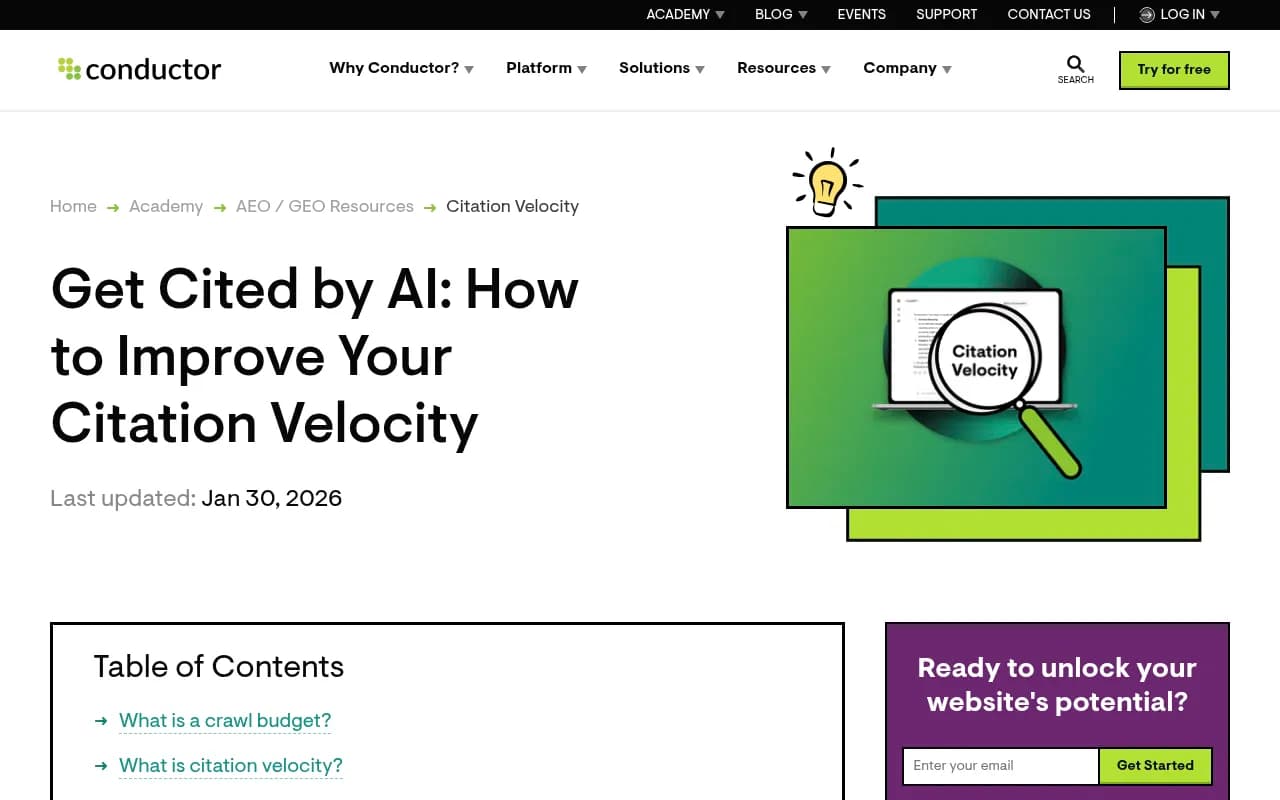
Citation velocity measures the speed at which AI models discover and start citing your content after publication. Think of it as the AI equivalent of indexing speed—but instead of just appearing in a database, your content starts showing up in actual AI-generated answers.
When you publish a new guide, comparison page, or product announcement, citation velocity tells you:
- How many days until ChatGPT first cites it
- How quickly Perplexity includes it in search results
- Whether Claude references it within the first week
- If Google AI Overviews picks it up faster than competitors
A high citation velocity means AI models trust your domain enough to crawl frequently and cite quickly. A low velocity suggests technical barriers, weak domain authority, or content that doesn't match what AI models prioritize.
Why citation velocity matters more than traditional rankings
Traditional SEO metrics measure where you appear in a static list of blue links. Citation velocity measures something more fundamental: whether AI models consider your content authoritative enough to cite when answering real questions.
Here's why that shift matters:
Buyers skip Google and go straight to ChatGPT
A Reddit discussion from late 2025 captured this perfectly: "LLM citation rate matters more than SERP because it's closer to how buyers actually ask questions now and it compresses the whole funnel into one interaction."
When someone asks ChatGPT "What's the best CRM for a 50-person sales team?", they're not clicking through to ten different review sites. They're reading one synthesized answer. If your brand isn't cited in that answer, you don't exist in that buyer's consideration set.
Citation velocity predicts long-term visibility
Content that gets cited quickly tends to stay cited. AI models use citation patterns as a ranking signal—if Perplexity cites your guide within 48 hours of publication, that's a strong signal to Claude and ChatGPT that your content is worth crawling too.
The opposite is also true. Content that takes weeks to get its first citation often never catches up. By the time AI models discover it, competitors have already established citation momentum.
It reveals technical and authority problems early
Slow citation velocity is an early warning system. If your new content isn't getting picked up within a week, you have a problem:
- AI crawlers might be blocked or rate-limited
- Your domain authority is too weak to warrant frequent crawls
- The content lacks the structured data or semantic signals AI models look for
- You're publishing in isolation instead of building citation networks through Reddit, YouTube, or authoritative backlinks
Fixing these issues improves not just citation velocity but overall AI visibility.
What factors impact your citation velocity?
Citation velocity isn't random. Specific technical, content, and authority signals determine how fast AI models discover and cite your work.
Domain authority and crawl budget
AI models allocate crawl resources the same way Google does—high-authority domains get crawled more frequently. If you're Booking.com or HubSpot, ChatGPT's crawler might check your site daily. If you're a new startup blog, it might crawl once a month.
This creates a compounding advantage. High-authority sites publish content that gets cited within hours, which reinforces their authority, which increases their crawl frequency. Breaking into that cycle requires either building authority slowly or leveraging external citation sources (more on that below).
Content length and depth
Research from SE Ranking found that articles over 2,900 words average 5.1 citations, while those under 800 words get 3.2 citations. For smaller domains, content length has roughly 65% more impact on citation rates than for established players.
This isn't about padding word count. Longer content tends to cover more angles, answer more sub-questions, and include more semantic context—all signals AI models use to determine citation-worthiness.
Technical optimization
AI crawlers encounter the same technical barriers as traditional search bots:
- JavaScript rendering issues that hide content
- Slow server response times that trigger rate limiting
- Missing or broken structured data
- Redirect chains that waste crawl budget
- Robots.txt blocks that prevent access
The difference: AI models are less forgiving. Google might eventually index a slow-loading page. ChatGPT's crawler will move on and come back later—maybe.
Tools like Promptwatch include AI crawler log analysis that shows exactly which pages AI models are hitting, how often, and what errors they're encountering. This visibility lets you fix technical issues before they kill your citation velocity.
External citation networks
AI models don't just crawl your website. They scrape Reddit threads, YouTube transcripts, Quora answers, and authoritative publications. Content that appears in multiple places gets cited faster.
This is the core insight behind "LLM seeding"—publishing content where AI models are already crawling heavily. A guide posted on your blog might take two weeks to get cited. The same guide posted on Medium, linked from a Reddit discussion, and referenced in a YouTube description might get cited in 48 hours.
Publishing cadence and freshness signals
AI models prioritize domains that publish consistently. If you publish one article every three months, crawlers have no reason to check back frequently. If you publish three articles per week, they'll crawl more often to catch new content.
This creates a citation velocity feedback loop:
- Publish frequently → crawlers check back more often
- New content gets discovered faster → citation velocity improves
- Higher citation velocity → stronger authority signals
- Stronger authority → even faster discovery on the next publish
Breaking into this loop requires a sustained publishing cadence, not one-off content drops.
How to measure your citation velocity
You can't improve what you don't measure. Tracking citation velocity requires monitoring when AI models first cite your new content and how that speed changes over time.
Manual tracking (the hard way)
The brute-force approach: publish content, then manually query ChatGPT, Claude, Perplexity, and Google AI Overviews every day to see when your page first appears in citations.
This works for one or two pages but breaks down at scale. You need:
- A spreadsheet tracking publish dates and first citation dates
- Daily queries across multiple AI models
- Consistent prompt phrasing to avoid false negatives
- Manual citation verification (some AI models hallucinate sources)
It's tedious and error-prone.
Automated tracking (the smart way)
Platforms built for AI visibility monitoring automate citation velocity tracking. They run daily queries, log first citation dates, and calculate velocity metrics automatically.
Promptwatch tracks citation velocity by monitoring when new pages first appear in AI-generated answers. Its Answer Gap Analysis shows which prompts competitors are cited for but you're not—a direct measure of citation velocity gaps.
Other tools that track citation velocity:
Otterly.AI



Key metrics to track
- Time to first citation: Days between publish date and first AI citation
- Citation spread: How many AI models cite the content within the first week
- Citation persistence: Whether the content stays cited or drops off after initial discovery
- Velocity trend: Whether your average time to first citation is improving or degrading over time
The last metric matters most. If your citation velocity is improving month over month, your domain authority and technical optimization are working. If it's degrading, you have a problem.
How to improve your citation velocity
Improving citation velocity requires a mix of technical optimization, content strategy, and external citation building.
Fix technical barriers first
Before worrying about content strategy, make sure AI crawlers can actually access your site:
- Check your robots.txt: Make sure you're not blocking AI crawlers (GPTBot, Claude-Web, PerplexityBot)
- Monitor crawler logs: Use tools like Promptwatch to see which pages AI models are hitting and what errors they're encountering
- Optimize server response times: AI crawlers are more sensitive to slow responses than traditional bots
- Implement structured data: Schema markup helps AI models understand your content's context and purpose
- Fix JavaScript rendering: If your content requires client-side rendering, use prerendering services to serve static HTML to crawlers
Publish where AI models are already crawling
Your blog is one citation source. Reddit, YouTube, Quora, and authoritative publications are others—and they often get crawled more frequently.
LLM seeding strategy:
- Post summaries or excerpts on Reddit in relevant subreddits
- Create YouTube videos that reference and link to your written guides
- Answer Quora questions with content from your site
- Guest post on high-authority domains that get crawled daily
- Get mentioned in industry publications and news sites
Each external mention creates another pathway for AI models to discover your content. The more pathways, the faster the discovery.
Optimize content for citation-worthiness
AI models cite content that directly answers questions, provides data, and demonstrates expertise. Optimize for those signals:
- Lead with the answer: Don't bury the key insight in paragraph seven. AI models scan for direct answers.
- Include data and numbers: Citations like "articles over 2,900 words average 5.1 citations" are more cite-worthy than vague claims.
- Use clear section headings: AI models parse structure to understand what each section covers.
- Add comparison tables: Structured comparisons are easy for AI models to extract and cite.
- Link to authoritative sources: Citing credible sources signals that your content is research-backed.
Build a consistent publishing cadence
AI crawlers prioritize domains that publish regularly. A consistent schedule trains crawlers to check back more often:
- Weekly publishing: Minimum cadence to maintain crawler attention
- 2-3x per week: Sweet spot for most domains to build citation velocity
- Daily publishing: Only necessary for news sites or high-authority domains
The key is consistency. Publishing three articles one week and nothing for a month trains crawlers to check less frequently.
Use AI content generation strategically
Tools like Promptwatch include AI writing agents that generate content grounded in citation data. This isn't generic SEO filler—it's content engineered to match the topics, angles, and questions AI models are already looking for.
The workflow:
- Identify citation gaps: See which prompts competitors are cited for but you're not
- Generate targeted content: Use the AI writer to create articles that fill those gaps
- Track citation velocity: Monitor how quickly the new content gets picked up
- Iterate: Double down on content types and topics that get cited fastest
Monitor and iterate
Citation velocity isn't a one-time optimization. Track your metrics monthly and adjust:
- If velocity is improving: keep doing what you're doing
- If velocity is flat: experiment with external citation sources or content formats
- If velocity is degrading: audit for technical issues or authority drops
The brands winning in AI search in 2026 are the ones treating citation velocity as a core KPI, not an afterthought.
Citation velocity vs traditional SEO metrics
How does citation velocity compare to the metrics you're already tracking?
| Metric | What it measures | Why it matters | Limitations |
|---|---|---|---|
| Citation velocity | Speed of AI model discovery and citation | Real-time visibility where buyers search | Requires AI-specific tracking tools |
| Organic rankings | Position in Google search results | Still drives traffic for research queries | Declining relevance as users shift to AI |
| Domain authority | Link-based trust signals | Predicts both SEO and AI visibility | Slow to change, doesn't reflect AI-specific factors |
| Crawl rate | How often Google crawls your site | Indicates technical health | Doesn't measure citation-worthiness |
| Backlinks | Number and quality of inbound links | Builds authority for both SEO and AI | Takes months to accumulate |
Citation velocity sits at the intersection of technical SEO and content authority. It's forward-looking—measuring how AI models will treat your content, not how they treated it last month.
Tools for tracking citation velocity
You need specialized tools to track citation velocity at scale. Here are the platforms that support this metric:
Promptwatch is the only platform that combines citation velocity tracking with content gap analysis and AI-powered content generation. It shows you which prompts you're not getting cited for, then helps you create content to fix it.
Otterly.AI
Otterly.AI tracks brand mentions across ChatGPT, Perplexity, and Google AI Overviews. It's monitoring-focused—you see when citations appear but don't get tools to improve velocity.
Peec.ai monitors AI search visibility with basic citation tracking. Missing: crawler logs, content generation, and optimization recommendations.
AthenaHQ tracks citations across multiple AI models. Strong on monitoring, weak on actionable insights for improving velocity.
Conductor's platform includes citation velocity tracking as part of its broader AI visibility suite. Good for enterprise teams already using Conductor for traditional SEO.
The citation velocity optimization loop
Improving citation velocity isn't a one-time project. It's a continuous loop:
- Publish new content → Track when AI models first cite it
- Identify velocity gaps → See which content types or topics get cited fastest
- Optimize for speed → Fix technical issues, build external citations, improve content quality
- Measure improvement → Track whether average citation velocity is improving month over month
- Scale what works → Double down on content formats and distribution channels that drive fastest citations
The brands winning in AI search in 2026 are running this loop weekly, not quarterly.
Why citation velocity will matter even more in 2027
AI search is growing faster than traditional search. ChatGPT hit 200 million weekly active users in late 2025. Perplexity is processing over 100 million queries per month. Google AI Overviews now appear on 15% of all searches.
As more buyers shift to AI-first search behavior, citation velocity becomes the primary visibility metric. Traditional rankings still matter for research queries, but the buying decision increasingly happens inside an AI-generated answer.
If your content takes two weeks to get cited, you're invisible during the critical window when buyers are evaluating options. If your content gets cited within 48 hours, you're in the consideration set from day one.
That speed advantage compounds over time. Brands with high citation velocity build authority faster, which increases crawl frequency, which improves velocity further. The gap between fast and slow citation velocity will widen in 2027.
Start tracking citation velocity today
You can't optimize citation velocity if you're not measuring it. Start with:
- Pick 5-10 recent pages → Choose content published in the last 30 days
- Query AI models manually → Search ChatGPT, Claude, and Perplexity for prompts related to those pages
- Log first citation dates → Track when each page first appears in AI-generated answers
- Calculate average velocity → How many days from publish to first citation?
- Set a baseline → This is your starting point for improvement
Once you have a baseline, implement the optimization strategies above and track whether your velocity improves. If you're publishing regularly, you should see measurable improvement within 60-90 days.
For automated tracking at scale, tools like Promptwatch eliminate the manual work and give you actionable insights on where to focus optimization efforts.
Citation velocity is the AI search metric that matters most in 2026. The brands tracking and optimizing it now will dominate AI visibility in 2027.