Key takeaways
- Copy.ai is a solid AI content generation and GTM automation tool, but it has no AI search visibility features -- it won't tell you if ChatGPT, Perplexity, or Google AI Overviews mention your brand
- Pricing starts at $49/month for individuals and scales to enterprise tiers; the free plan is very limited in 2026
- Long-form content quality, SEO depth, and factual accuracy remain genuine weaknesses
- If you're searching for "Copy.ai alternatives for AI search tracking," you're looking for a completely different category of tool -- GEO/AEO platforms like Promptwatch, not content generators
- For pure content writing, Copy.ai competes with Jasper, Writer, and Writesonic; for AI visibility, you need a dedicated monitoring and optimization platform
What Copy.ai actually is in 2026
Copy.ai started in 2020 as a straightforward AI copywriting tool -- you'd paste in a product name, pick a template, and get a dozen ad headline variations in seconds. That was genuinely useful, and it built a loyal user base fast.
By 2026, the product has shifted considerably. Copy.ai now positions itself as a "GTM AI platform" -- go-to-market automation that covers sales sequences, content workflows, prospecting research, and pipeline tasks. It's a bigger vision, and in some ways it works. But the rebranding has also made it harder to evaluate: is it a writing tool? A workflow tool? A sales tool?
The honest answer is it's trying to be all three, with varying success.

Core features worth knowing about
AI writing and templates. The original feature set is still there and still works well. Copy.ai has hundreds of templates covering product descriptions, email subject lines, social captions, ad copy, landing page sections, and more. For short-form content, it's fast and the output quality is decent -- not always publish-ready, but a solid starting point.
AI Chat. A multi-model chat interface that lets you switch between underlying models. Useful for brainstorming and quick drafts, though it doesn't offer anything meaningfully different from just using ChatGPT or Claude directly.
Workflows and automation. This is where Copy.ai has invested heavily. You can build automated pipelines -- for example, pulling a prospect's LinkedIn URL, researching their company, and generating a personalized outreach email. For sales and marketing ops teams, this is genuinely interesting. The no-code workflow builder is accessible enough that non-technical users can set things up without engineering help.
Content agents. Automated agents that can handle repetitive content tasks at scale -- generating product descriptions in bulk, creating variations for A/B tests, and similar jobs. Works better for structured, templated output than for nuanced editorial content.
Brand voice. You can train Copy.ai on your existing content to maintain a consistent tone. This works reasonably well for short-form copy but breaks down on longer pieces.
Copy.ai pricing in 2026
Copy.ai has gone through several pricing restructures. Here's where things stand:
| Plan | Price | Best for |
|---|---|---|
| Free | $0/month | Very limited -- a few hundred words per day, no workflows |
| Starter | ~$49/month | Individual creators, basic templates and chat |
| Advanced | ~$249/month | Teams, workflows, brand voice, integrations |
| Enterprise | Custom | Large orgs, SSO, custom workflows, dedicated support |
A few things to note: the free plan is genuinely restrictive in 2026. If you want to test the workflow features that make Copy.ai interesting, you'll need at least the Advanced plan. Annual billing brings the per-month cost down, but the jump from Starter to Advanced is steep.
For comparison, a tool like Jasper starts at a similar price point but has invested more heavily in marketing-specific features and brand guidelines. Writer targets enterprise teams and is priced accordingly.
What Copy.ai does well
Short-form copy generation. This is still the strongest use case. Ad copy, email subject lines, social posts, product descriptions -- Copy.ai produces usable output quickly. The template library is extensive and well-organized.
Ease of use. The interface is clean. New users can get something out of it within minutes, which matters for teams that don't want to spend a week learning a new tool.
Workflow automation for GTM teams. If you're in sales or RevOps and you're doing repetitive research-and-write tasks, the workflow builder can save real hours. Pulling company data, summarizing it, and generating personalized outreach is a legitimate time-saver.
Multi-language support. Copy.ai handles multiple languages reasonably well, which is useful for global marketing teams.
Where Copy.ai falls short
Long-form content quality
This comes up in almost every independent review. Blog posts and long articles generated by Copy.ai tend to be generic. The structure is usually fine -- intro, subheadings, conclusion -- but the actual content often lacks specificity, original insight, or factual depth. You'll spend significant time editing, which partly defeats the purpose.
For SEO-focused long-form content, tools like Surfer SEO or Frase that combine research with writing tend to produce more useful output because they're grounding the content in actual SERP data.
SEO depth
Copy.ai has some SEO features, but they're surface-level. There's no real keyword research, no SERP analysis, no content gap identification. If your goal is to rank in traditional search, you'll need to pair Copy.ai with dedicated SEO tools. It doesn't compete with platforms like Semrush or Ahrefs for search optimization.
Factual accuracy
Like most LLM-based writing tools, Copy.ai can confidently generate incorrect information. For anything that requires factual precision -- statistics, product specs, technical claims -- you need to verify everything it produces. This isn't unique to Copy.ai, but it's worth flagging explicitly.
No AI search visibility
This is the big one, and it's worth spending a moment on because there's genuine confusion in the market.
Copy.ai cannot tell you:
- Whether ChatGPT mentions your brand when users ask about your industry
- Whether Perplexity cites your content in its answers
- Which competitors are getting cited in AI responses instead of you
- What content you'd need to create to appear in AI-generated answers
That's a completely different category of problem, and Copy.ai doesn't touch it. If you're seeing your traditional SEO metrics decline while AI search handles more queries -- and most marketing teams are noticing this in 2026 -- Copy.ai won't help you understand or fix it.
Copy.ai vs the main alternatives
Copy.ai vs Jasper
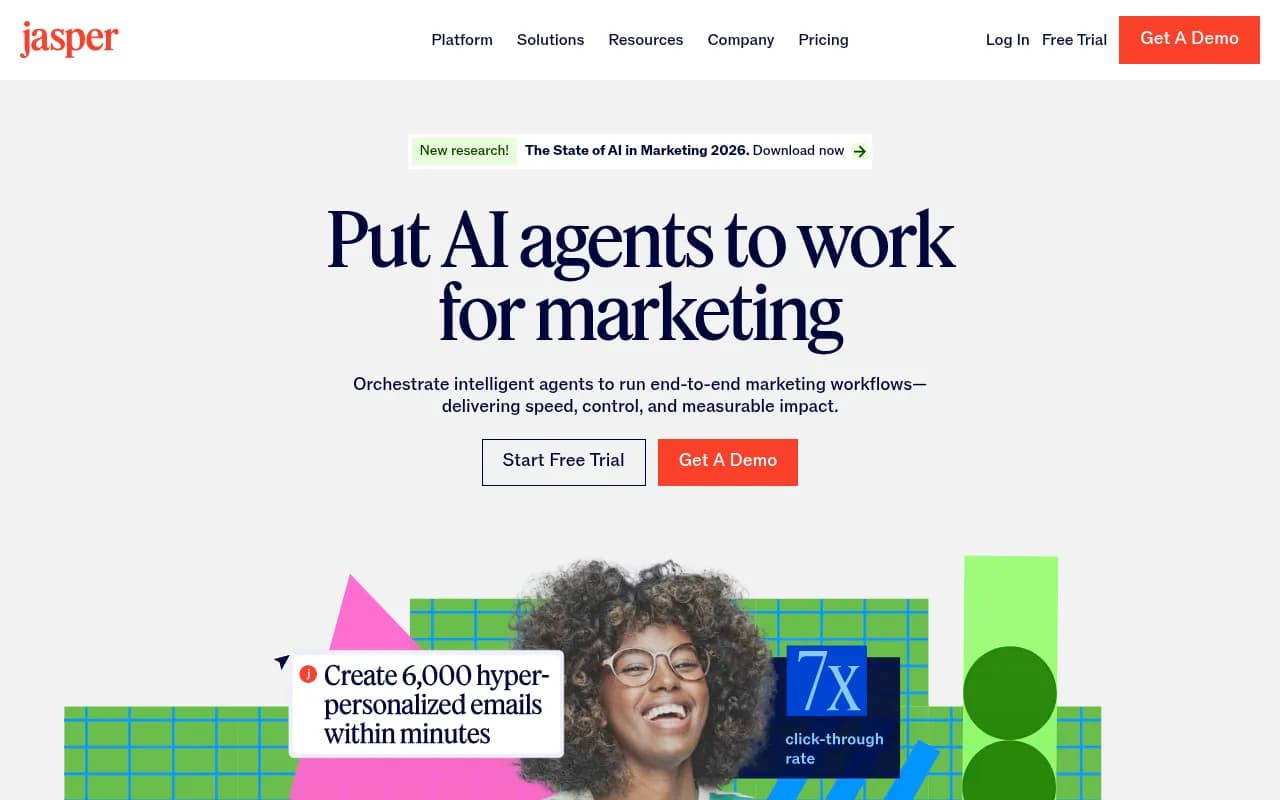
Jasper has positioned itself more explicitly as a marketing platform with brand guidelines, campaign management, and a stronger focus on content quality controls. It's generally considered better for teams that need consistent brand voice across a lot of content. Copy.ai has the edge on workflow automation and GTM-specific features. Pricing is comparable.
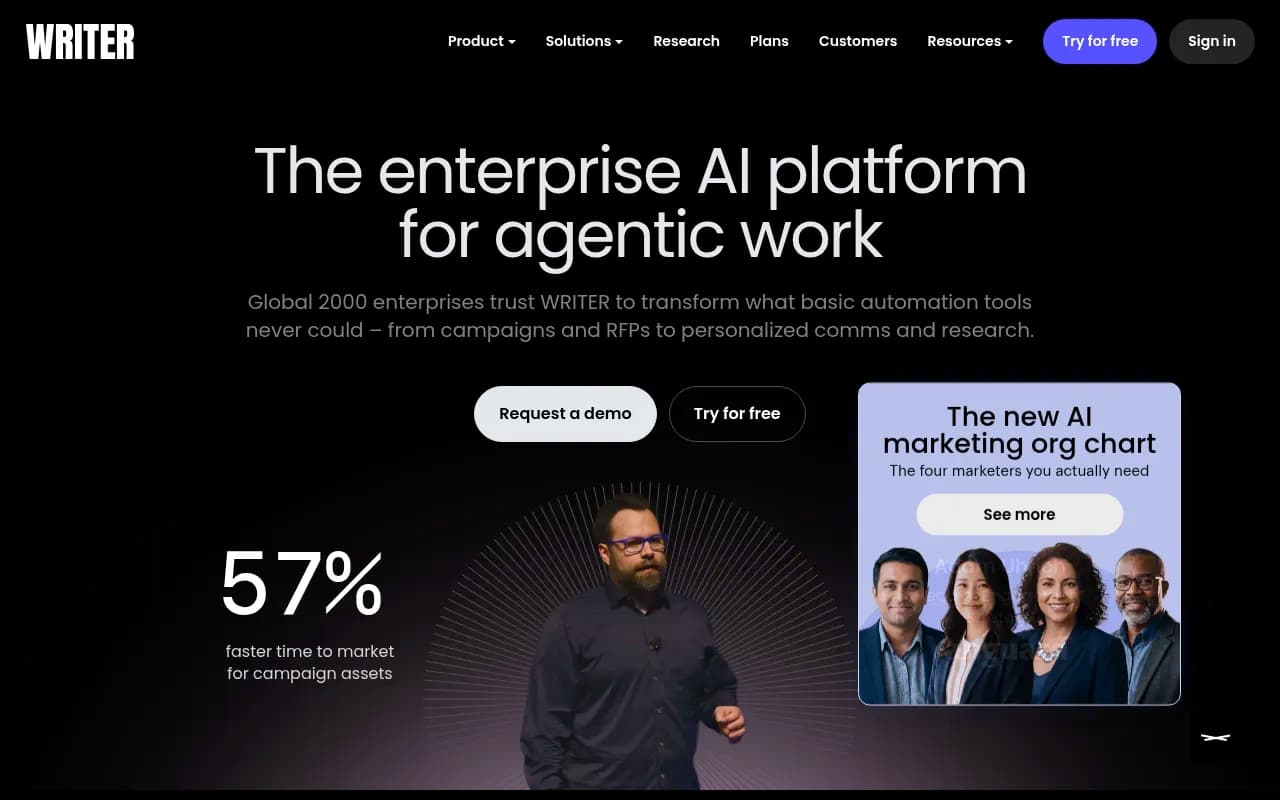
Copy.ai vs Writer
Writer is the enterprise play. It's built for large organizations that need strict brand compliance, fact-checking workflows, and deep integrations with existing tech stacks. If you're a 10-person marketing team, Writer is probably overkill. If you're a 500-person company with a legal review process for content, it makes more sense.
Copy.ai vs Writesonic
Writesonic has stayed closer to the content-generation roots and has invested in SEO features, including an AI article writer that pulls in search data. For teams that primarily want blog content with some SEO grounding, Writesonic is worth comparing directly.

Copy.ai vs ChatGPT / Claude
This is the question that comes up constantly on Reddit and in marketing forums. The honest answer: for many use cases, just using ChatGPT or Claude directly is cheaper and more flexible. Copy.ai's value is in the templates, the structured workflows, and the integrations -- if you need those, it's worth it. If you're just generating copy occasionally, a direct ChatGPT subscription is probably sufficient.
The AI search visibility gap -- and what actually fills it
Here's the thing that a lot of people searching for "Copy.ai alternatives" are actually trying to solve: they want to know how their brand appears in AI-generated answers. That's not a content generation problem. It's a monitoring and optimization problem.
The category that addresses this is called GEO (Generative Engine Optimization) or AEO (Answer Engine Optimization). These platforms track how AI models like ChatGPT, Perplexity, Claude, and Google AI Overviews respond to queries in your industry, identify where your competitors are getting cited, and help you create content that gets picked up by AI engines.
Copy.ai doesn't do any of this. It generates content, but it has no visibility into whether that content is being cited by AI models or whether your brand is appearing in AI search results.
Promptwatch is built specifically for this problem. It monitors 10 AI models -- ChatGPT, Perplexity, Claude, Gemini, Google AI Overviews, Grok, DeepSeek, Copilot, Meta AI, and Mistral -- and shows you exactly which prompts your competitors are visible for that you're not. The content generation side is also built around actual citation data (880M+ citations analyzed), so the articles it helps you create are grounded in what AI models actually want to cite, not just generic SEO filler.

The distinction matters: Copy.ai generates content. Promptwatch helps you understand the AI search landscape, find the gaps, create content engineered to get cited, and track whether it's working.
Other tools in this space worth knowing about:
Otterly.AI -- monitoring-focused, tracks brand mentions across ChatGPT, Perplexity, and AI Overviews. Good for basic visibility tracking but doesn't help you act on what you find.
Otterly.AI

AthenaHQ -- another monitoring platform with solid tracking features but limited optimization capabilities.

Profound -- strong enterprise feature set, good platform coverage, higher price point.
Profound

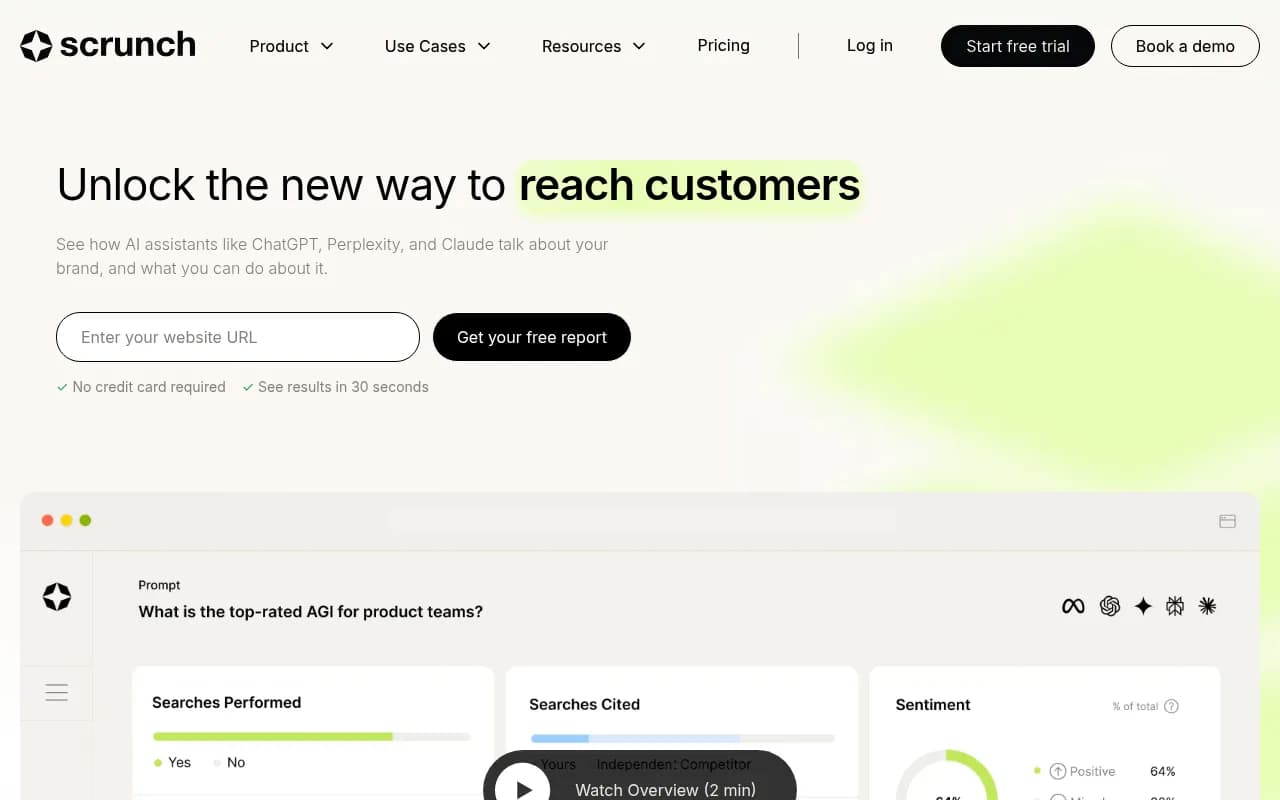
Scrunch AI -- AI search visibility tracking with some optimization features.
Full comparison: content generation vs AI visibility tools
| Tool | Category | Content generation | AI search tracking | SEO features | Best for |
|---|---|---|---|---|---|
| Copy.ai | GTM/content | Yes | No | Basic | Sales copy, GTM automation |
| Jasper | Content/marketing | Yes | No | Limited | Brand-consistent content |
| Writer | Enterprise content | Yes | No | Limited | Large org compliance |
| Writesonic | Content/SEO | Yes | No | Moderate | Blog content with SEO |
| Promptwatch | GEO/AEO platform | Yes (AI-grounded) | Yes (10 models) | Yes (gap analysis) | AI search visibility + optimization |
| Otterly.AI | GEO monitoring | No | Yes | No | Basic AI brand tracking |
| Profound | GEO enterprise | No | Yes | Limited | Enterprise AI monitoring |
| Semrush | Traditional SEO | Limited | Partial | Comprehensive | Traditional search + some AI |
Who should use Copy.ai in 2026
Copy.ai makes sense if:
- You're generating high volumes of short-form marketing copy (ads, emails, social posts)
- Your team does repetitive GTM tasks that could be automated (research + personalized outreach)
- You want a no-code workflow builder for content operations
- You don't need deep SEO integration or AI search visibility
It's probably not the right fit if:
- Your primary goal is long-form SEO content
- You need factual accuracy without heavy editing
- You want to understand or improve how your brand appears in AI search results
- You're comparing it to just using ChatGPT or Claude directly (the ROI case gets harder)
Final verdict
Copy.ai is a legitimate tool that does what it says -- generates marketing copy and automates GTM workflows. The short-form content quality is good. The workflow automation is genuinely useful for the right teams. The pricing is reasonable for what you get at the mid-tier.
But the "GTM AI platform" positioning has created some confusion about what Copy.ai actually is. It's not an SEO platform. It's not an AI search visibility tool. And in 2026, those distinctions matter more than ever, because AI search is eating into traditional organic traffic in ways that require a different category of tool entirely.
If you need content generation, Copy.ai is worth evaluating alongside Jasper and Writesonic. If you need to understand and improve how your brand appears in ChatGPT, Perplexity, and Google AI Overviews, you need a GEO platform -- and Copy.ai isn't one.