Summary
- Most GEO platforms report "prompt volume" metrics, but many are extrapolating from traditional keyword data rather than measuring actual AI search demand
- Real prompt volume validation requires direct measurement from AI engines, not statistical modeling from Google search volume
- The core problem: AI prompts are conversational and 80%+ unique, making traditional keyword-based estimation methods fundamentally unreliable
- Platforms like Promptwatch track actual citation data (880M+ citations analyzed) and crawler logs to validate real AI search behavior
- Look for platforms that show crawler activity, citation patterns, and actual AI traffic attribution -- not just estimated volumes based on Google data

The uncomfortable truth about prompt volume
Here's what nobody in the GEO space wants to admit: most "prompt volume" metrics you see in dashboards are not measurements. They're extrapolations stacked on top of guesswork.

The problem starts with how AI search differs from traditional search. When someone searches Google, they type "best CRM small business." When they ask ChatGPT, they say "What's the best CRM for a 10-person sales team that doesn't want to deal with Salesforce?" Same intent. Completely different phrasing. And that conversational, long-form nature breaks every assumption that keyword volume tools were built on.
Over 80% of AI prompts are phrased differently from Google search queries on the same topic. That means if you're using a platform that takes Google keyword volume and tries to map it to AI prompts, you're working with data that's fundamentally disconnected from reality.
How most platforms fake it
The majority of GEO platforms in 2026 use one of three approaches to generate "prompt volume" numbers:
Statistical modeling from keyword data
They take traditional keyword search volume from Google, apply some multiplier or transformation, and present it as "AI prompt volume." The logic goes: if "best project management software" gets 10,000 searches per month on Google, maybe it gets 2,000-5,000 prompts per month in ChatGPT.
The problem is that this assumes people ask AI engines the same questions they type into Google. They don't. Research shows the phrasing, intent, and context are fundamentally different.
Synthetic prompt generation
Some platforms generate variations of a base prompt using AI, then estimate volume based on how many variations they can create. If they can generate 50 different ways to ask about project management software, they might estimate total volume by multiplying some baseline number.
This is pure speculation. Just because you can generate 50 variations doesn't mean people are actually asking those 50 questions.
Panel-based extrapolation
A few platforms claim to use panel data -- tracking what a sample of users ask AI engines, then extrapolating to the broader population. This sounds more legitimate, but the sample sizes are typically tiny (a few thousand users at most) and the extrapolation assumptions are massive.
Panel data also can't tell you what prompts are being asked about your specific industry, competitors, or use cases unless those exact prompts happen to appear in the panel. The odds of that are low.
What real validation looks like
If you want to know whether a GEO platform is showing you real demand or guesswork, ask these questions:
Does it track actual AI crawler activity?
AI engines like ChatGPT, Claude, and Perplexity send crawlers to websites to gather information for their responses. If a platform can show you real-time logs of which pages these crawlers are hitting, how often they return, and what errors they encounter, that's a signal they're measuring actual AI behavior.
Promptwatch provides AI crawler logs that show exactly when GPTBot, ClaudeBot, PerplexityBot, and other AI crawlers visit your site. This is direct evidence of AI engines discovering and indexing your content.
Does it show citation patterns from real AI responses?
When AI engines answer a prompt, they cite sources. A platform that tracks which domains, pages, and content types are being cited across millions of AI responses is measuring real behavior, not estimating it.
Platforms that analyze citation data can tell you which competitors are being cited for specific topics, which content formats perform best, and which pages on your site are actually being referenced by AI models. This is validation that the prompts being tracked are real and the responses are being generated.
Can it tie AI visibility to actual traffic?
The ultimate validation is attribution. If a platform can show you that increased AI visibility leads to measurable traffic from AI referrers, that's proof the prompts being tracked are real and driving actual user behavior.
Look for platforms that offer traffic attribution through code snippets, Google Search Console integration, or server log analysis. If they can't connect visibility to traffic, they're probably not measuring real demand.
Does it show prompt difficulty and competition?
Real prompt volume data should come with context about how hard it is to rank for that prompt. If a platform shows you that a prompt has high volume but doesn't tell you that 50 competitors are already dominating the AI responses, the volume number is useless.
Prompt difficulty scoring requires analyzing actual AI responses to see who's being cited, how often, and in what contexts. Platforms that provide this are doing real measurement work.
The platforms that get it right
| Platform | Real crawler logs | Citation analysis | Traffic attribution | Prompt difficulty |
|---|---|---|---|---|
| Promptwatch | Yes | Yes (880M+ citations) | Yes | Yes |
| Profound | No | Limited | No | No |
| Otterly.AI | No | Limited | No | No |
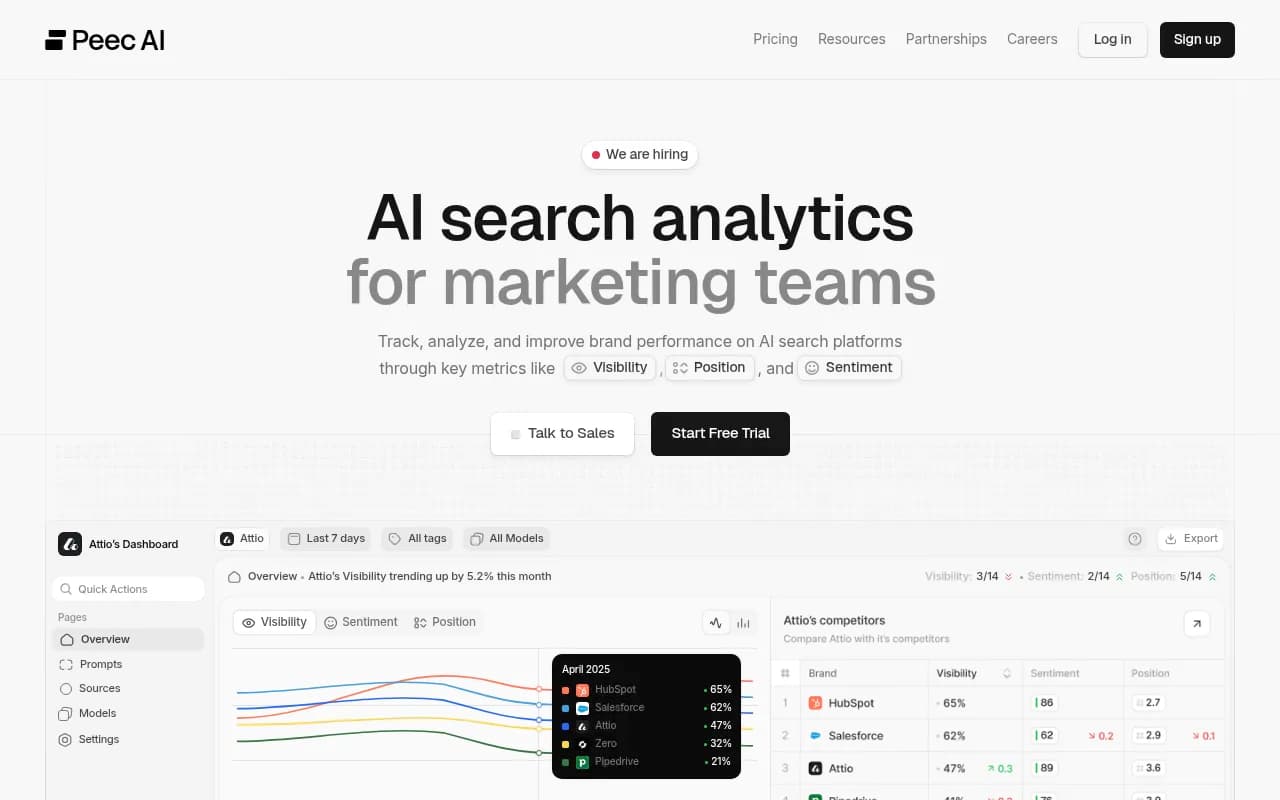
| Peec.ai | No | Basic | No | No |
| AthenaHQ | No | Basic | No | No |
Promptwatch stands out because it's built around the action loop: find the gaps in your AI visibility using real citation data, generate content that's engineered to get cited based on what AI models actually want, then track the results with page-level visibility scores and traffic attribution. Most competitors stop at monitoring and leave you stuck with data but no way to fix it.
Profound

Otterly.AI


Why this matters more than you think
The prompt volume validation problem isn't just an academic issue. It has real consequences for how you allocate resources.
If you're optimizing for prompts that don't actually have meaningful search demand, you're wasting time creating content that won't drive traffic or citations. If you're ignoring prompts that do have demand because your platform doesn't surface them, you're leaving opportunities on the table.
The platforms that rely on extrapolation and guesswork can't help you prioritize. They might show you 500 prompts with estimated volumes, but they can't tell you which 50 are worth your time because they don't know which ones are real.
Platforms that measure actual AI behavior -- through crawler logs, citation analysis, and traffic attribution -- can show you exactly where the demand is and where you're missing it. That's the difference between strategic optimization and throwing darts in the dark.
How to audit your current platform
If you're already using a GEO platform, here's how to figure out whether it's showing you real data or guesswork:
Ask for the methodology
Literally ask your platform: "How do you calculate prompt volume?" If they say anything about keyword data, statistical modeling, or synthetic generation, you're working with estimates.
If they say they're analyzing actual AI responses, tracking crawler behavior, or measuring citation patterns, ask for proof. Can they show you the raw data? Can they explain how they validate their numbers?
Check for crawler log access
Log into your platform and look for a section on AI crawler activity. If it doesn't exist, the platform isn't measuring real AI behavior. If it does exist, check whether the data is real-time or delayed, whether it shows errors and response codes, and whether it covers all major AI engines.
Look for citation source analysis
Find a prompt in your dashboard and drill down into the details. Does the platform show you which specific pages, domains, and content types are being cited in AI responses? If not, it's not doing real citation analysis.
Test the traffic attribution
If your platform claims to show AI traffic, cross-reference it with your own analytics. Do the numbers match? Can you see AI referrers in your server logs or Google Analytics? If the platform's numbers don't align with your own data, something's wrong.
The future of prompt volume measurement
The good news is that prompt volume measurement is getting better. As more AI engines expose APIs, provide crawler logs, and share usage data, platforms will have more direct signals to work with.
The bad news is that most platforms aren't investing in this. They're still relying on the same keyword-based estimation methods they've always used, just rebranded for the AI era.
The platforms that will win are the ones that treat AI search as a fundamentally different channel and build measurement systems from the ground up. That means tracking crawler behavior, analyzing citation patterns, measuring actual traffic, and connecting visibility to revenue.
If your platform can't do those things, you're not measuring AI search demand. You're guessing. And in 2026, guessing isn't good enough.
What to do next
If you're serious about AI search visibility, start by validating your current measurement approach. Ask the hard questions about where your prompt volume data comes from. Demand proof that the numbers are real.
If your platform can't provide that proof, consider switching to one that can. Promptwatch is the only platform rated as a "Leader" across all GEO categories in 2026 because it's built around real measurement -- crawler logs, citation analysis, and traffic attribution -- not guesswork.
The prompt volume validation problem is solvable. But it requires platforms that are willing to do the hard work of measuring actual AI behavior instead of extrapolating from traditional keyword data. Choose wisely.