Key takeaways
- Start with 20 to 50 buyer-intent prompts, not a keyword list. Prioritize prompts you can realistically win, not the ones dominated by category giants.
- Track four things in month one: mention rate, citations (which of your pages and which third-party pages get cited), sentiment/accuracy, and AI-referred traffic.
- A first baseline under 1% visibility is normal for a startup. The trend line matters more than the number.
- Check crawler access in week one. If AI bots cannot read your site, no content work will help.
- Free tools (a spreadsheet, Search Console, GA4) are enough to start. Move to a platform when manual runs stop scaling.
Why startups should start tracking now
Traditional SEO gave you a dashboard. You logged into Search Console and saw rankings, impressions, and clicks. AI search gives you nothing comparable by default. ChatGPT, Gemini, Perplexity, Copilot, and Google AI Overviews write answers that name a handful of brands, and nobody tells you whether yours is one of them.
That is an advantage for a startup, honestly. Established competitors have the same blind spot, and the baseline you build in month one will be more than most of them have. As one Omnia piece puts it, if your monitoring process is screenshots and vibes, you are hoping, not monitoring.
AI visibility is also not a rank you can check. The same prompt asked twice, minutes apart, can return different brands. Omnia's example: ask "best CRM for startups" and a major vendor is top pick in one chat, and not even in the top two in the next. So you track rates and trends across many prompts, not a position for one.

What to track: the short list
You cannot track everything on day one. Frase's tracking guide says the same: pick a strategy first, set a baseline, then expand. For a startup, this is the list I would commit to.
| Metric | What it tells you | Typical month-one reading |
|---|---|---|
| Mention rate (visibility) | % of tracked responses that name your brand | Often under 1% for a new brand |
| Share of voice | Your slice of all brand mentions vs competitors | Small, but shows who you are chasing |
| Position | Where you land in the list of brands in an answer | Only meaningful once you have mentions |
| Citations | Which URLs the engine used, yours or third-party | Your own domain cited rarely at first |
| Sentiment and accuracy | How AI describes you, and whether it is right | Wrong or empty descriptions are common |
| AI crawler activity | Whether AI bots can read your pages | Binary: reading or blocked |
| AI-referred traffic | Visits and conversions from AI engines | Small but usually high intent |
Read them together. Low share of voice is a coverage problem. Mentions without citations to your domain point at content or crawlability. Weak sentiment is a reputation problem. Different problems, different fixes.
Week 1: foundation
Days 1 to 3: build the prompt set
Everything else rests on the prompt list, so spend real time here. Start from customer language, not keywords. Good sources:
- Your sales call notes, support inbox, and demo request forms
- Google Search Console queries filtered for question words (why, what, how, which, should, can)
- People Also Ask and Perplexity's related questions after you ask about your category
- ChatGPT follow-up suggestions, turned into prompts ("best CRM for startups on a low budget")
- Reddit threads in your category
- Your own team: ask sales and customer success what customers actually ask
Aim for 20 to 50 prompts across three buckets, following the funnel structure HubSpot's AEO guide uses:
| Stage | Example prompt | Priority |
|---|---|---|
| Awareness | "Why do growing startups lose customers in the first 90 days?" | Lower |
| Consideration | "Independent CRM vs all-in-one platform for a 30-person team" | High |
| Decision | "Which CRM should a fintech startup use after a Series A?" | Highest |
Add a few about-you prompts ("What do you know about [your company]?") to check accuracy. And be honest about what you can win. You will not displace the category giants on "best CRM", but you can compete on specific segments, use cases, and comparisons.
Tag each prompt as organic (no brand named), brand-specific, or competitor comparison. This matters because the engines behave differently. In Promptwatch Data's ChatGPT unique-domains report (Sep 28 to Oct 4, 2026), 52.5% of organic prompt responses cited 10 or more domains, while the most common count for brand-specific prompts was 5 domains. Compare like with like.
Days 3 to 5: pick engines, countries, and competitors
Minimum engine set: Google AI Overviews, ChatGPT, and Perplexity. Add Gemini and Copilot if your buyers use them. Pick the countries and languages you sell in, since answers vary by location.
Name five or so competitors, including the ones AI mentions that you did not expect. Engines also cite differently. Promptwatch Data's sources-per-response report (dated Sep 2025, figures drift) found ChatGPT cites about 5 sources per web-search answer, while AI Overviews and Perplexity cite about 10. That report suggests Perplexity as a test bench, because its steady citation count means a change in your citations is more likely your content than engine noise. Measure AI Overviews separately instead of assuming one engine predicts another.
Days 5 to 7: check crawler access
Before any content work, confirm AI bots can read your site. Review robots.txt, CDN, and WAF rules for each provider. Promptwatch Data's AI crawler traffic report (IP-verified requests, June 8 to Sep 6, 2026) showed OpenAI at 79.8% of verified requests in the week of Aug 31 to Sep 6, down from 94.8% in mid-June. Its advice: compare your own logs against that mix. A provider that is large in the report but near zero in your logs suggests you are blocked.
Free helpers: the Agentic Readiness Check and Robots.txt generator for AI show which crawlers you allow. The AI bots directory lists 400+ crawlers.
Week 2: run the baseline
Manual method (free)
Run every prompt on every engine, same wording, in a logged-out window or temporary chat so personalization does not flatter you. Record for each answer: were you named, first or later, was the description accurate, was your site linked, who else was named, and which sources were cited. A spreadsheet works. Block 30 to 45 minutes on the same day each month, and keep the questions identical for at least three months so months compare fairly.
The weakness is variance. One run tells you little, so run each prompt several times if you can, and treat the result as a rate.
Automated method
When the prompt list passes a few dozen, manual runs stop being realistic. Automated tools run prompts daily and compute the rates for you. A fresh setup often shows brand visibility under 1% according to HubSpot's AEO walkthrough, which is normal. The goal is steady improvement, not 100%.
Platforms worth a look, depending on your needs:
Promptwatch covers monitoring, crawler logs, visitor analytics, and content creation in one loop. Its Essential plan is $95/mo for 50 prompts and daily tracking, and there is a 7-day free trial plus a free AI visibility report for a quick first scan. Confirm current pricing at promptwatch.com/pricing.
Profound
Profound is an enterprise platform with strong monitoring, query fanouts, and competitor comparison, typically at a higher price point.
Otterly.AI

Otterly.AI is a lighter prompt tracker for brand mentions across ChatGPT, Perplexity, and AI Overviews.
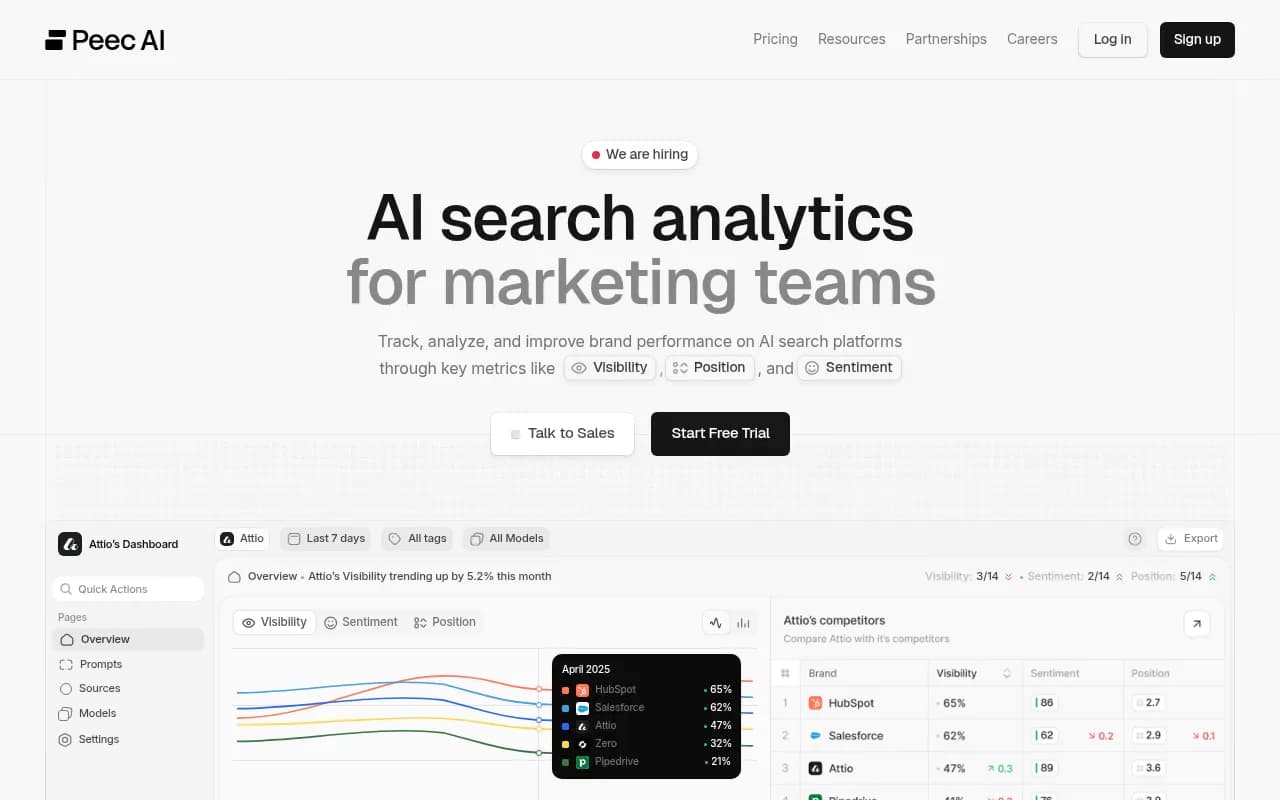
Peec AI is another monitoring-focused option for marketing teams.
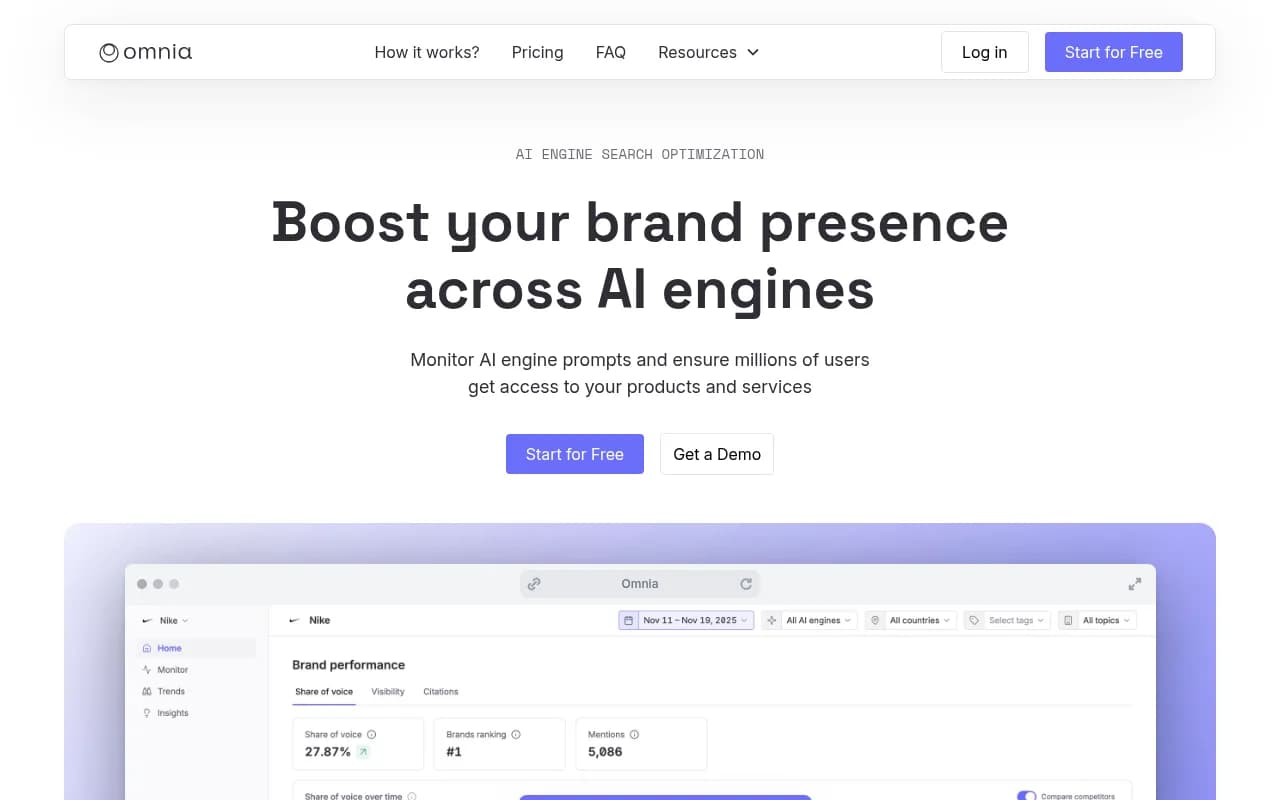
Omnia pairs monitoring with an execution backlog approach.
For a wider shortlist, the GEO software directory at bestgeosoftware.com compares more options.
| Approach | Cost | Best for | Limit |
|---|---|---|---|
| Spreadsheet + manual runs | Free | Under 20 prompts, first baseline | Noisy, time-consuming |
| Monitoring-only tracker | Low to mid | Mention rate and share of voice | You still do the fixing |
| End-to-end platform | Mid to high | Tracking plus crawler logs, traffic, content | More to learn |
Week 3: read the results
Find the pattern, not the number
Sort results by prompt type and engine. You will probably see that you are strong in one engine and invisible in another, which tells you where your audience and sources sit. Then look at citations, because they are where the work comes from:
- If a competitor is named and you are not, open the pages the AI cited. Often the cited page is a comparison, a review, or a docs page you do not have.
- If the same outside sites keep appearing (a review site, a listicle, a directory), that is where to earn a mention. Promptwatch Data recommends planning on sharing every answer and earning mentions on third-party sites such as reviews, listicles, and forums.
- If AI describes you wrong, fix the source. Contradicting facts across your site, a directory, and a profile (founding year, pricing, product names) make engines trust all of them less.
Content type matters too. In Promptwatch Data's content-type report (Sep 28 to Oct 4, 2026), product pages were the most cited type in ChatGPT at 22.4% of citations, followed by landing pages and listicles. For software prompts, GitHub, Microsoft docs, and G2 led, with documentation and help centers earning the largest share. If you sell software, your docs are marketing assets.
Also check the lifespan of what you publish. Promptwatch's content half-life data found landing pages and docs stayed cited longest, while news lost half its pages within 36 days. Startups with thin budgets should favor durable pages over news-style posts.
Sentiment and narrative
Visibility without good sentiment is not a win. Note the adjectives AI uses for you and your competitors ("affordable", "limited integrations"). Those claims come from sources, so each one points at a page to fix or a review to earn.
Week 4: connect visibility to traffic and decide what to ship
Measure AI-referred traffic
Set up a custom channel group in GA4 for AI referrers. It takes about 20 minutes and gives you a baseline for free, as Dataslayer's guide recommends. One caveat for 2026: ChatGPT stopped sending a referrer on October 8, 2026, so tag links with utm_source=chatgpt.com where you control them and expect some AI traffic to land in direct. Add "How did you hear about us?" as an open text field on demo forms, and ask sales whether prospects researched with AI tools. This catches influence analytics never sees. Promptwatch's guide to attributing AI traffic covers the approach in more depth.
Tools you probably already have help here:
Search Console shows which of your pages earn impressions but few clicks, good candidates for AI-friendly rewrites with clearer headings, summary bullets, and quotable statements.
Turn findings into a backlog
End the month with a short, ranked list:
- Fix factual errors and inconsistent facts across sources.
- Fix crawler blocks.
- Publish pages for prompts where competitors are named and you are not (comparison pages, pricing explainers, use-case pages).
- Update existing pages that already get cited or visited.
- Pitch or earn mentions on the third-party sites AI keeps citing.
This is where a monitoring-only tool and a platform differ. Promptwatch, for example, ties the loop together: content gap analysis, an Action Board of prioritized tasks, a Content Agent that writes and publishes, and crawler logs plus visitor analytics to check whether each new page gets read, cited, and clicked. Teams like Crisp reported 2x higher conversion from AI traffic. If you only need to count mentions, cheaper trackers are fine. If you need to act on them with a small team, the end-to-end option saves time.
Want a longer runway after month one? The 90-day GEO program is a natural next step.
A 30-day checklist
| Days | Task | Output |
|---|---|---|
| 1-3 | Build 20-50 prompts from customer language | Tagged prompt list |
| 3-5 | Choose engines, countries, competitors | Tracking scope |
| 5-7 | Audit robots.txt, CDN, WAF for AI bots | Crawler access confirmed |
| 8-14 | Run baseline across engines | Mention rate, citations, sentiment |
| 15-21 | Analyze citations and competitor gaps | Ranked gap list |
| 22-25 | Set up GA4 AI channel and form attribution | Traffic baseline |
| 26-30 | Ship first fixes, set month-two targets | Backlog and goals |
Set targets that are modest and specific, like the ones Frase suggests: a baseline citation rate to improve from, a competitive share-of-voice target, and a topic coverage goal such as being cited for most core topic queries.
Common mistakes
- Tracking brand-name prompts only. They flatter you and tell you nothing about discovery.
- Reading one run as truth. Rates over many runs, trends over months.
- Changing the prompt list every week, which destroys comparability.
- Skipping crawler checks, then wondering why content never gets cited.
- Treating tracking as the goal. If a month's data does not change what you publish or fix, it was a report, not a system.
Where to go from here
Month one gives you three things: a prompt set, a baseline, and a ranked to-do list. Month two is execution and re-measuring against the same prompts. If you want to compare more trackers before committing, the AI rank tracking directory at ai-rank-tools.com is a good place to start. Keep the first month cheap, keep the questions fixed, and write down what you change so you can tell, three months from now, which change actually moved the numbers.