Key takeaways
- Peec AI tracks brand visibility in AI search engines but lacks content generation, crawler logs, and actionable optimization features that growing businesses need.
- Most small businesses hit Peec AI's limits quickly — either on price, engine coverage, or the inability to act on what they find.
- The best alternatives in 2026 go beyond monitoring: they help you find content gaps, generate AI-optimized content, and track real traffic from AI engines.
- Budget-friendly options like LLM Pulse and LLMrefs start free or under $80/month, while platforms like Promptwatch offer a full optimization loop at $99/month.
- The right choice depends on whether you need pure monitoring, content creation, agency reporting, or a complete end-to-end GEO workflow.
Peec AI got a lot of attention in 2025, and for good reason. It was one of the first tools to make AI search visibility tangible for marketers who were used to traditional rank tracking. You could see how often your brand showed up in ChatGPT, Perplexity, and Google AI Overviews, and compare that against competitors. For many teams, it was their first real look at generative engine optimization (GEO).
But a year or so in, a pattern started emerging in SEO communities on Reddit and Slack: teams were hitting walls. The cost scaled awkwardly for large prompt sets. Some industries found the data unreliable. And the biggest frustration? Peec AI would show you where you were invisible, but not tell you what to do about it.
For small businesses especially, that's a problem. You don't have a dedicated GEO analyst to interpret the data and spin up a content strategy. You need a tool that does more of the heavy lifting.
This guide covers five alternatives that are worth your time and money in 2026, with honest notes on what each one does well and where it falls short.

Why small businesses outgrow Peec AI
Before jumping to alternatives, it's worth being specific about what's actually missing. The issues that come up most often:
- Monitoring without action. Peec AI shows you visibility scores, but there's no built-in way to fix gaps. You get the "what," not the "how."
- Limited engine coverage on lower tiers. Tracking ChatGPT and Perplexity is table stakes now. Businesses also want Claude, Gemini, Grok, DeepSeek, and Google AI Mode.
- No content generation. You can't create AI-optimized articles or briefs from inside the platform.
- No crawler logs. You can't see whether AI bots are actually crawling your site or hitting errors.
- Pricing pressure. For small teams tracking dozens of prompts across multiple competitors, the cost adds up fast.
If you're hitting any of these walls, one of the tools below is probably a better fit.
The 5 best Peec AI alternatives for small businesses in 2026
1. Promptwatch — best for end-to-end AI visibility optimization
Most AI visibility tools stop at monitoring. Promptwatch is built around a different idea: find the gap, fix it, track the result. That loop matters a lot for small businesses that don't have time to manually translate data into action.
The Answer Gap Analysis is the standout feature here. It shows you exactly which prompts your competitors are appearing for that you're not — and more importantly, it identifies the specific content your site is missing that would make AI models cite you. From there, the built-in AI writing agent generates articles, listicles, and comparisons grounded in real citation data (880M+ citations analyzed), not generic SEO filler.
Other things worth knowing: Promptwatch logs AI crawler activity in real time, so you can see which pages ChatGPT, Claude, and Perplexity are actually reading and where they're hitting errors. It also tracks Reddit and YouTube discussions that influence AI recommendations, which most tools completely ignore. And it covers 10 AI models including Google AI Mode, Grok, DeepSeek, and Mistral.
Pricing starts at $99/month for one site with 50 prompts and 5 articles per month. There's a free trial, and annual billing brings the cost down further.

The main trade-off: if you genuinely only need basic monitoring and have no interest in content optimization, Promptwatch may be more than you need. But for most small businesses trying to actually grow their AI visibility, the action loop is the whole point.
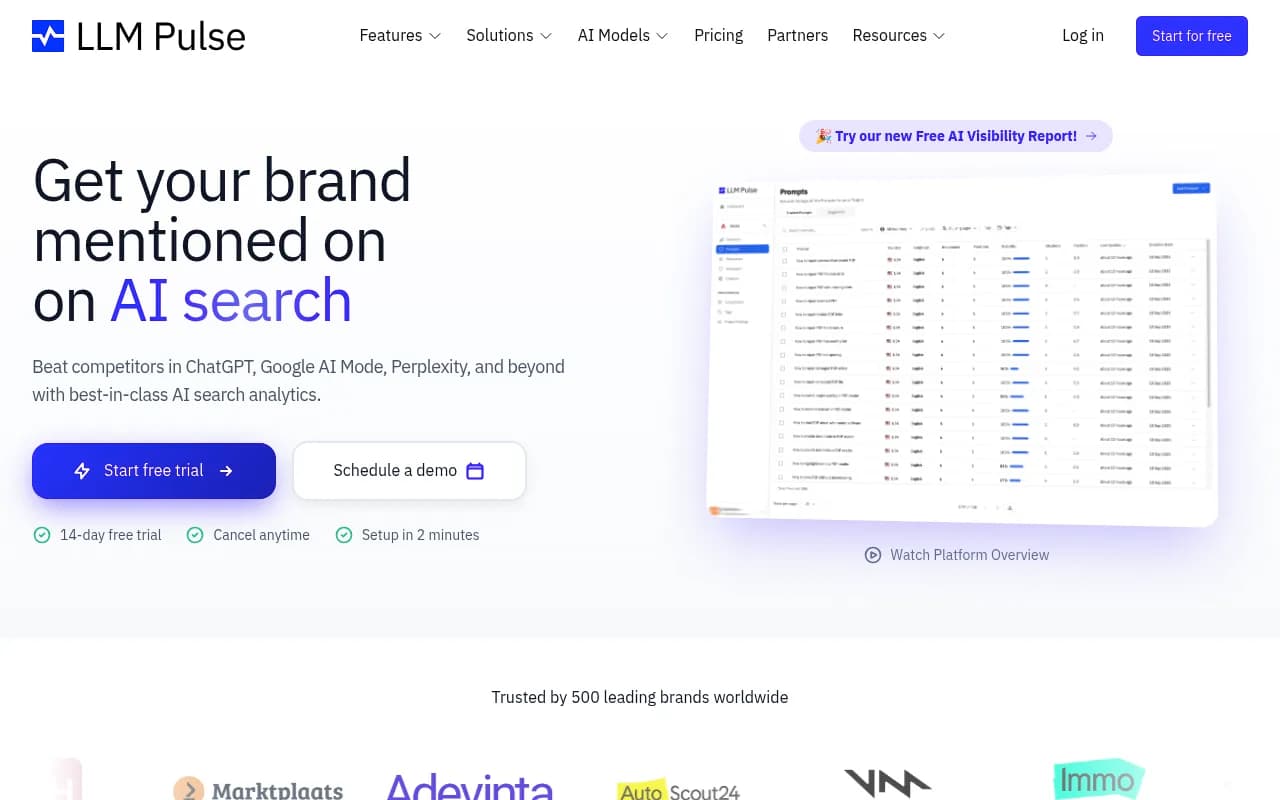
2. LLM Pulse — best for budget-conscious teams starting out
If you're just getting started with AI visibility tracking and want to keep costs low, LLM Pulse is worth a serious look. It tracks brand mentions, citations, and share of voice across ChatGPT, Gemini, and Google AI Mode, with a free tier and a paid plan that stays budget-friendly.
The feature set is more limited than Promptwatch or Profound, but for a small business that just wants to know "is our brand showing up in AI answers?" it covers the basics well. You get multi-model coverage, prompt discovery, and citation analysis. There's also API and BI connector support, which is useful if you want to pull the data into your own reporting.
What it lacks: no content generation, no crawler logs, no traffic attribution. It's a monitoring tool, not an optimization platform. But at its price point, that's an honest trade-off.
3. LLMrefs — best for solo operators and lean teams
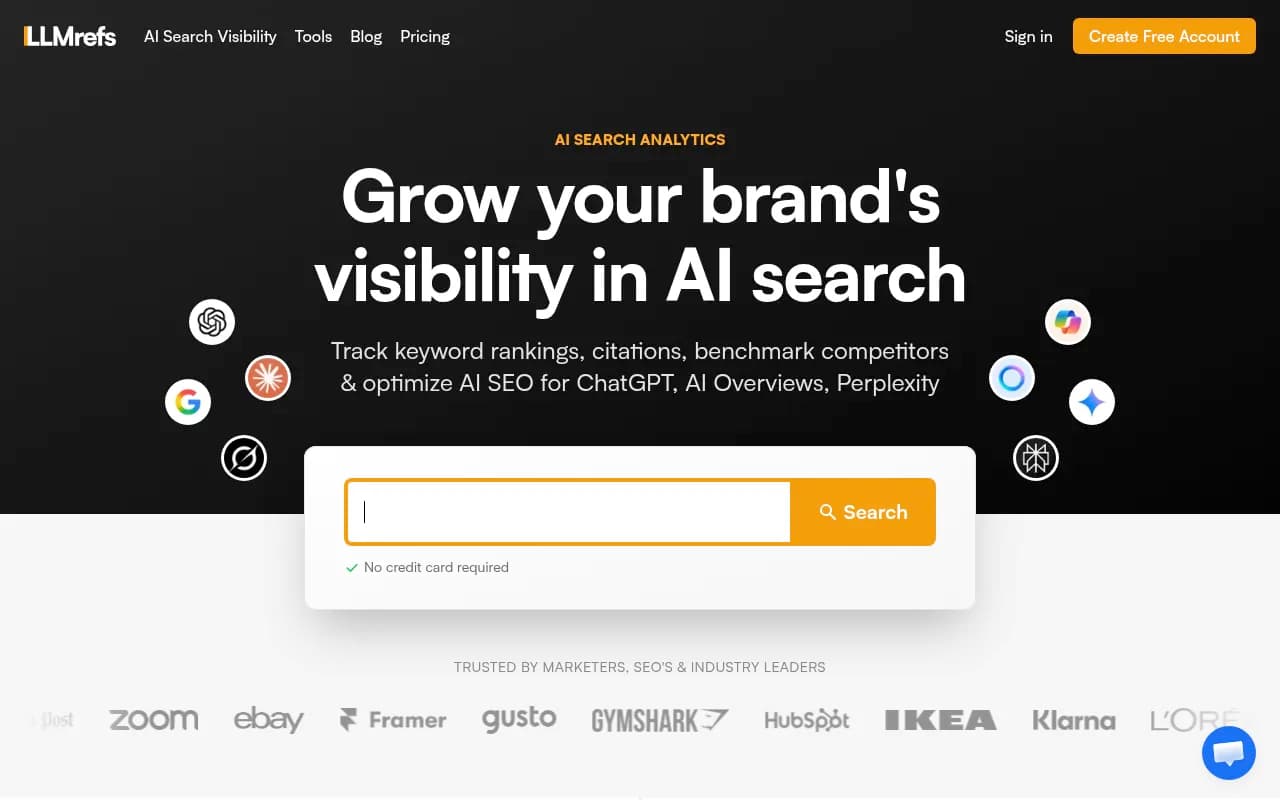
LLMrefs is probably the most accessible entry point in this space. There's a free plan, and the paid Pro tier is around $79/month. For a solo founder or a one-person marketing team, that's a meaningful difference.
The platform tracks your brand across ChatGPT, Claude, Gemini, Perplexity, and Copilot, with weekly trend views and lightweight visibility scoring. Setup is simple, and you don't need to be a technical SEO expert to get value from it quickly.
The honest caveat: LLMrefs is intentionally lightweight. You won't get deep competitor analysis, content gap identification, or anything resembling an optimization workflow. It's a starting point, not a full GEO stack. But if you're a small business that just wants a simple, affordable way to track whether AI models mention you, it does that job well.
LLMrefs
4. Omnia — best for competitive benchmarking and share of voice
Omnia takes a different angle than most tools in this space. Rather than focusing purely on whether you're cited, it's built around share of voice analytics — how your brand's AI presence compares to competitors across different topics and engines.
For small businesses in competitive markets (e-commerce, SaaS, local services), that framing is actually more useful than raw visibility scores. You want to know not just "do I appear?" but "am I appearing more or less than my main competitors, and for which topics?"
Omnia also offers automated insights and content workflow integration, which gives it more actionability than pure monitoring tools. There's a free tier and a free trial, which makes it easy to test before committing.
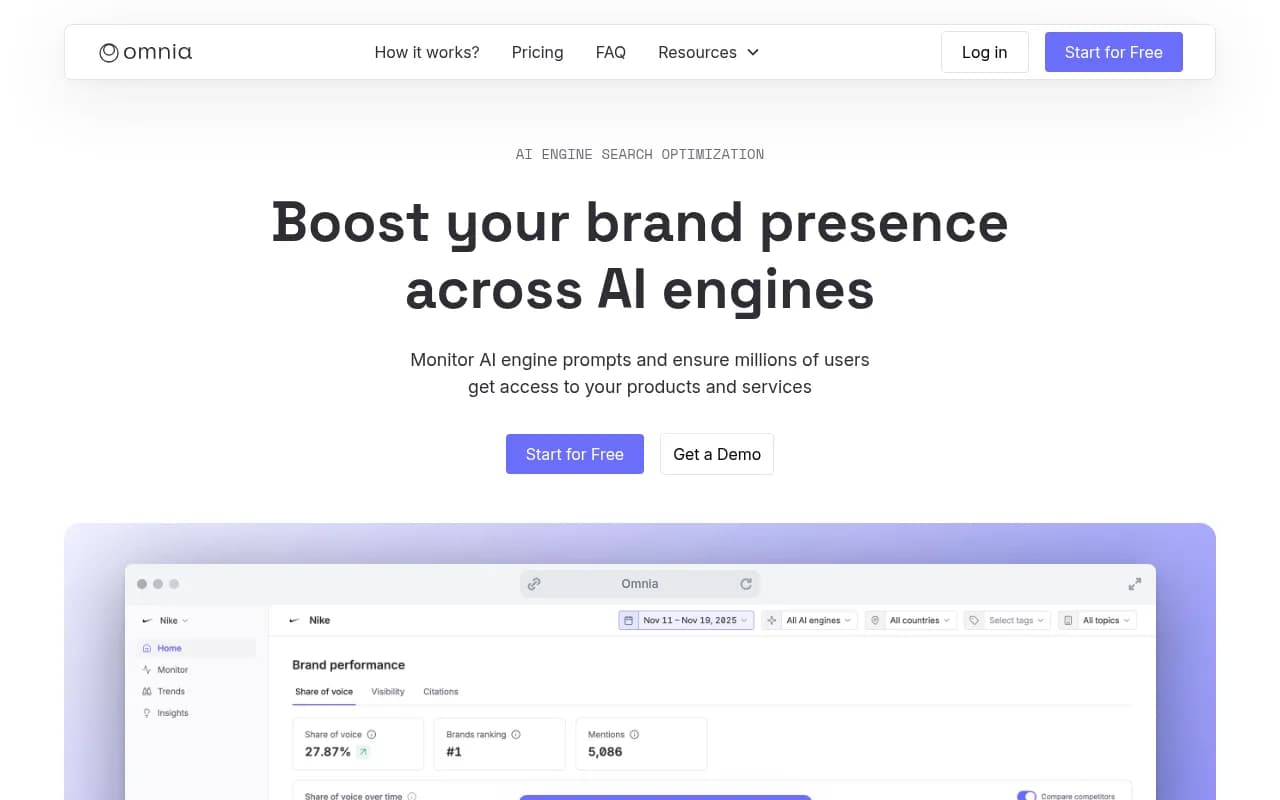
The limitation: Omnia doesn't have the depth of content generation or crawler log features that Promptwatch has. It's a strong monitoring and benchmarking tool, but if you need to act on what you find, you'll likely need to pair it with a content workflow outside the platform.
5. Scrunch AI — best for brands that want AI-readiness alongside monitoring
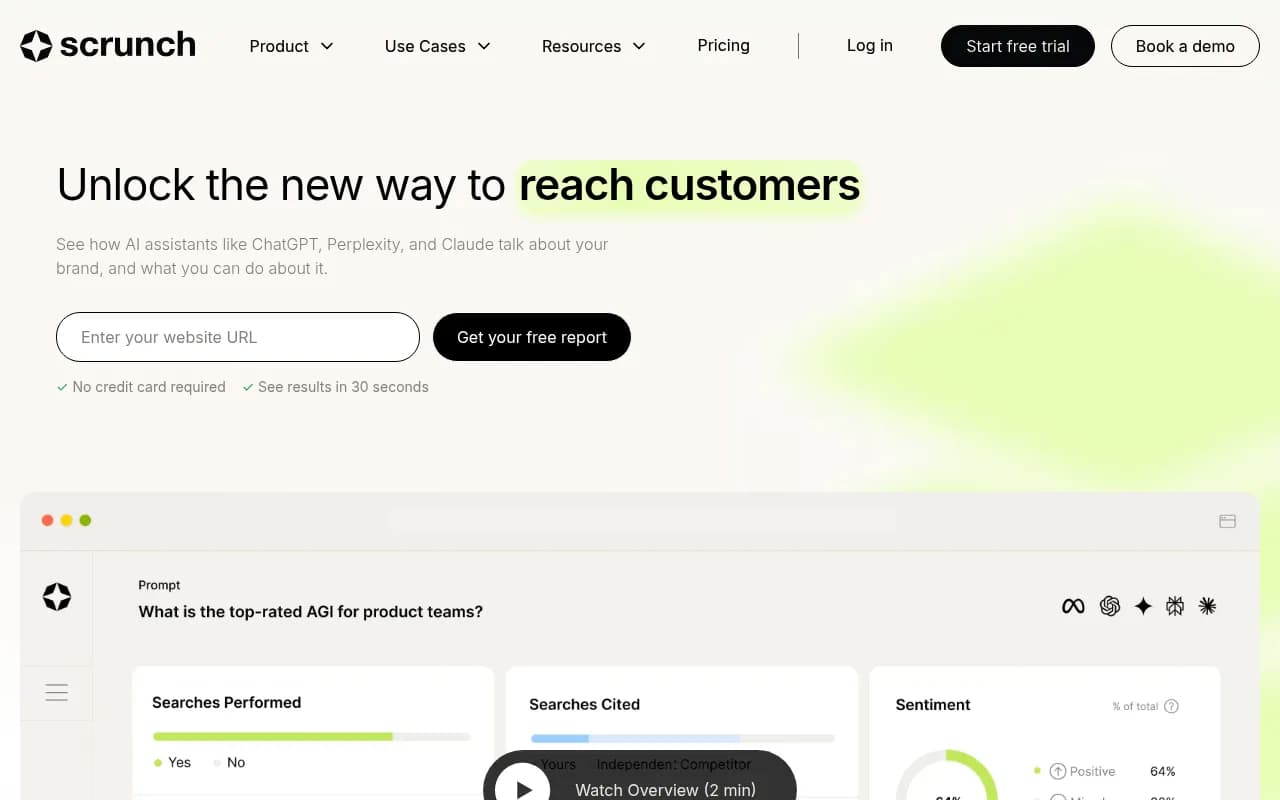
Scrunch AI sits at a higher price point ($300/month for the starter tier), which puts it at the edge of "affordable" for small businesses. But it earns its place on this list because it does something most tools don't: it goes beyond tracking to help you make your content more AI-readable.
The platform includes what it calls an "Agent Experience Platform" (AXP), which serves AI-optimized content to crawlers. It tracks across ChatGPT, Perplexity, Gemini, Claude, and Google AI Overviews/AI Mode, and includes brand narrative and descriptor analysis — useful for understanding how AI models characterize your brand, not just whether they mention you.
For a small business that's serious about GEO and willing to invest, Scrunch AI is a legitimate option. For teams on tighter budgets, it's probably worth starting with Promptwatch or LLM Pulse and scaling up later.
Side-by-side comparison
| Tool | Starting price | Engine coverage | Content generation | Crawler logs | Best for |
|---|---|---|---|---|---|
| Promptwatch | $99/mo | 10 engines | Yes (built-in AI writer) | Yes | End-to-end GEO optimization |
| LLM Pulse | Free / paid | ChatGPT, Gemini, AI Mode | No | No | Budget-conscious monitoring |
| LLMrefs | Free / $79/mo | 5+ engines | No | No | Solo operators, simple tracking |
| Omnia | Free tier available | Multiple engines | Limited | No | Share of voice, competitive benchmarking |
| Scrunch AI | $300/mo | 5+ engines | Partial (AXP) | No | AI-readiness + monitoring |
How to choose the right tool for your situation
There's no single right answer here. The best tool depends on what you're actually trying to do.
If you want to understand and improve your AI visibility — not just measure it — Promptwatch is the most complete option at a price small businesses can actually justify. The combination of gap analysis, content generation, and crawler monitoring means you're not just collecting data, you're doing something with it.
If budget is the primary constraint and you just want to start tracking, LLM Pulse or LLMrefs will get you in the game without a big commitment. You can always upgrade later once you understand what metrics matter for your business.
If competitive benchmarking is your main goal, Omnia's share of voice framing is genuinely useful and worth exploring on the free tier before paying.
If you're further along and want a more enterprise-grade setup, Scrunch AI is worth evaluating, though the price jump is real.
One thing worth saying plainly: the monitoring-only tools in this space (and there are many) will show you a visibility score and leave you wondering what to do next. For a small business without a dedicated GEO team, that's a frustrating place to be. Prioritize tools that give you a path from "here's the problem" to "here's what to publish."
A note on the broader market
The GEO tool market moved fast in 2025 and is still moving. New tools are launching regularly, pricing is shifting, and the AI engines themselves keep changing how they cite sources. What worked six months ago may not be the right approach today.
The safest bet is to pick a tool that tracks multiple AI engines (not just one or two), has some mechanism for helping you act on what you find, and is transparent about how it collects data. Free trials are widely available across this category, so there's no reason to commit without testing.
The tools listed here represent the strongest options for small businesses right now, but the landscape will keep evolving. Check vendor pages for current pricing before committing, and pay attention to what's included at each tier — the gap between starter and professional plans is significant across most of these platforms.