Key takeaways
- On August 8, 2026, the share of ChatGPT fan-out queries using the
site:operator jumped from 0.37% to 16.8%, per Promptwatch Data. That is roughly 1 in 280 to roughly 1 in 6. - Average fan-outs per response rose from about 1.08 to about 1.83 the same day, so
site:lookups look additive, not a replacement for generic searches. - A
site:query can only find what is indexed and readable on your domain. Thin pages, broken internal links and unindexed content now cost you answers. - The numbers come mostly from one publisher, and later third-party data suggests the behavior keeps moving. Treat the magnitude as provisional and monitor it.
- You do not need a site rebuild. You need indexation hygiene, topical depth per domain, and headings that read like the short queries ChatGPT writes.
What actually changed on August 8
ChatGPT does not answer many questions from memory. For search-enabled responses it breaks your prompt into background searches, a process called query fan-out. Most SEO writing on fan-out describes Google's AI Mode. ChatGPT's version is a different engine with a different retrieval pipeline.
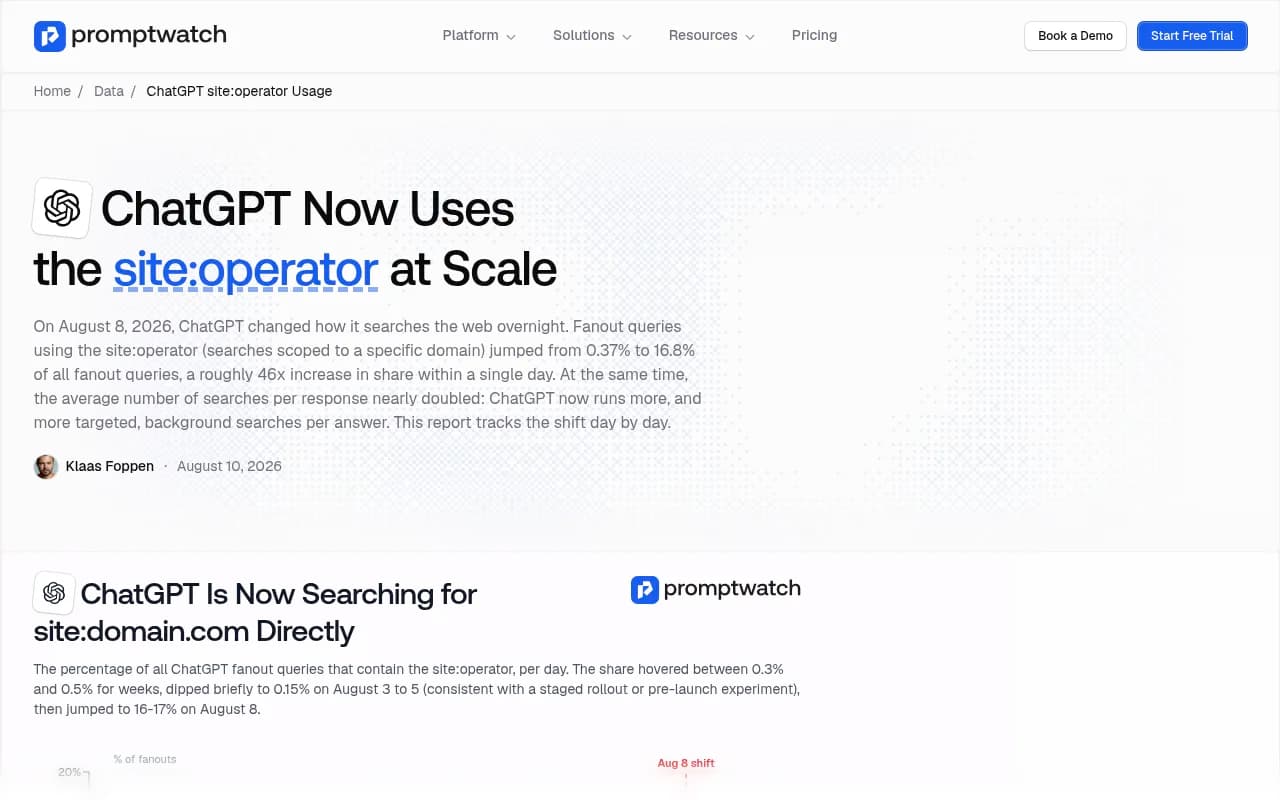
According to Promptwatch Data's report on the site: operator, published August 10, 2026, the share of fan-out queries scoped to a single domain sat between 0.3% and 0.5% for weeks. It dipped to about 0.15% on August 3 to 5, which fits a staged rollout or a pre-launch experiment. Then on August 8 it hit 16.8%, a roughly 46x jump in one day.
A single-day move of that size points to a model or system-prompt change on OpenAI's side. No individual site caused it, and none of them could have. I find that the most useful part of the finding: it tells you not to start rewriting your content strategy in a panic, because everybody's visibility profile shifted at once.
What a site: fan-out looks like
A normal fan-out asks the open web a narrower question, such as "best CRM for small agencies 2026". A site: fan-out asks one domain a question, such as site:yourdomain.com pricing. ChatGPT is deliberately going to a specific site to pull information from it, rather than waiting to see what the open web returns.
Additive, not a swap
The second number matters as much as the first. Promptwatch's data shows average fan-outs per response rising from about 1.08 to about 1.83 on August 8 and staying there. If ChatGPT had swapped generic queries for site: queries, the average would have stayed flat. So the generic searches you already compete in are still running, and site: lookups are a new retrieval path layered on top.
That is mostly good news. Your existing chances of appearing are intact, and there is an extra door into the answer, provided your domain is ready for someone to walk through it.
What we know, and what we do not
Be careful with this topic. The evidence is thinner than the confident blog posts suggest.
- The August 8 jump is measured by Promptwatch from live assistant interfaces. One independent write-up on nadiamohamed.me said it could find no second measurement at the time, and it stressed that fewer than two weeks of post-change data existed.
- There is no official OpenAI documentation I could find that describes the
site:behavior. - Third-party studies use different samples. Ahrefs analyzed 15 million fan-outs and found 6.8% used
site:, spread across about 116K domains, and 76% of those targeted a brand site (Ahrefs). That is a different sample and method from Promptwatch's daily share, so do not stack the numbers. - SUSO reports Peec data from October suggesting
site:use fell from 22.6% to 8.3% when GPT-6 began rolling out, with fan-outs per chat dropping from 3 to 2. That is third-party and unverified here, but it points the same way as everything else: this behavior is controlled by the platform and keeps changing.
My reading: the direction is clear (ChatGPT sometimes goes straight to specific domains), but the exact rate is a moving target. Plan for the behavior, not for a number.
Why a domain-scoped query changes the game
Two mechanics make site: fan-outs different from ordinary search visibility.
The query resolves against an index
A site: search can only return pages a search index already has from your domain. A brilliant page that is not indexed cannot be surfaced by it. Gaps in coverage become gaps in AI answers, directly.
The question is asked of your whole site
When ChatGPT asks site:yourdomain.com [topic], one excellent page does not help if the rest of the domain is silent on the angle being asked. It is a test of topical coverage across your site, not just a ranking contest for one URL.
Who gets looked up
Ahrefs found ChatGPT leans on official sources for facts: words like "official" and "price" were among the most common in fan-outs after "2026". For comparison questions, it leans more on third-party sites. SUSO also notes site: use is more common on commercial prompts, so brand recognition may affect whether your site is searched at all. Practical translation: put the facts only you can publish, such as pricing, specs, policies and support details, in plain crawlable text.
How to adjust your pages
None of this requires an emergency. It sharpens arguments for hygiene that was already sound.
1. Audit what is indexed
Start by running site:yourdomain.com searches yourself for your five most important topics. Then check coverage in Google Search Console and Bing Webmaster Tools. Look for pages that exist but are not indexed, and for pages that rank but are thin.
A crawler such as Screaming Frog will find orphan pages, redirect chains and broken internal links in an afternoon.
2. Fix thin category and hub pages
Category pages that are just a grid of product thumbnails give a domain-scoped search nothing to quote. Add a short explanation, key facts, and links to the detailed pages. If your internal site search is broken, fix it as well, since it is one more signal of a messy structure.
3. Make the facts findable as text
Prices, specs, shipping terms, integrations and support answers should live in plain HTML, not inside images, tabs that never render, or PDFs nobody indexes. A search scoped to your domain can only find what it can read.
4. Cover more angles per topic
Because site-scoped lookups sit on top of generic searches, you want the domain to answer the follow-up questions a buyer asks: comparisons, pricing, alternatives, who it is for, how it works. Promptwatch's own advice from its fan-out data is to build focused pages for each sub-question instead of one mega-page.
A warning, though. Google advises against publishing a page for every fan-out variation, and says doing so mainly to influence AI answers breaches its scaled content abuse policy. Cover real questions, not every permutation.
5. Write headings like short queries
Promptwatch's ChatGPT query fan-out data shows queries getting shorter over 2026: from about 117 characters in December to roughly 53 characters in April, around six to eight words. Put the entity and category first in titles and H2s, for example "Best CRM for small agencies 2026" rather than a conversational question.
6. Keep crawler access open
If AI bots cannot read your site, the best content in the world does not matter. Check your robots.txt and CDN rules. Promptwatch publishes free helpers for this, including an AI crawler URL inspector and a robots.txt generator for AI.
7. Re-run your fan-out mapping
Keyword-to-heading mappings built before August 8 are stale. Re-run fan-out analysis for the prompts you track, and do it again after each major model release. The ChatGPT query fan-out generator is a free way to start.
Monitor, do not guess
The lesson of August 8 is that platform behavior can flip in a day, and flip again later. One-off audits go stale quickly. You need something watching which queries ChatGPT issues, which of your pages get cited, and whether AI crawlers can read them.
An end-to-end platform such as Promptwatch covers that loop: it tracks prompts and query fan-outs in the real ChatGPT interface, logs AI crawler visits with IP verification, shows which pages get cited, and its Content Agent can publish the pages that fill gaps. Its Page Tracker also shows which prompts cite a given URL.

Other trackers exist, mostly monitoring-focused. If you want to compare, the GEO software directory at bestgeosoftware.com lists many of them.
| Task | What to use | Why it matters for site: lookups |
|---|---|---|
| Check what is indexed | Google Search Console, Bing Webmaster Tools | A site: query only finds indexed pages |
| Find orphan and thin pages | Screaming Frog, Sitebulb | Weak internal structure hurts domain-scoped answers |
| See which fan-outs ChatGPT runs | Promptwatch, Peec AI, Profound | Mappings built before Aug 8 are stale |
| Verify AI bots can read pages | Promptwatch crawler logs, robots.txt checks | Access problems look like content problems |
| Track citations per page | Promptwatch Page Tracker | Shows whether the fix worked |
A practical 30-day plan
- Week one: list your 20 most important topics and run
site:checks on each. Note where the domain is silent. - Week two: fix indexation gaps and expand the thinnest hub pages with plain-text facts.
- Week three: publish pages for real missing sub-questions, using short, entity-first headings.
- Week four: re-check crawler access and citations, and record the date and model for every prompt you test.
That last habit matters. SUSO's note that ChatGPT's behavior shifted again after GPT-6 started rolling out on October 7 is a reminder that results are only comparable if you know which model and date produced them.
Bottom line
ChatGPT now sometimes searches your domain directly. The August 8 data says it happens often enough to matter, and later reports say the rate can drop as quickly as it rose. So skip the content overhaul and make your domain a good place to be searched: indexed, readable, factual, and deep on the topics you want to be known for. Then watch the data, because the next change will arrive the same way this one did, overnight.