Key takeaways
- Around October 8-9, 2026, ChatGPT links stopped carrying utm_source=chatgpt.com and stopped passing a referrer. GA4 had nothing to go on, so those visits landed in Direct.
- OpenAI confirmed it was a bug. The tag came back from October 15, and by October 16 nearly all ChatGPT links carried it again. Sessions from the gap stay mislabeled as Direct.
- Most ChatGPT clicks still arrive with no referrer, so the UTM is now the only source signal. Filter on utm_source=chatgpt.com, not on the referrer.
- To repair reports: annotate the window, read ChatGPT plus Direct together on your top ChatGPT landing pages, and judge the channel on total visits and conversions.
- Treat the UTM as a bonus. Build measurement on signals you own: citations, visibility, self-reported attribution and crawler logs.
What actually happened
OpenAI added utm_source=chatgpt.com to links inside ChatGPT answers in 2025 (the tag first appeared on the "More" sources links in June 2025, as Search Engine Roundtable reported). For over a year it was the cleanest AI signal most analytics teams had.
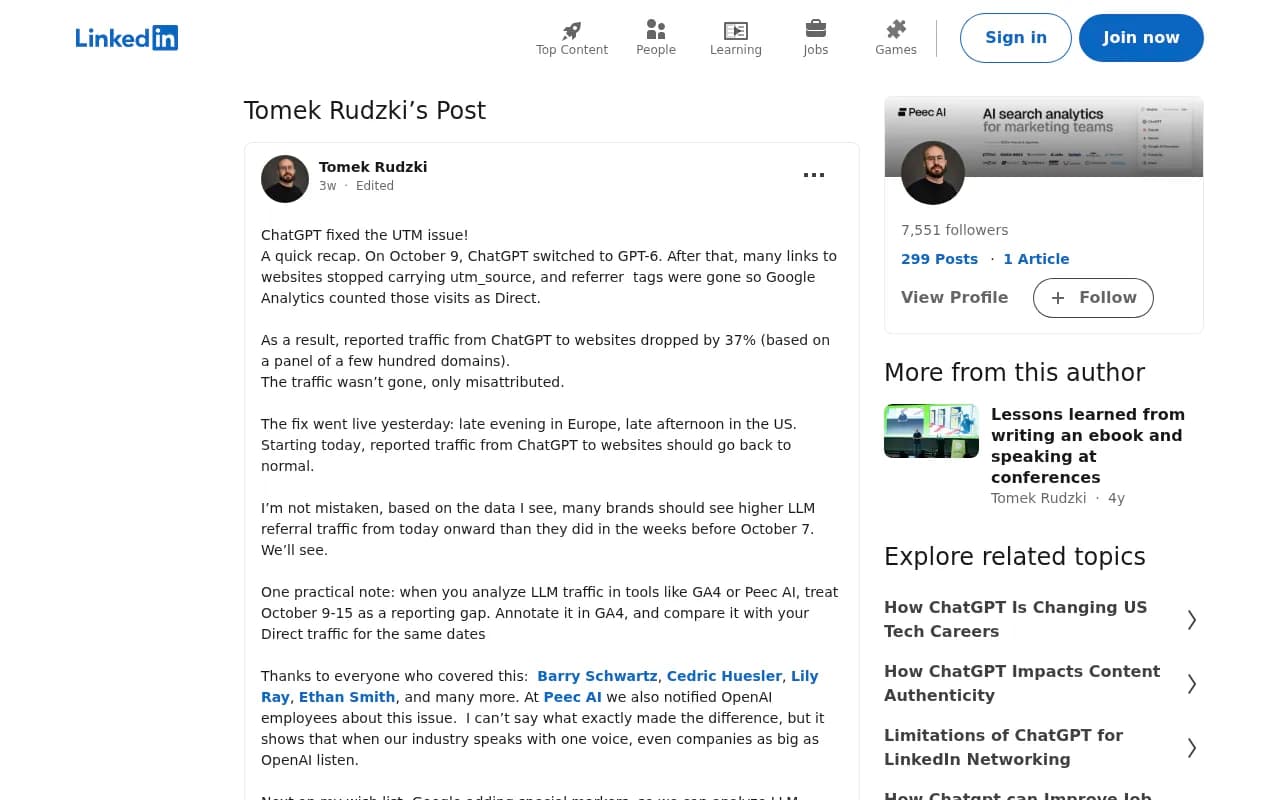
Then GPT-6 shipped in early October 2026. Cedric Huesler of Adobe documented the mechanics on LinkedIn: GPT-6 opened links with window.open(url, "_blank", "noopener,noreferrer") and dropped the UTM. No tag, no referrer. Analytics tools saw a visitor who looked like someone typing your URL by hand.
The exact dates differ by source, so treat them as approximate:
- Profound measured the UTM rate falling from Oct 8 at 18:30 UTC, with tags back by the morning of Oct 16 (about 99% of collected answers with cited links had at least one tagged link).
- Sitebrunch dates the lost sources from Oct 9, with the fix shipping from Oct 15.
- Huesler's recap says Thursday Oct 8 for the start and confirmed on Oct 15 that ChatGPT was tagging links again.
OpenAI has not published an official explanation. Profound offers a second theory that doesn't contradict the first: ChatGPT's new interactive "Intelligent UI" answers, whose share of responses rose from about 2% to about 34%, and links reached through product or info panels still carried the tag. So attribution could depend on which link in an answer someone clicked.
Why a missing tag becomes Direct traffic
GA4 decides where a session came from using two signals: UTM parameters and the HTTP referrer. Its default channel group only assigns "AI Assistant" when the medium is ai-assistant or the referrer matches a known AI assistant list. With neither, the session is Direct.
There is a wrinkle that predates the bug. Browsers default to a strict-origin-when-cross-origin referrer policy, so even a healthy ChatGPT click only passed https://chatgpt.com/ as the referrer, never the conversation. And per Sitebrunch, most ChatGPT clicks still arrive with no referrer after the fix. That is why the UTM matters so much: it is the only thing telling GA4 where those visits came from.
So the workaround is not clever. It is simply: stop relying on the referrer, and treat utm_source=chatgpt.com as the primary identifier.
What the data showed
Huesler looked at about 500 pages where ChatGPT drove at least 5% of visits, comparing Oct 9-13 with the week before:
- ChatGPT-attributed visits fell by about 31,000 a day.
- Direct rose by about 26,000 a day on the same pages.
- Direct rose on two out of three pages that lost ChatGPT traffic. The week before it was a coin flip.
- Organic search on those pages fell 7%, about the same as everywhere else.
- Among mobile Direct visitors, the share seeing the cookie banner for the first time (a proxy for new visitors) went from 36% to 44%. For known ChatGPT visitors it was 55%.
In other words, the new Direct traffic behaved like ChatGPT traffic wearing a different label. But be careful with this. The 31,000 and 26,000 don't match, so some traffic went to Unassigned or genuinely disappeared. LLM Pulse reportedly saw no matching Direct growth in its aggregated data, and Huesler's sample covers a few days and pages that were selected because ChatGPT was already prominent. It is a strong signal, not proof for your site.
Step-by-step: repair your attribution
1. Annotate the window
Mark roughly October 8 to 16, 2026 in GA4, Adobe Analytics or whatever you use, and in every performance report. Label it something like "ChatGPT tagging bug". Whoever reads the October or Q4 report later will thank you. Do it before anyone asks why ChatGPT "collapsed".
2. Pick the pages that matter
Pull the landing pages that normally get a meaningful ChatGPT share. Huesler used 5% or more. Add your homepage: Search Engine Journal's analysis found more than half of the Direct links in analyzed ChatGPT messages pointed there.
3. Read ChatGPT and Direct together
Compare the combined ChatGPT + Direct sessions for those pages before and during the window. If the sum is stable, you lost labels, not visitors. If the sum dropped, you have a real traffic problem and should look elsewhere.
4. Check behavior of the extra Direct visits
Look at new-user share, entry pages and engagement for the Direct bump. Deep-page entries from new users with no referrer look far more like AI clicks than like bookmark traffic.
5. Judge on totals and conversions
Check total visits and conversions before touching strategy. The mistake to avoid is cutting content budget because one channel line looks like it fell off a cliff.
6. Accept that history won't be rewritten
GA4 records source at visit time. No tool can recover a source value that was never sent. Sessions from the outage stay as Direct. What you can do is report them as "likely AI-assisted" using the proxy above, and say clearly that it is a proxy.
The utm_source workaround, spelled out
Here is what "the workaround" means in practice now that tags are back.
- Build your AI traffic definition on utm_source=chatgpt.com, not the referrer. In GA4, make sure a custom channel group or exploration matches source containing chatgpt.com regardless of medium.
- Keep a Direct proxy segment: sessions with no source landing on pages that historically received ChatGPT traffic. It is your backstop if the tag disappears again.
- If you run paid placements in ChatGPT, tag them with your own UTMs. Search Engine Journal reported that ads with your own UTM parameters were unaffected.
- Optionally, if you use a visitor analytics product, switch on any setting that counts utm_source=chatgpt.com visits as ChatGPT traffic. (ChatGPT also stopped sending a referrer on October 8, 2026, which is why such a setting exists.)
GA4 exploration filter:
  Session source contains "chatgpt"
  OR Session manual source = "chatgpt.com"
Backstop segment:
  Session default channel group = Direct
  AND Landing page IN (top ChatGPT landing pages + homepage)
Tools that help (and what they can't do)
No tool recovers lost sessions. But some reduce your dependence on one signal.
| Approach | What it tells you | Depends on UTM or referrer? |
|---|---|---|
| Google Analytics GA4 channel groups | Sessions by source and medium | Yes |
| Visitor analytics for AI traffic | AI-referred visits and conversions | Partly (UTM setting) |
| AI crawler logs | Which bots fetch which pages | No |
| AI visibility tracking | Mentions, citations, position, sentiment | No |
| Self-reported attribution forms | What buyers say | No |
Google Analytics is where the damage showed up, and it can only classify what it is sent.
For the upstream side, Promptwatch tracks how ChatGPT, Gemini, Perplexity and others mention and cite your brand, so you can tell a measurement problem from a real visibility problem. It also has visitor analytics for AI-referred traffic and IP-verified AI crawler logs. If your citations are steady and ChatGPT sessions fell, you had a labeling issue. If citations fell, that is a real one. Tracking is also useful in the other direction: Promptwatch Data showed that platform-wide ChatGPT changes can happen overnight, when site: queries jumped from about 0.4% to about 17% of fanouts on August 8, 2026.

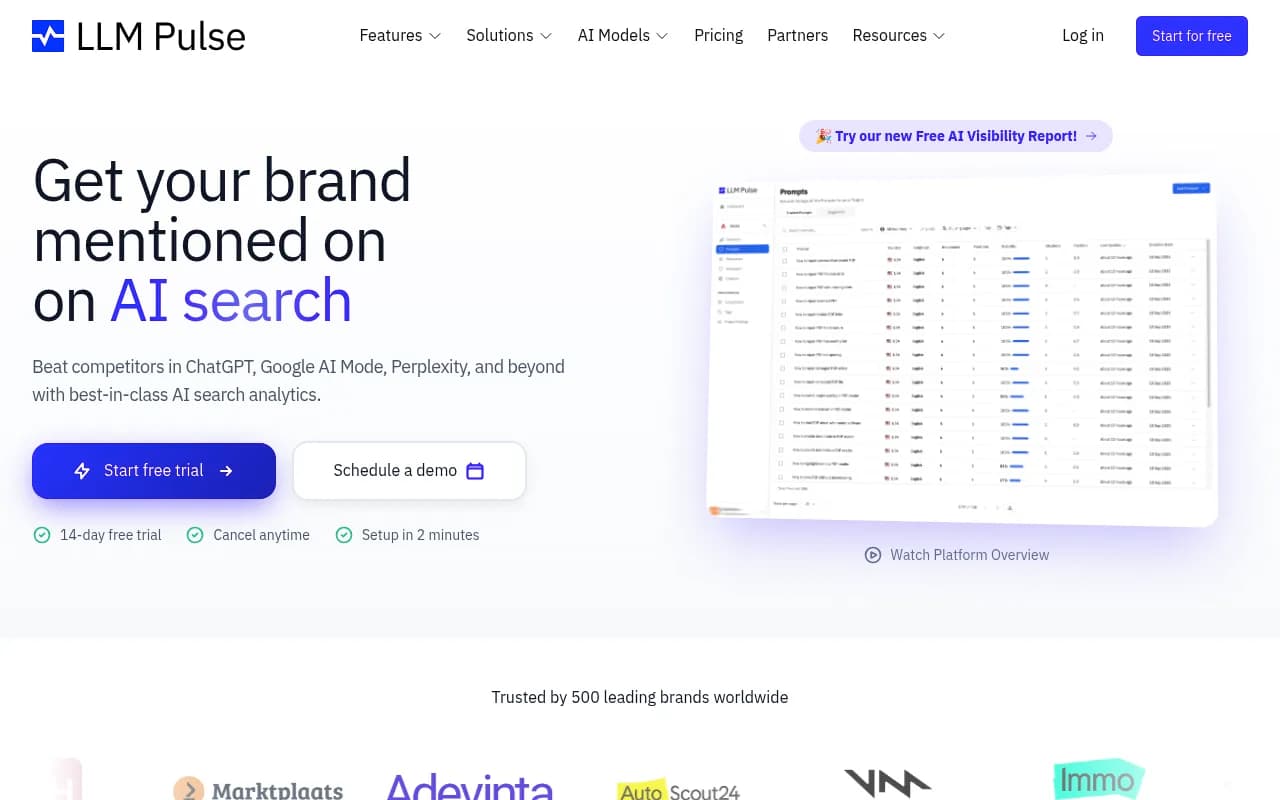
Other trackers in the same category include Profound, whose write-up of the incident has the most detailed UTM-rate timeline, and LLM Pulse. You can browse more at the GEO software directory at bestgeosoftware.com.
Profound

Crawler logs are a useful cross-check. Sébastien Billard reported a drop in ChatGPT-User traffic while OAI-SearchBot traffic rose during the same days, which is the kind of pattern you can only see if you log bots separately from humans. Promptwatch's AI crawler traffic report shows OpenAI at 79.8% of IP-verified AI crawler requests in Aug 31-Sep 6, 2026, down from 94.8% in mid-June, a baseline to compare your own logs against. That is crawler data, not click data, so use it as context.
Build attribution you don't have to trust a single tag for
I'd treat this episode as a free fire drill. A signal that one frontend change can switch off for a week with no announcement can be switched off again. Google moved keyword data behind "not provided" years ago and marketers have been rebuilding reports ever since. Same pattern, smaller scale.
What I'd put in place:
- A "How did you hear about us?" field with "ChatGPT or another AI assistant" as an option on demo forms, signups and onboarding. It is messy and underreported, and no platform can turn it off.
- Sales notes. Ask reps to log it when a prospect says they found you in ChatGPT.
- A monthly citation and visibility report next to the traffic report, so a traffic dip never travels alone.
- Two-channel reporting: ChatGPT plus Direct on AI landing pages, shown together with a footnote.
- A short list of other assistants to watch. Search Engine Journal noted Gemini added UTM parameters to its links two weeks before the ChatGPT incident, so referrer behavior differs by platform and changes often.
Also think about which numbers you put in front of leadership. Some of the "AI traffic is up 180%" slides from this summer rested on a tag existing, the same way October's drop rested on it vanishing. Last-click was always a thin frame for a channel where most influence happens before anyone clicks.
Common mistakes
- Rebuilding your whole model around utm_source=chatgpt.com. It came back, but it is a courtesy, not a contract.
- Assuming every Direct spike is ChatGPT. Relevant Audience cautions against pinning all Direct growth on one cause.
- Comparing month over month across Oct 8-16 without an annotation.
- Cutting content or GEO budget because the ChatGPT line dipped.
- Expecting retroactive correction. It won't happen.
- Assuming the Reddit chatter about ongoing UTM stripping still applies. The evidence points to the bug window, and I found no verified stripping after Oct 16, but check your own data.
Quick audit checklist
| Check | Where | Healthy result |
|---|---|---|
| Annotation for Oct 8-16, 2026 | Analytics | Present in all reports |
| ChatGPT-tagged sessions since Oct 16 | GA4 source filter | Back near pre-bug levels |
| ChatGPT + Direct on top landing pages | GA4 exploration | Stable sum across the window |
| Total visits and conversions | GA4 | No unexplained drop |
| Citations and visibility | AI visibility tool | Steady or growing |
If you want an outside hand setting this up as part of a wider AI-search measurement plan, agencies like 1001 SEO Media work on GEO reporting alongside technical SEO. Either way, start with the one thing that costs nothing: go to GA4, open your top ChatGPT landing pages, and look at the Direct line for October 8 to 16. That is where your missing visitors went.
FAQ
Did ChatGPT traffic really fall in October 2026?
Partly a labeling problem. Huesler's sample suggests most lost referrals reappeared as Direct, but at least some of the loss may be real or went to Unassigned. Compare totals before deciding.
Is the UTM tag back?
Yes. Reports say tagging resumed from October 15, and by October 16 almost all ChatGPT answers with links carried it again.
Why not just use the referrer?
Most ChatGPT clicks still arrive without one, and even when present the default referrer policy only passes the origin. The UTM is the reliable signal.
Can I fix the historical data?
No. GA4 stores the source at visit time. Annotate and use a proxy segment instead.
Are ChatGPT Ads affected?
Search Engine Journal reported that clicks on ChatGPT Ads with your own UTM parameters should be unaffected.