Key takeaways
- Plenty of GEO platforms still make you book a demo before you see a price. A smaller group publishes plans and lets you start the same day. That group is the focus here.
- Entry pricing runs from roughly $95 to $120 a month for a real starter plan, with full-featured tiers from about $245 to $579 a month.
- The cheap tier often has a catch: one AI engine only, a small prompt cap, or no way to act on what you find.
- Check three things before you pay: which engines are tracked, how many prompts and responses are included, and whether the tool helps you fix gaps or just reports them.
- Verify every price on the vendor's own page. Several of the third-party figures I found are from 2025 listicles and may be stale.
Why public pricing matters when you buy GEO software
I have sat through enough sales calls for monitoring dashboards to have an opinion here. If a tool tracks a few hundred prompts and shows a visibility chart, it does not need a discovery call. A visible price and a trial tells you the vendor expects the product to sell itself.
That is not a knock on enterprise tools. Platforms like Scrunch, Bluefish and Evertune sell to Fortune 500 teams with SSO, procurement reviews and custom prompt modeling, and a demo-gated process makes sense there. A comparison from Meikai makes the same point: public capability pages are good shortlist evidence, but they cannot tell you data quality or implementation fit.
But if you are a marketing lead, an SEO team of three, or an agency testing the category, you want to start Monday morning with a card, not a quarter-long evaluation. This guide covers that group.
The broader category is crowded. If you want to browse beyond what is covered here, the GEO software directory at bestgeosoftware.com lists far more options.
What counts as public pricing and instant signup
I used a simple filter:
- A pricing page that shows actual dollar amounts for at least the entry plans
- A self-serve signup, either a free trial or a paid plan you can start without talking to sales
- Real AI engine coverage, not a single-model demo
Plenty of vendors fail the second test. Custom enterprise tiers are fine as an upper rung, as long as the lower rungs are visible.
Quick comparison
| Platform | Public entry price | Trial or free start | What you get at entry | Acts on gaps? |
|---|---|---|---|---|
| Promptwatch | $95/mo (Essential) | 7-day free trial on monthly billing, free AI visibility report | 50 prompts, 6,000 responses, all AI models, unlimited seats | Yes, on higher plans |
| Profound | $99/mo Starter (annual billing) | Check vendor page | ChatGPT only, 50 prompts | Limited at entry |
| Semrush AI Toolkit | $99/mo per domain | Check vendor page | Extra prompts at $60/mo per 50 | Part of SEO suite |
| AthenaHQ | Free tier (300 credits), Starter $295/mo | Free tier | Credit-based | Content agents on paid |
| Glara | $120/mo Starter | Check vendor page | 20 products | Product-focused |
| HubSpot AEO Grader | Free | Free | One-off grade | No |
The Profound, AthenaHQ, Glara and Semrush figures come from third-party roundups (Findrix and Nick Lafferty's 2025 guide), not from the vendors' current pages. Treat them as a starting point and confirm before budgeting.
Promptwatch: published tiers, daily tracking, and the fix step
Promptwatch is the one in this list that spells out everything on its pricing page, including limits per plan, and it covers every AI model on every tier. That last part matters. Several competitors gate engines by plan, which makes the cheap tier a ChatGPT-only monitor.

The plans, in USD per month (annual billing gives 12 months for the price of 10):
| Plan | Price | Projects | Prompts | Responses | Notable extras |
|---|---|---|---|---|---|
| Essential | $95 | 1 | 50 | 6,000 | Agent Chat, country tracking, 360 Insights, MCP and API |
| Professional | $245 | 2 | 150 | 18,000 | 5 AEO articles, Knowledge Base, 25M crawler logs, custom reports, Looker Studio |
| Business | $579 | 5 | 350 | 42,000 | Content Agent, hourly tracking, state and city tracking, Fact Check, Shopping, Ads Radar |
| Enterprise | Custom | Multiple | Custom | Custom | SSO, white-label portal, dedicated success manager |
Every plan includes unlimited team seats, daily tracking, Brand Narrative, content gap analysis, visitor analytics and site audits. Signup is quick: you enter your brand URL, pick prompts, and it starts collecting brand and competitor mentions. The 7-day free trial applies to monthly billing, and if you just want a first look, the free AI visibility report needs no login.
What separates it from the cheaper monitors is what happens after the dashboard. It collects data from the real interfaces of ChatGPT, Google AI Overviews, AI Mode, Gemini, Perplexity, Copilot and others, rather than only APIs. It also reads your IP-verified AI crawler logs so you can tell whether a page is invisible because bots cannot reach it or because the content is weak. Then it moves into the Action Board and, on Business, the Content Agent that writes and publishes to WordPress, Webflow or Framer. Most competitors stop at reporting.
The honest caveat: the Essential tier does not include crawler logs or AEO articles. If you want the loop of write, publish and measure, plan for Professional or Business. The Promptwatch vs Profound page lays out the head-to-head, and the 2026 platform comparison covers the wider field. You can start with the free trial.
Profound: cheap on paper, narrow at entry
Profound is a well-known enterprise name, and it does publish a low entry plan. Per Findrix, the Starter is $99 a month on annual billing, covers ChatGPT only, and includes 50 prompts. The fuller platform reportedly starts at $399 a month, with enterprise custom above that.
Profound

The $99 plan is a fair way to try the product, but a one-engine tracker will mislead you in 2026. Promptwatch's average sources per response data shows how differently the engines behave: ChatGPT cites about 5 sources per web-search answer, while Google AI Overviews and Perplexity each cite about 10. A strategy built on ChatGPT alone misses where newer domains have the easier path in.
Semrush AI Toolkit: easiest if you already live in Semrush
The AI Toolkit is reportedly $99 a month per domain, with extra prompt capacity at $60 a month per 50 prompts. That per-50 pricing adds up quickly if you track several markets or products. The 2025 source for those numbers is old, so check the current page.
It makes sense when your team already has Semrush and wants one invoice and a familiar interface. The tradeoff is depth: SEO suites bolting on AI tracking tend to have fixed prompt sets and no crawler-level data. If you want to compare the broader suite, see Semrush next to a dedicated platform.
AthenaHQ: free credits, then a jump
AthenaHQ has a free tier with 300 credits, then a Starter plan reported at $295 a month. The free tier is useful for a trial run. The step up is steep compared with $95 to $245 for competitors that include more at the same level, but AthenaHQ pairs monitoring with content agents.

Peec AI and Otterly: low-cost monitors
Peec AI and Otterly.AI are the two names that come up for affordable tracking. Evertune's June 2026 ranking lists Otterly's key differentiator as a low entry price point, and Peec as affordable structured reporting. I did not verify their current price pages, so I am not quoting numbers.

Otterly.AI

Both are good for a first look at mentions and citations. Neither includes crawler logs, visitor analytics or content generation, so they answer "was I mentioned?" and leave the rest to you. There are head-to-head pages for Promptwatch vs Peec and Promptwatch vs Otterly if you are deciding between them.
Free and nearly free options
If your budget is zero today, there are a few starting points.
- HubSpot's AEO Grader is free and gives a one-off grade of your brand in AI answers. It is a snapshot, not tracking.
- Promptwatch's free AI visibility report scans how ChatGPT, Gemini and Perplexity talk about you and checks crawler access.
- Promptwatch also has free tools like the Agentic Readiness Check, an LLMs.txt generator and a robots.txt generator for AI crawlers.
For other lightweight trackers in our catalog, look at Rankshift, LLM Pulse and Rankscale, then confirm pricing on each site.

What demo-gated platforms look like instead
To be fair to the other side, here is what you give up and gain with enterprise-only vendors.
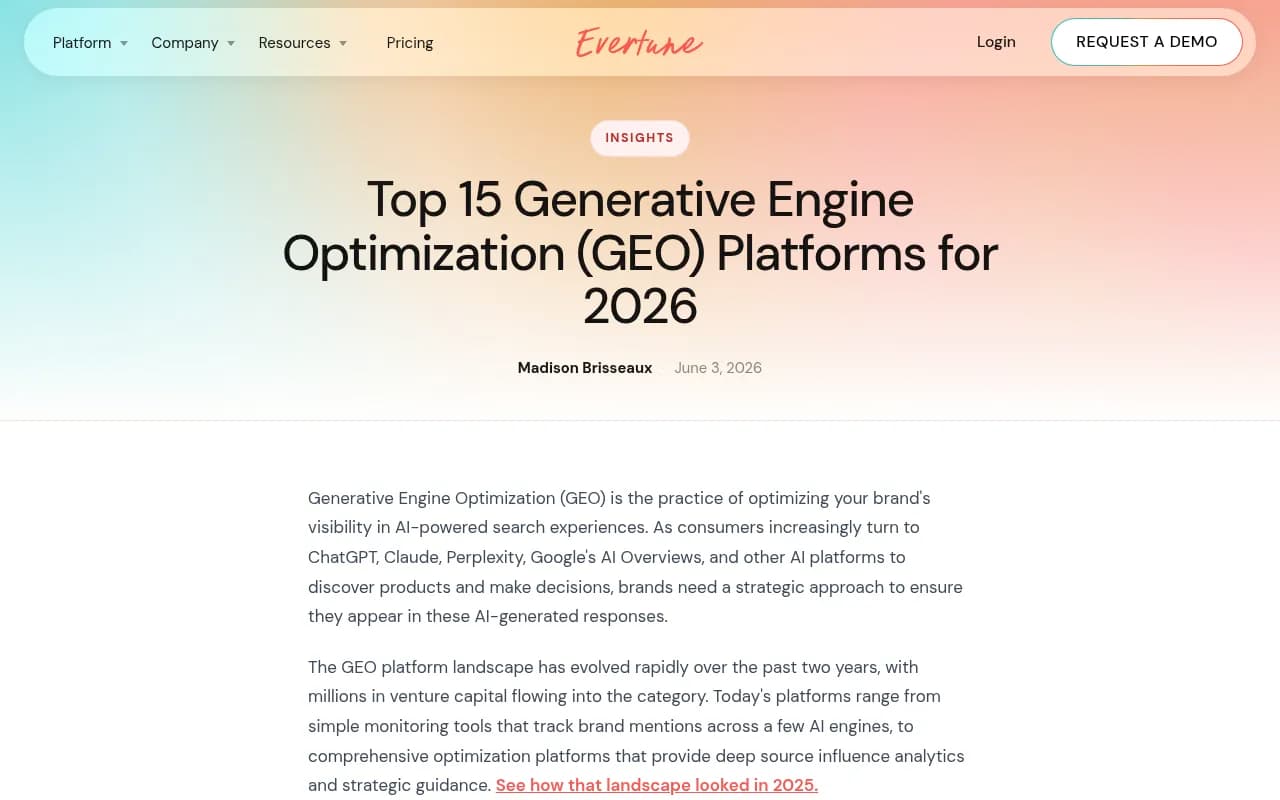
Evertune's own ranking puts itself first, and it is worth reading with that in mind, but the table is useful for seeing who is bootstrapped, who is venture-backed and who is public. Evertune, Scrunch and Bluefish sell through demos. You will get things self-serve tools rarely have: statistical sampling at very large prompt volume, SSO, custom measurement and managed services.
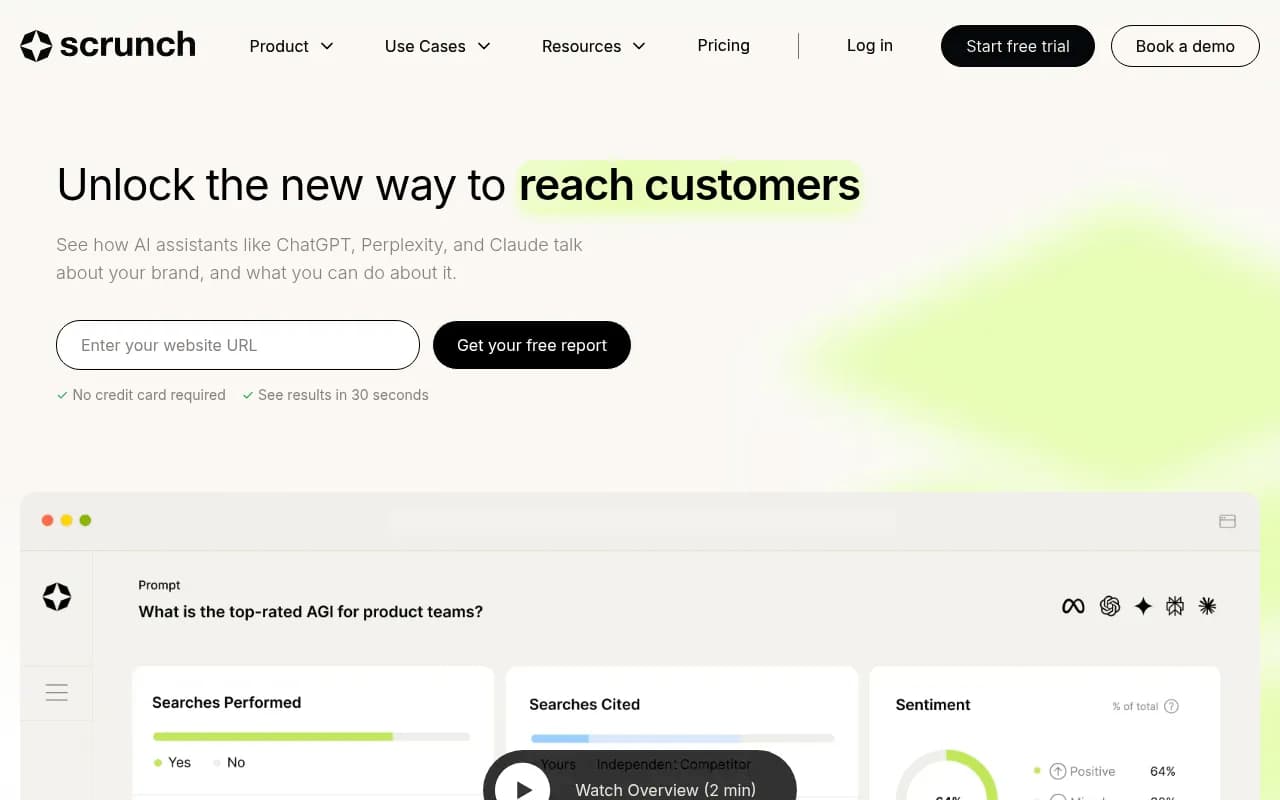
If you are a Fortune 500 brand with legal review and 100 markets, book the demo. If you are not, paying for that process is a waste.
How to compare plans without getting fooled
Count prompts and responses, not just plan names
Prompts are the questions you track. Responses are how many times they run across models, countries and days. A plan with 50 prompts and 6,000 responses is a different product from one with 50 prompts and a fraction of that. Always ask how many responses per month you get.
Check which engines are included
One-engine entry plans are fine for a trial. They are poor for decisions. Look for ChatGPT, Google AI Overviews, AI Mode, Gemini, Perplexity and Copilot at a minimum.
Ask whether data comes from real interfaces
API answers and what users see in the chat interface can differ, especially for citations and shopping results. Tools that scrape the real UI give you data closer to what customers see.
Separate monitoring from fixing
This is the biggest gap in the market. A dashboard shows you a score. Fixing the score means finding content gaps, writing pages, publishing them, and checking whether AI bots crawled and cited them. If a plan does not include that loop, budget for the labor yourself.
Watch for seat and project limits
Per-seat pricing punishes agencies and cross-functional teams. Unlimited seats, as on Promptwatch plans, remove that.
Which one to pick
| If you are... | Start with |
|---|---|
| A marketer who wants one tool that tracks and acts | Promptwatch Professional or Business |
| Already deep in Semrush | Semrush AI Toolkit, then reassess |
| Testing the category on a tight budget | HubSpot AEO Grader plus the free Promptwatch report |
| Only needing mention reports | Peec AI or Otterly |
| An agency with multiple clients | Promptwatch agency plans: Kick-off $199, Growth $399, Scale $799 |
| A global enterprise with procurement | Demo-gated platforms like Scrunch or Bluefish |
For wider browsing, the AI rank tracking directory lists more trackers.
A sane way to run a 30-day trial
- Pick 25 to 50 prompts that match how buyers actually ask: comparisons, "best X for Y", and brand questions.
- Add your top three competitors up front.
- Run it for a week before judging anything. Daily numbers wobble.
- Check the citations, not only the mentions. Mentions without your domain cited point to a content or crawlability problem.
- Pick one gap and try to close it. If the tool cannot help you do that, you bought a dashboard.
Final word
Public pricing is a decent filter. It removes vendors that rely on a sales process to explain value. Among the options with visible plans, Promptwatch is the one I would test first because the starting tier includes every engine and unlimited seats, and the higher tiers carry the work through to publishing and measurement. Everything else here is reasonable for a narrower need. Confirm each price on the vendor's page before you commit, because this category reprices often.
If you would rather hand the work to people, 1001 SEO Media runs GEO programs on Promptwatch with no long-term contracts.