Key takeaways
- Profound's trial is 50 prompts a day for 7 days on ChatGPT, Gemini and Google AI Overviews, in one region and one language, with no exports or history. Mirror that setup so the comparison is fair.
- Split your 50 prompts by type (organic, brand-specific, competitor comparison). Promptwatch Data shows each type behaves very differently.
- Judge each tool on five things: engine coverage, prompt control, data export, what it tells you to do next, and cost per tracked response.
- Export from your alternative before day 7. Profound's trial keeps nothing, so screenshot its results as you go.
- A tracker that only reports a score is fine for validating the channel. If you want the work done too, test crawler logs, content gaps and publishing in the same week.
Why a 7-day test is the right size
Seven days is short, and that is the point. Profound's pricing page (checked live) shows two options: a free Trial and a custom-priced Enterprise plan. Several third-party write-ups say its $99 and $399 self-serve tiers were withdrawn in September 2026. I could only confirm that on blogs, not on a primary Profound source, and the pricing FAQ still mentions a self-serve agency plan. So check the live page before you plan around it.
What I can confirm from the pricing page: the Trial runs 50 unique prompts daily for 7 days, covers ChatGPT, Gemini and Google AI Overviews, is limited to 1 language and 1 region, has unlimited seats, and has no history, no exports, no API and no support. The prompt set is recommended by Profound based on your industry, and you cannot customize it.
That shapes everything. If you test an alternative for 30 days with 300 custom prompts, you are not comparing like with like. A 7-day, 50-prompt sprint gives you a direct read on whether the alternative shows the same story, and whether its extra features are worth the switch.
What to settle before day 1
Pick the alternative and check the trial terms
Trial terms vary a lot. Third-party roundups report Scrunch offering 7 days on Starter with no card and Rankscale a 7-day Pro trial. Promptwatch has a 7-day free trial on monthly billing for Essential, Professional and Business. Verify each on the vendor's page, since these change.
Here is how some of the usual candidates differ on the points that matter for this test. Prices are from third-party roundups unless noted, so confirm them.
| Tool | Entry price (reported) | Prompts at entry | Notes for a trial |
|---|---|---|---|
| Profound (Trial) | Free, 7 days | 50 fixed prompts | 3 engines, no exports, one region and language |
| Promptwatch | $95/mo Essential | 50 | All models, daily tracking, Agent Chat, Brand Narrative, visitor analytics; 7-day trial on monthly billing |
| Peec AI | About EUR 85/mo | 50 | You write your own prompts; Claude selectable |
| Semrush One | $199/mo monthly | 50 daily | SEO toolkit on the same login; no Claude, per Fritz.ai |
| Otterly.AI | $29/mo monthly | 15 | Cheap for validating the channel |
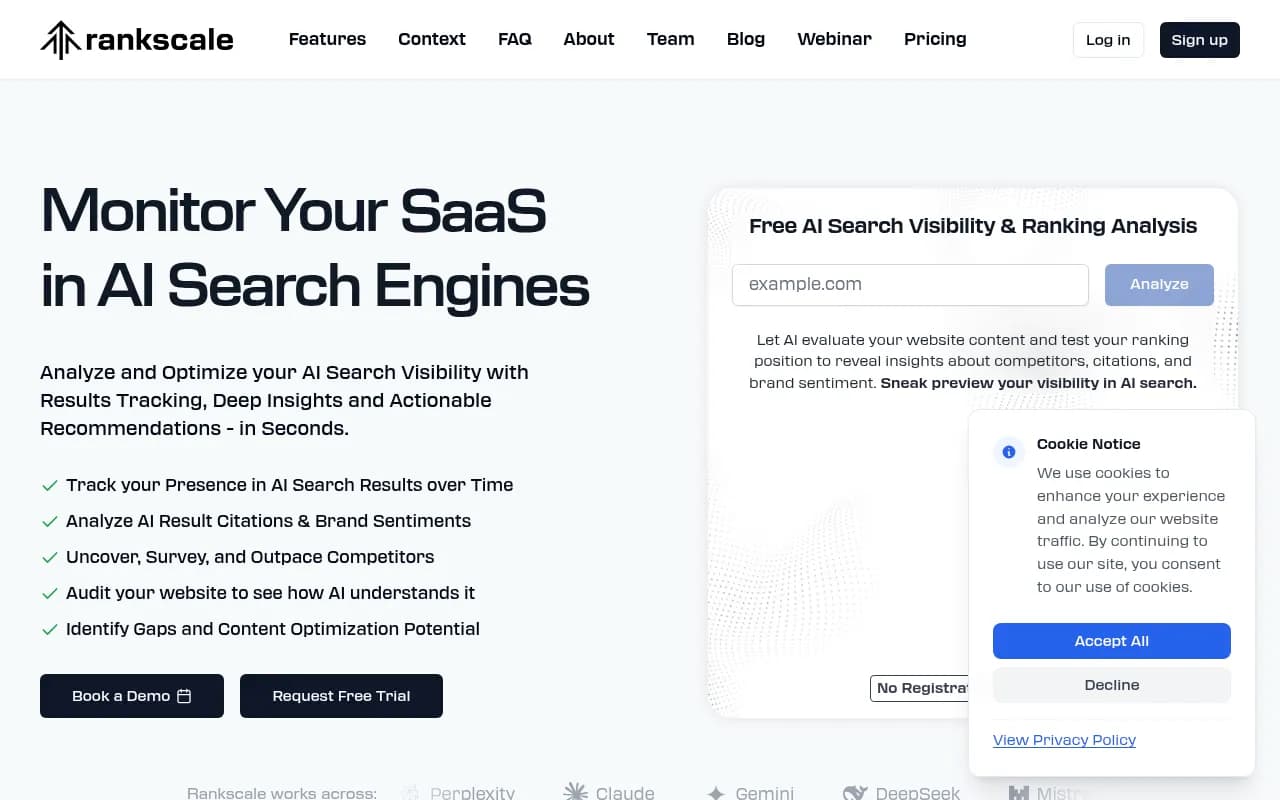
| Rankscale | $20/mo billed yearly | Credit-based | Claude on a budget |
| Scrunch AI | $250/mo annual | 350 custom plus 1,000 industry | Execution layer (AXP) |
If none of these fit, the directory at bestgeosoftware.com lists many more GEO platforms.
Lock the variables
Write these down before you start, so you cannot fudge them on day 5:
- One country and one language, same as Profound's trial.
- The same three engines: ChatGPT, Gemini, Google AI Overviews. Add Perplexity or Claude later as a bonus, not as part of the head-to-head. On Profound, those are Enterprise-only.
- Your brand plus three to five named competitors, entered identically everywhere.
- A shared spreadsheet with one row per prompt per day.
Building the 50 prompts
Here is the trap. You cannot see or edit Profound's trial prompts if the dashboard hides them. If you can see them, copy them straight into the alternative. If not, build a same-category set and accept that you are comparing patterns, not identical rows.
Split them by type. Promptwatch Data on domains cited per ChatGPT response (Sep 28 to Oct 4, 2026) shows why:
- Organic prompts (no brand named): 52.5% of responses cite 10 or more unique domains.
- Competitor comparison prompts: 49.1% cite 10 or more domains.
- Brand-specific prompts: only 21.3% cite 10 or more, and 5 domains is the most common count.
So a brand-specific prompt gives you a tight, almost closed set of sources, while an organic one is a crowded race. Mixing them without labeling will muddy your averages.
A workable split of 50:
| Prompt type | Count | Example |
|---|---|---|
| Organic, category level | 25 | best project management software for small teams |
| Organic, use case or persona | 5 | project tool for a 10-person agency with client approvals |
| Competitor comparison | 10 | Asana vs Monday.com vs [your brand] |
| Brand-specific | 10 | is [your brand] good for small teams, [your brand] pricing |
Write them like a buyer would type them, full sentences included. ChatGPT rewrites your prompt into short searches anyway. Promptwatch's ChatGPT query fanout data shows average fanout moving between roughly 2.15 searches per response in early December and 1.0 in April, with query length shrinking from about 117 characters to about 53. Translation: the same prompt can return different sources week to week, so do not over-read one day's result.
The 7-day plan
Day 1: Setup and baseline
Create the account, enter the 50 prompts, add competitors and set region and language. Run the first collection. Do not interpret anything yet. Record the baseline: visibility or mention rate per engine, average position, and the top 10 cited domains.
If the tool lets you tag prompts by type, do it now. If it does not, that is your first finding.
Day 2: Check the data against reality
Pick 10 prompts and run them by hand in ChatGPT, Gemini and Google. Compare what you see to what the tool reports. The question is whether the tool is collecting from the real interface or from an API. Answers and citations can differ between the two. Promptwatch, for instance, monitors the real UIs and tracks API models separately, and its explanation of how it collects data is worth reading as a standard to hold any vendor to.
Write down the mismatches. A tool that agrees with your manual checks on 8 of 10 is doing well.
Day 3: Stress the prompt controls
Profound's trial fixes the set. Test how much freedom the alternative gives you. Can you edit, disable and add prompts? Bulk-import a CSV? Tag by topic and intent? Can you track by persona? Can you add a second country without mixing markets?
Also check how it counts a mention. If your brand name is also a common word, you need rules to avoid false positives. Promptwatch handles this with plain-language analysis instructions in its Brand Book, for example. Whatever you test, break it on purpose with an ambiguous name.
Day 4: Look past the score
This is the day most trials skip, and it is where tools separate. A visibility score is one number. Ask what the tool explains.
- Does it show which of your pages are cited and where they land in the source list?
- Does it show what AI claims about you (pricing, features, reputation), not just whether you are named?
- Does it show which sources feed the answers, including Reddit, YouTube and LinkedIn?
- Can it show whether AI crawlers can actually read your site?
The last one matters more than people think. A tool can report that you are invisible, and the cause is a blocked crawler. Tools like Promptwatch include IP-verified crawler logs for this, so you can tell an access problem from a content problem. Test it if the vendor has it, and note which alternatives do not.

Profound itself has agent analytics, so include it in the comparison. The point is to check each tool on the same question.
Day 5: Competitor and sentiment pass
Take your 10 comparison prompts and read the actual answers. Where do competitors beat you on position? What reasons does the AI give? Compare the tool's sentiment output with your own read of 10 answers. Sentiment scoring is easy to do badly, and a 30-second manual check exposes it.
Also look at the engine spread. AI Overviews and ChatGPT behave differently, and Promptwatch's social media citations data shows how far apart they sit: ChatGPT drew 0.46% of its citations from social platforms between Sep 28 and Oct 4, 2026, while Google AI Overviews drew 12.2%. If your alternative flattens everything into a single score, you will miss that.
Day 6: The action test
Dashboards report. Some tools also tell you what to do. Ask each tool the same question: what are the three highest-value things I should do this week?
Profound's agent drafts and stages content for approval, according to third-party reviews, but trial credits are limited. On the alternative, check whether you get a prioritized to-do list, a content gap view, and a way to draft or publish. In Promptwatch, that means the Action Board, content gap analysis, and the Content Agent (Content Agent is Business plan and up, so ask for access if you are on a lower trial).
A fair way to score this: generate one piece of content or one recommendation from each tool, then give them to an editor without saying which came from where.
Day 7: Export, price and decide
Export everything the alternative allows: prompts, responses, citations. Profound's trial offers no exports, so screenshot its dashboards before the trial ends. Then compute cost per tracked response, not the headline price.
A quick way: monthly price divided by monthly responses. Promptwatch Essential, for example, is $95 for 6,000 responses. A 50-prompt tool that covers fewer engines is not the same product at a lower price. Confirm current pricing at promptwatch.com/pricing and each vendor's page.
Scorecard
Score each tool 1 to 5 on these. Weight what matters for your team, and keep the sheet open all week.
| Criterion | What to check | Weight (example) |
|---|---|---|
| Engine coverage | Same three engines, plus any extras you need | 20% |
| Data fidelity | Matches your manual checks on day 2 | 20% |
| Prompt control | Edit, tag, persona, multi-country | 15% |
| Depth | Citations, claims, crawler access, traffic | 20% |
| Action layer | Prioritized actions, content, publishing | 15% |
| Cost per response | Real cost, including add-ons | 10% |
How to read the results
When Profound is still the right buy
If you are an enterprise that needs up to nine engines, ChatGPT Shopping, all-time history, SSO and a security review, and you can sit through procurement, Profound's Enterprise plan is a legitimate choice. The trial tells you whether that depth matters to your team before you talk to sales. If your day 4 and day 6 results show the alternative does not match it, say so.
When to switch
Switch when the alternative matched your manual checks, covered the engines you need, gave you export and control the trial does not, and handed you things to do rather than a number. If you are an SEO or content team that wants the loop closed (monitor, trace the sources, publish, then measure whether it worked), weigh that heavily. Monitoring-only tools stop at the score.
If your budget is small and you only want to validate that AI search matters for your category, a cheap tracker such as Otterly.AI or Rankscale is enough. Reported entry prices are around $29 and $20 a month respectively, but verify them.
Otterly.AI

Teams that want the SEO suite and AI tracking on one login should test Semrush, bearing in mind the reported lack of Claude tracking at the entry tier.
For a prompt-by-prompt tracker that lets you write your own set, Peec AI is the common pick.

And for the incumbent itself:
Profound

Mistakes that ruin a 7-day test
- Using different prompts on each tool and then comparing scores. Use the same 50, or the same categories.
- Reading one day as truth. ChatGPT's fanout changes, so look at the week.
- Ignoring the engine you will care about in six months. Claude, Perplexity and AI Mode are Enterprise-only on Profound. Check whether your alternative covers them.
- Forgetting to export. Do it on day 7, or you lose the data.
- Treating a score as the goal. Position, tone and cited sources tell you what to fix.
What to do after the trial
Pick the winner, then run a 30-day follow-up on a larger custom set, plus a second country if you need it. If you are choosing an agency to run this program for you, an SEO and GEO team like 1001 SEO Media can set up tracking and act on the results.
For wider reading, the Promptwatch Data hub has the latest citation research, and the 90-day GEO program in the Promptwatch Academy is a sensible next step. You can start a free Promptwatch trial or run the free AI visibility report for a no-login baseline before you start day 1.