Key takeaways
- No independent, quantitative accuracy benchmark exists for GetMint, Peec AI, or Otterly.AI. Anyone claiming a clear accuracy winner is working from vendor claims or small tests.
- Peec AI documents UI scraping and reviewers tend to rate it highest on data fidelity. Otterly.AI is the cheapest entry point, but Gemini, AI Mode, and Claude cost extra. GetMint is the only one that promises a margin of error with every score, though the methodology wasn't verifiable.
- Plan limits shape accuracy as much as methodology. If a model isn't included in your plan, it isn't in your numbers.
- Run the same 10 prompts in the real chat interfaces, compare them to each tool's report, and ask each vendor for raw answers behind one score.
- If you need data collection plus the means to act on it, an end-to-end platform like Promptwatch is worth including in the shortlist.
What data accuracy means for AI visibility tools
People use "accuracy" loosely here, so let me pin it down. An AI visibility tool can be wrong in four distinct ways:
- Collection: it captured an answer that differs from what a real user sees (API versus real interface).
- Coverage: it silently skips a model, country, or language you assumed was included.
- Interpretation: it misreads the answer, for example by auto-detecting the wrong competitors or missing your brand when the name is a common word.
- Stability: the number moves because the engine changed, not because your visibility did.
That last one is underrated. Promptwatch Data's ChatGPT query fan-out report shows average fan-outs per ChatGPT response falling from 2.15 in early December to about 1.84 by early March, then returning in April at exactly 1.0 per response. Average fan-out query length dropped from roughly 117 characters to about 53. When the engine's search behavior shifts in steps like that, any tracker's prompt results can move without your brand doing anything. A good tool lets you see that; a weaker one hands you a falling line and a panic.
There's also the question of citation volume. The ChatGPT citation drop after GPT-5.3 data shows average citations per response fell across several models around the March 4, 2026 rollout. Same story: engine change, not brand change.
The three tools at a glance

Otterly.AI

Here is what I could confirm, and from where. Prices and plan details come from vendor pages or third-party reviews, so check them yourself before buying.
| GetMint | Peec AI | Otterly.AI | |
|---|---|---|---|
| Published pricing | No, two plans sized on a call | Lite about 85-89 EUR/mo, Pro about 199 EUR/mo+, Enterprise custom (per Otterly's blog; third parties quote $95 base) | $29 Lite, $189 Standard, $489 Premium (per HubSpot and ContentMonk) |
| Core engines | ChatGPT, Gemini, Perplexity on Advanced; Claude, Grok, Copilot, Mistral, DeepSeek on Enterprise | Pick 3 of 6 core engines on entry plan; extra models are add-ons | ChatGPT, AI Overviews, Perplexity, Copilot; Gemini, AI Mode, Claude as add-ons |
| Collection method | Not confirmed | UI scraping (stated in its docs) | Not confirmed in primary docs |
| Accuracy pitch | Math-led bias correction, margin of error on every score | Proprietary data layer, Sources panel with domain and page types | GEO audit, crawler simulation, query fan-out tools |
| Free trial | Not stated | 7-day trial reported | Free trial reported |
| Weak spot | Opaque methodology and pricing | Add-on models, no content tools | Narrow entry plan, add-ons add up |
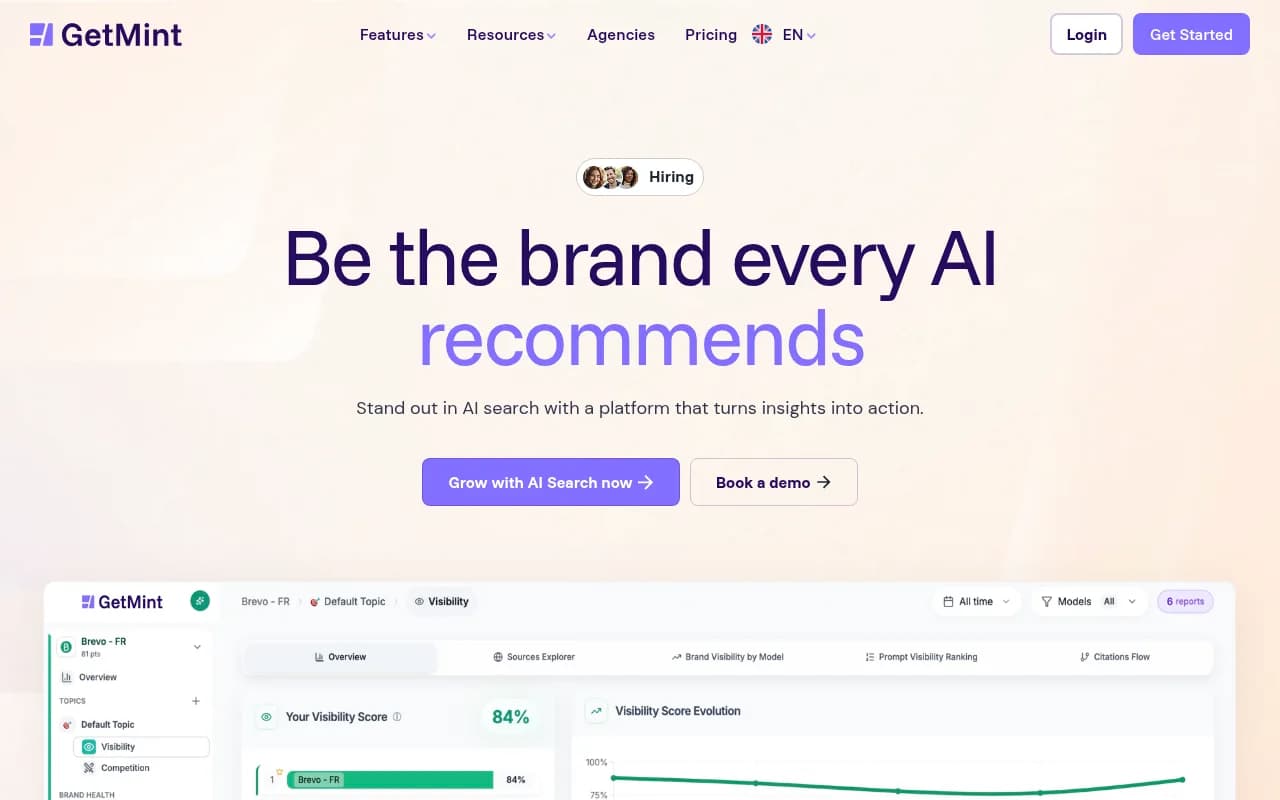
GetMint: the margin-of-error pitch
GetMint makes the boldest accuracy claim of the three. Its pricing page says a research team led by a PhD in mathematics builds frameworks and algorithms that correct each model's bias, and that every score ships with its margin of error.
I like the instinct. Most dashboards present a single number as if it were a measurement, when it is really a sample from a noisy process. Responses vary run to run, so an honest tool should say how noisy. A visibility score of 42 with a margin of plus or minus 3 is a different thing than a bare 42.
But I can't tell you whether the delivery matches the pitch. The research I drew on couldn't capture the pricing-page FAQ answer on how visibility is measured when answers change constantly, and I couldn't confirm whether GetMint uses API calls or UI scraping. The docs at docs.getmint.ai are the place to look.
What I can confirm on the Advanced plan: 300+ tracked prompts, 5 topics, 3 AI models, daily refresh, 10 competitors, 3 countries, 1 brand, unlimited users, and a 12-month commitment. Premium models cost extra. There is no API, Looker Studio, or Slack/Teams on that plan. Enterprise & Agency adds API access, custom models, and the full model list.
Two cautions. A 12-month commitment is a long time to test an accuracy claim you haven't verified. And the one comparison article I found mentioning GetMint's pricing is GetMint's own blog, so weigh it accordingly.
Peec AI: documented UI scraping
Peec AI is the most transparent of the three about how it collects data. Its docs say it uses UI scraping rather than official APIs, because API answers and cited sources can differ from what a real user sees. That is the right call for accuracy, and it's the same reasoning behind monitoring real interfaces.
The tradeoff is fragility. One critic (Authoritytech) points out that Peec's claim of resilience to API changes says nothing about resilience to interface changes, rate limits, or anti-automation measures. Fair point. A scraper that breaks quietly can leave gaps or stale data, so ask how Peec detects and flags failed collection runs.
On quality, a competitor's comparison (Analyze AI) says Peec tends to win on data fidelity and names it the winner on depth against Otterly. Treat that with the usual salt, since it comes from a rival, but it matches the general reviewer mood. Peec's Sources panel classifying domain and page type is useful for checking why a number moved, not just that it did.
Watch the model allowance. Peec's entry plan lists 50 prompts, a choice of 3 models, and 1 project, with extra models as add-ons that one review prices at $35 to $165 a month depending on plan. If you need Claude or Gemini, check whether they're in your plan before you compare scores with another tool.
Otterly.AI: cheap entry, narrower accuracy surface
Otterly is the one most people start with, at $29 a month. It tracks ChatGPT, AI Overviews, Perplexity, and Copilot on all plans, with Gemini, AI Mode, and Claude as paid add-ons. One review notes Claude alone can run up to $439 a month as an add-on, and that Grok, DeepSeek, and Meta AI aren't listed.
The $29 Lite plan gives 15 prompts, which AEO Labs calls a narrow window. Fifteen prompts is a small sample, and small samples are noisy no matter how good the collection is. For a real baseline, the $189 Standard plan with 100 prompts looks like the practical tier, and then the jump to $489 Premium is steep (HubSpot's words).
I couldn't confirm Otterly's collection method from primary documentation. A LinkedIn post lists it among tools scraping chat interfaces, but that's secondary. Ask them directly.
Otterly's own blog admits there is no native GA4 attribution dashboard, so you correlate with your analytics yourself. One Reddit user also advised checking automatic competitor detection before trusting any share figure. That's anecdotal, but the mechanism is real: if the tool tags the wrong brands as competitors, share of voice is wrong even when every individual answer was captured perfectly.
Where each tool is likely to be inaccurate
| Risk | GetMint | Peec AI | Otterly.AI |
|---|---|---|---|
| Method unknown or unverified | Yes, API vs UI unconfirmed | No, UI scraping documented | Yes, not in primary docs |
| Models missing on entry plan | Premium models extra | Only 3 of 6 core engines | Gemini, AI Mode, Claude extra |
| Small prompt sample | 300+ prompts on Advanced | 50 on entry | 15 on Lite |
| Auto-detected competitors | Unknown | Check | Check |
| Uncertainty shown | Margin of error claimed | Not advertised | Not advertised |
| Lock-in while you test | 12 months | Monthly, reportedly | Monthly, reportedly |
Notice what this table says: the biggest accuracy differences between these tools might not be in the algorithms at all. They're in what's included in the plan you can afford.
A 20-minute accuracy test before you pay
No benchmark exists, so build your own. This is adapted from advice by HubSpot, Arobis, and Authoritytech.
Step 1: pick 10 prompts you know the answer to
Use real buying questions where you can predict whether your brand should appear. Include a mix: branded, category, and competitor comparison prompts.
Step 2: run them by hand
Paste each into ChatGPT, Perplexity, and Gemini in the actual interfaces. Screenshot or save the answers. Score each 0 to 3: 3 for recommended first or cited directly, down to 0 for absent.
Step 3: compare to the tool's report
Run the same prompts through each tool's trial or demo. You are not looking for identical text, because answers vary. You're looking for the same pattern: same brands present, similar order, similar sources.
Step 4: ask for raw evidence
Authoritytech's suggestion is a good one: ask the vendor for 10 raw answers behind a single visibility score. Each should include the prompt, model, country, timestamp, full answer text, and cited sources. A vendor that can't produce this has a black box, not a measurement.
Step 5: validate against your own data
HubSpot recommends cross-referencing three sources: GA4 for AI-referred sessions, Search Console for any AI Overview impression data, and your manual spot checks. Tool-reported trends that never show up in GA4 deserve suspicion.
Step 6: check the competitor list
Open the auto-detected competitors and delete anything wrong. Do this before you read any share-of-voice number.
Questions to ask each vendor
- Do you collect from real interfaces or APIs, and how do you detect failed or blocked runs?
- How many times is each prompt run, and how is run-to-run variance handled?
- Which models, countries, and languages are in my exact plan, with no add-ons?
- Can I export raw responses and citations?
- (GetMint) How is the margin of error calculated, and can I see the method?
- (Otterly) What is the real-world workable prompt count for my category?
- (Peec) What happens when I exceed my prompt or model allowance?
An alternative worth including: Promptwatch
If your shortlist is built around accuracy, add one more option. Promptwatch monitors the real interfaces of ChatGPT, Google AI Overviews, Google AI Mode, Gemini, Perplexity, Copilot, and others per country and language, and its documentation on how it collects data is public. It also reads IP-verified AI crawler logs, which helps separate an access problem from a content problem, and the AI traffic it measures on your own site gives you a check against the dashboard numbers. Prompts run daily on every plan, with faster tracking on Business and above.

Pricing starts at $95 a month for Essential and $245 for Professional (confirm at promptwatch.com/pricing), with a 7-day free trial and a free AI visibility report if you want a no-commitment look. For a wider field, the GEO software directory at bestgeosoftware.com lists more options.
So which one for accuracy?
- Choose Peec AI if you want documented real-interface collection and the strongest reviewer reputation on fidelity, and you can live within its model allowance.
- Choose Otterly.AI if budget is tight and you want a baseline fast, but go in knowing 15 prompts is thin and key models are add-ons.
- Choose GetMint if the margin-of-error approach appeals and you can verify the methodology on a call before accepting a 12-month term.
- Consider Promptwatch if you want collection, crawler evidence, traffic measurement, and content workflows in one place.
My honest read: the margin-of-error idea is the most interesting claim here, and Peec's transparency is the most reassuring fact. Neither replaces the 20-minute test. Do it with your own prompts, and trust the vendor that shows its raw answers.
Note: prices and plan limits above come from vendor pages and third-party reviews and change often. Verify before buying.