Key takeaways
- Traditional Google rankings and AI search citations are powered by completely different mechanisms — ranking well in one does not guarantee visibility in the other.
- AI models select sources based on how often your brand appears across the web's "ingestion material," not where you rank in a SERP.
- Google AI Mode, announced at I/O 2026, operates on a citation model where trusted sources get surfaced even if they don't rank in the top 10 organically.
- According to Trustmary, AI visibility is up to 30 times harder to achieve than Google visibility — ChatGPT recommends only 1.2% of local businesses.
- The fix requires a different playbook: answer-focused content, offsite presence, and structured data — not just better SEO.
You've done everything right. Your site ranks on page one for your core keywords. Google Search Console shows healthy impressions and clicks. Your SEO team is happy.
Then someone asks ChatGPT or Perplexity a question that's squarely in your wheelhouse — and your brand isn't mentioned. A competitor you've never lost to in traditional search gets cited instead. You refresh the query a few times. Still nothing.
This isn't a fluke. It's a structural problem, and it's affecting brands across almost every industry right now.
The two systems don't share the same logic
Google's traditional search engine and AI search engines (including Google's own AI Mode) are fundamentally different machines. Understanding why requires a quick look at what each one actually does.
Traditional Google search crawls the web, indexes pages, and ranks them based on signals like backlinks, page authority, content relevance, and user engagement. If you've optimized for those signals, you show up. The relationship between effort and outcome is relatively predictable.
AI search engines work differently. They don't just retrieve documents — they synthesize answers from a wide range of sources and decide which brands, products, or entities to mention in that answer. The question isn't "which page ranks highest?" It's "which sources does the model trust enough to cite?"
As one Reddit commenter in r/digital_marketing put it bluntly: "For AI, it has much, much less to do with where your brand is ranking, than how many times it appears in ingestion material that is ranking."
That's the core of the problem. AI models are trained on and retrieve from a corpus of content that includes not just your website, but Reddit threads, review sites, YouTube videos, industry publications, listicles, and third-party directories. If your brand appears frequently and authoritatively across that broader ecosystem, you get cited. If you've only optimized your own site, you're largely invisible.
What Google AI Mode actually is (and why it changes things)
At Google I/O 2026, Google announced a significant expansion of AI Mode — its AI-powered search experience that generates synthesized answers rather than a traditional list of blue links. Elizabeth Reid, VP of Search at Google, described it as "the next step in bringing together the best of a search engine with the best of AI."
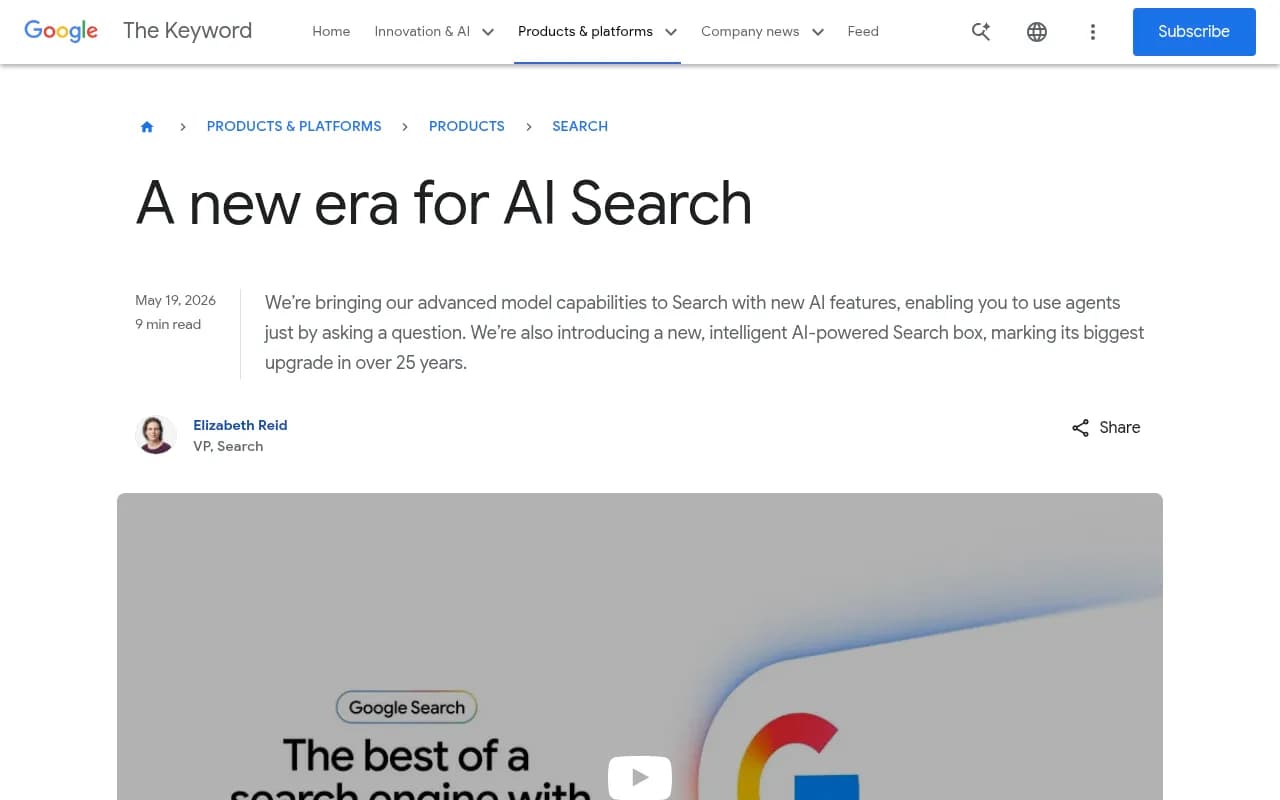
AI Mode now handles complex, multi-step queries through what Google calls "agent" behavior — it can break a question into sub-queries, gather information from multiple sources, and return a synthesized response. The implications for brand visibility are significant.
According to Semrush's analysis of AI Mode: "In AI Mode, visibility comes from citations, not first-page rankings. Google's AI selects trusted sources, even if they don't rank in the top 10."
Read that again. You can rank #1 organically and still not get cited in AI Mode. And a competitor who ranks #7 — but who has more authoritative mentions across the web — might get cited instead.
The click collapse problem
Before we get into the mechanics of why this gap exists, it's worth understanding why it matters so much commercially.
Pew Research found that users click traditional search results only 8% of the time when an AI summary appears. With AI Overviews now appearing on a large share of queries, the traffic that used to flow to your website from search is being intercepted at the answer layer. If you're not in that answer, you're not just missing a citation — you're missing the customer entirely.
This is the visibility gap in its most concrete form: your brand exists in Google's index, but it doesn't exist in the AI layer where buying decisions are increasingly being shaped.
Why the gap is so wide
Several factors explain why brands that perform well in traditional search struggle in AI search.
Citation frequency beats ranking position
AI models are trained on large corpora of web content. When a model learns about a topic, it absorbs which brands appear most frequently and in what context. A brand that's mentioned in 50 industry articles, 20 Reddit threads, and a handful of YouTube reviews will be more "known" to the model than a brand with a perfectly optimized website but minimal third-party presence.
This is a fundamentally different problem than SEO. You can't solve it just by improving your own pages.
AI models favor answer-shaped content
Traditional SEO rewards content that matches keyword intent and earns backlinks. AI models favor content that directly answers questions — clearly, specifically, and in a format that can be extracted and cited.
If your content is structured around keyword density and internal linking but doesn't actually answer the questions users are asking AI engines, it won't get cited. The models are looking for the clearest, most direct answer to a specific question. Vague, keyword-stuffed pages don't make the cut.
The platform gap is enormous
Data from 79 Development's State of AI Search 2026 report found a 46x gap in citation rates between AI platforms for the same brand and content. In other words, a brand might be cited regularly by Perplexity but almost never by ChatGPT — or vice versa. If you're only tracking one platform, you're missing most of the picture.
This matters because different AI engines have different training data, retrieval mechanisms, and citation preferences. Google AI Mode pulls from Google's index. Perplexity does real-time web retrieval. ChatGPT uses a combination of training data and browsing. Each has its own logic.
The difficulty gap is real
Trustmary's research puts it starkly: AI visibility is up to 30 times harder to achieve than Google visibility. ChatGPT recommends only 1.2% of local businesses in its responses. The bar for getting cited is much higher than the bar for ranking.
Part of this is structural — AI models generate synthesized answers and don't need to cite many sources to answer a question. Part of it is competitive — the brands that are getting cited are the ones that have been building offsite presence and answer-focused content for longer.
What AI search engines actually look for
If traditional SEO signals don't translate directly, what does matter for AI visibility?
Breadth of web presence
Your brand needs to appear across a wide range of sources that AI models ingest. This includes third-party review sites, industry publications, comparison pages, Reddit discussions, YouTube content, and directories. The more places your brand is mentioned in a positive, informative context, the more likely AI models are to surface it.
Structured, answer-ready content
Content that answers specific questions clearly tends to get cited. This means FAQ sections, how-to guides, comparison articles, and definitional content. If someone asks an AI "what's the best tool for X?" and your site has a detailed, well-structured page explaining exactly how you solve X, that page is a candidate for citation.
Entity recognition and structured data
AI models think in terms of entities — brands, products, people, places. If your brand is clearly defined as an entity across the web (consistent name, description, category, and attributes), models are more likely to recognize and cite it. Schema markup, Google Business Profile completeness, and consistent NAP (name, address, phone) data all contribute to this.
Trust signals from third-party sources
Reviews on Trustpilot, G2, Capterra, and similar platforms matter more for AI visibility than most brands realize. These platforms are heavily indexed and frequently cited by AI models when answering product or service questions. If your review presence is thin, your AI visibility will be too.
The content gap most brands are missing
Here's something that doesn't get talked about enough: AI models are answering questions that your website probably isn't answering.
When someone asks ChatGPT "what's the best [category] tool for [use case]?" the model is looking for content that addresses that exact combination. Most brand websites are built around what the brand wants to say, not around the specific questions AI users are asking. That mismatch is a content gap — and it's one of the most actionable things you can fix.
Identifying these gaps requires looking at what prompts AI models are actually responding to in your category, what competitors are being cited for, and what questions your content doesn't currently answer. Tools like Promptwatch can surface these gaps directly, showing you which prompts competitors are visible for but you're not.

A practical framework for closing the gap
This isn't a problem you solve overnight, but there's a clear sequence of actions that works.
Step 1: Audit your current AI visibility
Before you can fix anything, you need to know where you stand. Run your brand name and key category queries across ChatGPT, Perplexity, Google AI Mode, and Gemini. Note when you appear, when you don't, and who's getting cited instead.
Several tools can automate this across multiple platforms:
Otterly.AI

Profound


Step 2: Map the content gaps
Compare what AI models are saying about your category against what your website actually covers. Where are the gaps? Which questions are being answered by competitors but not by you? This is where the real work starts.
Step 3: Create answer-focused content
Write content that directly answers the questions AI models are fielding. This means:
- Specific comparison pages ("X vs Y for [use case]")
- FAQ content that mirrors how people actually prompt AI engines
- Category explainers that establish your brand's authority on a topic
- Use case pages that match the intent behind common AI queries
The goal isn't to game the model — it's to genuinely be the best answer to the questions your customers are asking.
Step 4: Build offsite presence
Publish on platforms that AI models trust and cite. This includes:
- Guest articles in industry publications
- Active participation in relevant Reddit communities (genuinely helpful, not promotional)
- YouTube content that answers category questions
- Getting listed on comparison and review platforms
- Building out your presence on G2, Capterra, Trustpilot, and similar sites
Step 5: Track what's working
AI visibility changes as models update, new content gets indexed, and competitors adjust their strategies. You need ongoing monitoring to see which pages are being cited, which prompts you're winning, and where you're still losing ground.
Comparing your options for tracking AI visibility
There are now quite a few tools in this space. Here's how the main options compare:
| Tool | Monitors AI engines | Content gap analysis | Content generation | Crawler logs | Best for |
|---|---|---|---|---|---|
| Promptwatch | 10+ engines | Yes | Yes (AI agents) | Yes | Full optimization loop |
| Profound | 9+ engines | Partial | No | No | Enterprise monitoring |
| Otterly.AI | ChatGPT, Perplexity, AI Overviews | No | No | No | Basic monitoring |
| Rankshift | ChatGPT, Perplexity, AI search | No | No | No | Lightweight tracking |
| Peec AI | Multiple engines | No | No | No | Marketing teams |
| AthenaHQ | Multiple engines | No | No | No | Monitoring-focused |
The key distinction is between tools that show you data and tools that help you act on it. Monitoring-only tools are useful for awareness, but they leave you to figure out the fix yourself. Platforms that combine gap analysis with content generation close the loop faster.


The mindset shift that matters most
The brands winning in AI search in 2026 aren't necessarily the ones with the best SEO. They're the ones who understood early that AI search is a different game with different rules.
Traditional SEO is about optimizing your own pages for Google's ranking algorithm. AI search optimization is about being the most credible, most frequently mentioned, most clearly answer-ready source across the entire web ecosystem that AI models draw from.
Your Google rankings are still valuable — they contribute to the broader web presence that AI models ingest. But they're not sufficient on their own. The brands that treat AI visibility as a separate discipline, with its own tracking, its own content strategy, and its own distribution channels, are the ones building durable presence in the places where their customers are increasingly making decisions.
The gap between Google visibility and AI visibility is real, it's measurable, and it's fixable. But it requires acknowledging that the playbook has changed.
The brands that figure this out now have a meaningful window. AI search is still early enough that the citation landscape isn't fully locked in. The brands building presence today are the ones that will be hardest to displace when AI search becomes the default way people find products and services.
That window won't stay open forever.