LangWatch Review 2026
LangWatch is an end-to-end AI agent testing, LLM evaluation, and observability platform used by thousands of AI engineering teams. It helps developers stress-test agents pre-production with synthetic simulations, run batch evaluations, monitor live LLM interactions, and optimize prompts using DSPy—a
Key Takeaways:
- Action-oriented testing platform: Unlike monitoring-only tools, LangWatch combines agent simulations, batch evaluations, prompt management, and DSPy optimization to help teams ship reliable AI systems
- Agent simulation engine: Run thousands of synthetic multi-turn conversations across scenarios, languages, and edge cases to catch issues before production
- OpenTelemetry-native: Works with any LLM framework (LangChain, DSPy, CrewAI, Pydantic AI, LiteLLM) and model provider without vendor lock-in
- Best for: AI engineering teams, ML engineers, and product teams building complex agentic AI systems that need systematic testing and quality assurance
- Pricing: Free developer plan available; paid plans from €59/month with unlimited evaluations and enterprise features
LangWatch is an AI agent testing and LLM evaluation platform built for teams shipping production AI systems. Founded as an open-source project (5,000+ GitHub stars), it's now used by thousands of AI developers who need more than basic monitoring—they need a systematic way to test, evaluate, and optimize AI agents before and after deployment. The platform addresses a critical gap in the AI development workflow: most teams still test agents manually or rely on one-off prompt tweaks, which doesn't scale when you're building complex multi-step agentic systems.
The core insight behind LangWatch is that reliable AI requires a continuous quality loop—define evaluations, run experiments, test with simulations, monitor production behavior, then feed learnings back into the next iteration. This mirrors how traditional software engineering works (unit tests, integration tests, monitoring) but adapted for the unique challenges of LLM-based systems: non-deterministic outputs, multi-turn conversations, tool usage, and hallucination risks.
LangWatch is particularly strong for teams building agentic AI—systems where LLMs make decisions, call tools, and handle multi-step workflows. If you're building a customer support bot, a coding assistant, a research agent, or any AI that does more than simple question-answering, LangWatch gives you the infrastructure to ship it reliably.
Agent Simulations (Synthetic Testing)
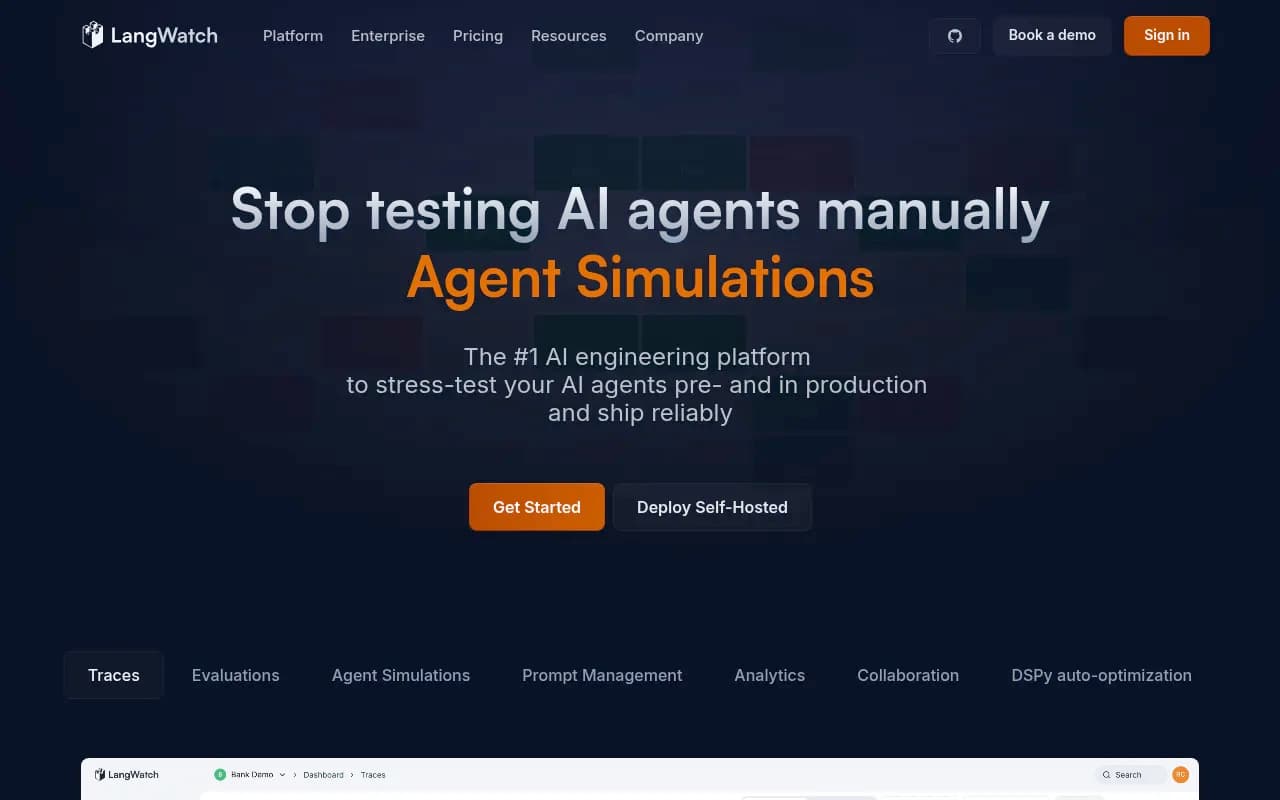
The standout feature is agent simulations—LangWatch can generate thousands of synthetic user conversations to stress-test your agent across scenarios you define. You specify personas (e.g. "frustrated customer with billing issue", "developer asking about API rate limits"), edge cases ("user switches languages mid-conversation", "asks for something outside the agent's scope"), and success criteria ("agent resolves issue in under 3 turns", "never hallucinates pricing information"). LangWatch then spins up simulated users powered by LLMs and runs full multi-turn conversations against your agent.
This is fundamentally different from batch evaluations on static datasets. Agent simulations test the full interactive loop—how your agent handles follow-up questions, clarifications, tool failures, and conversational dead-ends. You can test voice agents (multimodal), RAG pipelines, and complex tool-calling workflows. The platform tracks which tools the agent used, whether it stayed on-task, and whether it met your quality criteria. Most competitors (Langfuse, Arize Phoenix, Humanloop) don't offer this level of synthetic interaction testing—they focus on logging and analyzing real production traces.
LLM Evaluations (Custom Evals)
LangWatch includes a full evaluation framework for measuring quality specific to your product. You can create custom evals using LLM-as-a-judge (GPT-4, Claude, or your own model), rule-based checks (regex, keyword matching), or code-based evaluators (Python functions). The platform ships with pre-built evals for common concerns—hallucination detection, toxicity, PII leakage, prompt injection attempts, RAG relevance, answer correctness—but the real power is in defining evals that match your business logic.
For example, if you're building a medical advice chatbot, you might create an eval that checks whether the agent always includes a disclaimer, never recommends specific medications without context, and cites sources for medical claims. You define the eval once, then LangWatch automatically runs it across all your test cases, experiments, and production traffic. The evaluation wizard helps non-technical team members (product managers, domain experts) create evals without writing code.
Evals run in three contexts: during development (instant feedback in the UI), in batch experiments (compare prompt versions or model changes), and in production (auto-evals that flag issues in real-time). This closes the loop between testing and monitoring—your test suite becomes your production quality gate.
LLM Observability (Trace Inspection)
LangWatch provides full observability into every LLM interaction. When you integrate the SDK (Python or TypeScript), it captures traces—complete records of inputs, outputs, token usage, latency, tool calls, and intermediate steps. You can search and filter traces by user ID, session, model, cost, latency, or custom metadata. Click into any trace to see the full conversation tree, including nested LLM calls (e.g. agent calls a summarization model, which calls an embedding model).
The trace view shows exactly what happened: which prompt template was used, what the model returned, which tools were invoked, and where failures occurred. This is critical for debugging production issues—when a user reports "the agent gave me wrong information", you can pull up the exact trace and see what went wrong. The platform is OpenTelemetry-native, so traces integrate with your existing observability stack (Datadog, Grafana, etc.) if needed.
Unlike basic logging tools, LangWatch's observability is evaluation-aware. Each trace shows which evals passed or failed, so you can filter for "all traces where hallucination eval failed" or "traces with latency over 5 seconds". This makes it easy to spot patterns—maybe your agent hallucinates more often when users ask follow-up questions, or when the RAG retrieval returns low-confidence results.
Prompt Management & Experimentation
LangWatch includes a prompt management system with versioning, A/B testing, and feature-flag-style rollouts. You define prompt templates in the UI (with variables, few-shot examples, and system instructions), then deploy them to your application via the SDK. When you want to test a new prompt, you create a variant, run batch evaluations to compare performance, then gradually roll it out (e.g. 10% of traffic, then 50%, then 100%).
The platform tracks every prompt change with full audit trails—who changed it, when, and what the impact was on key metrics (eval pass rates, latency, cost). This is especially valuable for regulated industries (healthcare, finance) where you need to prove what version of the prompt was live at any given time. You can also roll back to previous versions instantly if a new prompt causes issues.
Prompt experiments run alongside model experiments—you can test GPT-4 vs Claude 3.5 Sonnet, or compare different temperature settings, all within the same framework. LangWatch automatically runs your full eval suite against each variant and shows you which combination performs best.
DSPy Optimization Studio
LangWatch integrates DSPy (Declarative Self-improving Language Programs), a framework for systematically optimizing prompts and pipelines. Instead of manually tweaking prompts, you define the task, provide examples of good outputs, and let DSPy search for better prompt formulations. LangWatch's Optimization Studio provides a UI for running DSPy optimizers (BootstrapFewShot, MIPRO, etc.) and tracking results.
This is particularly powerful for RAG systems—DSPy can optimize the retrieval query, the re-ranking logic, and the final answer generation prompt all at once. The platform shows you before/after comparisons on your eval suite, so you can see exactly how much the optimization improved quality. This feature is rare among LLMops platforms—most competitors don't offer any automated optimization beyond basic prompt suggestions.
Dataset Management & Human-in-the-Loop
LangWatch lets you convert production traces into reusable test datasets. You can tag interesting traces ("edge case", "good example", "failure"), annotate them with expected outputs, then add them to your regression test suite. This creates a flywheel: production issues become test cases, which prevent regressions in future releases.
The platform supports collaborative data review—domain experts can label traces, flag issues, and provide feedback without needing to understand the underlying code. Product managers can mark traces as "good" or "bad", and those labels feed into evals and fine-tuning datasets. This human-in-the-loop workflow is critical for improving AI systems over time—automated evals catch obvious issues, but human judgment is needed for nuanced quality problems.
Integrations & Developer Experience
LangWatch is OpenTelemetry-native and integrates with every major LLM framework: LangChain, LangGraph, DSPy, CrewAI, Pydantic AI, LiteLLM, Agno, Mastra, Langflow, n8n. The Python and TypeScript SDKs are lightweight (one-line integration in many cases) and don't require you to rewrite your code. You can also use the OpenTelemetry SDK directly if you prefer.
The platform works with all model providers—OpenAI, Anthropic, Google Gemini, AWS Bedrock, Azure OpenAI, open-source models via Ollama or vLLM. There's no vendor lock-in—you can export all your data (traces, evals, datasets) and run LangWatch self-hosted if needed. The self-hosted version is fully open-source (GitHub repo with 5,000+ stars) and can be deployed on-prem, in your VPC, or air-gapped.
LangWatch also provides a REST API for programmatic access—you can trigger batch evaluations from your CI/CD pipeline, query traces for custom analytics, or build internal dashboards on top of LangWatch data. The platform integrates with Looker Studio for custom reporting.
Analytics & Collaboration
The analytics dashboard shows aggregate metrics across all your AI features: total traces, eval pass rates, average latency, cost per conversation, most common failure modes. You can slice by time period, model, user segment, or custom tags. This gives product and engineering leaders visibility into AI system health without needing to dig through individual traces.
LangWatch is built for cross-functional collaboration. Engineers run evals and debug traces. Data scientists optimize prompts with DSPy. Product managers review production conversations and define success criteria. Domain experts label data and validate outputs. Everyone works in the same platform with role-based access controls, so there's a single source of truth for AI quality.
Who Is LangWatch For?
LangWatch is best suited for AI engineering teams building production agentic systems—companies where AI is a core product feature, not a side experiment. Typical users include SaaS companies building AI copilots, customer support automation platforms, developer tools with AI assistants, and enterprises deploying internal AI agents. Team size ranges from 3-person startups to 100+ person AI teams at larger companies.
The platform shines for teams that have moved beyond simple chatbots and are now dealing with multi-step agents, tool usage, RAG pipelines, and complex conversation flows. If your agent needs to call APIs, query databases, handle multi-turn conversations, or make decisions based on context, LangWatch gives you the testing and monitoring infrastructure to ship it reliably.
It's also a strong fit for teams in regulated industries (healthcare, finance, legal) where you need audit trails, compliance controls, and systematic quality assurance. The platform is ISO 27001 and SOC2 certified, supports on-prem deployment, and provides role-based access controls.
LangWatch is less relevant if you're just experimenting with LLMs or building simple one-shot prompts. For early-stage prototyping, the free developer plan works fine, but the real value comes when you're shipping to production and need systematic testing, monitoring, and optimization.
Pricing & Value
LangWatch offers a free developer plan with unlimited traces, basic evaluations, and access to the core platform. Paid plans start at €59/month (Professional) and include unlimited evaluations, agent simulations, DSPy optimization, and advanced analytics. Enterprise plans (custom pricing) add on-prem deployment, SSO, dedicated support, and SLA guarantees.
Compared to competitors, LangWatch is competitively priced. Langfuse charges $39-$99/month for similar features but lacks agent simulations and DSPy optimization. LangSmith (from LangChain) starts at $39/month but has more restrictive usage limits. Humanloop is $99-$299/month and focuses more on prompt management than testing. Arize Phoenix is open-source but requires significant DevOps effort to self-host and lacks the agent simulation capabilities.
The value proposition is strongest for teams that would otherwise build their own testing infrastructure. LangWatch replaces 3-4 internal tools: a trace logging system, an evaluation framework, a prompt versioning system, and a synthetic testing harness. For a mid-sized AI team, that's easily 2-3 months of engineering time saved, which justifies the cost many times over.
Strengths
- Agent simulations are unique: No other platform offers this level of synthetic multi-turn conversation testing. This is a game-changer for teams building complex agents.
- End-to-end workflow: LangWatch covers the full loop from development to production—most competitors are strong in one area (monitoring or testing) but weak in others.
- Open-source and self-hostable: You're not locked into a vendor. The self-hosted version is production-ready and actively maintained.
- DSPy integration: Automated prompt optimization is rare in LLMops tools. LangWatch makes it accessible to teams that don't have ML researchers on staff.
- Cross-functional collaboration: The platform is designed for engineers, data scientists, product managers, and domain experts to work together—not just a tool for developers.
Limitations
- Newer platform: LangWatch is younger than Langfuse or LangSmith, so the ecosystem and community are smaller. Fewer third-party integrations and tutorials.
- Learning curve for advanced features: Agent simulations and DSPy optimization are powerful but require some ramp-up time. Teams used to simple logging tools may find the feature set overwhelming at first.
- Limited fine-tuning support: LangWatch helps you create datasets for fine-tuning but doesn't handle the actual fine-tuning workflow. You'll need to export data and use another tool (OpenAI fine-tuning API, Hugging Face, etc.).
Bottom Line
LangWatch is the best choice for AI engineering teams that need systematic testing and quality assurance for production agentic systems. If you're building multi-step agents, handling complex conversations, or shipping AI features where reliability matters, LangWatch gives you the infrastructure to test thoroughly, monitor continuously, and optimize systematically. The agent simulation engine alone is worth the price for teams that would otherwise test manually. Best use case in one sentence: AI teams building production agents that need to stress-test with synthetic users, prevent regressions, and maintain quality at scale.
Frequently asked questions
What is LangWatch and what does it do?
Who is LangWatch best for?
How much does LangWatch cost?
Is LangWatch free to use?
What LLM frameworks and providers does LangWatch work with?
How does LangWatch test AI agents?
What makes LangWatch different from other AI monitoring tools?
Can LangWatch prevent AI agent regressions?
Similar and alternative tools to LangWatch