Remesh Review 2026
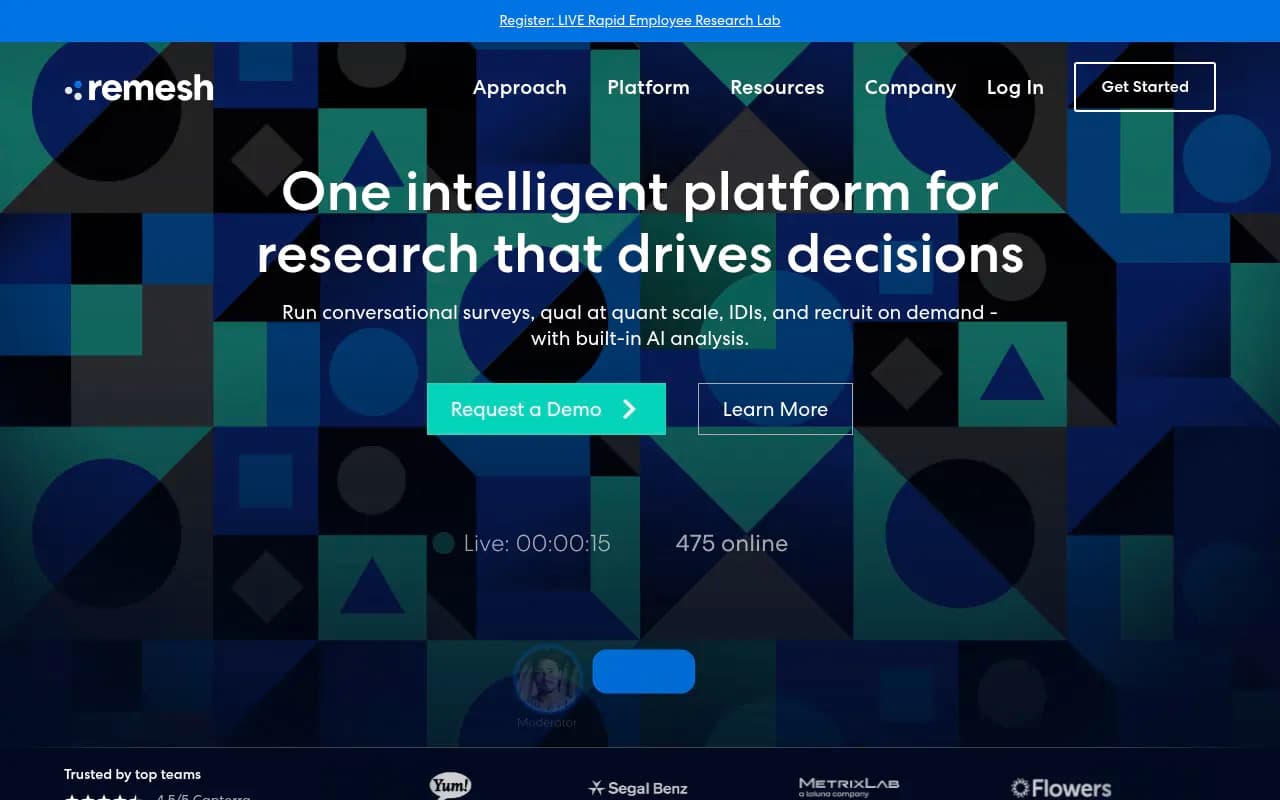
Remesh is an AI-powered hybrid insights platform that enables teams to run live digital focus groups, conversational surveys, and in-depth interviews with hundreds or thousands of participants simultaneously. Combining qualitative depth with quantitative scale, it delivers real-time analysis, multil
Summary
- Best for: Market researchers, brand strategists, employee experience teams, and agencies needing qualitative insights at quantitative scale
- Standout capability: Live collective dialogue sessions where hundreds of participants respond and vote on each other's answers in real-time, surfacing consensus and divergence instantly
- Key differentiator: Combines focus group depth with survey scale -- run sessions with 50-1000+ participants that feel conversational, not transactional
- Honest limitation: Premium pricing (starting around $3,500 per project) puts it out of reach for small teams and individual researchers
- Bottom line: If you need to understand why people think what they think -- not just what they think -- and you need those insights fast, Remesh delivers a research experience that traditional surveys and focus groups can't match
Remesh is a hybrid insights platform built for teams that need qualitative depth without sacrificing speed or scale. Founded over a decade ago, the platform has evolved into an AI-native research tool used by major brands like Nestlé, Yum! Brands, Barclays, and NASCAR. The core promise: run live conversational research sessions with your audience -- customers, employees, constituents -- and get analysis-ready insights in hours, not weeks.
The platform targets market researchers, brand strategists, UX teams, employee experience professionals, political campaigns, and research agencies. It's particularly strong for organizations that have moved beyond basic surveys but find traditional focus groups too slow, too small, or too expensive to run at the frequency modern decision-making demands. If you're testing messaging, exploring brand perceptions, uncovering employee pain points, or validating product concepts, Remesh offers a middle ground between the richness of qual and the statistical confidence of quant.
Collective Dialogue: The Core Innovation
Remesh's signature feature is Collective Dialogue -- live, moderated research sessions where participants don't just answer questions in isolation. They respond to prompts, then vote on each other's answers. This creates a dynamic where the most resonant ideas surface naturally through peer validation. You see not just what one person thinks, but what the group collectively agrees or disagrees with.
In practice, this means you can ask an open-ended question like "What frustrates you most about our checkout process?" and get hundreds of unique responses. Participants then vote on which responses resonate most with their own experience. Remesh's AI clusters similar responses and calculates Percent Agree Scores -- a proprietary metric showing how much consensus exists around each theme. You're not reading 500 verbatims hoping to spot patterns; the platform surfaces the patterns for you in real-time.
Sessions can run live (synchronous, 60-90 minutes) or asynchronous (participants join over several days). Live sessions feel like a digital town hall -- you're moderating in real-time, probing deeper on interesting threads, pivoting questions based on what you're seeing. Asynchronous sessions work better for hard-to-reach audiences (busy executives, shift workers, global time zones) and allow more thoughtful, considered responses.
AI-Powered Analysis That Actually Saves Time
Remesh's AI analysis tools go beyond basic sentiment tagging. The platform automatically groups similar responses into themes, generates summaries by segment (e.g. compare Gen Z vs Millennials, or customers vs non-customers), and highlights key quotes that represent broader sentiment. You can ask the AI assistant questions like "What are the top concerns among female respondents aged 25-34?" and get instant answers grounded in the session data.
The auto-moderation feature flags low-quality responses (gibberish, off-topic answers, suspected bots) in real-time, maintaining data integrity without manual review. Translation across 35+ languages happens automatically -- participants respond in their native language, you moderate in yours, and the AI handles the rest. According to Remesh, this delivers culturally relevant insights 250% faster than traditional translation workflows.
Unlike platforms that dump raw transcripts and leave you to figure out the rest, Remesh's analysis is designed to get you from data to decision in one sitting. You can export polished reports with charts, quotes, and segment breakdowns ready to share with stakeholders.
Research Design Support and Flexibility
Remesh offers three service models: self-serve (you design and run everything), supported (their team helps with setup and moderation), and fully managed (they handle the entire project). This flexibility matters because not every team has a dedicated research ops function. Agencies and consultancies often run self-serve; internal brand teams lean on supported or managed services.
The platform includes an AI assistant that helps refine your research questions, suggests follow-up prompts, and flags potential biases in your discussion guide. There's also a simulated practice environment where you can test your session flow with AI-generated responses before going live with real participants. This reduces the risk of poorly worded questions or confusing logic flows derailing a $5,000 research project.
Participant Recruitment: On-Platform or BYOP
Remesh offers on-platform recruitment from a vetted panel with an average sub-3% removal rate (participants flagged for poor quality or fraudulent behavior). You can target by demographics, psychographics, behaviors, and custom screeners. Alternatively, you can bring your own participants (BYOP) -- useful if you're surveying employees, existing customers, or a proprietary community.
The recruitment quality is a major differentiator vs cheaper panel providers. Remesh's vetting process includes behavioral checks, response quality monitoring, and fraud detection. You're not dealing with bots or professional survey takers gaming the system for incentives.
Conversational Surveys and Video IDIs
Beyond live dialogues, Remesh supports conversational surveys (asynchronous, AI-moderated) and in-depth video interviews (IDIs). Conversational surveys feel more natural than traditional surveys -- questions adapt based on previous answers, and the AI can probe deeper when it detects interesting signals. Video IDIs allow one-on-one interviews at scale, with AI transcription and thematic analysis built in.
This makes Remesh a true hybrid platform -- you're not locked into one methodology. You can run a live dialogue to explore broad themes, then follow up with video IDIs to go deeper with specific personas.
Integrations and Workflow
Remesh integrates with common research and analytics tools, though the specifics aren't heavily marketed. The platform exports data to Excel, PowerPoint, and PDF. There's no mention of direct integrations with CRMs, data warehouses, or BI tools like Tableau -- this is a research platform, not a data pipeline. If you need to push Remesh data into your broader analytics stack, expect manual exports or custom API work.
Who Should Use Remesh
Remesh is ideal for:
- Brand and marketing teams at mid-to-large companies testing messaging, exploring brand perceptions, or validating campaign concepts before launch. If you're spending six figures on a rebrand, a $5K Remesh session to pressure-test positioning is a rounding error.
- Employee experience and HR teams uncovering why engagement scores are dropping, understanding frontline worker frustrations, or exploring DEI perceptions. The anonymity and scale of Remesh sessions often surface issues that don't come up in one-on-one interviews or engagement surveys.
- Research agencies and consultancies running client projects. The platform's white-label capabilities and flexible service model make it easy to incorporate into existing workflows.
- Political campaigns and advocacy groups gauging voter sentiment, testing messaging, or building consensus around policy positions. The speed and scale are particularly valuable in fast-moving campaign environments.
- Product and UX teams exploring user pain points, testing concepts, or prioritizing feature requests. Remesh won't replace usability testing, but it's excellent for understanding the "why" behind user behavior at scale.
Who Should NOT Use Remesh
Remesh is overkill (and overpriced) for:
- Small businesses and solopreneurs who need quick feedback on a landing page or product idea. At $3,500+ per project, you're better off with a $50 UserTesting session or a free Google Form.
- Teams that only need quantitative data. If you just want to know "Do 60% of users prefer Option A?" a traditional survey tool like Qualtrics or SurveyMonkey is faster and cheaper.
- Academic researchers on tight budgets. Remesh is priced for commercial use cases, not grant-funded studies.
- Anyone expecting a DIY freemium tool. There's no free tier, no self-service trial. You're scheduling a demo and getting a custom quote.
Pricing and Value
Remesh pricing is project-based, starting around $3,500 per session according to third-party sources. Exact pricing depends on participant count, session complexity, recruitment needs, and service level (self-serve vs managed). There's no public pricing page -- you're scheduling a demo and getting a custom quote based on your use case.
For context, a traditional in-person focus group with 8-10 participants costs $5,000-$10,000 (facility rental, recruiting, moderator fees, transcription, analysis). A Remesh session with 200 participants delivers far more statistical confidence and thematic richness for roughly the same cost. The value proposition is clear if you're already spending on qual research.
That said, the lack of transparent pricing and the high entry point are barriers for smaller teams. If you're a startup or small agency, you're likely priced out unless you're running a high-stakes project.
Strengths
- Qualitative depth at quantitative scale: Run focus groups with 500 people. This is Remesh's killer feature -- no other platform does this as well.
- Real-time consensus metrics: Percent Agree Scores and voting mechanics surface what resonates across the group, not just individual opinions.
- AI analysis that actually works: Thematic clustering, segment comparisons, and instant summaries save hours of manual coding.
- Multilingual support: 35+ languages with automatic translation. Rare in the research space and genuinely useful for global brands.
- Flexible service model: Self-serve, supported, or fully managed. You're not forced into one workflow.
- High data quality: Vetted panels with sub-3% removal rates. You're not dealing with bots or low-effort responses.
Limitations
- Premium pricing with no transparency: Starting at $3,500+ per project, and you can't see pricing without a sales call. This limits accessibility and makes it hard to budget.
- No free trial or freemium tier: You can't test the platform before committing to a paid project. The simulated practice environment helps, but it's not the same as running a real session.
- Limited integrations: No direct connectors to CRMs, data warehouses, or BI tools. If you need Remesh data in your broader analytics stack, expect manual work.
- Overkill for simple use cases: If you just need a quick poll or basic survey, Remesh is too much platform (and too much cost).
- Learning curve for self-serve users: The platform is user-friendly, but designing effective research sessions still requires skill. First-time users will lean heavily on support resources.
Bottom Line
Remesh is the best-in-class platform for running qualitative research at quantitative scale. If you need to understand the "why" behind customer behavior, employee sentiment, or brand perception -- and you need those insights fast -- Remesh delivers a research experience that traditional methods can't match. The combination of live collective dialogue, AI-powered analysis, and flexible service models makes it a powerful tool for brands, agencies, and organizations that take insights seriously.
The premium pricing and lack of transparency are real barriers, but if you're already spending on qual research, Remesh often delivers better ROI than traditional focus groups. It's not for everyone -- small teams and budget-conscious researchers should look elsewhere -- but for mid-to-large organizations that need actionable insights at speed, Remesh is worth the investment.
Best use case in one sentence: Run a live dialogue with 200+ customers to explore why your rebrand messaging isn't landing, get AI-analyzed themes and consensus scores in real-time, and walk into your Monday strategy meeting with clear direction.
Tags:
Similar and alternative tools to Remesh