SEOmonitor Review 2026
SEO agency platform that has expanded into AI visibility tracking, helping teams monitor brand presence in ChatGPT and other AI-generated search results.
Key takeaways
- SEOmonitor is a mature SEO agency platform that has expanded into AI search visibility tracking, covering Google, AI Overviews, ChatGPT, Gemini, and Perplexity in a single dashboard
- Its core differentiator is a keyword-based methodology: instead of tracking AI prompts separately, it maps your existing keyword strategy across all channels simultaneously
- Includes a genuinely capable AI content writing agent that handles topic discovery, drafting, fact-checking, and CMS publishing -- with published performance data to back it up
- Lacks the optimization depth of dedicated GEO platforms: no AI crawler logs, no content gap (Answer Gap) analysis, no Reddit/YouTube citation tracking, no ChatGPT Shopping monitoring, and no AI traffic attribution -- capabilities that Promptwatch provides
- Best fit for SEO agencies that want to add AI visibility reporting to an existing SEO workflow without switching tools; less suited for teams whose primary need is understanding and improving AI search presence specifically
SEOmonitor has been around long enough to have earned real credibility in the agency SEO space. The Romanian company built its reputation on rank tracking and forecasting, and its client list -- Vodafone, Publicis, Gymshark, TUI, Marks & Spencer, Miro -- reflects genuine enterprise adoption. The platform's G2 rating of 4.7/5 is consistent with what you'd expect from a tool that agencies actually use day-to-day rather than just evaluate.
The AI visibility features are a more recent addition, and the framing is interesting: SEOmonitor argues that tracking AI prompts separately is the wrong approach. Their position is that keywords already capture the intent behind thousands of long-tail prompts, and that prompt-based tracking lacks verified demand data. It's a defensible argument, and it makes the unified dashboard genuinely useful for agencies that don't want to manage two separate workflows. Whether it's the right approach for teams specifically trying to optimize their AI search presence is a different question.
Key features
Unified organic performance dashboard
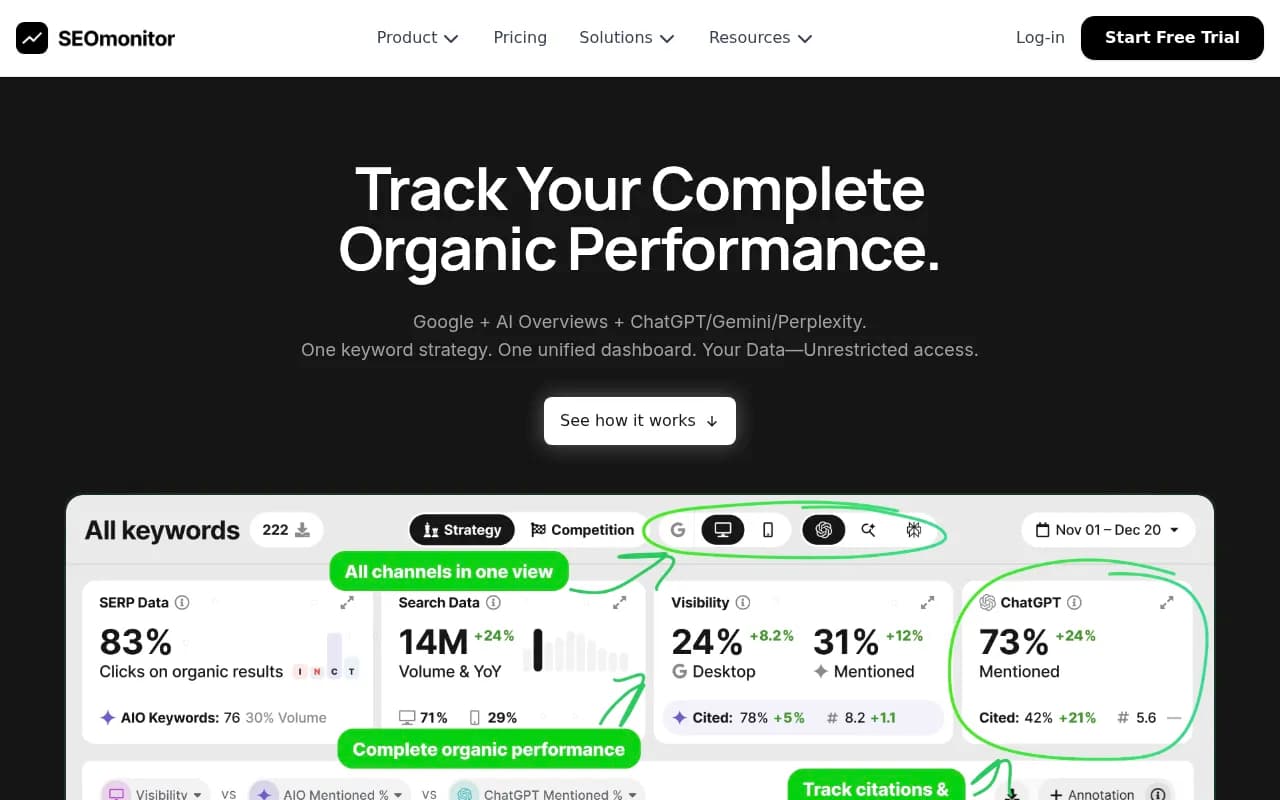
The headline feature is a single view that shows Google rankings, AI Overview appearances, and ChatGPT/Gemini/Perplexity citations -- all tied to the same keyword set. This is genuinely useful for agencies that currently juggle separate tools for traditional SEO and AI monitoring. The methodology is keyword-first: you define your keyword strategy once, and SEOmonitor maps performance across all channels automatically. Daily updates for Google rankings, weekly for AI search data.
AI search visibility tracking
SEOmonitor tracks brand mentions and citations in ChatGPT, Gemini, and Perplexity responses. The competitive visibility view is particularly well-executed -- you can see how your brand and competitors perform across Google, AI Overviews, and AI search simultaneously, with percentage breakdowns and trend lines. The women's fashion example on their homepage (comparing ASOS, Next, M&S, H&M, Debenhams) shows the kind of competitive intelligence this produces.
AI Overviews tracking
Separate from general AI search, SEOmonitor tracks whether your pages appear in Google's AI Overviews for tracked keywords. This is one of the more mature implementations in the market -- the Chief Strategy Officer at Relevance is quoted saying it's "the only tool I'm seeing that provides that kind of tracking," which was likely true when she said it, though the market has caught up since.
AI content writer
This is more than a text generator. The workflow covers topic discovery (based on your site's actual authority), editorial calendar planning, brief creation, article writing, fact-checking, CMS publishing, and post-publish performance tracking across Google, AIO, and AI search. The case study data they publish is specific: 657 articles from the AimUP agency, with 80% ranking within 30 days, 52% cited in AI Overviews, and 43% cited in AI search. Those numbers are worth scrutinizing, but the fact that they're publishing specific case study data rather than vague claims is a good sign.
SEO forecasting
This is one of SEOmonitor's oldest and most refined features. The forecasting methodology converts ranking improvements into traffic projections, accounts for seasonality, applies CTR models that factor in zero-click behavior from AI Overviews, and produces pitch-ready business case exports. The claim that "competitors copied it" is self-serving, but the methodology is genuinely more sophisticated than most rank trackers offer. For agencies that need to close deals with data-backed projections, this is a real differentiator.
Keyword research and clustering
Full keyword strategy generation from a URL, with automatic clustering, intent detection, and irrelevant keyword filtering. The Keyword Vault feature lets you track unlimited keywords with monthly updates -- useful for maintaining a broad keyword universe without paying daily tracking rates for every term.
Content audit and cannibalization detection
Automatically identifies pages competing for the same keywords, intent mismatches, and content gaps. This is table-stakes for agency SEO tools at this point, but SEOmonitor's implementation is solid and integrated with the rest of the platform rather than bolted on.
Pricing model
Worth calling out as a feature in itself: unlimited users, full API access, no per-seat fees, no data export limits. The pitch is "5x more keywords for the same budget as competitors." For agencies managing multiple client accounts with large teams, this economics model is genuinely attractive compared to tools that charge per seat or per export.
Client reporting and dashboards
White-label client dashboards with unified reporting across all channels. The pitch workflow (draft campaigns, traffic predictions, business case builder) is free -- you only pay once you activate a campaign. This is a smart model for agencies that need to win business before committing budget.
Who is it for
SEOmonitor is built for SEO agencies, full stop. The entire product -- from the pitch-to-prove workflow to the unlimited user model to the white-label reporting -- is designed around agency operations. Specifically, it fits agencies managing 10+ client accounts where the team needs to track hundreds or thousands of keywords across multiple domains without per-seat costs eating into margins. Agencies like Brainlabs, Wavemaker, and Performics (all listed as customers) are the target.
In-house SEO teams at mid-to-large brands are a secondary audience. Gymshark, Miro, and Omni are listed as customers, which suggests the platform works for brands with sophisticated SEO operations and enough keyword volume to justify the investment. A solo SEO consultant or a small business doing basic rank tracking would find this overkill.
The AI visibility features make it relevant for agencies whose clients are asking about AI search performance -- which is most agencies in 2026. If a client asks "are we showing up in ChatGPT?", SEOmonitor can answer that question within the existing workflow rather than requiring a separate tool.
Who should look elsewhere: teams whose primary goal is specifically optimizing for AI search visibility rather than tracking it. SEOmonitor tells you where you stand in AI search results, but it doesn't help you understand why you're not appearing, what content gaps are causing it, or how to systematically close those gaps. For that kind of work -- content gap analysis, AI crawler diagnostics, Reddit/YouTube citation tracking -- you need a dedicated GEO platform.
Integrations and ecosystem
- Google Search Console: Direct integration to pull real traffic data alongside rank data
- Google Analytics: Connect for actual click and session data to prove ROI
- CMS publishing: The AI content writer publishes directly to your CMS (specific CMS integrations not detailed on the public site, but direct publishing is a stated feature)
- Full API access: Included in all plans, no restrictions. Useful for agencies building custom reporting workflows or integrating SEOmonitor data into client dashboards
- Data exports: No limits on data exports, which matters for agencies that need to pull data into their own reporting systems
No Discord community or GitHub repository found. No browser extension mentioned. The platform is web-based.
Pricing and value
SEOmonitor uses a configurable pricing model rather than fixed tiers -- you pay for the data volume you need (keywords tracked, AI search queries, etc.) rather than a fixed package. Pricing is available in EUR and USD, with a 17% discount for annual billing.
- Starter: Entry-level plan for smaller agencies or single-client use
- Configurable plans: Scale based on keyword volume and features needed
- 14-day free trial: No credit card required, with full setup support
Specific pricing numbers aren't published on the homepage (you configure your plan on the pricing page), which makes direct comparison harder. The positioning is "5x more keywords for the same budget as competitors" -- suggesting they're competing on data volume per dollar rather than absolute price.
For context: Promptwatch's Professional plan at $249/month includes 150 prompts, 15 articles, crawler logs, and AI traffic attribution. SEOmonitor's value proposition is different -- more keyword volume, more traditional SEO depth -- but teams evaluating both should be clear about what they're buying.
The unlimited users model is a genuine advantage for agencies. Tools like Semrush charge per seat, which adds up quickly for teams of 10-20 people. SEOmonitor's model means the cost scales with data volume, not headcount.
Strengths and limitations
What it does well
- The unified keyword-based methodology is genuinely smart. Mapping one keyword strategy across Google, AIO, and AI search simultaneously reduces workflow complexity and makes competitive comparisons meaningful
- Forecasting and business case generation is best-in-class for agency use. The ability to generate pitch-ready projections before paying for a campaign is a real competitive advantage in winning new business
- The AI content writer's end-to-end workflow -- from topic discovery to CMS publishing to performance tracking -- is more complete than most competitors. The published case study data (80% ranking in 30 days) gives it credibility
- Pricing model (unlimited users, no export limits) is well-suited to agency economics
- Client list and G2 rating suggest genuine enterprise adoption, not just marketing
Limitations
- The AI visibility tracking is monitoring-only. SEOmonitor shows you where you appear (or don't) in AI search results, but provides no tools to diagnose why or fix it. There's no Answer Gap Analysis, no AI crawler logs showing how AI bots are crawling your site, no Reddit/YouTube citation tracking to understand what third-party content is influencing AI recommendations, and no ChatGPT Shopping monitoring
- No AI traffic attribution. You can't connect AI search visibility to actual website traffic or revenue the way you can with platforms that offer server log analysis or attribution code snippets
- Prompt-level intelligence is absent. There's no prompt volume data, difficulty scoring, or query fan-out analysis -- the kind of data that helps you prioritize which AI search opportunities to pursue
- The keyword-based methodology, while defensible, means you're inferring AI search performance from keyword data rather than directly measuring prompt-level behavior. For teams that need granular AI search intelligence, this is a real gap
Bottom line
SEOmonitor is a strong choice for SEO agencies that want to add AI search visibility reporting to an existing, mature SEO workflow. The unified dashboard, forecasting tools, and AI content writer are genuinely well-built, and the pricing model works in agencies' favor. If you're already using SEOmonitor for rank tracking and your clients are starting to ask about ChatGPT visibility, the AI features are a natural extension rather than a separate tool to manage.
For teams whose primary need is understanding and improving AI search visibility specifically -- diagnosing why they're not appearing in AI answers, finding content gaps, tracking AI crawler behavior, or attributing AI search traffic to revenue -- Promptwatch is the more capable platform. SEOmonitor monitors AI search; Promptwatch is built to optimize for it.
Best use case: SEO agencies managing 10+ client accounts that need unified Google + AI search reporting, pitch-ready forecasting, and AI-assisted content creation in a single platform with no per-seat fees.
Tags:
Frequently asked questions
What is SEOmonitor?
How does SEOmonitor track AI search visibility?
Is there a free trial for SEOmonitor?
How does SEOmonitor pricing work?
What are SEOmonitor's main limitations for AI search optimization?
Who is SEOmonitor best suited for?
Similar and alternative tools to SEOmonitor